

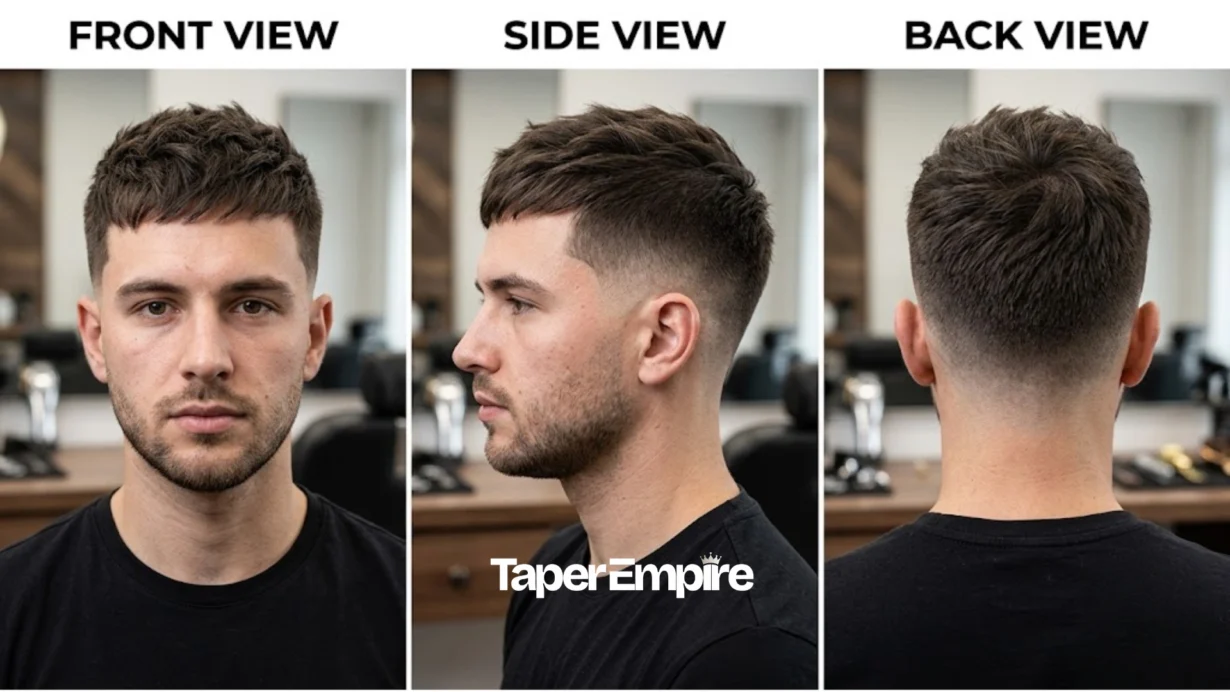

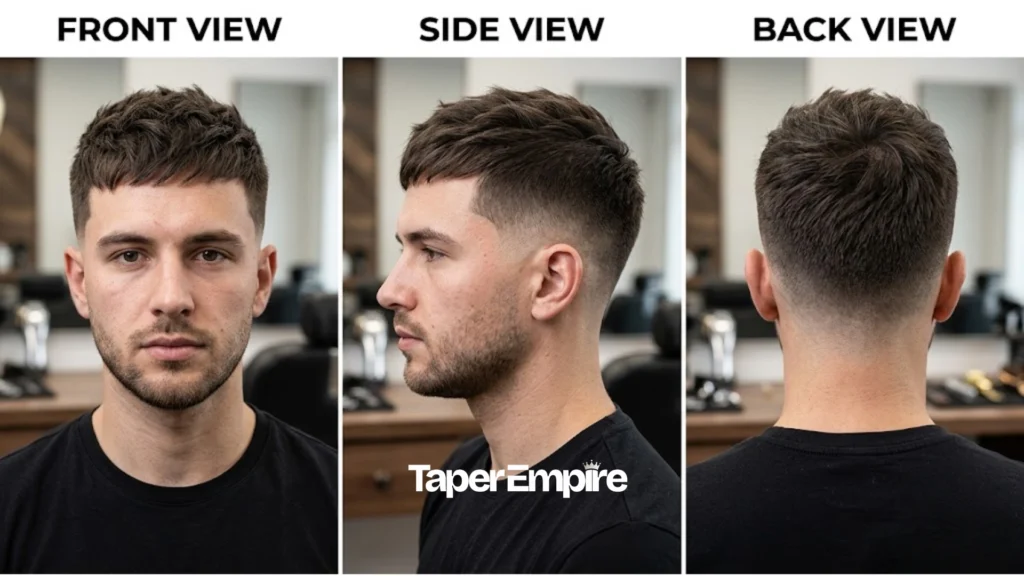
A mid-taper fade short haircut cuts the sides and back with a gradual taper that starts at temple level and blends cleanly into 1–2 inches of textured length on top. Searchers receive 28 specific variations, face-shape and hair-texture suitability, exact barber phrasing, product routines, 2–6 week maintenance timelines, and visual grow-out expectations in one reference.
The taper fade haircut family spans dozens of placement heights and finish lengths. This article covers only the mid taper fade applied to short hair on top, one of the most versatile combinations in modern men’s barbering.
What is a mid taper fade on short hair, and how do I ask for it?
A mid-taper fade on short hair blends the sides and back starting at temple level, keeping 1–2 inches of textured length on top. Specify the placement height, finish length (skin or guard number), neckline shape, and top length in inches before your barber starts cutting.
Key Points
- Starts at temple level
- Specify finish and neckline
- Suits most face shapes
- Refresh every 2–3 weeks
Table of Contents
What does a mid-taper fade on short hair look like from multiple angles, across hair types, and on different face shapes?
The mid-taper fade on short hair is immediately recognizable for its clean transition starting at the temples. The sides compress sharply from the midpoint of the head downward, while the top carries 1 to 2 inches of length that can be styled flat, textured, or directional. From any angle, the primary visual signal is a balanced silhouette: neither too tight around the entire head, like a high fade, nor confined to the bottom hairline, like a low taper.
The sides and back display a seamless blend; the hair appears to get shorter in controlled steps toward the skin or a short guard length. The neckline and sideburns define the perimeter of the cut, making them equally important to the overall impression as the taper height itself.
| Angle | Hair Type | Face Shape | Visual Description |
|---|---|---|---|
| Front | Straight | Oval | Crisp vertical temple line; flat or slightly lifted 1–2 inch top |
| Side | Wavy | Square | Visible gradient beginning at temple; textured mass sitting above the ear |
| Back | Curly | Round | Clean tapered neckline; natural curl volume contained above the transition |
| Side | Thick | Diamond | High contrast between compressed sides and dense, short top |
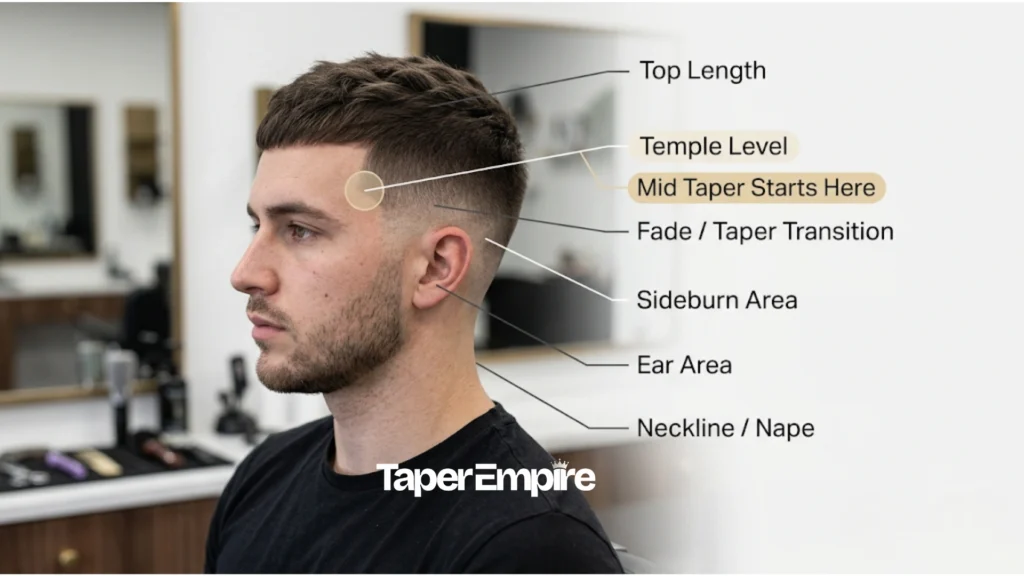
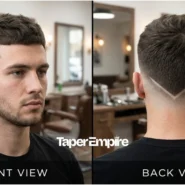
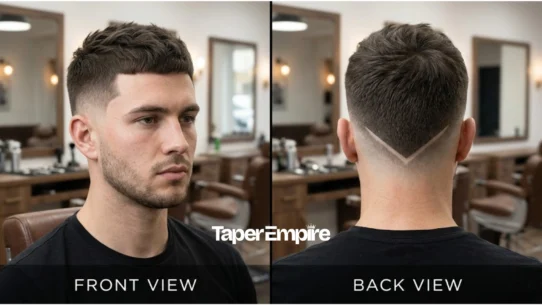
Front, side, and back views of the mid taper fade short hair
- Front View: The temple edges are clean and precise. Volume or texture on the 1–2 inch top adds vertical framing to the face without widening the silhouette.
- Side View: The blend moves visibly from full-length hair on top to progressively shorter hair at the temple, then tighter toward the sideburn and ear. The “weight line” where the longest and shortest areas meet sits at mid-head height.
- Back View: The nape tapers downward into the neckline. Whether the neckline is squared, rounded, or naturally tapered changes the perceived sharpness of the entire back section.
How hair texture and density change the appearance
- Straight hair produces the most sharply defined gradient because the uniform direction of growth makes each guard length read as a clean band. Grows out with visible steps if not maintained.
- Wavy hair softens the transition slightly, making the blend appear smoother with less frequent trims. Volume on top naturally creates a quiff-adjacent shape.
- Curly hair creates visible contrast between the tight sides and the volume above the weight line. Shrinkage means the top appears shorter than it measures, so length requests should account for the expected shrinkage factor.
- Coily hair benefits most from the mid taper because the defined fade boundary makes the natural volume above it look deliberate and structured rather than untamed.
- Thick hair can develop a “shelf” at the transition point if the barber doesn’t properly de-bulk the weight line. Specifically requesting “no shelf at the blend” prevents this.
- Fine hair shows the mid taper clearly because there is less mass to obscure the transition. However, a very short finish at the bottom can make the scalp too visible in strong light.
- Head shape considerations: A flat occipital region (the back of the skull) can visually push the neckline taper upward, making it appear higher than intended. A prominent occipital bone can make the nape stand out. Informing your barber of either condition allows them to adjust the fade positioning so the final result looks proportional from the back.
How does a mid taper fade differ from a low taper fade, high taper fade, mid skin fade, burst fade, and traditional taper?
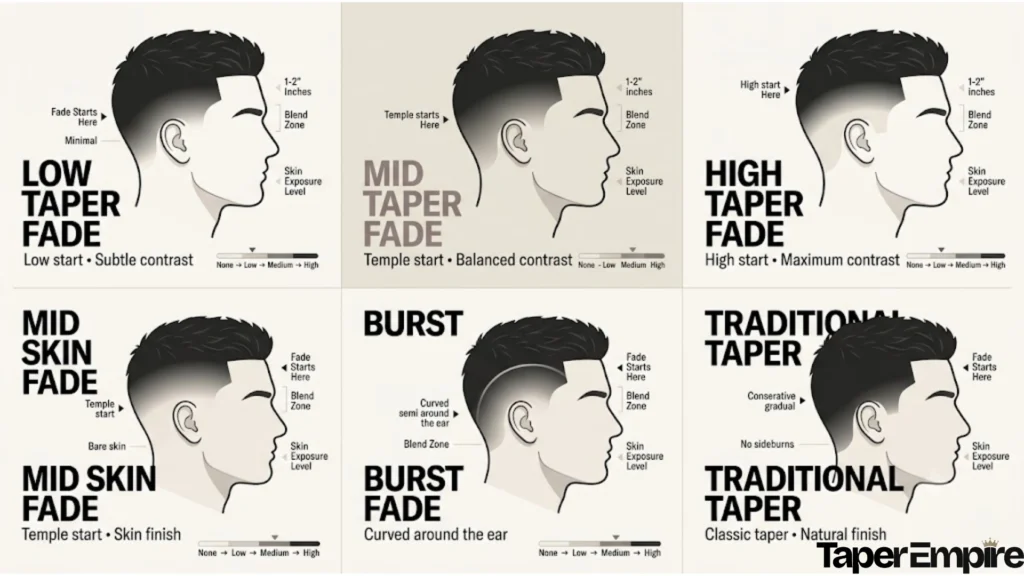
The defining difference between all taper and fade variations is where the blend starts and how short the finish goes. A mid taper fade begins its gradient at temple level, approximately the midpoint between the ear and the crown. A low taper stays close to the natural hairline, well below the ear. A high taper begins near the upper sides, close to the crown. Understanding this placement axis, along with whether the finish is skin or guard length, allows you to order the exact result you want. The complete taxonomy of taper fade types expands on all variations across both axes.
| Type | Starting Point | Skin Exposure | Best For |
|---|---|---|---|
| Low Taper Fade | Below and around the ear | Minimal | Conservative work settings; slower grow-out |
| Mid Taper Fade | Temple level (mid-head) | Moderate | Most face shapes; balanced modern look |
| High Taper Fade | Upper sides near crown | Significant | Bold silhouettes; athletic and strong-jaw profiles |
| Mid Skin Fade | Temple level | Maximum (to skin) | High contrast; strong modern aesthetic |
| Burst Fade | Circular arc behind the ear | Moderate to high | Curved silhouettes; mohawk and mullet styles |
| Traditional Taper | Natural hairline only | None | Classic longer styles; minimal fade effect |
For those deciding among all three placement heights, the low taper vs mid taper vs high taper breakdown covers visual examples, grow-out behavior, and differences in suitability in full. If you are considering a skin finish regardless of placement height, the skin fade vs taper vs taper fade comparison shows how the choice of finish affects the result independently of height. The low-taper fade and high-taper fade each have dedicated galleries for direct visual comparison.
For readers discovering drop fades or burst fades in this article’s variation list, those shapes use a different geometric path around the head the taper fade vs drop fade vs burst fade comparison explains exactly how the silhouettes differ from a standard mid taper. Equally, for readers who prefer the short-hair version of the low taper, the low taper fade on short hair page provides an apples-to-apples comparison. The skin taper fade is the alternative for readers who want maximum contrast from a skin finish at the bottom.
Fade versus taper: technical distinctions
- Taper: A localized shortening of hair at the sideburns and neckline only. The rest of the perimeter retains some visible length. The result is a gradual reduction confined to the edges. The taper vs fade distinction covers both techniques in full technical detail.
- Fade: A shortening that wraps around the entire back and sides. The hair moves from short often to skin or a very low guard across a much larger surface area, creating more all-around contrast.
Which hair textures, densities, and face shapes does the mid-taper fade short hairstyle suit best?
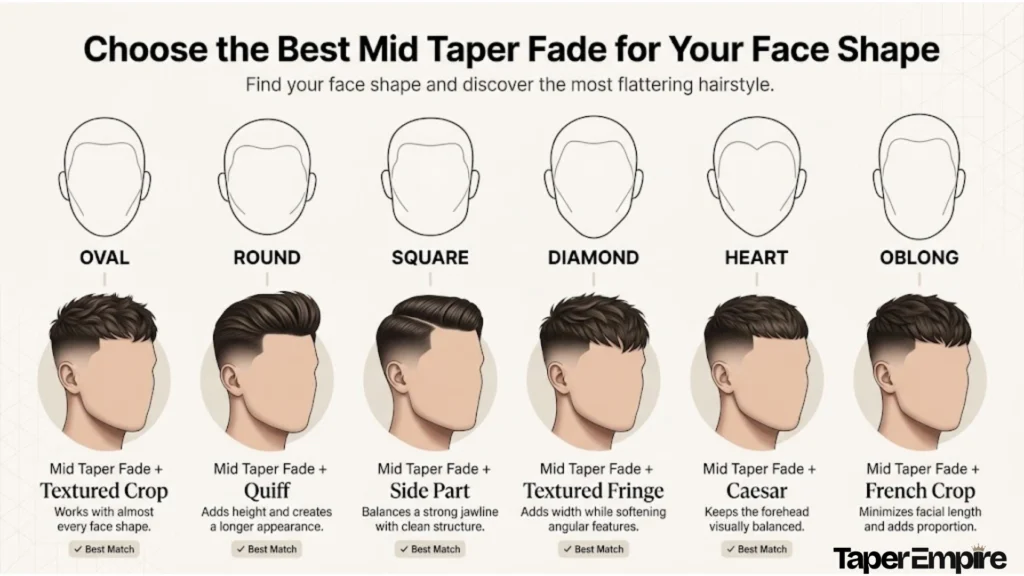
The mid taper fade short hair suits the broadest range of face shapes and hair textures of any fade placement because the mid height doesn’t exaggerate width or height excessively. The critical variable is how the 1–2 inches of short top length is styled; volume and direction on top can compensate for most face-shape considerations. Paired with the right finish and texture, the mid taper is workable for oval, round, square, diamond, heart, and oblong faces.
| Face Shape | Recommended Variations | Hair Textures | Density Notes |
|---|---|---|---|
| Oval | Any variation | All textures | No compensation needed; all finishes work |
| Square | Textured Crop, Side Part | Straight, Wavy | Emphasizes strong jawline; avoid flat buzz |
| Round | Quiff, Faux Hawk, Pompadour | Thick, Wavy, Coily | Height on top elongates the face |
| Diamond | Side Part, Crew Cut | Wavy, Curly | Softens cheekbone prominence; avoid volume at sides |
| Heart | French Crop, Side Part | Straight, Fine | Fringe balances wider forehead |
| Oblong | Crew Cut, Caesar, Textured Crop | All textures | Avoid high-volume tops that add more length |
| Receding Hairline | French Crop, Caesar Cut | Fine, Straight | Blunt fringe reduces hairline visibility |
Men with straight hair may find that the clean gradient of the mid taper looks sharper and ages faster because straight growth makes every millimeter of regrowth visible. The mid-taper fade for straight hair guide covers variation selection and product routines that specifically address straight hair’s grow-out rate and styling behavior.
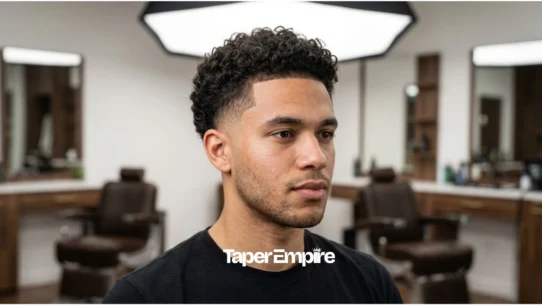
Curly hair benefits from the mid taper’s defined border, which frames natural volume without requiring aggressive shortening on top. Shrinkage makes the top appear shorter than requested, so always communicate your desired length in its stretched — not natural — state. The mid-taper fade for curly hair page covers shrinkage-adjusted length requests, curl-specific products, and variation galleries in detail.
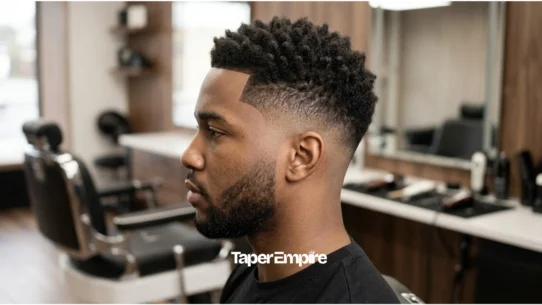
Coily and type 4 hair interacts with the mid taper differently because the natural density above the fade creates high visual contrast with the tapered sides. Shape-up traditions, temple-edge preferences, and fade-finishing techniques for coily hair carry specific cultural and technical nuances that the mid taper fade styles for Black men page addresses comprehensively.
Fine hair suits the mid-taper fade well as long as the finish isn’t taken to skin. A guard finish (#1 or higher) prevents excessive scalp show and keeps the sides looking denser than a skin fade would.
Quick Tip
Not sure which variation suits your face shape and texture? The Taper Empire style tool analyzes your features and recommends the strongest-matching mid-taper short-hair variation before your appointment.
What exact phrasing describes a mid-taper fade with 1–2 inches on top when speaking to a barber?
Clear barber communication requires four specific decisions: placement height, finish length, neckline and sideburn shape, and top length in exact inches. Vague requests like “short sides, short back and sides” or “mid fade” without a finish give your barber too much room for interpretation and interpretations vary widely among stylists.
From a practitioner perspective, the most common reason a client receives an ear-level taper when they wanted a temple-level start is that they said “mid taper” without pointing to the intended landmark. Your barber is interpreting “mid” relative to their own default reference point, which may sit lower than yours. Anchoring your request to a physical landmark “start the blend here, at my temple” while touching the area eliminates that ambiguity instantly.
For readers unfamiliar with basic taper terminology before walking into the barbershop, the taper haircut guide covers foundational vocabulary that makes these scripts easier to deliver with confidence.
Ready-to-use scripts:
“Mid taper fade starting at the temples. Blend down to a #1 guard at the lowest point. Leave 1.5 inches on top with texture. Squared neckline.”
“I want a mid taper fade; start it at my temple level. Take the top to about 2 inches, textured. Keep the sideburns tapered naturally.”
“Mid taper, not to skin. Keep the lowest point at a #2. Around 1 inch on top as a French crop. Tapered neckline.”
“I’m after a mid taper fade with a quiff leave 2 inches on top, product-ready length. Blend into a #1 at the sides. Sharp lineup.”
“Give me a mid taper starting at the temple. Blunt fringe on top, about 1.5 inches. Skin at the very bottom if possible. Natural neckline.”
“Mid taper fade, guard #2 at the transition. Top stays at 1–2 inches with heavy texture. Rounded neckline.”
“Classic mid taper fade. 1.5 inches on top, side-parted. Soft blend with a #2 into a #4 at the transition. Squared neckline.”
“Mid taper fade, not too tight. Start at temple, take it down to a #1. Keep about 2 inches on top for a textured crop. Clean neckline.”
Barber communication checklist:
- Reference photos: Bring a front view AND a back or side view. Front-only photos leave the interpretation of the neckline entirely to the barber.
- Physical landmark: Touch your temple and confirm “start the taper here.”
- Finish length: State skin, #0.5, #1, or #2. “Short” is not a finish.
- Top length: Use an inch measurement “1.5 inches” communicates far more precisely than “short.”
- Neckline shape: State “squared,” “rounded,” or “tapered/natural” explicitly.
- Guard progression: For a softer blend, request a “#1 into a #2 into a #4” sequence. For harder contrast, request “#0.5 into a #1.”
Quality verification before leaving the chair: Check the arc around the ear (sometimes called the “C-cup”) for symmetry on both sides. Examine the temple line; the blend should be smooth without visible steps or hard lines between guard lengths. Use a hand mirror to check the back neckline is the shape you specified. If the placement looks lower than temple level, ask for clarification before the cut is finished rather than after.
Quick Tip
After choosing your variation below, the Taper Empire tool generates a shareable barber card with your selected specs placement, finish, neckline, and top length ready to show in the chair.
28 Top Variations of Mid-Taper Fade Short Hair
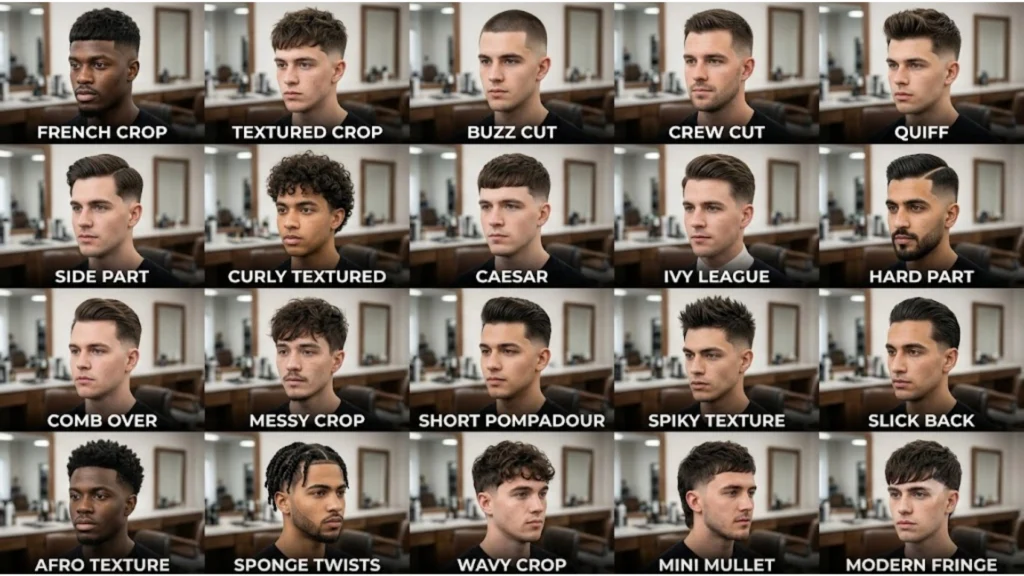
The 28 variations below represent every major short hairstyle that pairs naturally with a mid-taper fade. Each entry is scoped specifically to short top lengths of 1–2 inches — the defining characteristic of this page’s intent. For mid-taper haircuts on medium or longer top lengths, the mid-taper haircuts gallery covers the full spectrum of top-length options. For readers drawn to the cleaner, more conservative end of the taper aesthetic, classic taper haircuts provides a dedicated gallery of traditional styles. Each variation below includes a styling brief, a face-shape match, a texture match, a morning styling time, and a maintenance interval.
1. French Crop Mid Taper Fade Short Hair
The French Crop pairs a blunt horizontal fringe with a closely cropped back and sides. The fringe sits about 1 to 1.5 inches long and is cut straight across the forehead, creating a bold horizontal line that draws attention away from the hairline. It is the most effective short-hair option for men with receding hairlines because the fringe visually fills the front corners. The mid taper fade adds modern sharpness to what would otherwise be a flat, classic cut.
Face Shape: Oval, Square, Receding Hairline
Texture: Straight, Wavy
Styling Time: 3 minutes
Maintenance: 2–3 weeks
2. Textured Crop Mid Taper Fade Short Hair
The Textured Crop uses point cutting or razoring to create choppy, separated pieces across 1.5 to 2 inches of top length. Unlike the French Crop’s blunt fringe, the Textured Crop has an uneven, deliberate messiness that reads casually stylish. It requires very little styling because the texture is cut into the hair rather than achieved with product. The mid-taper fade keeps the perimeter tight, while the top carries all the visual interest.
Face Shape: Round, Diamond, Oval
Texture: All textures
Styling Time: 5 minutes
Maintenance: 3 weeks
3. Buzz Cut Mid Taper Fade Short Hair
The Buzz Cut applies a uniform clipper length across the entire top, typically a #3 or #4, while the mid taper fade produces a cleaner perimeter than a standard all-over buzz. The result is a step up in formality from a basic buzz, adding deliberate shaping to what is otherwise the most low-maintenance short haircut. It is the fastest variation to execute in the chair and requires almost no morning routine.
Face Shape: Square, Oval
Texture: Thick, Dense
Styling Time: 0 minutes
Maintenance: 2 weeks
4. Crew Cut Mid Taper Fade Short Hair
In professional barber education, the crew cut maintains slightly more length at the front hairline, roughly 1.5 to 2 inches and tapers naturally toward the crown. The front can be styled slightly forward or upward, giving the wearer a small amount of styling flexibility. Applied with a mid taper fade, the crew cut looks more polished than its low taper counterpart, which tends to read softer and more conservative.
Face Shape: All face shapes
Texture: Straight, Thick
Styling Time: 2 minutes
Maintenance: 3 weeks
5. Ryan Reynolds Short Side Part Mid Taper Fade
This variation mimics the clean, professional side-swept style associated with Ryan Reynolds in professional settings. The top is left at approximately 1.75 to 2 inches, combed and styled firmly to one side. A hard or soft part line on the left or right side creates the defining structural element. The mid taper fade keeps the sides clean enough that the parted top reads as intentional and neat rather than casual.
Face Shape: Heart, Oval, Oblong
Texture: Straight
Styling Time: 5 minutes
Maintenance: 4 weeks
6. Quiff Mid Taper Fade Short Hair
The Quiff builds vertical lift at the front of the hair before sweeping slightly backward. With a top length of only 1.5 to 2 inches, the quiff is a miniaturized version of the classic, but it retains the same face-elongating effect. It is the strongest option for round faces because the height offsets facial width. A mid taper fade gives the look a modern edge while ensuring the sides don’t compete with the top for visual attention.
Face Shape: Round, Heart
Texture: Thick, Wavy
Styling Time: 8–10 minutes
Maintenance: 3 weeks
7. Spiky Style Mid Taper Fade Short Hair
The Spiky Style uses product to push 1 to 1.5 inches of top length into defined upward points across the crown. It reads younger and more casual than quiff or crop variations. The mid-taper fade keeps the silhouette from looking uncontrolled; without it, spiky hair at short lengths can look shapeless. According to Cadmen Barber Academy, styling paste creates texture with a flexible, natural-looking hold, while gel provides stronger hold for spikes that need to stay firmly in place throughout the day.
Face Shape: Oval
Texture: Straight, Fine
Styling Time: 4 minutes
Maintenance: 3 weeks
8. Curly Textured Mid Taper Short Hair
The curly adaptation keeps 1.5 to 2 inches of natural curl volume on top, which reads as significantly shorter due to shrinkage. The mid taper fade provides a clean structural border that makes the curls above it look intentional rather than overgrown. This variation suits men who want to embrace their natural texture while maintaining a sharp, maintained appearance at the sides. Curl-enhancing cream applied to damp hair defines the coils without making them crunchy. For a full breakdown of curly-hair-specific variations, product routines, and shrinkage-adjusted length guidance, the mid taper fade for curly hair page covers it in detail.
Face Shape: Diamond, Square, Oval
Texture: Curly, Coily
Styling Time: 6 minutes
Maintenance: 3 weeks
9. Zayn Malik Buzz Variant Mid Taper Fade
This variation takes the buzz cut concept and adds a higher-contrast mid taper, producing almost no visible transition zone between the top length and the sides. The top sits at a #3- to #4-guard while the sides fade much more aggressively downward. Zayn Malik has worn versions of this style with highly compressed sides, creating a sharp, geometric effect. It is one of the boldest buzz-adjacent options in the short-hair mid-taper family.
Face Shape: Angular, Oval
Texture: All textures
Styling Time: 1 minute
Maintenance: 2 weeks
10. Zac Efron Textured Quiff Mid Taper Fade
This variation references the matte-finish, high-movement quiff that Zac Efron has worn across multiple public appearances. The top is approximately 2 inches long, with the front lifted and slightly pushed back. The defining product choice is a matte clay rather than a pomade — no shine, heavy texture, natural movement. The mid taper fade compresses the sides tightly enough that the top mass reads as the sole design element.
Face Shape: Oval, Square
Texture: Wavy, Straight
Styling Time: 8 minutes
Maintenance: 3 weeks
11. Side Part Mid Taper Fade Short Hair
The Side Part creates a hard or soft division on either the left or right side of the 1.5 to 2 inch top length. It is among the most versatile and widely accepted variations in professional and formal settings. A hard part (razor-cut line) adds precision; a natural part adds softness. The mid taper fade produces a cleaner and more contemporary version of what the low taper would deliver with the same top styling the higher placement adds visible contrast.
Face Shape: Square, Oval, Diamond
Texture: Straight, Wavy
Styling Time: 5–6 minutes
Maintenance: 4 weeks
12. Faux Hawk Short Taper Mid Taper Fade
The Faux Hawk on short hair keeps the central 1 to 1.5 inches of top length and styles it toward the center of the crown, with the material to either side lying flatter. At 1–2 inches, this is a muted, office-safe version of the full faux hawk. The mid taper fade supports the shape by keeping the perimeter tight without going to the skin. Clay or paste separates the center mass from the sides without creating a harsh mohawk line.
Face Shape: Round, Oblong
Texture: Thick, Wavy
Styling Time: 7 minutes
Maintenance: 2–3 weeks
13. Pompadour Short Variant Mid Taper Fade
The short pompadour keeps all the structural intent of the classic swept-back volume from a front lift but restricts the top to 1.75 to 2 inches rather than the traditional 3 to 4 inches. The result is a compact, wearable version of the pomp that reads modern rather than vintage. A medium-hold pomade with some shine gives the swept-back shape its staying power. The mid-taper fade ensures that the contrast between the lifted top and the compressed sides remains sharp.
Face Shape: Oblong, Square, Oval
Texture: Straight, Thick
Styling Time: 10 minutes
Maintenance: 3 weeks
14. Line Design Mid Taper Fade Short Hair
Line designs add geometric shaved lines, typically one or two within the tapered zone of the mid taper fade. These lines sit in the compressed area between the fade’s weight line and the sideburn. The top remains 1 to 1.5 inches in standard crop or buzz configuration, making the design element the primary visual point of interest. This variation is most common in coily and type 4 hair, where high contrast between the skin and the hair makes the lines especially defined.
Face Shape: All face shapes
Texture: Coily, Dense
Styling Time: 2 minutes (not counting the design execution)
Maintenance: 1–2 weeks (lines lose definition fastest)
15. Brad Pitt Classic Taper Mid Taper Fade Short Hair
This variation references the natural, soft-looking short sides that Brad Pitt wore in the late 1990s and early 2000s: clean, proportional, and understated. The top sits at 1.5 to 2 inches with a natural, slightly forward-swept direction. No aggressive product hold, no extreme contrast. The mid taper fade is applied with a guard finish rather than a skin fade, preserving the soft, lived-in quality of the overall look. It is among the most grow-out-friendly variations in this list.
Face Shape: Square, Oval
Texture: Wavy, Straight
Styling Time: 4 minutes
Maintenance: 4 weeks
16. Timothée Chalamet Short Curls Mid Taper Fade
This variation keeps the natural curl pattern on 1.5 to 2 inches of top length, styled slightly forward. Timothée Chalamet has consistently worn tight, defined curls close to the head with a clean perimeter fade. The defining quality is restraint the curls sit close, forward, and unmanipulated beyond basic definition product. The mid taper fade creates a tidy border that lets the natural movement of curly hair carry the aesthetic.
Face Shape: Heart, Oval
Texture: Curly
Styling Time: 5 minutes
Maintenance: 4 weeks
17. Flat Top Short Mid-Taper Fade Short Hair
The Flat Top cuts the crown to a uniform height, creating a level, horizontal surface a sharp geometric plane across the crown. At short length, it reads as a bold, structured choice rather than an extreme statement. The mid-taper fade transitions the flat surface into compressed sides, reinforcing the boxy geometry of the overall shape. Coily hair holds the flat top’s shape best because of natural density and resistance to lying flat.
Face Shape: Round, Square
Texture: Coily, Dense
Styling Time: 8 minutes
Maintenance: 2 weeks
18. Caesar Cut Mid Taper Fade Short Hair
According to Cadmen Barber Academy, the Caesar cut features a short, uniform length on top typically 1 to 2 inches with a straight or slightly rounded fringe brushed forward across the forehead. Pairing it with a mid taper fade gives the classic haircut a cleaner, more contemporary appearance while maintaining its signature shape. Its simple structure also makes it a practical choice for men who prefer a low-maintenance daily styling routine.
Face Shape: Oval, Oblong
Texture: Straight, Fine
Styling Time: 2 minutes
Maintenance: 3 weeks
19. Ivy League Mid Taper Fade Short Hair
The Ivy League is a longer crew cut, approximately 1.5 to 2 inches, that can be side-parted and combed. It occupies the midpoint between the crew cut and a full side part, offering the versatility to wear it flat on conservative days or with slight lift on casual ones. The mid-taper fade positions it more stylistically than a traditional Ivy League with a low taper would, making it suitable for a broader range of social settings.
Face Shape: Oval, Square, Heart
Texture: Straight, Wavy
Styling Time: 5 minutes
Maintenance: 4 weeks
20. Butch Cut Mid Taper Fade Short Hair
The Butch Cut uses a slightly longer, uniform clipper length than a buzz, usually #4 or #5 all over the top. It is longer and softer than a buzz, shorter and more casual than a crew cut. The mid taper fade creates a defined perimeter on what is otherwise a borderless uniform cut. It suits men who want low maintenance without the near-skin shortness of a buzz cut.
Face Shape: Square, Oval
Texture: Coarse, Thick
Styling Time: 0–1 minute
Maintenance: 3 weeks
21. Induction Cut Tapered Mid Taper Fade Short Hair
The induction cut takes the top to a #1 or #0.5, the shortest clipper length, before skin across the crown. The mid taper fade’s gradient is minimal at this top length because the transition from the top to the sides is already so compressed. The result is a near-uniform very short crop with a slightly defined perimeter. This variation suits men undergoing a hair reset or those who prefer maximum convenience with a marginally cleaner finish than a full skin cut.
Face Shape: Oval, Square
Texture: All textures
Styling Time: 0 minutes
Maintenance: 2 weeks
22. Messy Short Fringe Mid Taper Fade Short Hair
The messy fringe pushes 1.5 to 2 inches of top length forward toward the hairline in a deliberately undone arrangement. It differs from the textured crop by emphasizing forward direction over scattered texture. The “messy” quality comes from product application technique worked through the hair with fingers rather than combed or brushed. It pairs naturally with wavy hair, which adds movement to the forward-swept mass without requiring additional product manipulation.
Face Shape: Oblong, Heart
Texture: Wavy, Straight
Styling Time: 4 minutes
Maintenance: 3 weeks
23. Slicked Back Short Mid Taper Fade Short Hair
The Slicked Back Short keeps 1.5 to 2 inches of top length combed directly backward from the hairline, using a medium-hold pomade with moderate shine. At this short length, the slicked-back effect is subtle more “controlled backward” than dramatically swept. The mid-taper fade provides the structural contrast that prevents the short slick-back from looking flat or formless. It reads professional in formal settings and polished in casual ones.
Face Shape: Oval, Square
Texture: Straight
Styling Time: 5 minutes
Maintenance: 3 weeks
24. High and Tight Mid Taper Fade Short Hair
The high and Tight aggressively shortens the sides very close to the skin starting from a relatively high point, while keeping 1 to 1.5 inches of length flat on the top. At mid-taper placement, the transition is sharper and more visible than a low-taper high-and-tight but less extreme than a true high-fade version. It originated as a military cut and retains a clean, no-nonsense visual quality. The minimal top length means zero product is needed.
Face Shape: Square, Oval
Texture: Thick, Dense
Styling Time: 1 minute
Maintenance: 2 weeks
25. Hard Part Short Mid Taper Fade Short Hair
The Hard Part uses a razor or narrow clipper to cut a precise division line into the scalp on one side of the head, creating a sharper and more permanent-looking part than any combed version. At 1.5 to 2 inches of top length, the hard part becomes the focal element of the style the mid taper fade’s clean sides provide the contrast that makes the line pop visually. It is most effective on straight or fine hair where the razor line is most visible.
Face Shape: Diamond, Oval
Texture: Straight, Fine
Styling Time: 5 minutes
Maintenance: 2 weeks (the hard part fades before the taper does)
26. Burst Taper Hybrid Mid Taper Fade Short Hair
The Burst Taper Hybrid combines the standard mid taper fade with a localized burst-fade arc directly behind the ear. Instead of a straight horizontal gradient, the area behind the ear fades in a semicircular pattern, creating a curved transition. It is popular among men with curly or coily hair who want extra definition around the ear. The top remains 1 to 1.5 inches in a standard crop or curl configuration.
Face Shape: Round, Oval
Texture: Curly, Coily
Styling Time: 6 minutes
Maintenance: 2–3 weeks
27. Forward Fringe Mid Taper Fade Short Hair
The Forward Fringe differs from the French Crop in that the fringe is slightly longer — around 1.5 to 2 inches and carries visible texture rather than a blunt horizontal cut. The hair is styled forward and slightly to one side, creating a diagonal or swept-forward mass at the front. It works naturally with wavy hair, which gives the forward mass movement and dimension without aggressive product use.
Face Shape: Square, Oval y
Texture: Wavy, Straight
Styling Time: 3 minutes
Maintenance: 3 weeks
28. Mohawk Short Mid Taper Fade Short Hair
The Short Mohawk keeps 1.5 to 2 inches of length running down the central strip of the crown while the mid taper fade compresses the sides tightly. At this short top length, the mohawk reads as bold and deliberate rather than extreme. Product pushes the strip upward and together to maintain the central ridge. The mid taper rather than a full skin fade gives the overall look a slightly softer edge than the traditional punk mohawk.
Face Shape: Round, Oval
Texture: Thick, Dense
Styling Time: 8 minutes
Maintenance: 2 weeks
Which products and daily styling routines maintain a mid taper fade short haircut?
Product selection for 1- to 2-inch top length should prioritize texture over weight. Heavy pomades and thick waxes can flatten short hair, making the top look thinner than it is and causing visible buildup at the fade transition line. Matte paste, texture clay, and light-hold creams give short hair definition and movement without the greasy residue that heavy products leave behind.
Product dosage matters significantly at this length. A dime-sized amount is the correct starting point for most short styles using more adds weight without adding hold. For very short tops under 1 inch, a pea-sized amount is sufficient. Applying too much product at the fade transition point where the hair is shortest, clumps the sparse hair together and makes the gradient look patchy.
Product selection by finish and hold
| Product Type | Finish | Hold Strength | Best Variation Match | Pre-styler Compatible |
|---|---|---|---|---|
| Texture Clay | Matte | High | Textured Crop, Faux Hawk | Yes — sea salt spray |
| Matte Paste | Low Shine | Medium | Crew Cut, Messy Fringe | Yes — leave-in cream |
| Pomade | High Shine | Medium–High | Side Part, Slicked Back | No |
| Sea Salt Spray | Matte | Low | Wavy natural styles | N/A — is the pre-styler |
| Curl Cream | Natural | Low–Medium | Curly Textured, Chalamet | Yes — water mist |
| Gel | Wet/Hard | Very High | Spiky, line design styles | No |
Morning styling routines by variation type
Routine 1 — Zero-effort (Buzz, Butch, Induction):
- Towel dry or air dry.
- Apply a pea-sized amount of matte paste to tame any crown irregularities.
- Done.
Routine 2 — Quick texture (Textured Crop, Messy Fringe, Caesar):
- Towel dry to approximately 70% damp.
- Spray sea salt spray through the top and scrunch briefly.
- Apply a dime-sized amount of texture clay, worked between palms.
- Push through top with fingers, no combing.
- Air dry or briefly diffuse.
Routine 3 — Structured (Quiff, Side Part, Pompadour, Slicked Back):
- Towel-dry, then blow-dry with a brush; direct heat toward the front and lift at the roots for a quiff; direct flat and backward for slicked styles.
- Apply a dime-sized pomade or paste while hair is still slightly warm.
- Comb or brush into final shape.
- Allow to cool before leaving.
Routine 4 — Curl definition (Curly Textured, Chalamet Curls, Burst Hybrid):
- Apply curl cream to soaking-wet hair.
- Scrunch upward to encourage curl formation.
- Do not towel-dry roughly — blot only.
- Air dry fully or diffuse on low heat.
How often does a mid taper fade short haircut require trims, and how does the style grow out over 4–6 weeks?
According to the Professional Barber Association, a mid taper fade on short hair typically requires edge cleanups every 2 to 3 weeks to maintain a consistently sharp appearance. The American Academy of Dermatology Association (AAD) notes that the average person’s scalp hair grows about 0.5 inches (1.25 cm) per month, which explains why regular maintenance helps preserve the fade’s clean, defined look.
At mid taper placement, that half-inch of growth affects the most visible part of the cut the temple and ear area making the gradient look blurred and the sideburns appear overgrown faster than a low taper would.
| Timeline | Visual Change | Recommended Action |
|---|---|---|
| Days 1–3 | Crispest appearance; maximum gradient contrast | None |
| Days 7–10 | Temple line softens; sideburn shadow appears | Neckline edge cleanup (optional) |
| Days 10–14 | Blend begins to blur; sideburn and temple growth visible | Neckline and sideburn cleanup |
| Weeks 2–3 | Gradient contrast drops noticeably | Full taper refresh |
| Week 4 | Sides look fuzzy; top reaches 1.5–2.5 inches depending on start length | Full haircut recommended |
| Weeks 5–6 | The original mid-placement look is largely gone | Full reset cut |
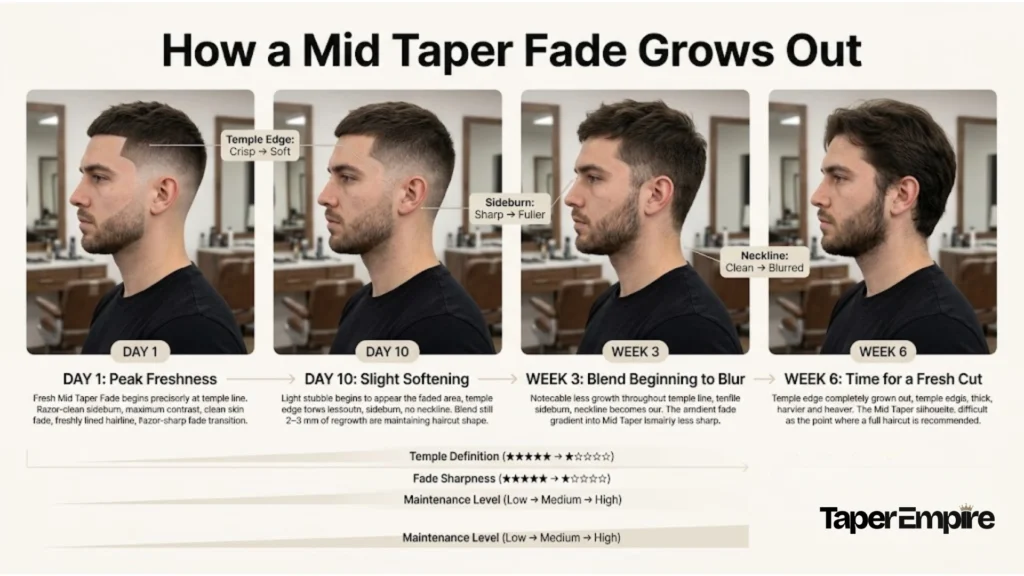
Variation-specific maintenance intervals vary meaningfully. The 28 variations listed in this article range from 1-week maintenance (line designs, which lose razor sharpness fastest) to 4-week maintenance (conservative crew cuts, side parts, and Ivy League styles where a softened gradient is still acceptable). Reviewing the maintenance interval for your chosen variation before committing to a trim schedule will save cost and chair time.
Based on average men’s haircut prices of $15 to $40 per visit, maintaining a mid taper fade every two weeks can cost approximately $390 to $1,040 per year, depending on local barber rates. Many men reduce this cost by performing neckline and sideburn touch-ups between appointments using a personal trimmer, keeping the perimeter clean without attempting to rework the fade itself. The how to maintain a mid taper fade guide covers step-by-step home maintenance techniques, recommended trimmer settings for between-visit touch-ups, and scalp care routines in full.
What common mistakes occur with mid taper fade short hair and how does one avoid an uneven blend or overly aggressive fade?
The majority of mid-taper-fade-short-hair disappointments trace back to three root causes: incomplete communication before the cut starts, incorrect photo angles as reference, and no mirror check before leaving the chair. These aren’t barber failures they’re information gaps that produce predictable, avoidable outcomes.
| Mistake | What It Produces | How to Prevent It |
|---|---|---|
| Saying “mid taper fade” without a landmark | Ear-level start instead of temple-level | Touch your temple; say “start here” |
| No finish specified | Barber defaults to their preferred depth — often skin | State “#1” or “not to skin” |
| Front-only reference photo | Mismatched neckline and back | Bring side and back photos |
| Vague top request (“short”) | Too short or too flat | Use inch measurement |
| Omitting neckline shape | Squared when you wanted tapered | State “tapered,” “rounded,” or “squared” |
| No chair-side mirror check | Asymmetry or incorrect placement not caught until home | Check both sides and the back before paying |
| Product over-application | Heavy buildup at fade transition; patchy appearance | Start with a dime-sized amount; build if needed |
Practitioner observation: In my chair, the single most common revision request is a taper that landed at ear level when the client wanted it at temple level. The phrase “mid taper fade” suggests temple-level to many barbers, but not all, particularly in shops where “mid” is interpreted as the midpoint between the ear and the low-taper zone rather than the midpoint of the head. Pointing physically and confirming in the mirror before the clipper starts takes six seconds and eliminates that entire category of error.
Practitioner observation: The second most common issue is a finish that turned out more aggressive than expected. “Skin” sounds like a slight finish to many clients it doesn’t until you see the scalp. If you haven’t worn a skin-finish fade before, request a #1 for your first mid-taper and work toward skin on a subsequent visit once you’ve seen how the contrast reads on you.
Honest tradeoffs to consider:
A sharper lineup looks immaculate on day one but can make the cut appear harsher at days 10–14 when new growth disturbs the razor edge before you can get back to the barber.
A squared neckline grows out more visibly than a tapered one the straight horizontal line becomes obviously grown-in within 10 days on most hair types. A tapered neckline grows out naturally and stays presentable twice as long.
A skin finish produces the highest contrast but also the fastest visible regrowth. A guard finish sacrifices some initial crispness for significantly better longevity between visits.
The mid-taper fade is genuinely one of the most versatile haircuts — but it is among the least forgiving in terms of maintenance commitment. If a 2- to 3-week refresh schedule isn’t realistic for your budget or schedule, a low taper fade provides a similar silhouette with a slower, more graceful grow-out.
Frequently Asked Questions
What should I tell my barber for a mid-taper fade?
Say: “Mid taper fade starting at temple level, 1.5 inches on top with texture, blended with a #2 guard at the transition, squared neckline.” Touch your temple to confirm the start height. Show front, side, and back reference photos to eliminate interpretation gaps before cutting begins.
How long does a mid-taper fade last before it looks messy?
Sharpness typically lasts 10–14 days. The fade remains presentable for 3–4 weeks on most hair types before requiring a full trim. Men with straight, dark hair and high-contrast finishes will notice the gradient blurring sooner than those with lighter or curlier hair.
Which mid-taper fade styles work for round faces?
Choose variations with height and texture on top quiff, faux hawk, or textured crop to add vertical length to the face. Avoid buzz cuts and Caesar cuts, which emphasize the width of the head without adding compensating height. Keep the mid taper tight to maintain the elongating silhouette.
Does a mid taper fade work with fine hair?
Yes, but specify a guard finish rather than skin at the lowest point. Keeping the bottom at a #1 or #2 prevents excessive scalp show, which is more noticeable in fine hair. Use a lightweight matte paste rather than a pomade; heavy products weigh fine hair flat and make the top look thinner.
What does a mid taper fade look like after 4 weeks?
The taper softens significantly, and the top grows approximately half an inch. The overall shape remains broadly balanced, but the gradient contrast at the sides has blurred, and the sideburns and neckline look overgrown. A touch-up is needed for crisp edges; a full reset is needed to restore the original mid-placement look.
How much pomade do you use for a mid taper fade?
Use a dime-sized amount of pomade or clay, warmed between the palms before applying to slightly damp hair. For very short top lengths under 1 inch, reduce to a pea-sized amount. Starting small and adding more if needed prevents product buildup at the fade transition line, which can make the blend look patchy.
Key Takeaways
A mid-taper fade short hair delivers a clean, versatile result when you specify four things clearly: temple-level placement, a finish length by guard number or skin, a neckline shape, and a top length in inches. The 28 variations above cover every major short-top style from the minimal-maintenance buzz to the high-effort quiff, each with its own face-shape match, texture fit, and maintenance interval so you can match the cut to your lifestyle rather than adapting your lifestyle to the cut.
Choose your variation, use the corresponding barber script, bring side and back reference photos, and confirm your start point in the mirror before the clippers move. That four-step process eliminates most mid-taper fade disappointments.
Quick Tip
Before your next appointment, the Taper Empire style tool can confirm whether your chosen variation is the strongest match for your face shape, hair texture, and maintenance tolerance, taking the guesswork out of the final decision.
[…] your hair hasn’t grown out enough yet for the full blowout volume, a shorter mid taper still has plenty of styling options while you wait for length. Once your top hair passes the 4-to-5-inch mark, you’ll find more […]