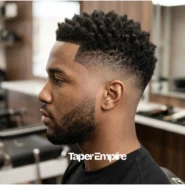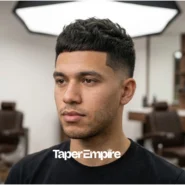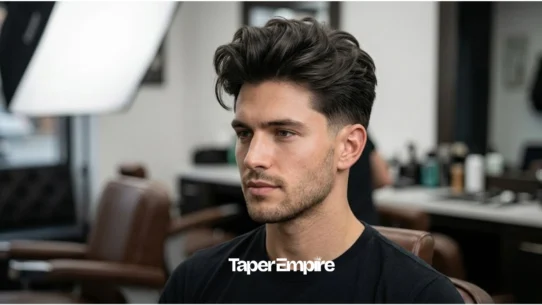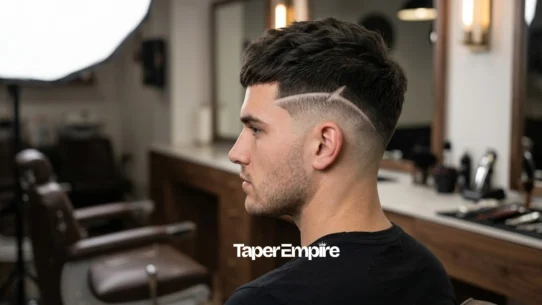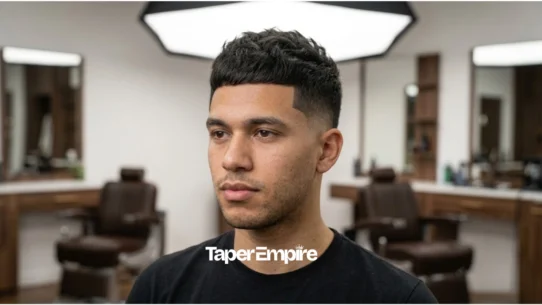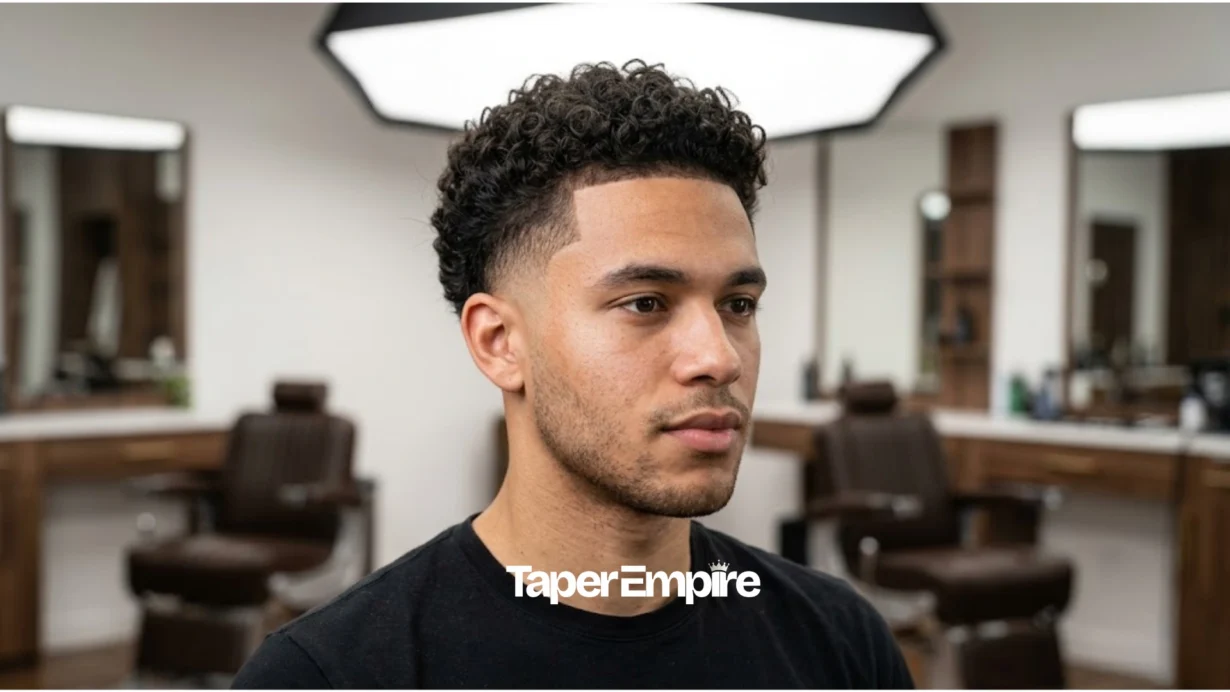

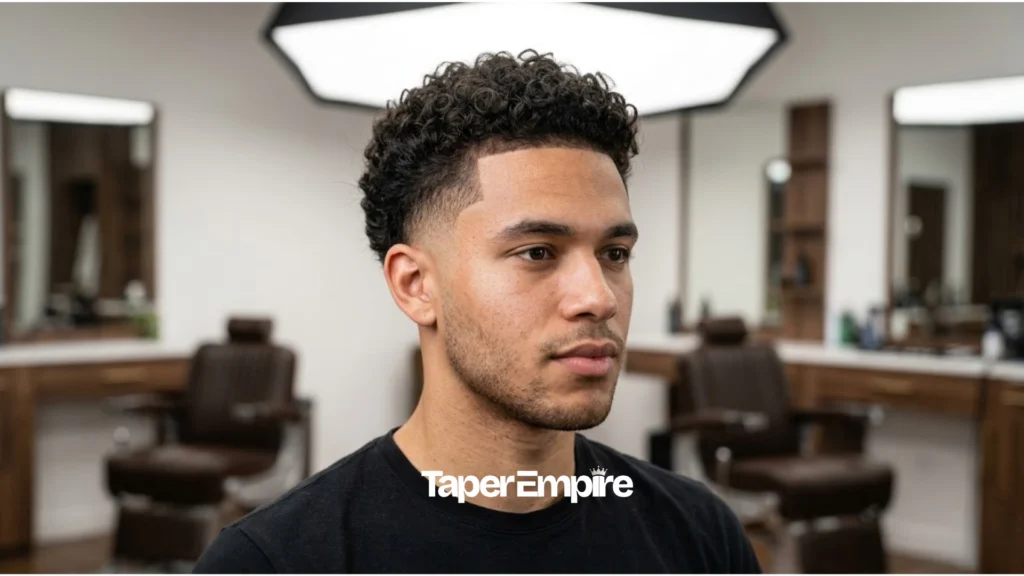
A high taper fade for curly hair is a haircut in which the fade begins above the temples and blends the sides and back into shorter lengths, creating a sharp contrast with voluminous curls on top. This style works on all curl patterns from 2B waves to 4C coils, flatters round, oval, and square face shapes, and requires touch-ups every 2–3 weeks to maintain the clean fade line.
What is a high taper fade for curly hair?
A high taper fade for curly hair starts the fade just above the temples, blending the sides and back short while leaving voluminous curls on top. It suits all curl patterns from 2B to 4C and works across most face shapes, with touch-ups needed every 2–3 weeks.
Key Points
- Fade starts above the temples
- Works on all curl patterns
- Touch-ups every 2–3 weeks
- Pairs best with round and oval faces
Table of Contents
What Is a High Taper Fade?
A high taper fade is a men’s haircut where the fade begins just above the temples and blends the sides and back down to skin or a very short length using clippers. This creates a sharp, high-contrast look between the tightly faded sides and the hair on top.
The distinction between a taper and a fade matters here. A taper gradually reduces hair length using scissors or clippers, but it stops at the visible hair; it never reaches the skin. A fade takes the hair all the way down to skin level or near-skin. A high taper fade combines both: the gradual shortening of a taper, executed at a high starting point, with a clean fade finish. For a more detailed breakdown of how these two cuts differ technically, the comparison between a taper and a fade covers the full terminology, tools, and contrast levels.
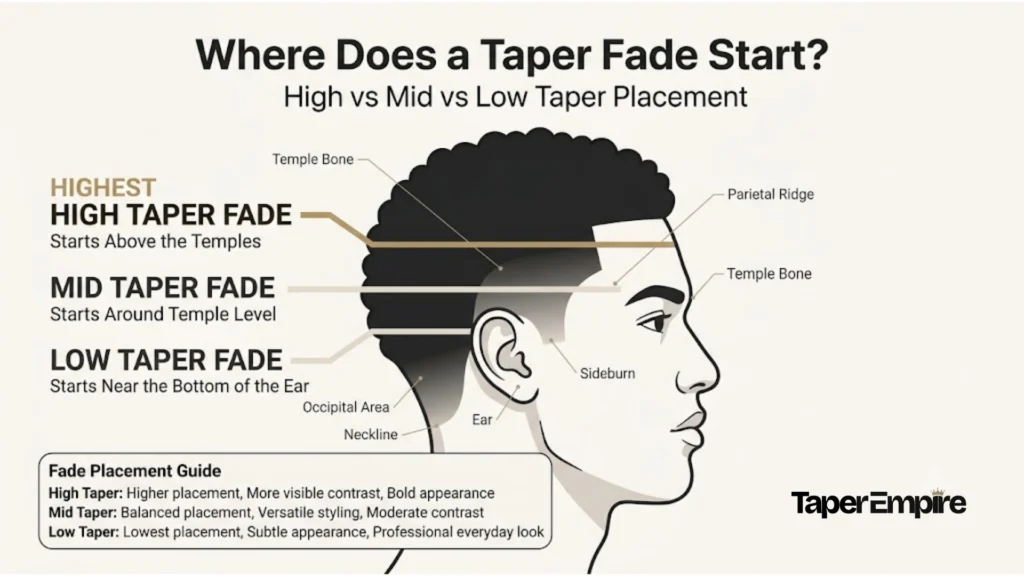
If you want the high starting point without the skin finish, a high taper haircut keeps visible hair through the sides rather than fading to bare skin worth knowing before you sit in the chair.
According to professional barber education, a high taper fade begins higher on the sides, around the temple area, creating a greater contrast between the shorter sides and the longer hair on top. This stronger contrast enhances the appearance of volume and definition, making the style particularly well suited to curly hair.
Does a High Taper Fade Work on Curly Hair?
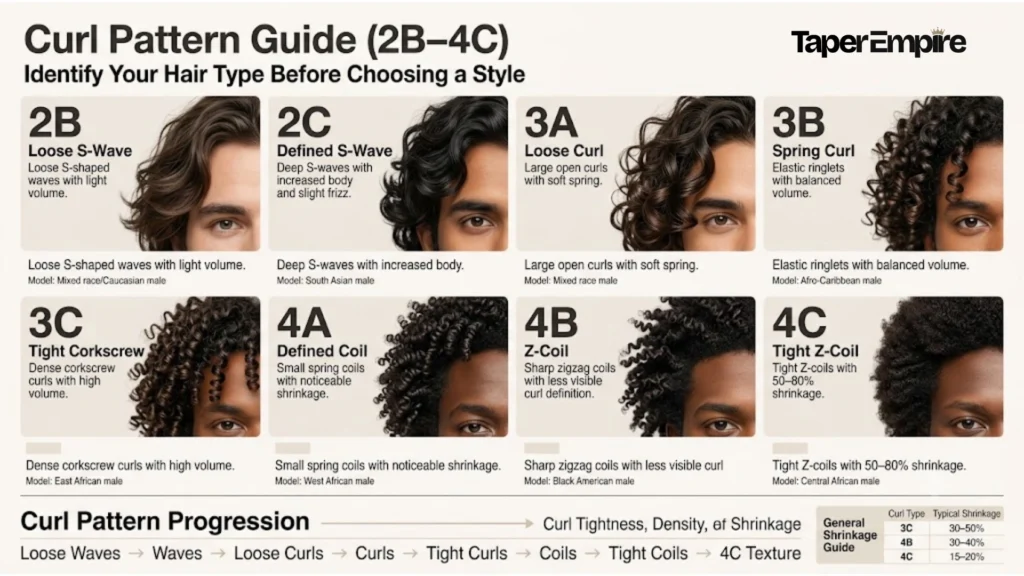
Yes a high taper fade works on all curly hair types, from loose 2B waves to tight 4C coils. The fade removes weight and width from the sides, which actually enhances the natural curl pattern on top by giving it a clean, defined frame.
Here is how the cut behaves across the main curl categories:
2B–2C (Wavy) Waves sit looser and longer. The high taper creates strong contrast because the wavy top moves freely with noticeable volume. Lighter hold products work best heavy creams can flatten the wave pattern.
3A–3B (Curly) Defined ringlets and spiral curls produce the “classic” curly high taper look. Curl clumps sit with enough density to hold their shape without product assistance, and the contrast between the taper and the top is immediately visible.
3C–4A (Coily) Tighter coils mean more shrinkage but also more volume per inch. The top appears full and rounded. Barbers should cut this pattern dry so they can see the natural formation before deciding on length.
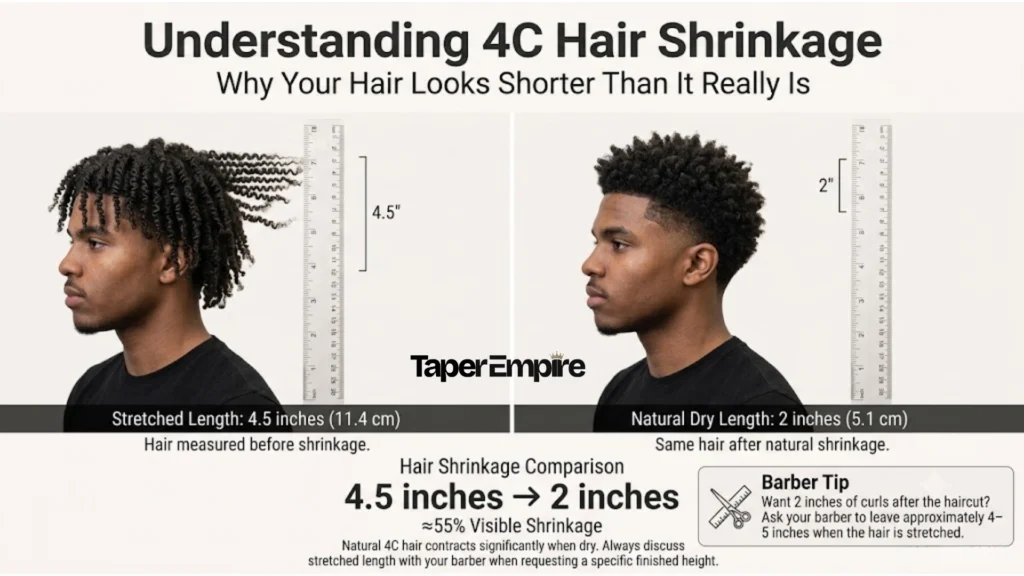
4B–4C (Kinky/Coily) can experience significant shrinkage, making it appear much shorter than its stretched length. Because of this natural shrinkage, many barbers recommend leaving extra length on top to achieve the desired finished appearance after the hair dries and coils. This means you need to request more length on top than you think. Ask for 4–6 inches of hair if you want a 2–3 inch finished look after shrinkage.
One factor no competitor in this space addresses is curl shrinkage as a cutting variable. If your barber cuts your hair without accounting for it, you will leave the chair with far less length on top than intended. Always specify your desired dry length, not your desired wet or stretched length.
Will a High Taper Fade Suit My Face Shape?
A high taper fade adds vertical height by concentrating volume at the top and reducing width at the sides. That directional effect makes it particularly flattering for face shapes that benefit from length and definition.
The table below presents a decision framework that combines face shape, recommended taper height, and curly-hair-specific notes. No single taper height is universally wrong, but some combinations are more flattering than others.
| Face Shape | Best Taper Height | Why It Works | Curly Hair Note |
|---|---|---|---|
| Oval | High, mid, or low | Balanced proportions suit any fade height | Any curl length works; long curly top adds elegance |
| Round | High or mid | Vertical elongation from volume on top adds definition; a low fade widens the silhouette | Medium-length curls (3–4 inches) create the best upward direction |
| Square | High or mid | The natural softness of curls on top contrasts with an angular jawline and reduces harsh geometry | Loose curls and coils work especially well to soften jaw edges |
| Diamond | Mid | Balances a narrow chin and forehead; a high fade can over-accentuate the widest point | Keep top length moderate (2–3 inches) to avoid top-heaviness |
| Heart | Mid or low | A wider forehead narrows toward the chin; a high fade can exaggerate forehead width | Keep curl volume controlled and avoid very high, wide afro-style tops |
A professional observation worth passing on: Barbers consistently recommend bringing both a front-facing photo and a side-profile photo to any fade consultation, not just a single front shot. Side-profile photos reveal face depth and jawline structure that are invisible in a straight-on image; both matter when specifying where the fade starts.
A common mistake is choosing taper height based on what looks good on a celebrity rather than on your own bone structure. Celebrities and athletes are often professionally styled for photos to account for their specific facial geometry.
Quick Tip
Face shape tables give you a starting point, but they can’t account for your exact facial proportions, hairline, and curl texture together. TaperMatch analyzes your facial geometry in under 60 seconds and returns three ranked style matches scored to your actual structure, not a general estimate.
20 High Taper Fade Styles for Curly Hair
The styles below cover curl patterns from 2B to 4C, with face-shape notes and product guidance for each. Descriptions focus on the cut mechanics and finish, not just the visual result.
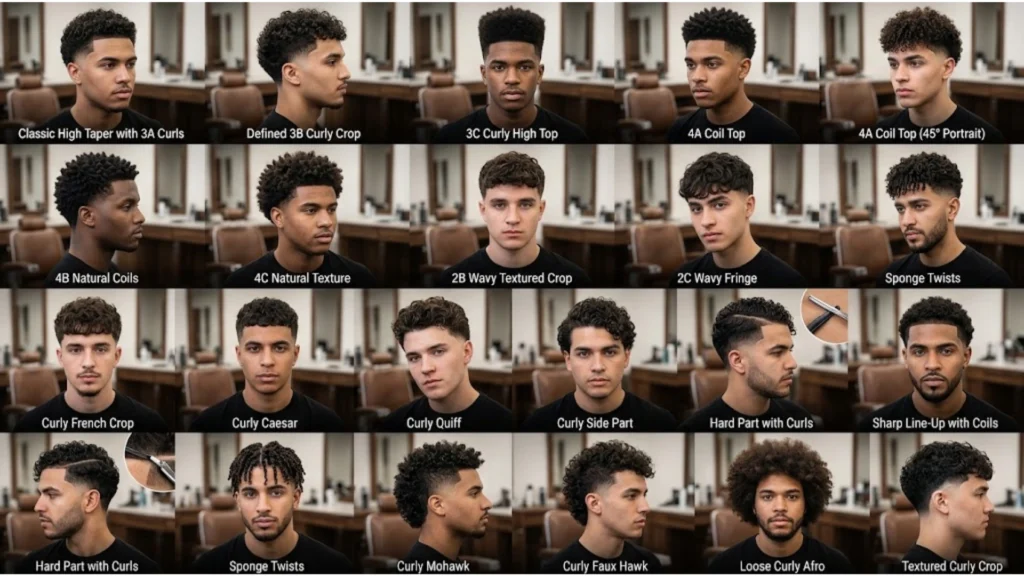
1. Classic High Taper Fade with Natural Curls. The foundational version. A #1 or skin fade on the sides blends up to 3–4 inches of defined curls on top. The curls are left in their natural formation, with no forced shaping. Works on 3A–3B curl patterns. Apply a medium-hold curl cream while hair is damp, then diffuse on low heat. Best for oval and round faces.
2. High Taper Fade with 4C Coily Top: A skin fade blended from bare skin through a #0.5 and #1 guard into a full, rounded 4C top. Request 4–6 inches to account for shrinkage. Style with a thick leave-in conditioner followed by curl-defining cream for maximum volume and definition.
3. High Taper Fade with Defined Ringlets: Loose, defined spiral curls (3B pattern) sit naturally on top without excessive product. The fade is blended from a #2 guard to skin. Apply a light curl cream and finger-coil individual strands while damp for definition. Best for oval and square faces.
4. High Taper Fade with Wavy Textured Top: Looser 2B–2C waves on top give a relaxed, less structured look. The high placement of the fade creates strong contrast despite the softer wave pattern. Use sea salt spray on damp hair and scrunch — avoid heavy creams that flatten the wave. Best for round and oval faces.
5. High Taper Fade with Curly Fringe: Curls are left longer at the front (4–5 inches at the hairline) and shorter toward the crown, creating a natural fringe. The fade is high and tight on the sides. This works well on 3A–3C patterns. Use curl cream at the roots and edges for definition, and let the fringe fall naturally as it dries.
6. High Taper Fade with Curly Pompadour: The curls on top are directed forward and upward using a brush and diffuser, creating a pompadour shape with natural texture. The high fade keeps the sides very tight. Apply a light curl mousse before diffusing to hold the curl in place. Best for round and diamond face shapes, where vertical height is beneficial.
7. High Taper Fade with Textured Crop: A shorter variation, 1.5–2 inches on top, cut bluntly across the top and left with natural texture. The high fade gives the clean sides that prevent a short curly crop from looking unintentional. Best for men who want low daily styling time. Works across most curl patterns (2C–3C). Apply a small amount of curl cream and air-dry.
8. High Taper Fade with Curly Quiff: Similar to the pompadour variation, but the curls are directed slightly forward rather than straight up. Adds volume at the front hairline without requiring completely straight-back styling. Best for heart-shaped faces, where forward volume distracts from a wider forehead. Use a medium-hold mousse and a wide-tooth comb to set the direction while damp.
9. High Taper Fade with Sponge Curls: A sponge tool applied to short, coily hair (4A–4B) creates uniform, defined curl patterns across the top. The high taper fade frames the sponge-curled top cleanly. Hair on top should be ½ to 1 inch long after cut the sponge defines what’s there. Best for round and oval faces. Use a light curl activator before sponging.
10. High Taper Fade with Finger Coils: Individual curl sections are wound around a finger while wet to create uniform defined coils. Works on 3C–4A hair. The technique takes more time but produces more consistent curl definition than air-drying alone. Apply a thick curl cream section by section. Best for men who want a very polished finish.
11. High Taper Fade with Loose Ringlets: A looser, more casual version of the defined ringlet style. The curls are not forced into uniform coils; they fall in natural clusters of varying sizes. Works on 3A–3C patterns. Use a leave-in conditioner only and air-dry for the most effortless finish. Popular for weekend or casual styling.
12. High Taper Fade with Side-Swept Curls. Curls on top are directed to one side with finger-shaping while damp, then diffused in that direction. Creates an asymmetric, contemporary finish. Works well on 3B–3C patterns with 3–4 inches of length on top. Use a light curl cream and direct with your fingers; avoid brushes, which break up the curl clumps. Best for oval and square faces.
13. High Taper Fade with Dense Coil Crown: A full, rounded coil crown on 4B–4C hair, shaped during the cut so it sits evenly without excessive manipulation afterward. The high fade creates a sharp base for the coil crown to sit above. This is a high-impact style bold, architectural, and unmistakable. Use a moisture-rich leave-in conditioner daily to maintain coil definition and prevent dryness at the perimeter.
14. High Taper Fade with Messy Textured Top: An intentionally undone finish on 2C–3B hair. The curls are scrunched rather than defined, and no attempt is made to create uniform clusters of curls. Apply a light sea salt spray and scrunch; that’s it. The high fade gives the entire look structure even when the top is deliberately effortless. Best for oval and round faces.
15. High Taper Fade with Curly Mohawk: The fade on both sides is taken very high and tight, leaving a strip of curls running front-to-back along the center of the head. The curls are free-standing rather than clumped into a traditional mohawk shape. Works on 3A–4A patterns. Use a strong-hold curl gel to keep the center strip defined. Best for oval and square faces.
16. High Taper Fade with Short Curly Top (2 inches) A conservative variation with minimal length on top. The high fade creates a very clean, professional look even at short lengths. For 3C–4C patterns, 2 inches of actual length will appear shorter after shrinkage account for this. Apply a small amount of curl cream and let air-dry. Fastest daily styling time of all variations.
17. High Taper Fade with Long Curly Top (4+ inches). The boldest volume variation. Longer curls sit high above the fade line, maximizing the top-to-sides contrast. For this to work structurally, the curls need enough density to support their own weight 3B–4C patterns are best. Use a leave-in conditioner as the moisture base, then a curl-enhancing cream for hold. A diffuser is needed to prevent the curl’s weight from pulling the pattern straight. Best for round and oval faces.
18. High Taper Fade with Hard Part: A shaved line (hard part) is added at the temple, creating a visual separator between the top and the fade. The line is cut with a trimmer or a straight razor, giving the style a graphic edge. Works on all curl patterns. The hard part requires touch-ups every 7–10 days as it grows out faster than the rest of the fade on curly hair due to the coil growth direction.
19. High Taper Fade with Curly Fringe and Line-Up: The curls are left full at the front with a sharp, squared hairline (line-up or edge-up) across the forehead and temples. The fade is high, and the line-up is crisp. This variation is especially popular among Black men with 4C coily hair who want maximum definition at the hairline. The line-up requires touch-ups on the same schedule as the fade: every 2–3 weeks. Use a leave-in conditioner plus curl cream daily.
20. High Taper Fade with Rounded Coil Top: The barber shapes the coily top into a clean, symmetrical rounded silhouette during the cut often called a “shape-up on top.” Works on 4A–4C hair. The rounded shape combined with the high fade creates a bold, architectural look with a clear geometric silhouette. This style requires the barber to assess the natural growth direction of the coils before cutting to ensure the final shape sits evenly. Use a thick leave-in conditioner and avoid over-drying.
Quick Tip
Found a style in this gallery that fits your vision? TaperMatch converts your preferred style into a barber-ready brief including the exact taper geometry, top length, product recommendations, and the precise language to use at your appointment. It takes under 60 seconds.
How Do You Style a High Taper Fade with Curly Hair?
Styling a high taper fade with curly hair comes down to moisture, technique, and heat management. Use leave-in conditioner and curl cream together, then apply low heat through a diffuser. Follow these steps for the best result:
Step 1: Start with damp, not soaking wet, hair. Towel blot after washing until the hair is about 70% dry. Applying products to soaking wet hair dilutes them and weakens curl definition.
Step 2: Apply leave-in conditioner throughout the top curls, section by section. It forms the moisture foundation, sealing the cuticle to reduce frizz and prime hair for curl cream. This often-skipped step significantly improves results for 3C–4C hair.
Step 3: Scrunch curl-enhancing cream through the curls. Use a scrunching motion from the ends upward, not a rubbing or combing motion. Rubbing breaks curl clumps. Scrunching encourages the curl to form around itself.
Step 4: Blow-dry on low heat with a diffuser, keeping it moving constantly. The diffuser protects curl formation, but high heat breaks hydrogen bonds in the hair shaft and can loosen the curl pattern.
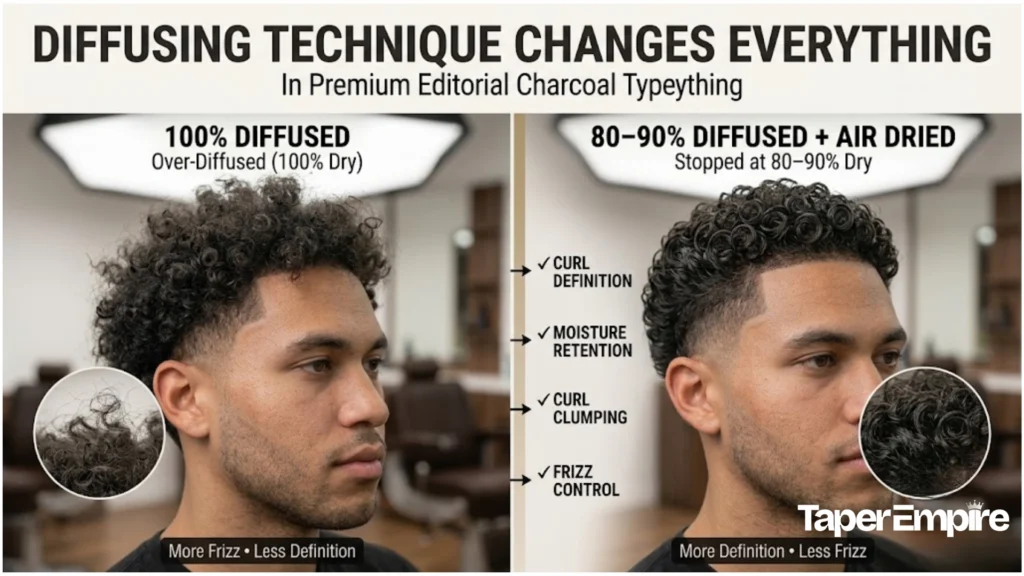
Step 5: Stop at 80–90% dry This is the most commonly ignored instruction in curly hair care. Stopping before full dryness and allowing the last 10–20% to air-dry eliminates frizz caused by over-diffusing. Barbers often see clients return disappointed because they diffused to 100%, destroying the curl definition in the process.
Step 6: Finish with light texture spray (optional). A light texture spray adds separation and a subtle matte finish. Skip it on 4B–4C coil patterns; these textures need moisture retention, not spray finishes that can dry out the hair shaft.
What Products Work Best for This Cut?
Product choice for a high-taper fade with curly hair depends on your curl pattern and hair porosity, not just on personal preference. Using the wrong product weight for your pattern is the most common reason curly hair looks flat, crunchy, or undefined.
By Curl Pattern:
2B–2C (Wavy) Use a lightweight curl mousse or sea salt spray. Heavy creams flatten the wave and reduce natural movement. The goal is to enhance what’s already there without weighing it down.
3A–3B (Curly) A medium-hold curl cream or curl-defining custard works well. Apply to damp hair and scrunch. A light texture spray after drying adds separation. Avoid butters and heavy oils; they’re too dense for this pattern.
3C–4A (Coily) A leave-in conditioner paired with a heavier curl cream is the standard combination. The leave-in provides moisture; the cream defines and holds. A curl activator gel can be layered on top for more definition and hold.
4B–4C (Kinky/Coily) This pattern needs maximum moisture. Apply a thick leave-in or curl butter first, then a heavier cream or gel. Finish with jojoba or castor oil as a sealant to lock in hydration and slow rapid dryness typical of high-porosity coils.
By Hair Porosity:
Hair porosity determines how well your hair absorbs and retains product.
- Low porosity (cuticles are tightly closed):Water and products sit on the surface. Use lightweight, water-based products; avoid heavy butters and oils that build up. Apply to warm, damp hair after a shower for better absorption.
- High porosity (cuticles are open or damaged): Hair absorbs products quickly but loses moisture fast. Use heavier creams and butters. Seal with a light oil after your cream to slow moisture loss.
Washing Frequency:
For 3C–4C hair, co-washing (washing with conditioner only, skipping shampoo) two to three times per week preserves the natural oils that define and protect the curl pattern. Shampoo once per week to remove product buildup. Over-shampooing strips the scalp’s natural sebum, which causes dryness and frizz in tighter curl patterns.
What Should You Tell Your Barber?
Getting a high taper fade right on curly hair depends on your barber understanding two things before they pick up the clippers: your curl pattern and your shrinkage. Most barber miscommunications happen because clients specify a length based on what they see in a photo without accounting for how their specific curl type will behave after being cut and dried.
Before Your Appointment:
Find a barber who regularly works with curly or textured hair. The most reliable way to verify this is to look at their portfolio specifically for clients with your curl pattern, not just any textured hair. A barber comfortable with curly hair will ask to physically feel your hair before cutting to assess density and curl tightness. That is a green flag. If a barber starts cutting without first examining your dry curl pattern, that is a sign to rebook with someone else.
One question to ask during booking or at the start of the appointment: “Do you cut curly hair wet or dry?” The correct answer for a high taper fade on curly hair is dry. Cutting wet curls stretches them, which leads to significantly more length being removed than intended. When the hair dries and shrinks, you end up shorter than you wanted to be.
The High Taper Fade for Black Men guide covers texture-specific guard sequences for waves, coils, and locs in greater detail if your texture requires that level of precision.
The Barber Script (Copy and Read Directly from Your Phone):
“I want a high taper fade starting just above my temples. Keep [X] inches of length on top my curls shrink about [your shrinkage %] when dry, so please cut the top to [final desired dry length + your shrinkage buffer]. Use a [#1 or skin] finish on the sides. My hair is [fine/medium/thick] in density, and my curl pattern is [2C/3B/4C or describe it as wavy/curly/coily]. Please cut my top dry so you can see the natural curl formation before you decide on length.”
Key Specifications to Confirm Before the First Clipper Pass:
- Taper starting point: Just above the temples (high), mid-ear level (mid), near the bottom of the ear (low)
- Top length after shrinkage: State your desired finished dry length, not your current stretched length
- Fade finish: Skin (#0), near-skin (#0.5), or short visible hair (#1)
- Density check: Ask the barber to assess your density before they start — fine-textured coily hair needs more gradual blending than thick-textured hair
Shrinkage Reference:
| Curl Pattern | Typical Shrinkage | Request for ~2″ Dry |
|---|---|---|
| 2B–2C (Wavy) | 10–20% | 2.5″ |
| 3A–3B (Curly) | 20–40% | 2.5–3″ |
| 3C–4A (Coily) | 40–60% | 3.5–4″ |
| 4B–4C (Kinky/Coily) | 50–80% | 4–6″ |
How Is a High-Taper Fade Different from a Mid- or Low-Taper Fade?
The only structural difference between high, mid, and low taper fades is where the fade begins on the head. Everything else the blending technique, the finish, and the top styling- remains the same. For curly hair specifically, that starting point changes the contrast level, the face-shape effect, and how quickly the cut grows out.
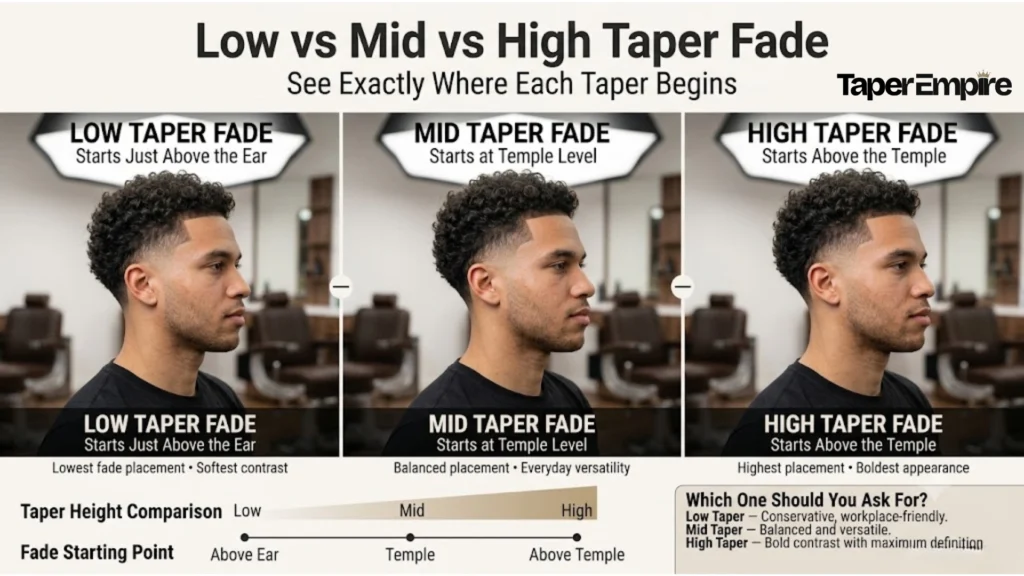
| Fade Type | Starting Point | Best Face Shapes | Best Curl Patterns | Contrast Level | Touch-Up Frequency |
|---|---|---|---|---|---|
| High Taper Fade | Just above the temples | Round, oval, square | All patterns; most dramatic on 3C–4C | High maximum contrast | Every 2–3 weeks |
| Mid Taper Fade | Mid-ear level | Oval, diamond | 2B–3C; softer, balanced look | Medium | Every 2–3 weeks |
| Low Taper Fade | Near the bottom of the ear/nape | Round, square (used carefully) | 2B–3A; most subtle | Low gradual blend | Every 3–4 weeks |
The high taper fade is the boldest choice. It creates the sharpest contrast between the faded sides and the curly top, and it produces the most noticeable vertical elongation. For round face shapes, that height effect is genuinely flattering.
The trade-off is grow-out speed. A high fade starts higher, which means more surface area is affected as the hair grows. At week three, a high taper fade looks noticeably different from a fresh cut. A low taper, by comparison, grows out more gradually and can stay sharp-looking for closer to four weeks.
For a complete side-by-side comparison of all three heights including face-shape scoring, curl-pattern recommendations, and maintenance timelines the guide to low, mid, and high taper differences covers each variation in full. If a mid-taper is a better fit for your curl pattern or face shape, the mid-taper fade for curly hair offers 20+ styles built around that height. For the softest contrast, low taper fade curly hairstyles show what that placement looks like on naturally curly hair.
How Do You Maintain a High Taper Fade with Curly Hair?
Maintaining a high taper fade on curly hair requires two parallel routines: the fade itself (barber-dependent) and the curl condition (product-dependent). Neither substitutes for the other.
Touch-Up Schedule:
- Week 1–2: Fresh cut. The fade line is sharp; contrast is at its maximum.
- Week 2–3: The faded area begins to blur. The hard line softens, and the gradient loses definition. This is when a touch-up is needed.
- Week 4+: The fade has fully grown out. The cut loses its structural contrast and begins to look overgrown rather than styled.
Most barbers recommend a 2–3-week touch-up interval for skin fades or high fades to keep the lines crisp.
Cost Reality:
Expect to pay $30–65 per fade touch-up at most US barbershops, with curl-specialized shops often landing at the higher end of that range. At a 2–3-week interval, that adds up to roughly $60–140 per month a real commitment worth budgeting for.
Chain salons typically charge $20–30 per cut. The lower price reflects less specialization: barbers at chain salons may not have extensive experience with curly or coily textures, and the difference in result is usually visible.
If you cannot commit to barber visits every 2–3 weeks, a low taper fade is a more practical alternative. It lasts about 3–4 weeks before it looks grown out, reducing your annual maintenance visits by roughly one-third.
Can You Maintain It Yourself?
DIY fade touch-ups are not recommended for curly or coily hair. The clipper-over-comb blending technique used to keep the fade line smooth requires professional training. Curly hair’s uneven growth direction makes mistakes obvious: a patchy blend or a hard line from a misplaced guard shows immediately. Trimming the neckline with a trimmer is feasible for most people. The taper blend itself is not.
Between Touch-Ups — Daily Curl Refresh:
Curls don’t need to be washed every day, but they do need moisture. Every 2–3 days:
- Lightly dampen the curls on top (a spray bottle works well)
- Apply a small amount of leave-in conditioner
- Scrunch and air-dry, or diffuse briefly on low heat
This keeps the curl pattern defined and prevents the dryness that makes curly hair look frizzy and dull between wash days.
Climate and Season:
Humidity causes curls to absorb atmospheric moisture, leading to frizz and a larger silhouette than the freshly styled look. In humid climates or summer, layer an anti-frizz serum over your curl cream to shield the cuticle. In dry or cold climates, increase your leave-in conditioner low-humidity air strips moisture from the hair shaft faster.
Does a High Taper Fade Reduce Bulk?
Yes, a high taper fade significantly reduces the bulk of curly hair by removing weight from the sides and back. The result is that the natural curl pattern on top can move and spring freely, without the visual heaviness of full-length sides.
The practical benefits are real:
- Faster drying time: Less overall hair volume means shorter diffusing or air-dry sessions
- Easier daily styling: Curl product only needs to be applied to the top section, not throughout
- Better airflow: The scalp at the sides breathes more easily, particularly relevant in warm weather
- Reduced neck bulk: Curly hair that grows full on the back and sides can feel physically heavier; the taper removes that weight
The honest limitation: the high taper fade simplifies the hairstyle’s shape, but it does not reduce the curl maintenance required on top. The curls on top still need leave-in conditioner, curl cream, and regular moisture. If you are looking for low-maintenance hair overall, not just a cleaner silhouette, a much shorter cut like a textured crop or buzz cut is more realistic.
The fade also does not change the curl pattern itself. Your 4C coils will still require the same care routine after the cut as before it. What changes is how contained and intentional the overall silhouette looks.
Common Mistakes to Avoid
These six mistakes account for the majority of disappointing results from high-taper fades on curly hair. Each one is avoidable with the right information before the appointment.
1. Choosing a barber without curly-hair experience A barber unfamiliar with curly or coily textures may cut the top wet (causing shrinkage miscalculation), fail to account for growth direction, or blend the fade too harshly at the transition zone. The result — patchy blending and unintended length removal — takes 6–8 weeks of grow-out to correct.
2. Asking to be cut while hair is wet. Curly hair stretches significantly when wet. A barber who cuts the top wet will remove more length than visually apparent. When the hair dries and the curl contracts, you end up shorter than intended. Always request a dry cut for the top section.
3. Not specifying length with shrinkage in mind: Saying “leave it 2 inches on top” without accounting for your curl’s shrinkage percentage means the barber cuts to 2 stretched inches, which becomes 1 inch or less after drying on tighter patterns. State your desired finished dry length, then add your shrinkage buffer.
4. Over-diffusing to 100% dryness. Diffusing until completely dry is the most common cause of post-styling frizz. Stop at 80–90% dry and let the remaining moisture evaporate naturally. The last stage of air-drying is where the curl contracts and sets forcing it with heat at that point breaks the curl formation.
5. Skipping leave-in conditioner on 3C–4C hair. Going straight to curl cream without a leave-in conditioner base leaves the hair shaft without a moisture foundation. The result is dryness, breakage over time, and reduced curl definition. Leave-in conditioner is not optional for coil patterns — it is the foundational step.
6. Attempting DIY fade touch-ups: The most well-intentioned DIY fade attempt on curly hair usually produces a visible hard line, an uneven blend, or a section where too much length was removed. The perimeter of a curly high taper fade is complex the curl growth direction changes at the temples. Leave the blending to a trained barber.
Frequently Asked Questions
Does a high taper fade work on 4C hair?
A high taper fade works well on 4C hair. The tight coils create dramatic volume on top when paired with closely faded sides. Request 4–5 inches of hair length on top to achieve 2 inches after shrinkage, and confirm with your barber that they cut the top section dry.
How much does a high taper fade cost?
Expect to pay $30–65 per cut at most US barbershops, with curl-specialized shops pricing toward the higher end. At a 2–3-week touch-up interval, that’s roughly $60–$ 140 per month. Generic chain salons charge less but typically lack experience with curly and coily textures.
Should curly hair be cut wet or dry for a taper fade?
Curly hair should be cut dry for a taper fade. Dry cutting allows the barber to see the natural curl formation, accurately assess shrinkage, and avoid removing more length than intended. Wet curls stretch and appear longer than they actually are once dry.
Can you maintain a high taper fade at home?
Trimming the neckline with a trimmer is manageable at home. The taper blend itself is not recommended for DIY the clipper-over-comb blending technique requires professional training, and mistakes are highly visible on textured and curly hair. Book a barber for the fade every 2–3 weeks.
How long do curls need to be to get a high taper fade?
Curls should be at least 2–3 inches in stretched length to provide enough volume and definition on top. For 4C patterns, you need 4–5 inches of actual hair to finish with 2 inches after shrinkage. Anything shorter risks the top looking too close-cut to contrast meaningfully with the fade.
What is the difference between a taper and a fade?
A taper gradually reduces hair length at the sideburns and neckline without reaching bare skin. A fade blends the hair down to skin level. A high taper fade combines both: the gradual shortening of a taper, applied at a high starting point just above the temples, and a finish at skin or near-skin level.
Key Takeaways
A high-taper fade for curly hair is one of the most structurally flattering cuts available to men with natural curl patterns. The high starting point maximizes contrast, the removal of side weight lets the top curls move freely, and the defined silhouette works across face shapes from round to square to oval.
Three things determine whether your result matches your expectation. First, find a barber who works with curly hair regularly and cuts the top dry. Second, build your shrinkage calculation into the requested length. Third, commit to the 2–3 week touch-up schedule this cut earns its appearance only when the fade line stays sharp.
The daily routine matters too. Leave-in conditioner as a moisture base, curl cream for definition, and low-heat diffusing to 80–90% dryness are the consistent actions that keep the curls on top looking intentional rather than incidental.
If you are still deciding between a high, mid, or low placement, or you want to confirm which variation best suits your specific face shape and curl texture, TaperMatch analyzes your facial geometry in under 60 seconds and returns three ranked style options each with the exact barber language to use at your next appointment.