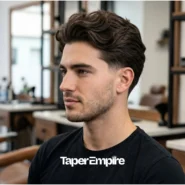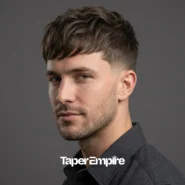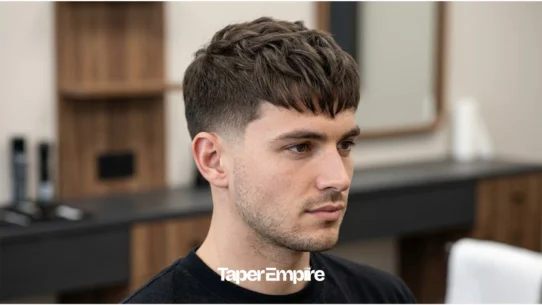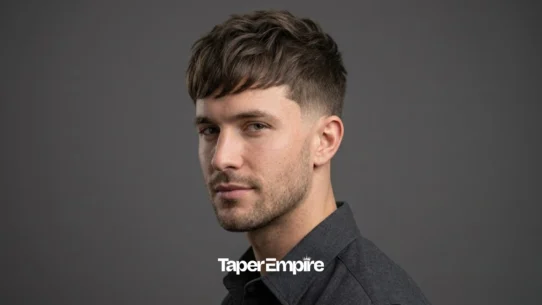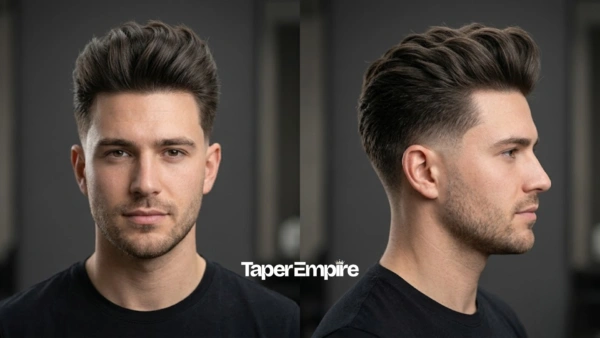

A high blowout taper is a men’s haircut where the fade begins above the temples, higher than a mid or low taper while the top stays long enough to blow-dry into full, lifted volume. It suits round and oval face shapes best and needs a trim every two to three weeks to hold its sharp contrast.
This guide breaks down exactly where the high taper begins, which face shapes and hair textures suit it best, and what to say when you sit in the barber’s chair. You’ll find a growth timeline for reaching blowout-ready length, a face-shape decision matrix, and the specific mistakes that turn a sharp high taper into an uneven one. Every section answers a real question people ask before booking this cut.
What Is a High Blowout Taper and Who Should Get One?
A high blowout taper is a haircut where the fade starts above the temples and the top is left long for blow-dried volume. It works best for men with round or oval face shapes and curly or coily hair textures.
Key Points
- Fade starts above the temples
- Top left long for blowout volume
- Best for round and oval faces
- Needs trims every two to three weeks
Table of Contents
What Is a High Blowout Taper?
A high blowout taper starts its fade above the temples — noticeably higher than a mid taper, which begins around the temple line, or a low taper, which stays close to the neckline and ears. The top is left long and gets blow-dried into a full, lifted shape, which is what separates a blowout taper from a standard high fade.
The contrast is the whole point. Short, tight sides meet a tall, textured top, and the transition between them has to look smooth instead of stepped.
Here’s how the three heights compare directly:
| Attribute | Low Blowout Taper | Mid-Blowout Taper | High Blowout Taper |
|---|---|---|---|
| Fade start point | Neckline and ears | Temples | Above the temples |
| Best face shapes | Long, oblong | Most shapes (versatile) | Round, oval, diamond |
| Maintenance | Lowest – hides regrowth longest | Moderate | Highest – every 2–3 weeks |
| Contrast level | Subtle | Balanced | Sharp, high-contrast |
If your priority is low upkeep rather than sharp contrast, it helps to see how the three taper heights compare outside the blowout context before deciding.
Taper vs. Fade: What’s the Difference?
A taper only shortens hair near the edges around the sideburns, behind the ears, and down the neckline while leaving more length above that point. A fade blends much higher up the head and exposes more skin along the way.
In everyday barbershop language, people use “taper” and “fade” almost interchangeably when talking about a blowout style. Technically, they’re different techniques. A taper grows out softer and looks cleaner for longer. A fade creates crisper contrast but needs more frequent upkeep to stay sharp. If you want the full breakdown of how these two terms diverge outside the blowout context, the distinction between a taper and a fade holds true across every haircut style, not just this one.
Where Does the “High” in High Taper Start?
The fade line begins above the temple area, near the parietal ridge, the widest point of the skull where the top curves into the sides well above where a low or mid taper would sit.
Barbers use this landmark because it’s visible on any head shape, regardless of hair density or curl pattern. It gives both you and your barber a fixed point to reference instead of a vague description like “somewhere on the side.”
Is a High Fade the Same Cut?
No. A high fade and a high blowout taper can share the same fade height, but the top treatment is different. A high fade usually keeps the top short and textured. A high blowout taper leaves the top long enough to blow-dry into volume.
This distinction matters at the barbershop. If you ask for a high taper without mentioning the blowout element, you may end up with a shorter, flatter top than you expected. Naming both parts of the cut the fade height and the blowout finish removes the guesswork.
What Does a High Blowout Taper Look Like?
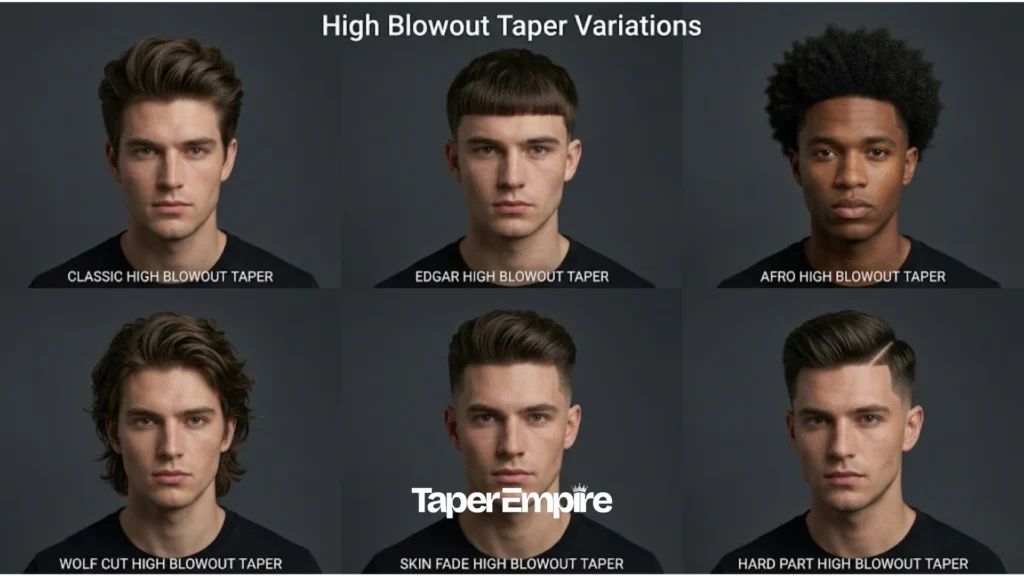
A high blowout taper looks different depending on how the top is textured, parted, or layered, but every version shares the same tight, high fade on the sides. Below are the most requested variations.
- Classic High Blowout Taper — A rounded, evenly lifted top with no fringe or part, styled straight up and back.
- High Blowout Taper Edgar — A straight, sharp fringe across the forehead paired with the tapered sides, giving a bolder, more structured look.
- Afro High Blowout Taper — Natural curls left long on top for volume, with the high taper controlling bulk around the ears and neckline.
- High Blowout Taper with Fringe — Movement and texture on top with a soft fringe piece falling forward, paired with a clean high taper.
- High Blowout Taper Mullet — A voluminous front and crown combined with longer, layered hair at the back, with the taper keeping the sides sharp.
- Temple Blowout Taper — The fade focuses tightly around the temples and sideburns while the back stays natural or lightly tapered.
- High Blowout Taper Wolf Cut — Shaggy, layered chaos on top paired with clean, high-contrast sides.
- Blowout Perm Taper Fade — Soft curls or waves added through a perm, styled up and out, with a high taper underneath.
- High Blowout Taper with Skin Fade Sides — The sides taken down to skin for maximum contrast against the voluminous top.
- High Blowout Taper with Hard Part — A shaved line dividing the top from the taper, adding a sharper visual break.
If you want to add a shaved line or pattern on top of the base cut, a high taper with a design works as a natural next step once the fade and blowout are dialed in.
What Beard Pairs Best with a High Taper?
A clean shave or light stubble balances the height of a high blowout taper without competing with it for visual attention. A short, boxed beard also works, since its tight lines echo the sharpness of the fade.
A full, rounded beard can work against the proportions a high taper creates, since it adds width at the jaw right where the cut is already drawing the eye upward.
Does a High Blowout Taper Suit All Hair Types?
A high blowout taper works across straight, wavy, curly, and coily hair, but each texture needs a different amount of styling effort to hold the volume. Here’s how each type performs:
| Hair Type | Suitability | Styling Note |
|---|---|---|
| Straight | It works, but needs the most effort | Texture must be cut into the top; daily blow-drying required to hold lift |
| Wavy | Easiest texture: natural lift | Gets volume with minimal product |
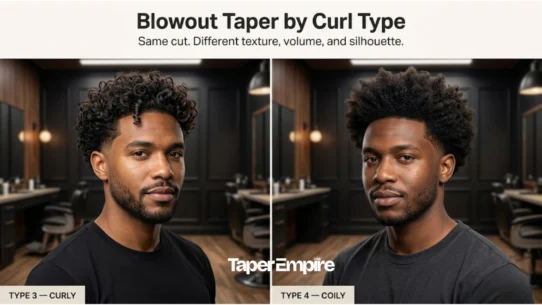
| Curly (Type 3) | Excellent: strong volume retention | A diffuser works better than a round brush |
| Coily/Afro-textured (Type 4) | Excellent: holds shape longest between cuts | Can carry significant weight on top without losing definition |
| Fine or thinning | Works well for creating visual density | Volume on top makes hair appear thicker than it is |
Straight hair naturally wants to lie flat, so it depends the most on the blow-dry step to build lift. In the Andre Walker Hair Typing System, numbers describe the basic curl shape: 1 is straight, 2 is wavy, 3 is curly, and 4 is coily. Type 3 is characterized by visible curls, which may be loose or tight, while Type 4 encompasses very tightly coiled or kinky hair. That built-in movement is why wavy and curly hair holds the blowout shape with far less daily maintenance.
If you have coily or Afro-textured hair specifically, there’s a deeper breakdown of high taper styles organized by hair texture with barber-script wording matched to that texture. The same goes for curly hair and straight hair, each of which behaves differently once the blowout technique gets applied. For a wider set of examples across every taper height, not just high, a style gallery organized by hair type shows how the blowout effect changes depending on texture.
How Long Does Hair Need to Grow First?
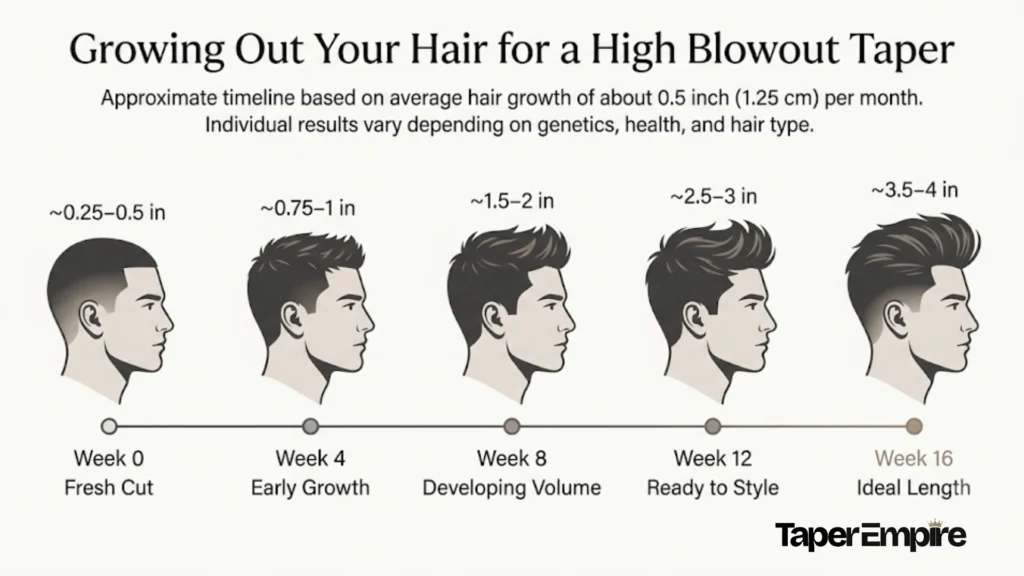
Your hair needs to be at least three inches long on top before a blow-dry can create real lift. Anything shorter simply doesn’t have enough length for the dryer and brush to grip, direct upward, and hold volume once the heat is removed.
If you’re starting from a close, high-and-tight fade, reaching that length takes time. According to the American Academy of Dermatology, scalp hair grows at an average rate of about half an inch per month.
Here’s roughly what to expect at each stage:
| Timeline | Approximate Top Length | What’s Achievable |
|---|---|---|
| Week 0 | Guard 1–2, very short | Standard high fade only, no blowout |
| Week 4 | About 0.5 inch | Still too short for a blowout finish |
| Week 8 | About 1 inch | Light texture possible, minimal lift |
| Week 12 | About 1.5 inches | Approaching blowout-ready length |
| Week 16 | 2 inches or more | Full high blowout taper achievable |
Quick Tip
If you’re not sure how your current length translates into styling options, the taper style tool lets you compare a high, mid, or low taper against your face shape and hair type before you commit to a length or a cut.
Does Your Face Shape Fit a High Taper?
A high blowout taper flatters some face shapes more than others because the added height on top changes how long or wide your face appears. Here’s how it breaks down by shape:
| Face Shape | Verdict for High Taper | Reason | If Not Recommended, Try |
|---|---|---|---|
| Oval | Recommended | Naturally balanced proportions suit any taper height | — |
| Round | Recommended | Added height elongates the face | — |
| Diamond | Recommended, with clean edges | Accentuates cheekbones without adding width | — |
| Square | Use with caution | Sharp contrast can emphasize jaw width | A mid taper with a softer blend |
| Long or oblong | Not recommended | Extra vertical volume tips proportions too far | A low taper instead |
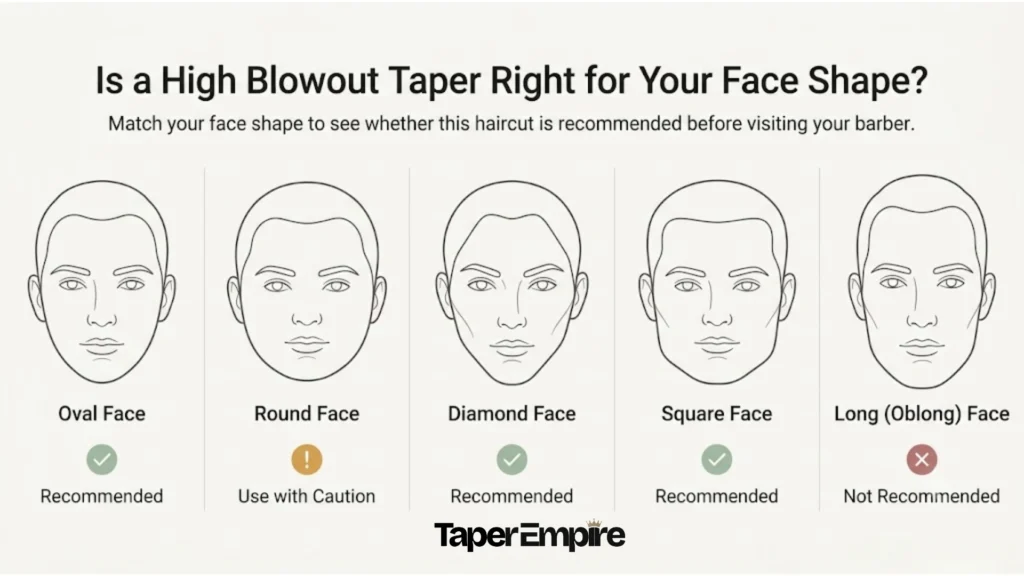
If your face is already long, adding more height on top only stretches it further. Keeping some width at the sides works better for that shape, which is exactly what a lower taper height does instead.
Quick Tip
Face shape is easier to judge in a mirror than in a photo. The taper-style tool can help you preview how a high taper’s added height might change your proportions before you sit in the chair. See How It Looks on You →
What Do You Tell Your Barber?
Being specific about fade height, top length, and the transition zone is what separates a sharp high blowout taper from an uneven one. Use language your barber can act on immediately, not general descriptions.
Here’s a script that covers all three points:
“I’d like a high blowout taper. Start the fade above the temples, keep it tight and clean into the skin near the ears and neckline, and leave at least two to three inches on top so it can be blown out with volume.”
Which Clipper Guard Should You Ask For?
Guard numbers give your barber an exact reference instead of a rough estimate. A typical high taper progression moves from shortest at the neckline to longest near the crown.
| Skull Position | Typical Guard/Length |
|---|---|
| Neckline | Guard 0 (skin or near-skin) |
| Near the ear | Guard 1 |
| Mid-head, below the fade line | Guard 2–3 |
| Above the temple, blend into top | Scissor-over-comb or clipper-over-comb blend |
What Should You Never Say to Your Barber?
Avoid saying just “taper it up” without naming a height, since that phrase means something different to every barber. Don’t ask for a “high fade” if what you actually want is the blowout-style volume on top, since that phrase implies a shorter, textured finish instead.
Skipping the top-length request is another common gap. If you don’t specify at least two to three inches on top, your barber has no way of knowing you plan to blow-dry it afterward.
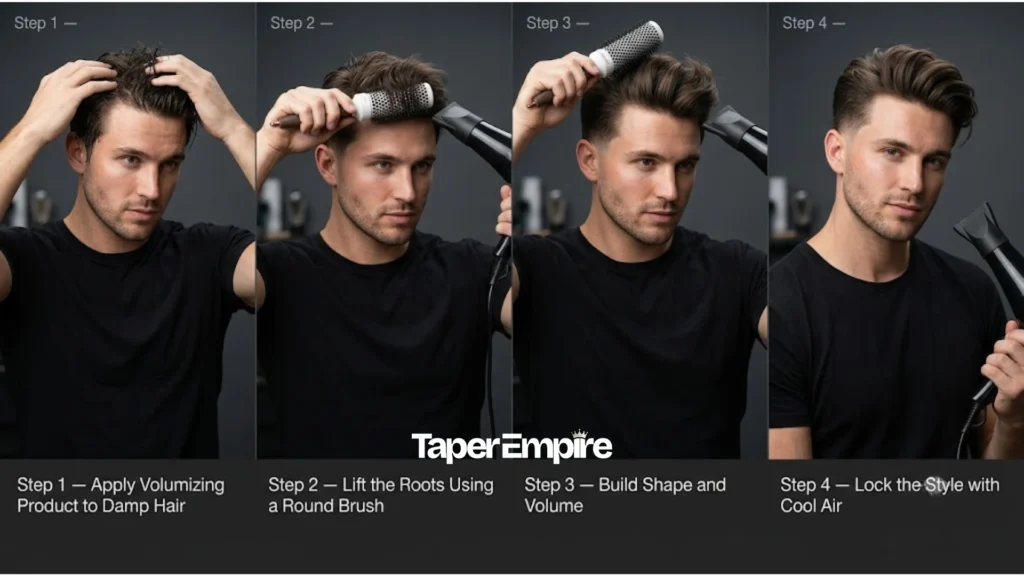
How Do You Style a High Blowout Taper?
Styling a high blowout taper comes down to five steps done in order: protect, product, dry, direct, and set. Skipping any one of them usually shows up in the final result.
- Apply a heat protectant to damp hair before using any hot tools.
- Add a small amount of product matched to your hair type (see the table below).
- Blow-dry with a round brush for straight or wavy hair, or a diffuser attachment for curly or coily hair, lifting at the roots as you go.
- Direct the airflow forward and upward toward the crown to build height where it’s needed most.
- Finish with a short burst of cool air to lock the shape in place.
Which Product Matches Your Hair Type?
Using the wrong product for your texture is one of the fastest ways to lose the volume you just styled. Match the category to your hair, not to whatever’s already in your bathroom.
| Hair Type | Product Category | Application | Common Mistake |
|---|---|---|---|
| Straight | Volumizing mousse or texture powder | Root-focused, on damp hair | Using heavy pomade, which flattens the lift |
| Wavy | Light curl cream | Mid-length to ends | Overloading product, which weighs down natural movement |
| Curly | Curl cream plus a diffuser | Applied to damp hair, scrunched upward | Brushing while dry, which breaks the curl pattern |
| Coily/Afro-textured | Leave-in cream with a light-hold gel | Section by section, on damp hair | Using a thin, low-hold product with no grip |
A heavy pomade on fine, straight hair flattens the exact volume you’re trying to build. A light mousse on thick, curly hair won’t hold anything at all. Matching product to texture solves both problems at once.
Does Humidity Affect the Style?
Yes, and it affects some climates more than others. High humidity causes blow-dried volume to collapse faster, sometimes within a few hours of leaving the house.
In humid regions, a stronger-hold product and a quick reapplication of texture powder midday help the shape hold longer. In dry climates, volume tends to last through the full day with far less touch-up needed. In cold, dry winter conditions, added moisture in your styling product prevents the hair from looking flat and brittle.
What Mistakes Ruin a High Blowout Taper?
Most bad outcomes trace back to one of five specific causes, and each one has a direct fix.
- Sides taken too high, creating a visible “shelf.” This happens when the transition zone isn’t blended. Ask specifically for a blended, not hard, transition next time.
- Top cut too short to blow out. This happens when less than two inches is left on top. Specify the exact top length before the cut begins.
- Flat, lifeless top after leaving the barbershop. This usually comes down to the wrong product for your texture. Match the product to the hair-type table above.
- Boxy, disconnected silhouette. This means the transition zone wasn’t properly faded. Request a seamless blend explicitly in your barber script.
- Volume that collapses within hours. This is caused by humidity or a skipped heat protectant step. Always apply heat protectant, and adjust your product for the climate you’re in.
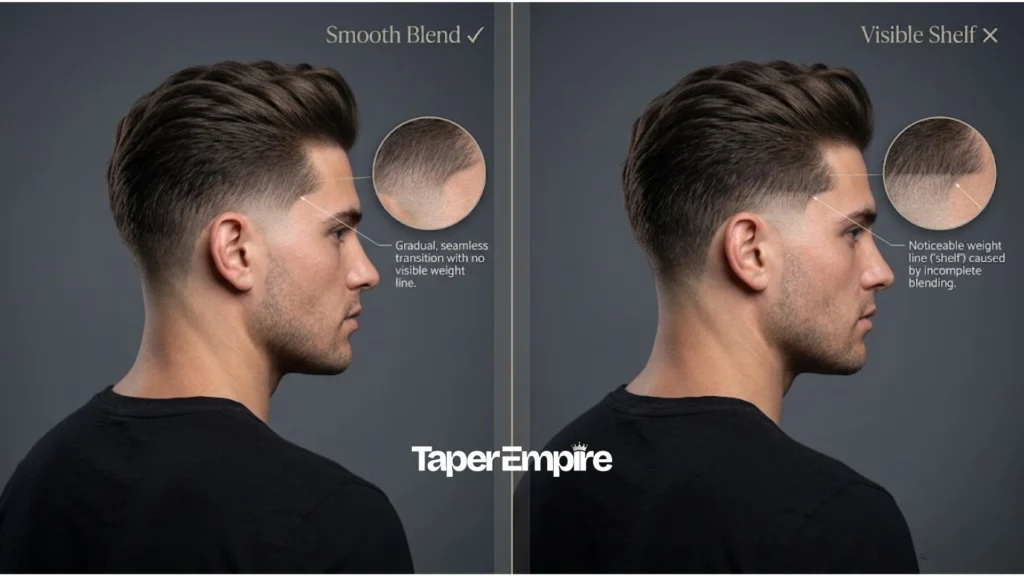
A properly blended high taper shows no visible line between the short sides and the tall top the eye reads it as one continuous shape. A poorly blended one shows a distinct step where the clippers stopped, and the length begins, which is the single most common giveaway of a rushed cut.
How Often Does a High Taper Need a Trim?
A high blowout taper looks sharpest during the first week and starts losing definition by week three. That means it typically needs a trim every two to three weeks to keep the fade line crisp.
This is noticeably more frequent than a low taper, which grows out cleanly and can go 3 to 4 weeks between visits; the lower contrast hides regrowth for much longer.
If a two-to-three-week barbershop schedule doesn’t fit your routine, it’s worth being honest with yourself about that before booking a high taper. A mid taper’s lower-maintenance schedule may suit your routine better if frequent visits aren’t realistic for you. Choosing a lower taper height isn’t a downgrade; it’s simply a better match for how often you’re willing to sit in the chair.
Frequently Asked Questions
What is the difference between a high blowout taper and a high fade?
A high blowout taper leaves the top long enough to blow-dry into full volume, while a high fade typically keeps the top short and textured. The fade height can be identical on both cuts; the top treatment is what separates them.
Can a high blowout taper work on curly or Afro-textured hair?
Yes. Curly and coily hair naturally holds volume and shape longer than straight hair, making it well-suited to a high blowout taper. A diffuser attachment and curl cream typically produce the best results for these textures.
How long does hair need to be for a high blowout taper?
The top needs to be at least two to three inches long to create enough volume for the blow-dry effect. Growing from a close fade to that length usually takes several months of consistent growth.
How often do you need to get a high blowout taper trimmed?
A high blowout taper needs a trim every two to three weeks to maintain its sharp contrast, since the high fade line grows out faster than a low or mid taper. It’s one of the higher-maintenance taper heights.
Is a high blowout taper good for a round face?
Yes. A high blowout taper is one of the most recommended cuts for round faces because the added height on top helps elongate facial proportions and adds visual contrast against the face’s width.
What should you tell your barber to get a high blowout taper?
Ask for the fade to start above the temples, request a blended transition into the skin near the ears and neckline, and specify at least two to three inches of length on top for blow-dry volume.
Key Takeaways
A high blowout taper works best when three things line up: your hair is long enough on top to hold volume, your face shape benefits from added height, and you’re genuinely willing to keep up with a trim every two to three weeks. Get any one of those wrong, and the cut looks flat, boxy, or grown-out within days instead of weeks.
The fastest way to avoid a bad outcome is to walk into the barbershop with specific language fade height, top length, and a request for a blended transition instead of a general description. If your face shape or maintenance tolerance points toward a lower height, a mid or low taper delivers similar styling with less upkeep.
If you’re still weighing the height, face shape, and hair type together, the taper style tool can help you compare those factors side by side before your next appointment.