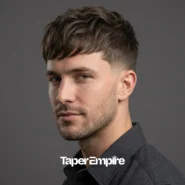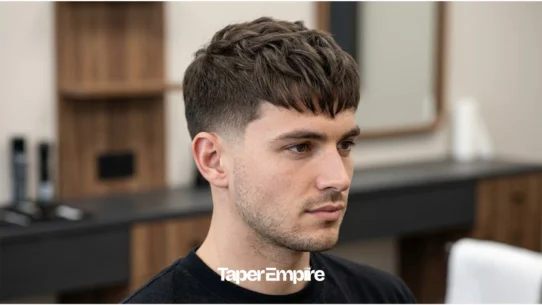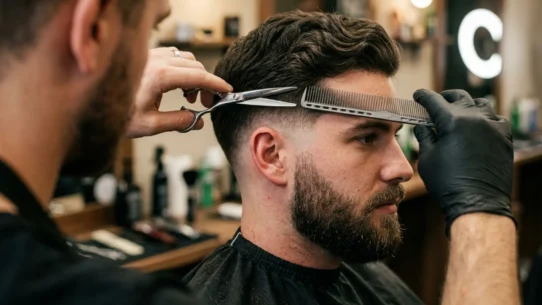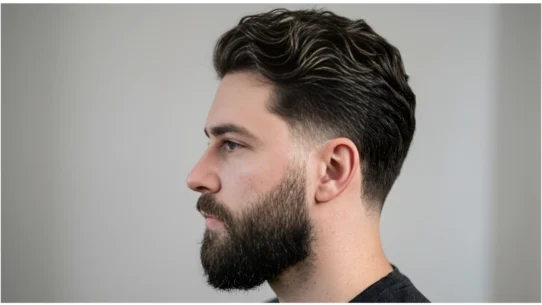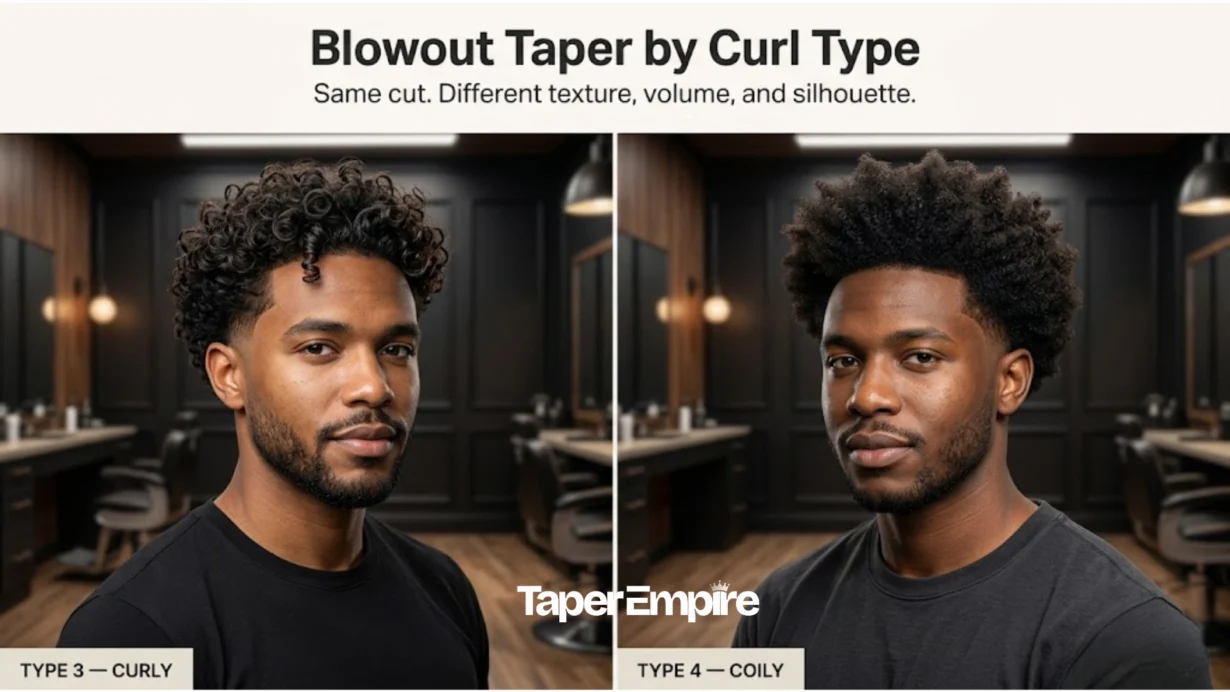

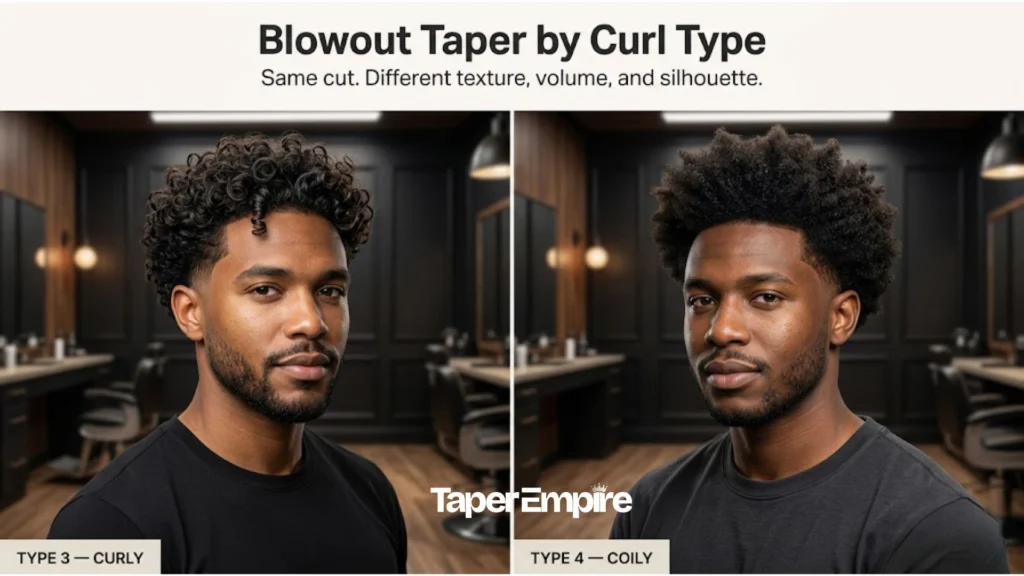
A blowout taper for curly hair combines a precision-tapered fade at the sides with a volumized, diffuser-styled curly top. The cut works on Type 3 wavy-to-curly and Type 4 coily hair. The taper position low, mid, or high controls contrast and maintenance frequency. The single detail that makes or breaks this cut on curly hair is telling your barber to cut the top dry, not wet.
This guide covers every decision you need to make before your next barbershop visit. You’ll learn how the cut looks on different curl types, which taper height fits your hair and lifestyle, and the exact words to use with your barber. You’ll also get a full styling routine for keeping your curls sharp between cuts.
What is a blowout taper for curly hair, and who is it best suited for?
A blowout taper for curly hair pairs a tapered fade at the sides and neckline with a voluminous, diffuser-styled curly top. It suits Type 3 and Type 4 hair types and works best for men who want defined curls with clean, structured sides.
Key Points
- Works on curly and coily hair
- Low, mid, or high taper options
- Requires curl-specific cutting technique
- Needs a diffuser-based styling routine
Table of Contents
Your curly hair already suits a blowout taper. Your curl type and face shape decide which taper height works best.
The Taper Style Tool matches your curl pattern (Type 3 or Type 4) and face shape to the right blowout taper variation before your next appointment.
What Is a Blowout Taper and How Is It Different from a Regular Fade?
A blowout taper for curly hair is a two-part haircut: a precision-tapered graduation at the sides, neckline, and temples, paired with a diffuser-styled voluminous curly top. The “blowout” refers to the styled top section, not the sides. The sides are tapered, never blown out.
This distinction matters because taper and fade are not interchangeable terms, even though barbers and clients often use them that way. A taper narrows the hair gradually and stops well above the skin, leaving a soft, natural line. A fade takes the sides down to skin level, creating more contrast and a sharper visual break.
| Element | Taper | Fade | Blowout Taper |
|---|---|---|---|
| Where it starts | Above the ear (low), at the ear (mid), or above the temple (high) | Higher up the head with more scalp exposure | Same graduated taper paired with a volumized top |
| Skin exposure | Minimal | Significant, especially at high fade | Taper-level exposure at the sides only |
| Visual contrast | Soft and subtle | High contrast | Moderate to high, depending on taper height |
| Grow-out | Soft, gradual | A sharp regrowth line appears sooner | Depends on taper height; low hides regrowth longest |
| Best for curly hair? | Yes | Yes, with more frequent upkeep | Ideal curl volume naturally enhances the top |
The most common mix-up happens when clients ask for a “blowout fade” when they actually want a blowout taper. The word choice tells your barber how high to take the blend and how much skin to expose, so getting it right before you sit in the chair saves you a frustrating conversation mid-cut.
Curly hair pairs especially well with this style because the natural coil and curl pattern creates vertical lift that straight hair has to fight for. If you want to see how the same concept applies across other textures, the blowout taper guide, which covers every hair type, breaks down the differences side by side. And if the taper-versus-fade distinction still feels unclear at a broader level, the full directory of taper fade types walks through every variation the barbering world uses.
What Does a Blowout Taper Look Like on Curly Hair?
A blowout taper looks different depending on your curl pattern, because Type 3 curls and Type 4 coils respond to the same cut in distinct ways. Both textures work with this style. The visual result and the technique behind it change based on how tightly your hair coils.
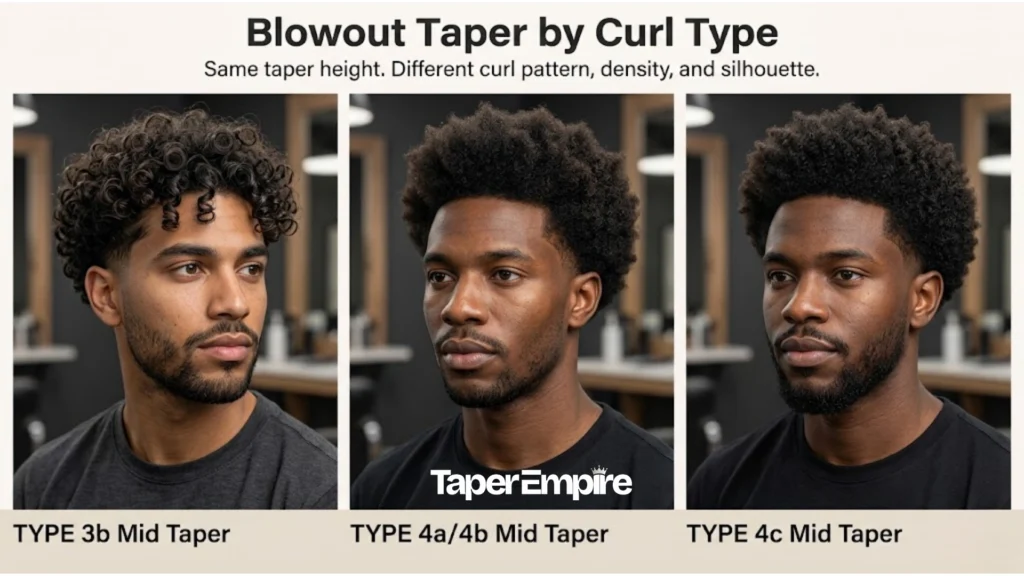
Type 3 Curly Hair (2c, 3a, 3b, 3c): Defined Curl Rings with Volume
Type 3 hair produces full, bouncy curl rings on top, with a clean, sharp taper framing the sides and neckline. The taper creates a crisp visual contrast against the natural texture above it, and layered curls add dimension instead of a flat, uniform shape.
Type 3 hair shrinks less than tighter curl patterns, which makes the top length more predictable when your barber cuts it. The curl pattern also softens the graduation line naturally, so a low or mid taper tends to look best on this texture; the curl blends into the taper instead of creating a hard visual break.
If your curl pattern falls somewhere between defined rings and a looser wave, a textured fringe variation of the blowout taper is worth a look, especially if your front section naturally falls forward instead of standing up.
Type 4 Coily Hair (4a, 4b, 4c): Afro-Shaped Top with Precision Taper
Type 4 coily hair produces a rounded, afro-shaped top rather than individual curl rings, and the density of the coil creates a sharper-looking graduation line than on looser curl types. The top holds significant weight and volume because the coil pattern packs more hair into the same space.
On 4c hair especially, the blowout taper top looks noticeably different from the photos most clients bring in it should read as a shaped, clean afro silhouette, not loose ringlets. Barbers who work with coily hair regularly will often show two reference photos side by side, one Type 3 result and one Type 4 result, so the client and barber are aligned before the clippers come out.
The tools matter here too. A diffuser adds the initial volume, but an afro pick and curl sponge are what shape the top into its final rounded form- a step that’s easy to skip if you’re used to styling looser curls. If a full afro-shaped top isn’t quite the direction you want, the high taper fade styles organized by hair texture for Black men show non-blowout alternatives that keep more length control at the sides.
Which Blowout Taper Is Right for You Low, Mid, or High?
The right taper height depends on your curl type, your maintenance schedule, and how much contrast you want between your sides and your top. Curly hair interacts with each height differently than straight hair does, because the curl pattern at the sides softens the graduation line and reduces harsh visual breaks even at higher taper positions.
| Taper Height | Where It Starts | Visual Contrast | Best Curl Type | Maintenance Interval | Best If You… |
|---|---|---|---|---|---|
| Low taper | Just above the ear | Low, subtle | Type 3 and Type 4 | Cleanup every 3 weeks; full cut every 4–5 weeks | Want a natural grow-out and fewer barbershop visits |
| Mid taper | At the ear level | Moderate, balanced | Type 3 (all subtypes) | Cleanup every 2–3 weeks; full cut every 3–4 weeks | Want visible contrast without heavy upkeep |
| High taper | Above the temples | High, bold | Type 3b/3c with defined rings | Cleanup every 1–2 weeks; full cut every 3 weeks | Want a bold look and can commit to frequent trims |
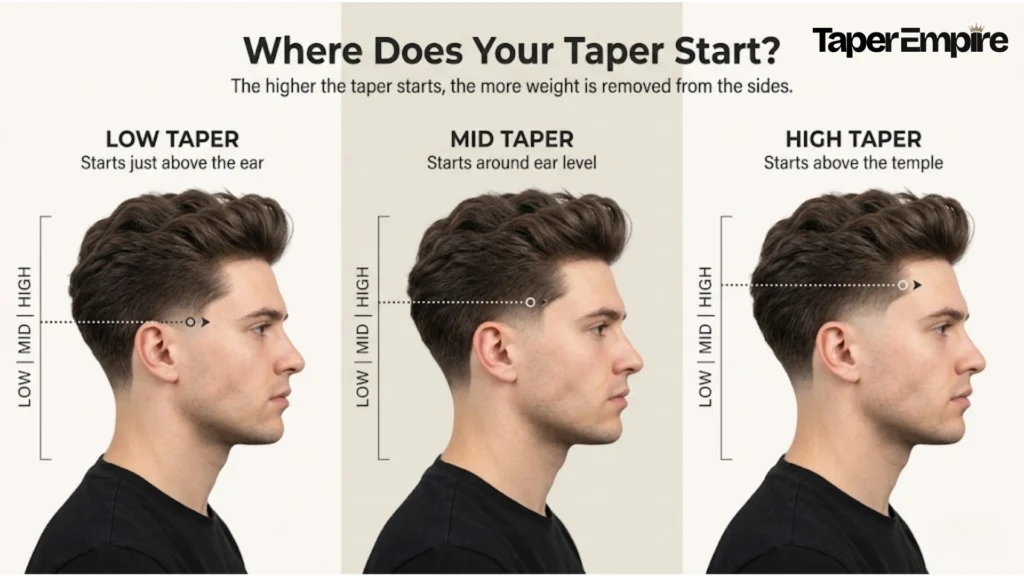
A high taper on Type 4 coily hair creates a striking visual break between the dense afro top and the closely cropped sides, but it demands the most frequent trims of any option. Coily hair at the temples becomes visually noticeable quickly as it regrows, so this height only works if you’re comfortable seeing your barber every 1 to 2 weeks.
For a broader comparison of these three heights that isn’t filtered by curl type, the low vs. mid vs. high taper breakdown covers the general trade-offs for any hair texture.
Quick Tip
If you’re still torn between two taper heights, the Taper Empire tool generates personalized recommendations based on your specific face shape and hair type in a few clicks.
Does Head Shape Affect Which Taper Height Works Best?
Head shape changes how taper height looks most balanced. A flatter crown benefits from a mid or high taper, because the added contrast draws the eye upward and makes the crown appear taller. A low taper on a flat crown can make the head look wider instead.
Curly hair softens this effect somewhat. The natural volume that curls create at the crown partially compensates for a flatter profile, but it helps to tell your barber directly: “I want extra crown weight, don’t thin the top too much.” Thinning the crown on a flat head shape removes the very volume needed to create the illusion of height.
What Exactly Should You Tell Your Barber?
Tell your barber your target taper height, your desired top length measured while stretched (not wet), and a request to point-cut rather than blunt-cut the top. These three pieces of information prevent almost every common miscommunication that happens when curly-haired clients sit in the chair.
The Shrinkage Problem: Why Curly Hair Requires Different Instruction
Wet curly hair shrinks significantly from its true dry length, which means a barber who cuts to a length while your hair is wet can leave you with far less volume than you expected once it dries. Type 3 curls typically shrink 25 to 50 percent from wet to dry, while Type 4 coils can shrink 50 to 75 percent or more.
This is why the dry-cut instruction matters more than almost anything else you tell your barber. Cutting the top dry or measuring it while stretched is the single most reliable way to ensure you end up with the length you actually asked for.
Here’s how to find your stretched length before your appointment:
- Pick a curl near your crown at its natural, resting length.
- Pull it gently downward until it’s fully elongated but not strained.
- Measure from your scalp to the tip. This number is your stretched length — give this number to your barber, not the length your curls show at rest.
Ready-to-Use Barber Scripts (Copy or Screenshot These)
The exact words you use matter more than the general idea you’re trying to communicate. Here are three ready-to-use scripts based on curl type and taper height.
Type 3 Curly Hair, Low Taper: “I want a low blowout taper on curly hair. Start the taper just above my ear and keep it clean around the neckline and sideburns. Leave the top at [X] inches when it’s stretched, not when it’s wet. Please point-cut the top instead of blunt-cutting it, and cut the top section dry so you can see the actual curl volume.”
Type 3 Curly Hair, Mid Taper: “I want a mid blowout taper on curly hair. Start the taper at ear level and keep the sides tight with clean edges. Leave the top at [X] inches measured while stretched. I have curl shrinkage, so please don’t measure wet. Point-cut the top for texture, not blunt.”
Type 4 Coily Hair, Low Taper: “I want a low blowout taper on coily hair a full afro top, not individual curl rings. Keep the taper soft and start it just above the ear. Leave significant weight in the crown and don’t thin the top too much. The top shrinks a lot when dry, so please cut it dry or stretched. Sharp line-up at the edges.”
Fill in your target length using the stretched measurement from the previous section. The most common reason this cut disappoints curly-haired clients is that the barber measured wet hair against a dry-length target one sentence about stretched length prevents that outcome entirely. If you’d rather see the site’s general approach to barber terminology for a standard mid taper, barber-approved terminology for asking for a mid taper design covers that non-blowout version in detail.
How Should Your Barber Cut Curly Hair Differently?
Curly hair needs point cutting instead of blunt cutting, and the top section should be cut dry or stretched rather than wet. These two differences in technique separate a blowout taper that looks great on curly hair from one that falls flat.
Point Cutting vs. Blunt Cutting on Curly Hair
| Technique | How It Works | Result on Curly Hair | When to Use It |
|---|---|---|---|
| Point cutting | Scissors angled diagonally into the hair, cutting strands at varied lengths | Adds internal texture and removes bulk while curls move and separate naturally | Always, for the blowout taper top on curly hair |
| Blunt cutting | Scissors held horizontal, cutting all strands at the same length | Creates a uniform edge that makes curly hair puff outward instead of lifting upward | Avoid on curly tops; fine for straight hair |
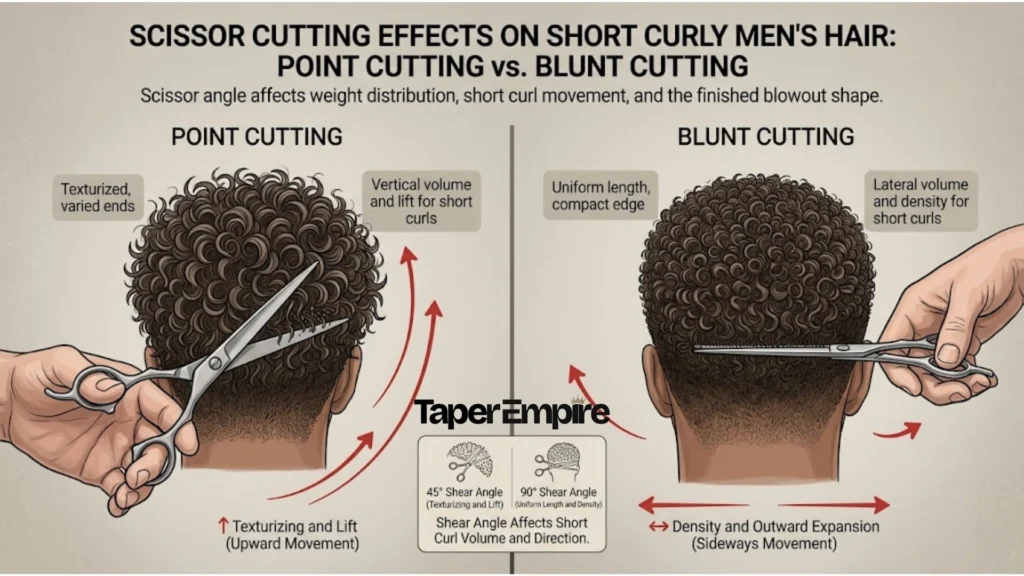
A blunt cut on curly hair is one of the most common technical mistakes barbers make when they primarily work with straight hair. The curl tries to spring at the cut line, but instead of lifting, it pushes out to the side. Point cutting solves this in a single step: you remove the same amount of length, but the curl behaves completely differently afterward.
Why the Fade Line Matters More on Coily Hair
Coily hair has a denser, more opaque texture at the sides, which makes the graduation line between the taper and the full top look sharper than it does on looser Type 3 curls. The looser curl pattern on Type 3 hair softens that same transition naturally.
Some barbers apply an enhancement spray, such as Black Ice or Tomb45, to the perimeter and neckline of dark, coily hair to sharpen the line-up contrast. The pigment darkens the edge, making the gradation pop. Many shops treat this as a premium add-on and charge separately for the step, so ask your barber about pricing before the service begins.
How Do You Style a Blowout Taper at Home?
Styling a blowout taper on curly hair starts with the right wash routine and ends with a diffuser or a heat-free drying method; the exact steps depend on whether you have Type 3 curls or Type 4 coils.
Type 3 Curly Hair Styling Routine (Step-by-Step)
- Wash with a sulfate-free shampoo or co-wash on clean, damp hair; this removes buildup without stripping your natural curl pattern.
- Apply a heat protectant evenly from root to tip before any heat touches your hair.
- Apply curl cream or mousse to soaking wet hair to define the curl ring before diffusing.
- Flip your head forward and hold the diffuser flat against your scalp, keeping it still.
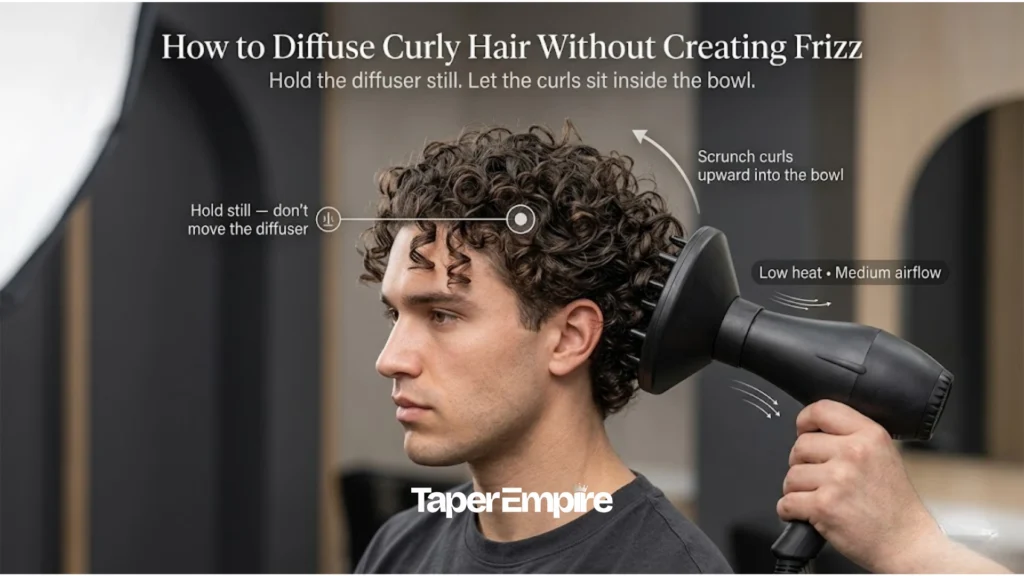
- Use low heat and medium airflow; high heat disrupts the curl pattern and causes frizz as it dries.
- Scrunch sections upward into the diffuser bowl to compress the curl and reinforce its ring shape.
- Work through your whole head, section by section, letting each area dry to about 80 percent before moving on.
- Finish with two minutes of cool air to set the curl and reduce frizz.
- Once fully cool, smooth a small amount of curl cream onto your fingertips and gently separate any clumps, leaving some clumping intact for definition.
Type 4 Coily Hair Styling Routine (Step-by-Step)
- Wash with a moisturizing shampoo. Type 4 coily hair loses moisture faster than looser curl types because the tight coil structure makes it harder for natural scalp oils to travel down the hair shaft, leaving the ends drier.
- Apply a leave-in conditioner to soaking-wet hair immediately after washing. This foundational moisture layer helps coily hair avoid drying out and becoming brittle during styling.
- Layer a curl activator over the leave-in conditioner. Curl activator penetrates the tight coil structure in a way curl cream, formulated for looser curls, cannot.
- Diffuse on low heat, holding the bowl steady against your scalp until the hair is roughly 70 percent dry.
- Switch to a blow-dryer without an attachment, using low-to-medium heat, pointed upward from underneath, to stretch the coil pattern and build height at the crown.
- While hair is still warm, use an afro pick at the roots, gently lifting to build a rounded afro shape without disturbing curl definition at the ends.
- Run a curl sponge over the top in circular motions to reactivate any compressed coils and even out the shape.
- Finish with two minutes of cool air to set the style.
- Do a final shaping pass with the pick, checking the silhouette from the front, sides, and top before the style fully cools.
How to Refresh Your Curls on Day 2 and Day 3
Your curls will flatten and lose definition after a night of sleep, but a short refresh routine restores most of the volume without a full rewash.
| Step | Type 3 Curly Hair | Type 4 Coily Hair |
|---|---|---|
| 1. Rehydrate | Mist lightly with water; don’t saturate | Mist generously with water mixed with leave-in conditioner |
| 2. Product | Apply a small amount of curl cream, focusing on the ends | Apply a small amount of curl activator to the roots and mid-shaft |
| 3. Reshape | Scrunch sections upward to reactivate the curl ring | Use an afro pick at the roots to rebuild volume and shape |
| 4. Dry | Air-dry or diffuse on low heat for 3–5 minutes | Air-dry or diffuse briefly on low heat |
| 5. Finish | Gently separate any over-clumped sections with fingertips | Reshape the silhouette with the pick, checking the front and top profile |
Sleeping on a satin or silk pillowcase reduces the friction that flattens curls overnight. Board-certified dermatologist Dr. Annie Gonzalez of Riverchase Dermatology confirms these materials “stop the friction between skin/hair and the pillow,” preventing frizz and knotting. Gathering curls loosely at the top of your head with a satin scrunchie, often called “pineappling,” helps preserve top volume on Type 3 hair specifically.
What Products Do You Need for a Blowout Taper on Curly Hair?
You need a moisture base, a hold-and-definition product, heat protection, and the right styling tool and each of these looks different depending on whether you have Type 3 curls or Type 4 coils.
| Product Category | Type 3 Curly Hair | Type 4 Coily Hair | Why It Matters |
|---|---|---|---|
| Moisture base | Curl cream | Leave-in conditioner | Coily hair loses moisture faster during heat styling, and leave-in provides protection that curl cream alone can’t match |
| Hold & definition | Mousse (light hold) | Curl activator | Curl activator is a lightweight, water-based product that hydrates tight coils. Mousse prioritizes volume and often needs layering with cream or gel for 4A–4C hair |
| Heat protection | Heat protectant spray | Heat protectant cream or spray | Both curl types need heat protection before diffusing; cream formulas add extra moisture for coily hair |
| Finishing | Lightweight styling cream | Curl activator (light second pass) | Finishing products should add shine and definition without re-wetting hair or creating stiffness |
| Tool | Diffuser attachment | Diffuser plus afro pick and curl sponge | Coily hair needs the pick and sponge to build the rounded afro shape a diffuser alone won’t get you there |
Avoid heavy gels and waxes on the blowout taper top for either curl type. Heavy gels create a hard, crunchy cast over the curl that requires scrunching to break, which redistributes product unevenly and causes frizz. Waxes coat the hair shaft and build up residue over repeated use, dulling curl definition until a clarifying wash removes it.
There’s no single product line that works identically across every curl type on this cut. What defines curls beautifully on Type 3 hair will sit on top of Type 4 coils without absorbing matching the product to your specific curl structure isn’t a preference, it’s a technical requirement for getting the result you want.
How Long Does a Blowout Taper Last and How Do You Maintain It?
A blowout taper typically stays sharp for two to four weeks before needing a cleanup, and the exact timeline depends on your taper height and curl type.
| Taper Height | Curl Type | When Taper Looks Grown-Out | Cleanup Visit | Full Cut |
|---|---|---|---|---|
| Low taper | Type 3 | ~2.5–3 weeks | Every 3 weeks | Every 4–5 weeks |
| Low taper | Type 4 | ~3–4 weeks | Every 3–4 weeks | Every 4–5 weeks |
| Mid taper | Type 3 | ~2 weeks | Every 2–3 weeks | Every 3–4 weeks |
| Mid taper | Type 4 | ~2.5–3 weeks | Every 2–3 weeks | Every 3–4 weeks |
| High taper | Type 3 | ~1–1.5 weeks | Every 1–2 weeks | Every 3 weeks |
| High taper | Type 4 | ~1.5–2 weeks | Every 2 weeks | Every 3 weeks |
According to the American Academy of Dermatology, human hair grows at an average rate of about half an inch per month, and curl type doesn’t change that growth rate. What changes is how visible that growth becomes at the taper line.
The low taper on Type 4 coily hair holds its shape the longest of any combination on this list. The dense coil pattern at the sides naturally obscures the graduation line as hair regrows, blurring the boundary into the surrounding texture instead of forming a visible regrowth line. That’s the main reason a low blowout taper tends to be the most practical starting point for Type 4 clients who want to minimize barbershop visits. For general upkeep principles that apply beyond curl-specific timing, maintaining a mid taper fade covers barbershop-visit basics that hold true across hair types.
Does the Blowout Taper Work for Your Hair? (First-Timers and Edge Cases)
Yes, the blowout taper works on nearly every curl type, but a few practical details make the difference between a smooth first experience and a disappointing one.
Getting Your First Blowout Taper on Curly Hair
If this is your first blowout taper, start with a mid taper. It gives you visible contrast without the demanding maintenance schedule of a high taper, and it grows out far more gracefully if you decide the style isn’t for you.
Bring two reference photos to your appointment: one showing the taper height from the side, and one showing the top texture and volume from the front. These two angles communicate more than any verbal description on its own.
Before you sit down, check for these three signals that your barber knows how to work with curly hair:
- Their portfolio includes at least two photos of taper cuts on curly or coily hair, not just straight hair.
- They can answer whether they point-cut or blunt-cut curly tops without hesitation.
- They confirm they’ll cut the top dry or stretched rather than wet.
Quick Tip: If you’re heading into your first appointment and still unsure which taper height and curl style will suit you, the Taper Empire tool can generate a personalized match based on your face shape and curl type before you ever sit in the chair.
Common Mistakes to Avoid
- Telling your barber a length in wet inches. Saying “leave it three inches on top” while your hair is wet almost guarantees less volume than you expect once it dries. Always specify your length while stretched.
- Choosing a high taper for your first cut. The high taper demands the most frequent maintenance of any option. A first-timer who can’t commit to weekly cleanups will end up with a grown-out look within ten days.
- Skipping the heat protectant. Blow-drying curly hair without heat protection damages the outer layer of each strand, and that damage compounds with every future styling session.
- Using the wrong product for your curl type. Curl cream on Type 4 coily hair won’t produce the same result you see in Type 3 photos. The product needs to match your curl structure, not the look you’re chasing.
- Not bringing a reference photo. Verbal descriptions of taper height and top volume are easy to misread. One clear photo removes the ambiguity entirely.
Frequently Asked Questions
How much does curly hair shrink from wet to dry?
Type 3 curly hair shrinks roughly 25 to 50 percent from its wet stretched length to its dry resting length. Type 4 coily hair shrinks 50 to 75 percent or more. This is why curly-haired clients should ask barbers to cut the top dry or measure it stretched, never wet.
What is the difference between a blowout taper and an afro taper?
A blowout taper on Type 3 curly hair produces defined individual curl rings on top. An afro taper, usually done on Type 4 coily hair, produces a rounded, dense afro-shaped top instead. The sides are tapered the same way in both styles.
How often should I get a blowout taper cleaned up?
A low taper on Type 4 coily hair stays sharp for three to four weeks before it needs a cleanup. A mid- or high-taper on Type 3 curly hair usually needs attention every two to three weeks. A full restyle is typically needed every three to five weeks.
Does a blowout taper work on 4c hair?
Yes, a blowout taper on 4c coily hair produces an afro-shaped top with a precision-tapered side. Use a curl activator instead of curl cream, shape the top with an afro pick and curl sponge, and always ask your barber to cut the top dry.
What do I tell my barber if I have curly hair and want a blowout taper?
State your taper height, specify your desired top length in stretched inches rather than wet inches, and ask your barber to point-cut the top instead of blunt-cutting it. Bring one photo showing taper height and one showing top texture.
What is the best product for a blowout taper on curly hair?
For Type 3 curly hair, use curl cream and mousse on wet hair before diffusing. For Type 4 coily hair, start with a leave-in conditioner, then layer a curl activator for hold and coil definition. Avoid heavy gels and waxes on either curl type.
Final Takeaways
A blowout taper works on curly and coily hair alike, but the details that separate a great result from a disappointing one come down to three things: choosing the right taper height for your curl type, giving your barber the shrinkage-aware instructions this guide covers, and following a curl-specific styling routine at home. Start with a mid taper if this is your first time, always specify your length while stretched, and match your products to your actual curl structure rather than the results you see in someone else’s photos.
If you’re still deciding between taper heights or want a starting point based on your own face shape and curl type, the Taper Empire tool turns everything in this guide into a personalized recommendation in a few clicks.