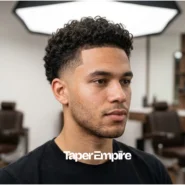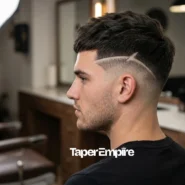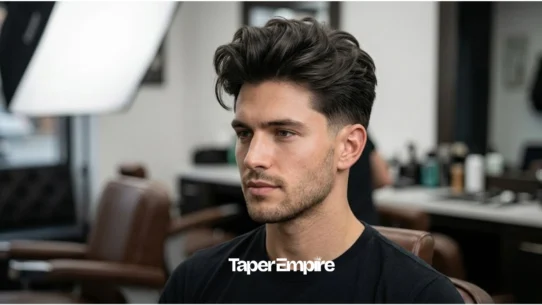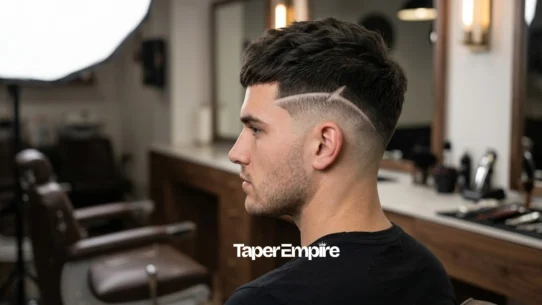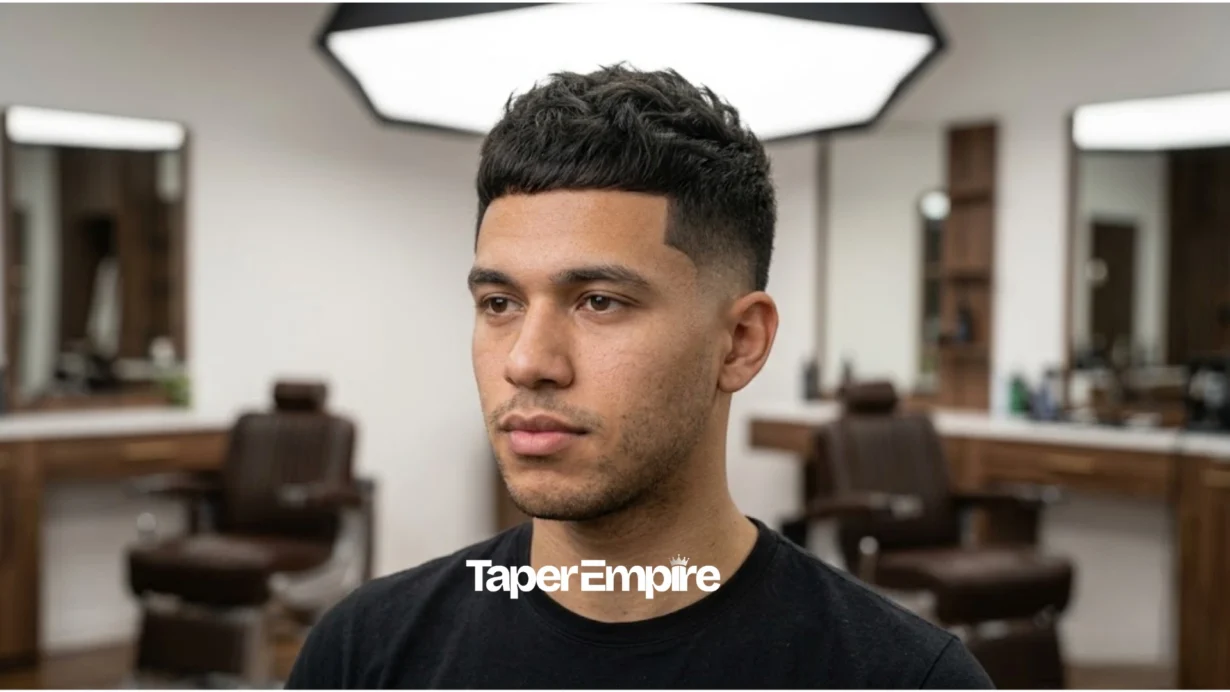

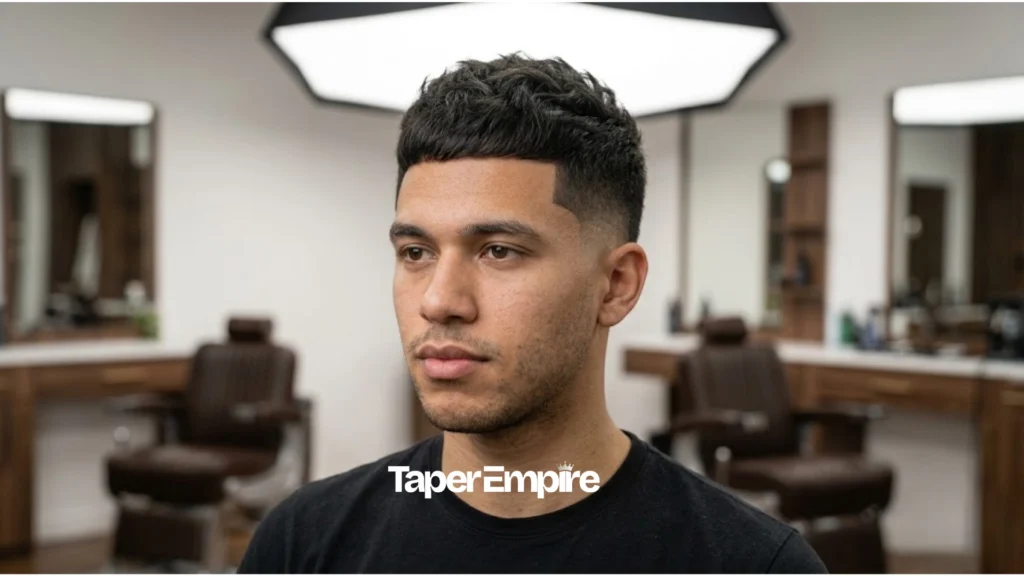
High taper fade works exceptionally well with straight hair; the clean, uniform texture of straight strands shows the fade’s gradient lines with precision. The cut begins above the temples, fades the sides short, and leaves length on top for styling. With the right products and blow-dry technique, straight hair achieves natural volume and strong visual contrast.
Does a high taper fade work with straight hair?
A high taper fade suits straight hair well. The cut starts above the temples, fades the sides short, and keeps the top length. Straight hair’s uniform texture shows the gradient cleanly. Medium-density dark hair produces the strongest contrast; lighter or finer hair benefits from a softer blend.
Key Points
- Starts above the temples
- Works best on medium density
- Light hair needs a softer blend
- Requires trims every 1–2 weeks
Table of Contents
What Is a High Taper Fade and Does It Work for Straight Hair?
A high taper fade is a haircut in which the hair begins blending at or above the temples, higher on the sides and back than a low or mid fade, transitioning from very short or skin-length at the bottom to full length on top. The gradient is gradual rather than abrupt, which distinguishes a taper from a hard fade.
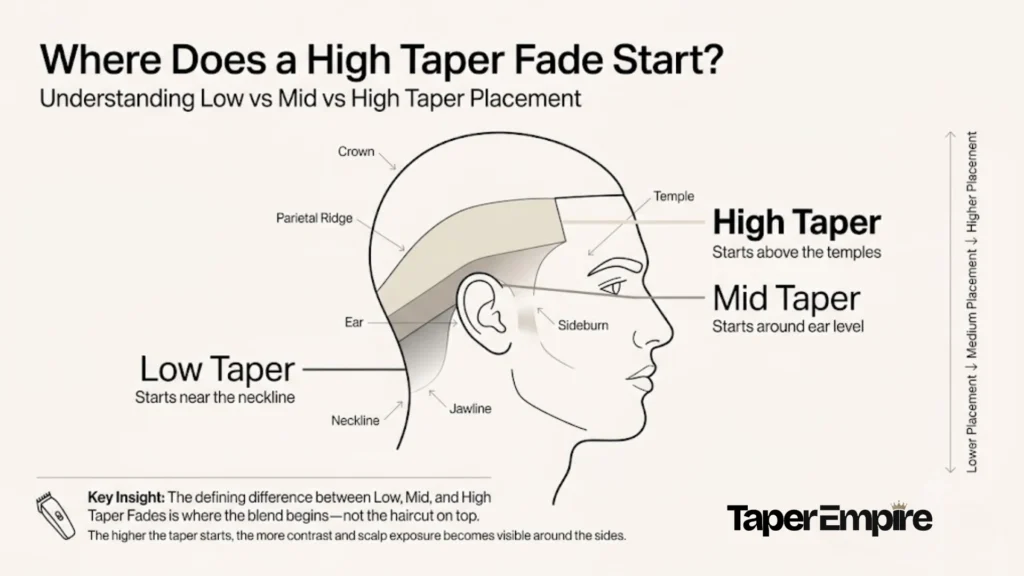
Straight hair is one of the best textures for this cut. Because straight strands lie uniformly, they follow the fade’s gradient without resistance, showing each length transition cleanly. There are no natural curls or coils to obscure the blend; the line from short to long reads exactly as the barber cut it.
Medium-density straight hair produces the sharpest result. The sides taper close without risking scalp exposure, and the top holds enough volume to create a clear contrast with the faded sides. Fine or thin straight hair can work but requires a softer gradient rather than a skin fade. More on that in the next section.
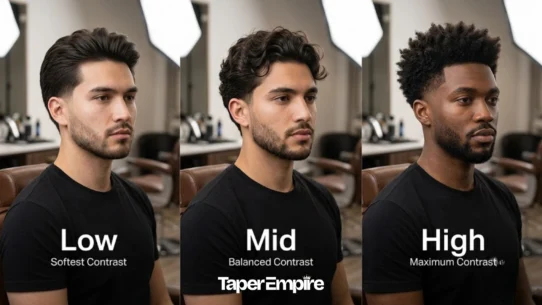
The fundamental difference between a low, mid, and high taper comes down to where the blend starts. A low taper begins near the neckline. A mid taper starts at ear level. A high taper starts above the temples, creating the boldest contrast and the most structured silhouette. Understanding the full spectrum of taper fade types helps clarify why height matters. The higher the start point, the more dramatic the transition looks from a distance.
Will a High Taper Fade Show Up on Light or Blonde Straight Hair?
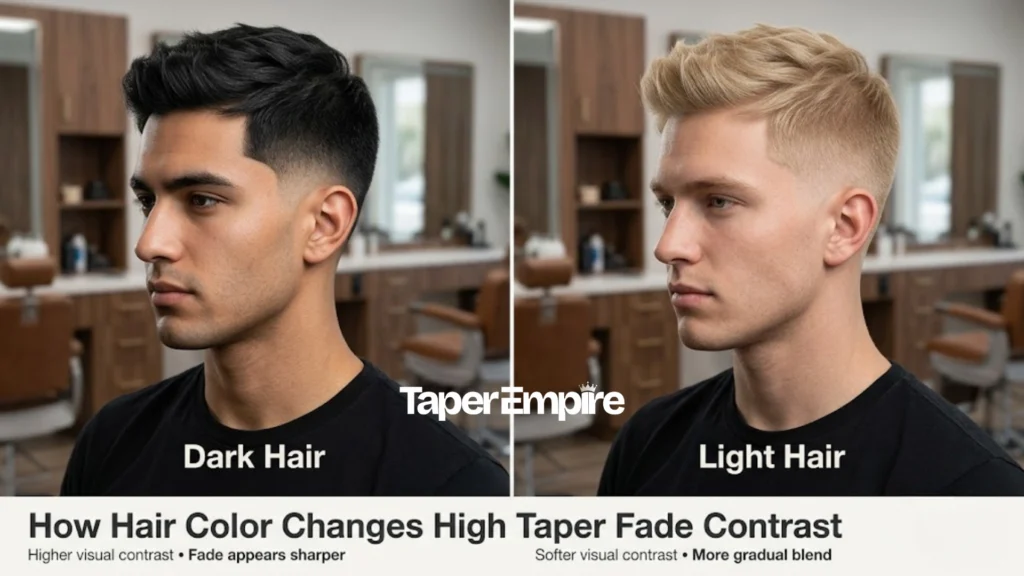
Light-colored straight hair presents a specific challenge: fade contrast depends on two things, not one. Most people assume the fade creates definition by shortening the sides. It does but color contrast between the shorter sides and the fuller top matters just as much as length contrast. Dark brown or black straight hair shows both signals simultaneously. Blonde or light brown hair shows only the length differential.
The honest reality: a standard high-taper fade on platinum-blonde or very light hair can read as thinning rather than styled. A barber who takes the sides to skin on light, fine hair is removing both length and color, leaving the sides looking exposed rather than tapered.
That does not mean the cut is off-limits. It means execution matters more.
Contrast decision guide by hair color and density:
| Hair Color | Hair Density | Contrast Level | Recommended Approach |
|---|---|---|---|
| Dark Brown / Black | Medium–Thick | High | Standard high taper, any top style |
| Dark Brown / Black | Fine | Medium | High taper with a soft blend; avoid skin at the base |
| Medium Brown | Medium | Medium–High | Standard high taper; hard part optional |
| Light Brown / Dirty Blonde | Medium | Low–Medium | Softer gradient; hard part adds definition |
| Blonde / Platinum | Medium | Low | Mid taper, or high taper with a very soft blend |
| Blonde / Platinum | Fine | Very Low | Mid taper recommended |
Technique 1 — The Hard Part
A hard part is a razor-cut line running from the temple toward the crown, creating a structural division between the top and sides. On light hair, this line provides visual contrast that the fade gradient alone cannot deliver. The razor line is sharp and visible regardless of hair color. It works especially well paired with a side part or comb-over top style.
Technique 2 — Soft Gradient Over Skin Fade
Keeping a minimum length at the bottom of the fade rather than going to bare skin preserves some color at the shortest point. This reduces the “exposed scalp” appearance while still delivering a polished taper. Ask your barber for a #1 guard minimum at the lowest point rather than a skin fade. The taper still reads clearly; it simply transitions more gently.
Technique 3 — Textured Top Styling
Product-created texture on top adds dimensional contrast through volume and shadow. When the top is styled with matte clay or a texturizing paste, it creates a lifted, dimensional surface that contrasts with the flatter, shorter sides independent of color. For light-haired men, this styling technique compensates for the reduced color differential.
If none of these techniques deliver the definition you want, a mid taper fade on straight hair is the closest alternative. It creates a comparable silhouette with a softer contrast level that reads cleanly on lighter hair.
What Products Does Straight Hair Need for a High Taper Fade?
Straight hair has no natural texture to create grip, wave, or volume. Without the right products, it lies flat against the scalp and a flat top next to faded sides loses the contrast that makes the cut work. Product selection and application are not finishing touches. They are structural decisions.
Product by hair density:
| Hair Density | Product Type | Hold Level | Finish | When to Apply |
|---|---|---|---|---|
| Fine Straight | Lightweight mousse or light-hold clay | Light | Matte | Damp hair, roots only |
| Medium Straight | Texture clay or medium-hold pomade | Medium | Matte or low shine | Towel-dried (70% dry) |
| Thick Straight | Strong-hold pomade or paste | Strong | Matte or gloss | Damp or dry hair |
The most common mistake with straight hair is using a product that’s too heavy for the density. Heavy pomade on fine straight hair collapses within hours. Match product weight to your hair’s natural resistance; fine hair needs lightweight formulas that create volume without adding mass.
How to Style a High Taper Fade on Straight Hair
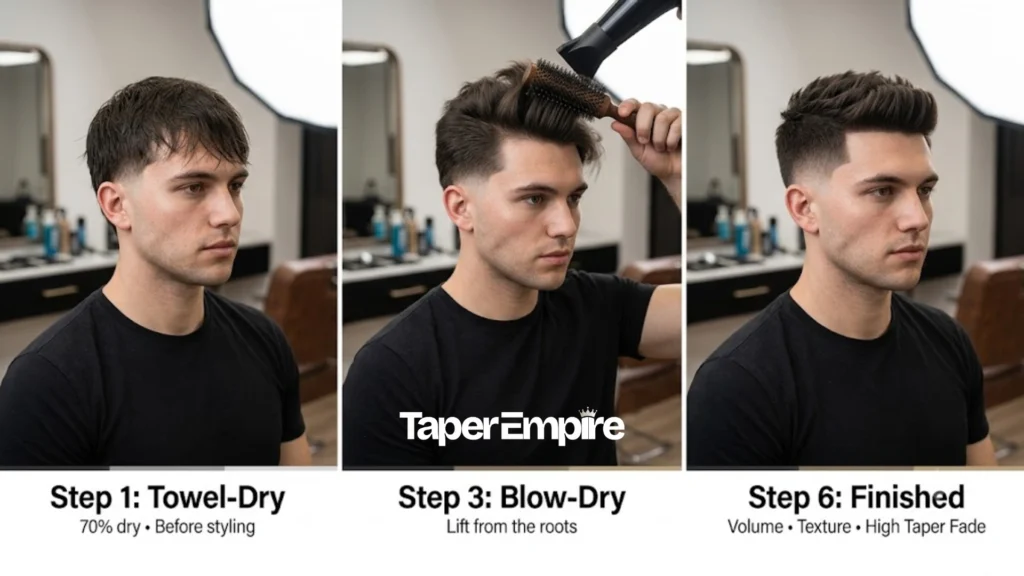
These steps produce consistent volume from morning through the day.
- Towel-dry to approximately 70% dry, not soaking, not fully dry.
- Apply a dime-sized amount of Texture Clay or lightweight mousse to the roots only, concentrating on the crown.
- Blow-dry upward and backward with a round brush, lift at the roots, and direct the air toward the back of the head.
- Press the cool-shot button for 10–15 seconds before releasing. This sets the volume before your fingers touch the hair.
- Apply a pea-sized amount of styling cream to the mid-lengths and ends only for control without weight.
- Finish with one or two light passes of a texturising spray if additional hold is needed at the top.
5 mistakes straight-haired men make with a high taper fade:
| Mistake | Why It Fails | Fix |
|---|---|---|
| Applying product to fully dry hair | Reduces absorption and creates uneven hold | Apply product when hair is about 70% dry |
| Using product at the ends, not the roots | Weighs down straight hair and flattens volume | Apply product at the roots for lift and the ends for control |
| Blow-drying downward | Flattens straight hair against the scalp | Always direct the airflow upward and backward |
| Heavy pomade on fine hair | Volume collapses within the first hour | Use a lightweight clay or mousse instead |
| Skipping the cool shot | Volume falls immediately after styling | Use the cool shot for 10–15 seconds before releasing |
Which High Taper Fade Styles Work Best on Straight Hair?
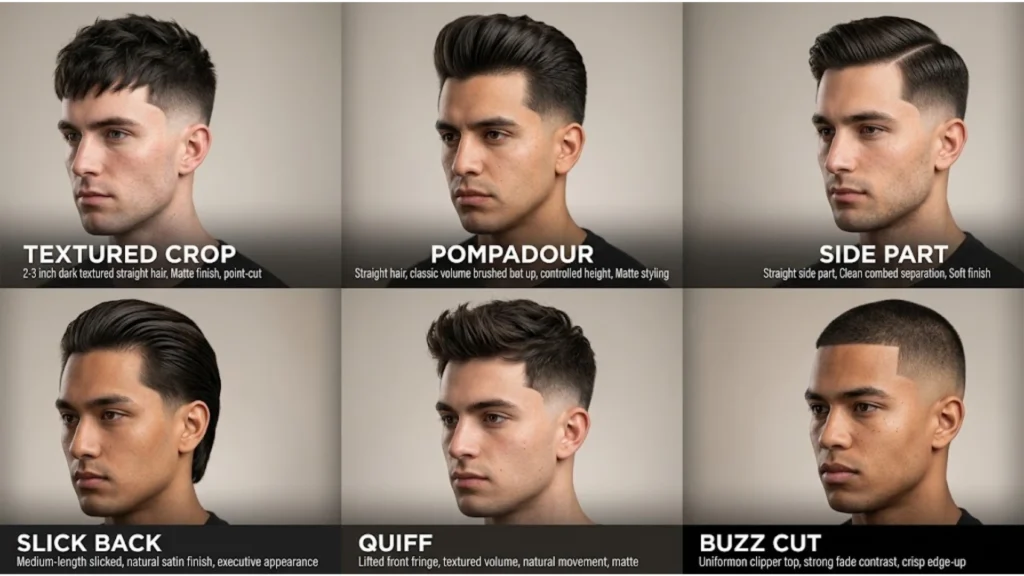
Straight hair’s defining quality is its smooth, uniform lie, making it well suited for structured styles that require clean lines and intentional volume. The top style you choose determines the overall character of the cut, from low-maintenance and professional to fashion-forward and expressive. Six styles consistently perform on straight hair at a high taper.
Textured Crop Best for Low-Maintenance Straight Hair
The textured crop keeps the top short, typically 1.5 to 2.5 inches with choppy, point-cut ends that create movement without requiring much daily effort. Matte clay applied to roots and tousled with fingers delivers a natural, dimensional finish in under five minutes. This style suits medium-density straight hair, oval and square face shapes, and anyone who wants a cut that transitions cleanly from casual to office settings.
Styling difficulty: Easy.
Pompadour Best for Volume Goals
The pompadour sweeps hair upward and backward from the front hairline, creating height that contrasts sharply with tight high taper sides. Medium-to-thick straight hair handles this best the density provides natural structure for volume. Apply mousse to damp hair, blow-dry upward and back with a round brush, then set with a strong-hold pomade for definition. The added height is especially flattering for round face shapes.
Styling difficulty: Moderate.
Side Part / Comb-Over Best for Professional Settings
The side part combs the longer top section to one side, creating a clean, polished, conservative division. It requires the least restyling throughout the day once set; it holds. Apply a light-to-medium pomade while the hair is damp, comb the part in the desired direction, and blow-dry along the same path. Any face shape accommodates this style, making it the most versatile option for workplace settings.
Styling difficulty: Easy.
Slick Back: Best for Thick Straight Hair
Thick or coarse straight hair has the density to hold a slick-back style without collapse. All hair is brushed toward the crown and secured with a strong-hold pomade or paste. The result is a sleek, streamlined profile that emphasizes the high taper’s contrast. This style does not work on fine straight hair the weight of a strong-hold product will flatten fine strands immediately. Oval and longer face shapes carry this style best.
Styling difficulty: Easy for thick hair.
Quiff: Best for Round Faces with Straight Hair
The quiff lifts the frontal section upward rather than sweeping it backward, creating height at the hairline rather than across the crown. This is the most effective style for round faces because the lift is concentrated at the front, where it has the greatest elongating effect. Apply volume mousse at the roots, blow-dry the front section with a round brush in an upward motion, then shape with a medium-hold clay.
Styling difficulty: Moderate.
Buzz Cut Top Best for Zero-Maintenance Straight Hair
A buzz cut top keeps the crown short, 0.5 to 1 inch of uniform length, requiring zero daily styling. The contrast between the clipped top and the high taper sides is structural, not product-dependent. This works on every straight hair density and every face shape. The only tradeoff is that the sides grow out faster with such a short top. The contrast differential is highest immediately after a cut and fades noticeably within 7–10 days.
Styling difficulty: None.
Style comparison at a glance:
| Style | Face Shape | Hair Density | Styling Time | Difficulty | Setting |
|---|---|---|---|---|---|
| Textured Crop | Oval, Square | Medium | 5 min | Easy | Casual + Office |
| Pompadour | Round, Oval | Medium–Thick | 15 min | Moderate | Casual + Smart Casual |
| Side Part | All | Medium | 8 min | Easy | Professional |
| Slick Back | Oval, Long | Thick | 5 min | Easy | Formal |
| Quiff | Round, Heart | Medium–Thick | 12 min | Moderate | Casual + Smart |
| Buzz Cut Top | All | All | 0 min | None | Active + Casual |
Which Face Shape Gets the Best Results from a High Taper Fade?
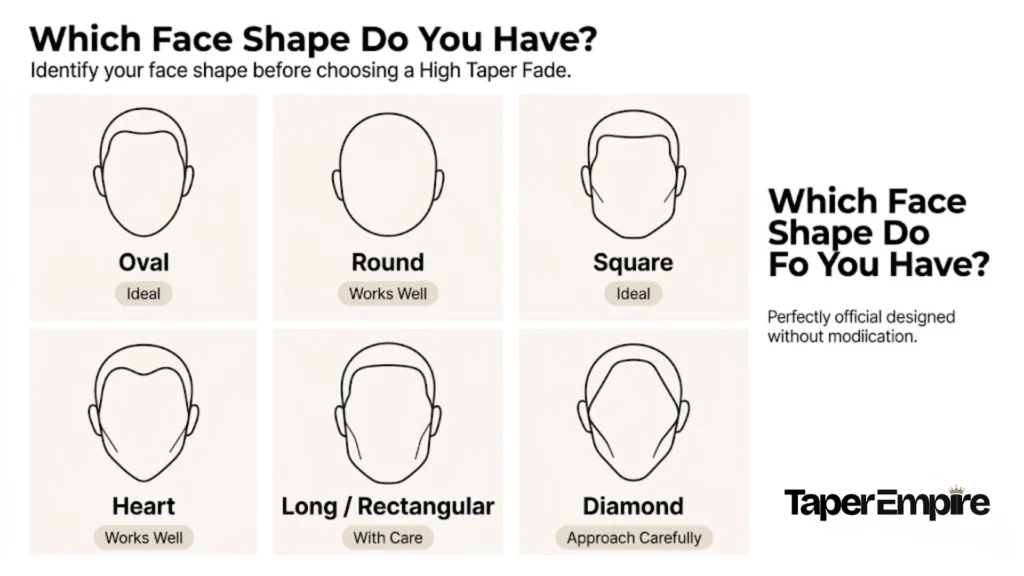
Face shape determines two things with a high-taper fade: whether the cut flatters the overall silhouette and how long the top should be to create balanced proportions. Both matter equally. A man with a round face who gets a high taper with a flat, short top defeats the purpose of the fade height.
Face shape guide with top length targets:
| Face Shape | High Taper Suitable? | Top Length | Why It Works / Caution |
|---|---|---|---|
| Oval | Yes, ideal | 2–4 inches | Balanced proportions; any top style works |
| Round | Yes, ideal | 3–4 inches | Creates vertical elongation; avoid flat tops |
| Square | Yes — works well | 2–3 inches | High taper sharpens the look; a soft blend reduces jaw harshness |
| Heart | Yes — with care | 2–3 inches | Keep top volume moderate; a side part or textured crop works best |
| Long / Rectangular | Approach carefully | 1.5–2 inches | A high taper with a tall top can elongate the face; a mid fade is often a better choice |
| Diamond | Yes | 2–3 inches | Well balanced; a textured crop or side part is recommended |
Round faces benefit the most from a high taper fade paired with straight hair. The vertical height of 3–4 inches on top compensates for the face’s width, and the natural directional lie of straight hair makes the upward styling movement easy to achieve and hold. The combination of high fade and lifted top works like a vertical frame it draws the eye up rather than across.
Long or rectangular face shapes require more consideration. A high taper fade adds visual height to the sides by removing the hair’s weight, and a tall pompadour or quiff on top amplifies that height further. For men with long faces, keeping the top at 1.5–2 inches and choosing a side part or a textured crop helps maintain balance. A mid-taper fade is often the more flattering option for this face shape because the sides retain slightly more mass, creating the horizontal width that longer faces benefit from.
How Often Does a High Taper Fade Need to Be Trimmed?
A high taper fade requires more frequent maintenance than any other fade height. The fade begins above the temples, which means more of the head is tapered, and more of that tapered area is visible during everyday interaction. As the hair grows, the blend point shifts downward, and the contrast diminishes noticeably faster than with a low or mid taper.
Maintenance cost comparison across fade heights:
| Fade Height | Trim Frequency | Cost per Visit (US Avg.) | Annual Visits | Annual Cost (Est.) |
|---|---|---|---|---|
| Low Taper | Every 3–4 weeks | $30–45 | 13–17 | $390–$765 |
| Mid Taper | Every 2–3 weeks | $35–50 | 17–26 | $595–$1,300 |
| High Taper | Every 1–2 weeks | $40–55 | 26–52 | $1,040–$2,860 |
The upper end of the high taper range assumes weekly visits with no at-home maintenance. Most men extend the cycle to 2–3 weeks by cleaning up the neckline and lower edge at home between appointments. That brings the realistic annual cost to $910–$1,300 for most people.
How to Extend Your High Taper Fade at Home
At-home maintenance is limited to one specific task: cleaning the neckline and lower sideburn edge. This is not the same as re-blending the fade, which requires barber skill and should never be attempted at home.
What you can do at home:
- Clean the neckline using a #0 or bare clipper guard along the natural hairline
- Tighten the lower sideburn edge using the same guard
- Use a single-blade trimmer for hairline definition if available
What to leave to your barber:
- The blend gradient between lengths requires clipper technique and multiple guard changes
- Any adjustment to the height of the fade starting point
- Point cutting or texturizing on the top
Clipper guard reference for high taper fades:
| Fade Zone | Guard Number | Approximate Length |
|---|---|---|
| Lowest Point (Skin or Near-Skin) | #0 or Bare | 0–0.5 mm |
| Lower Transition | #0.5–#1 | 1.5–3 mm |
| Mid Blend | #2–#3 | 6–10 mm |
| Upper Blend / Taper Start | #3–#4 | 10–13 mm |
| Top (Scissors, Left to Barber) | N/A | Varies |
Quick Tip
If you’re still weighing whether a high taper fits your lifestyle and maintenance budget, Taper Empire’s AI tool helps you match your face shape, hair type, and schedule to the right fade height before you book.
How Do You Ask Your Barber for a High Taper Fade on Straight Hair?
Clear barber communication eliminates the gap between what you picture and what you leave with. Most communication failures occur because the client describes the style in general terms (“I want a fade”) while the barber needs specific anatomical instructions (“start the blend here, take it to this length at the bottom”). The vocabulary below gives you everything you need.
Your complete consultation script:
“I’d like a high taper fade start the blend above the temples and take the sides down to a [#1 / skin] at the bottom. I have straight hair, so keep the transition gradual, no harsh lines. Leave [2–4 inches] on top for [textured crop/pompadour/side part]. Clean the neckline with a [straight razor / natural taper]. Can you recommend a product for volume at the roots?”
Fill in the brackets based on your preferences. Everything else in the script is standard, transferable language that any trained barber understands immediately.
Terminology decoder:
| Term | What It Means | Use It When |
|---|---|---|
| High Taper | The blend starts above the temples | Always establishes the fade height |
| Soft Blend / Gradual Transition | No visible harsh lines between lengths | Straight hair, light hair, and professional settings |
| Hard Part | A razor-cut line from the temple toward the crown | When you want added definition or a side-part style |
| Natural Neckline | Follows the existing hairline curve | For lower maintenance and cleaner grow-out |
| Straight Razor Neckline | Clean, sharp horizontal line | For a formal look with a defined edge |
| Leave [X] Inches on Top | Top-length instruction | Essential to specify during every haircut |
| Point Cut on Top | A texturizing scissors technique | To add movement and texture to straight hair |
Visual reference guidance: Save 2–3 images that show the style you want from front, side, and back angles. Show them to your barber before the cut begins, not halfway through. If the images conflict slightly, tell your barber which element takes priority: top length, contrast level, or neckline finish.
Barber communication for different fade heights follows the same framework the language adjusts with the fade’s starting point, not the underlying principles. A well-structured consultation yields more consistent results than any single photo reference.
High Taper vs. Mid Taper vs. Low Taper: Which Is Right for Your Straight Hair?
The three taper heights serve the same aesthetic goal, a clean, structured haircut with visible contrast, but each creates a different level of commitment, contrast, and suitability for straight hair types.
| Feature | Low Taper | Mid Taper | High Taper |
|---|---|---|---|
| The Blend Starts At | Neckline / just above the ear | Ear level | Above the temples |
| Contrast Level | Subtle | Moderate | Bold |
| Best for Straight Hair? | All densities; ideal for fine hair | All densities | Medium–thick hair; dark tones perform best |
| Maintenance Frequency | Every 3–4 weeks | Every 2–3 weeks | Every 1–2 weeks |
| Annual Cost (Est.) | $390–$765 | $595–$1,300 | $910–$2,600 |
| Light / Blonde Hair? | Best option | Good option | Possible with a soft blend strategy |
| Lifestyle Fit | Low-maintenance, professional | Balanced | Fashion-forward, high commitment |
No grow-out is required to move between taper heights. Switching from a high taper to a low taper is a single appointment change; the barber adjusts where the blend starts. Moving from a low taper to a high taper requires no additional length on the sides. The blend simply begins higher.
For a full comparison across all hair types and use cases, the dedicated breakdown of low, mid, and high tapers covers scenarios beyond straight hair in greater depth.
Which Straight Hair Type Works Best with a High Taper Fade?
Straight hair is not a single category. Hair color, density, and lifestyle interact to determine which approach to the high taper fade produces the best result and, in some cases, whether a high taper is the right choice at all.
Integrated decision matrix:
| Hair Color | Hair Density | Face Shape | Recommended Fade | Recommended Top Style | Primary Product |
|---|---|---|---|---|---|
| Dark | Medium–Thick | Round | High Taper | Pompadour or Quiff | Mousse + Pomade |
| Dark | Medium | Oval | High Taper | Textured Crop | Texture Clay |
| Dark | Fine | Any | High Taper (Soft Blend) | Textured Crop or Caesar | Lightweight Clay |
| Medium Brown | Medium | Square | High Taper | Side Part or Quiff | Medium-Hold Clay |
| Light Brown | Medium | Oval | High Taper (Soft Blend) | Textured Crop | Texture Clay |
| Blonde / Light | Medium | Round | Mid Taper or High Taper with Hard Part | Side Part | Light Pomade |
| Blonde / Light | Fine | Any | Mid Taper Recommended | Caesar or Buzz Cut | Mousse Only |
Quick Tip
Not sure which row describes your hair? Taper Empire’s AI tool walks you through your hair color, density, and face shape to match you with the right fade-and-style combination.
Edge case: Fine straight hair:
Fine straight hair with a high taper fade and light hair color is the most challenging combination to execute well. If you have all three characteristics, request a softer gradient with a #1 guard minimum at the bottom, keep the top at 2–3 inches maximum, and use only lightweight mousse. Avoid matte clay or paste; the weight collapses fine hair’s volume within an hour, eliminating the contrast the cut depends on.
Edge case: Scalp visibility risk:
A high taper taken to bare skin on fine, straight hair exposes the scalp on the sides, which can read as thinning rather than styled. Ask your barber to keep a #1 guard minimum at the shortest point. Scalp visibility risk increases with both fine density and light hair color; if you have both, a mid taper is the safer default. The difference between a skin fade and a taper fade matters most for this hair profile; understanding that distinction helps you specify exactly what to avoid.
Seasonal Styling Adaptations for a High Taper Fade on Straight Hair
Straight hair reacts more to environmental changes than most people expect. A product routine that performs perfectly in October may fail completely in July. The high taper fade’s reliance on product for contrast makes seasonal adjustments more consequential than with a less structured cut.
Summer — Humidity and Sweat
Humidity causes straight hair to lose hold by disrupting the product’s grip on individual strands. A mousse-only routine that works in dry months collapses in high humidity because moisture reactivates the mousse and releases the set shape.
Switch to a humidity-resistant styling cream or a beeswax-based pomade during summer months. Apply a light texturising spray as a second layer after the primary product to create a sealed hold layer. Avoid mousse alone in high-humidity conditions and on active days, carry a travel-sized styling product to restyle if sweat breaks down the morning application.
Winter — Static and Dryness
Static electricity affects fine and medium straight hair in winter, lifting individual strands unpredictably and disrupting the smooth top line the cut depends on. Apply 1–2 drops of lightweight argan oil to fingertips and smooth it lightly over styled hair, enough to neutralize static without adding visible weight or shine.
Scalp dryness increases in winter due to indoor heating. A moisturising shampoo used 2–3 times per week, along with a light scalp oil applied between washes, keeps the scalp healthy and reduces flaking. If you wear hats frequently, trim the top 0.5 inches shorter; in winter, hat compression distorts the styled shape less when the top is shorter.
Spring and Fall — Flexible Hold
Unpredictable weather across both transition seasons means a product that locks the hair rigidly will require restyling more often. A medium-hold matte clay, rather than a strong pomade, allows the style to be finger-restyled midday without washing. Keep a travel-size version in a bag or car for quick touch-ups between morning and evening.
Frequently Asked Questions
Does a high taper fade work on fine straight hair?
A high taper fade works on fine straight hair when the barber uses a soft gradient with a minimum #1 guard at the bottom. Avoid skin fades, which risk exposing the scalp on fine hair. Keep the top at 2–3 inches and use only lightweight mousse or clay. Heavy products quickly collapse fine, straight hair.
How often does a high taper fade need to be cut?
A high taper fade requires a trim every 1–2 weeks to maintain sharp contrast at the sides. The high starting point above the temples grows out faster and more visibly than a low or mid-taper. Most men extend visits to 2–3 weeks by cleaning up the neckline at home between barber appointments.
What products do I need to style a high taper fade with straight hair?
Straight hair needs a texture clay or lightweight mousse for root volume and a styling cream for end control. Apply both to towel-dried hair at approximately 70% dry. Blow-dry upward and backward for lift. Heavy pomades are only appropriate for thick straight hair; they flatten fine and medium densities within an hour.
Will a high taper fade look good on blonde or light-colored straight hair?
Light or blonde straight hair shows reduced contrast in a high taper fade because the color differential between the top and sides is smaller. A softer gradient prevents scalp exposure, a hard part adds structural definition, and textured top styling creates dimensional contrast. Alternatively, a mid taper produces a similar silhouette with more visible results on light hair.
How do I tell my barber what I want for a high taper fade?
Say: “High taper fade starting above the temples, gradual soft blend, leave [X] inches on top for [style], clean the neckline with a straight razor.” Bring reference photos showing front, side, and back angles. Specify that you have straight hair and want a soft transition rather than harsh lines.
Can I switch from a mid taper to a high taper without growing my hair out?
No grow-out is required. Switching from a mid taper to a high taper is a single appointment; the barber raises the blend starting point from ear level to above the temples. Moving from a high taper back to a mid or low taper is equally immediate. Neither direction requires waiting for additional length.
Key Takeaways
A high taper fade on straight hair delivers clean contrast, a structured silhouette, and strong versatility across styles when the execution is right. Medium-density, dark, straight hair yields the strongest result with the fewest adjustments. Light or fine hair requires a softer gradient, a hard part for definition, and lightweight products that build volume without weight.
The cut demands commitment: a 1–2 week trim cycle at a realistic US cost of $910–$1,300 per year. That commitment is manageable with at-home neckline maintenance and a barber consultation script that communicates exactly what you need.
Face shape determines top length. Products determine volume. Blade depth determines contrast. All three variables are within your control before you sit in the chair.
Quick Tip
Before your appointment, Taper Empire’s AI tool matches your hair profile color, density, and face shape to the right fade height and top style combination, so you walk in knowing exactly what to ask for.