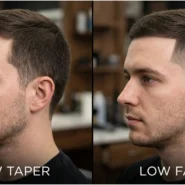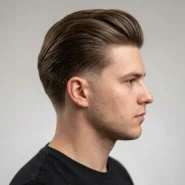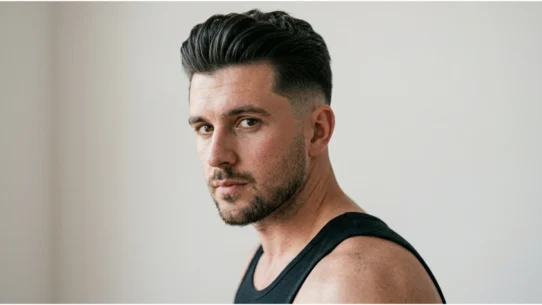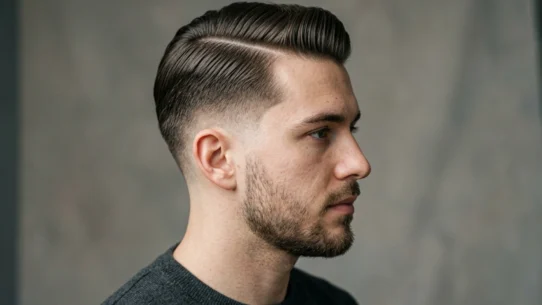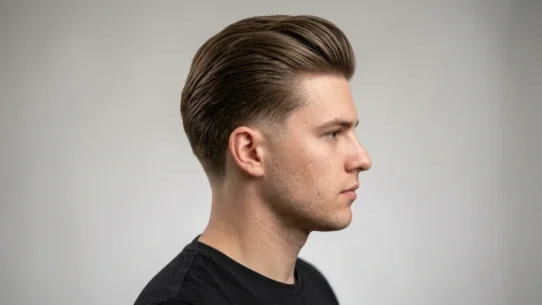

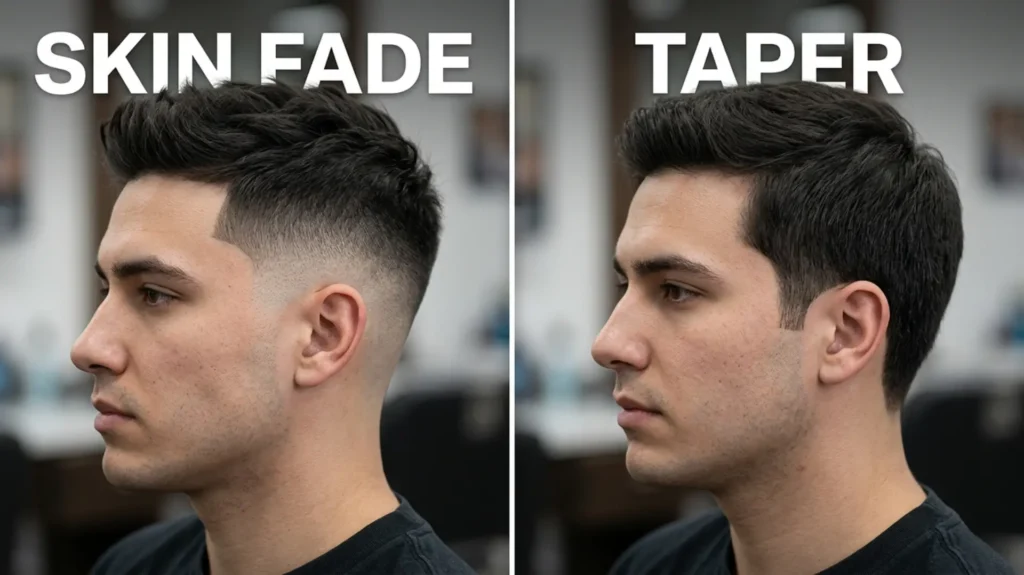
A skin fade blends hair down to bare skin around the entire head. A taper gradually shortens hair at the sideburns and neckline but never reaches the skin. A taper fade is not a standardized haircut; it’s a hybrid term born of decades of confusion in barbershop terminology.
Quick Difference:
- Skin Fade (Bald Fade): Hair blends to bare skin. Wraps the entire head. Uses a zero guard and a razor. Bold and modern. Maintenance every 2–3 weeks.
- Taper: Hair shortens gradually but stays visible. Only at the sideburns and the neckline. Uses scissors and longer guards. Classic and subtle. Maintenance every 4–6 weeks.
- Taper Fade: Not a defined cut. Barber’s interpretation varies. Usually means a softer fade or a blended taper.
This guide covers various styles, such as skin fades, tapers, and bald fades, as well as combinations like low and mid tapers. You’ll find clipper guard numbers, barber scripts, face-shape matching, hair-type tips, and maintenance timelines for total confidence at your next appointment.
What Is the Difference Between a Skin Fade, Taper, and Taper Fade?
A skin fade blends hair all the way to bare skin around your entire head using a zero guard or razor. A taper gradually shortens hair only at the sideburns and neckline while keeping hair visible at every point. A taper fade is a hybrid term with no fixed definition, but it typically means a softer fade that stops short of full skin exposure. Each cut differs in scope, contrast, and maintenance needs.
KEY POINTS:
– Skin fades go to bare skin, while tapers always keep hair visible
– Tapers last 4–6 weeks, but skin fades need touch-ups every 2–3 weeks
– Long or thin hair should be tapered to avoid exposing the scalp
– Always give your barber a height, guard number, and reference photo
Table of Contents
Three cuts, one right answer for your face shape and hair type.
Skin fades, tapers, and taper fades each work differently depending on your face structure and texture. The Taper Style Tool takes both into account and tells you which cut works best for you specifically.
What Is the Difference Between a Skin Fade and a Taper?
The difference is where the hair ends. A skin fade takes hair all the way to the bare scalp. A taper stops at visible hair length and never touches skin.
Quick Answer:
- Skin Fade: Blends to 0mm (bare skin) around the entire head. Uses clippers + razor. Bold and modern.
- Taper: Shortens to visible length at sideburns and neckline only. Uses scissors + longer guards. Classic and subtle.
But length is only part of the story. These two cuts differ in scope, tools, contrast, and where they appear on your head.
Skin Fade: The Technical Breakdown
A skin fade wraps around your entire head, sides, back, everything. The hair gradually disappears into your scalp, which is why it’s also called a bald fade. Barbers use clippers with progressively smaller guards (#3, #2, #1, #0.5, and finally a zero guard or straight razor) to create that seamless blend from hair to nothing.
Tools used: Clippers, zero guard, straight razor or electric foil shaver, lever adjustments
Result: Sharp, high-contrast, unmistakably modern
Taper: The Technical Breakdown
A taper only affects two specific areas: your sideburns and your neckline. It doesn’t go all the way around your head. The hair gradually gets shorter as it approaches those areas, but even at the very shortest point, you can still see hair. Barbers typically use scissors or longer clipper guards, such as #2 or #3.
Tools used: Scissors, comb, clipper guards #2–#4
Result: Soft, natural, classic what some barbers call the “gentleman’s cut.”
Side-by-Side Comparison
| Aspect | Skin Fade | Taper |
|---|---|---|
| Shortest Point | 0mm (bare skin) | 6mm (#2 guard) |
| Coverage | Entire head (360°) | Sideburns + neckline only |
| Visual Style | Bold, high-contrast, modern | Subtle, natural, classic |
| Primary Tool | Clippers + razor | Scissors + comb |
| Execution | Requires lever adjustments | Can be done scissors-only |
| Grows Out In | 2–3 weeks (loses sharpness) | 4–6 weeks (stays intentional) |
| Best For | Creative fields, bold looks | Corporate, formal settings |
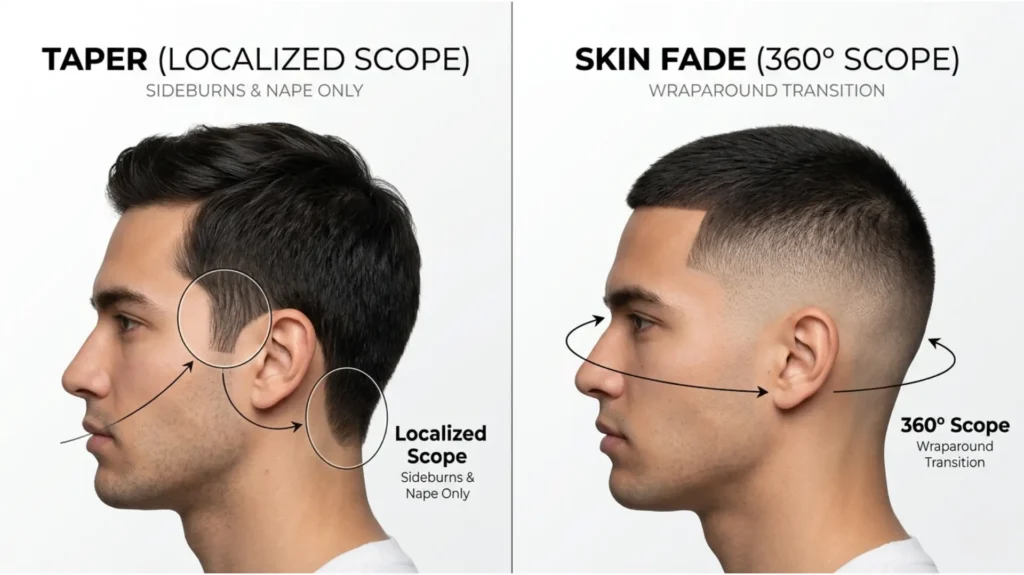
Charts are helpful for understanding the definitions, but knowing which column your face actually fits is another story. You can use TaperMatch to scan your facial geometry and get a definitive recommendation in under 60 seconds.
The Technical Difference Most People Miss
According to professional barber training standards, a taper can be executed with only scissors and a comb; electric clippers are not required. A skin fade requires clippers, blade lever adjustments, and usually a straight razor or electric foil shaver to finish the skin line.
That technical difference affects three things:
- Execution precision: Skin fades demand higher technical skill
- Time in the chair: Skin fades typically take 10–15 minutes longer
- Grow-out behavior: Tapers maintain shape longer because there’s no skin-to-hair contrast
Visual Impact: Bold vs Subtle
Skin fades are bold and high-contrast. They stand out. The dramatic transition from full hair to bare skin creates a sharp, modern edge that demands attention.
Tapers are subtle and understated. They blend into your overall look without announcing themselves. The gradual shortening is gentle enough that most people won’t even consciously notice the haircut; they’ll just think you look sharp.
Professional context matters: If you work in a corporate office, law firm, financial institution, or formal business environment, a taper is almost always the safer choice. If you’re in a creative field, tech, design, media, or or advertising, or just want something with more visual edge, a skin fade delivers that impact.
The Grow-Out Reality
Tapers: Grow out gracefully over four to six weeks. At week four, you still look intentional and put-together. At week six, you’re ready for a refresh but not desperate.
Skin fades: Start losing their sharpness within two weeks. By week three, that crisp fade-to-skin effect is gone. By week four, the fade has fully grown out, and the contrast has disappeared.
Pro Tip: If you hate frequent barber visits or travel often for work, a taper gives you far more flexibility. If you love that always-fresh look and don’t mind committing to biweekly cuts, a skin fade keeps you razor-sharp.
What Is a Taper Haircut?
A taper is a gradual reduction in hair length at the sideburns and neckline, always leaving visible hair at the shortest point. It never goes to the skin.
The biggest misconception about tapers is that they affect your whole head as a fade does. They don’t. A taper only happens in two localized zones: your sideburns and the base of your neckline. The rest of your sides stay longer, maintaining more hair volume and fullness than any other fade.
Barbers execute tapers using a technique called scissors-over-comb or clipper-over-comb with longer guards. The hair transitions smoothly from longer at the top to shorter at the edges, with a gentle, natural-looking, never-dramatic change. Professional barber training confirms that a true classic taper can be executed entirely with scissors, no electric clippers required.
The taper is often called the “gentleman’s cut” because it’s understated, polished, and appropriate for virtually any setting. It’s the kind of haircut that works in a boardroom on Monday and at a barbecue on Saturday without looking out of place in either context.
Types of Tapers: Low, Mid, and High
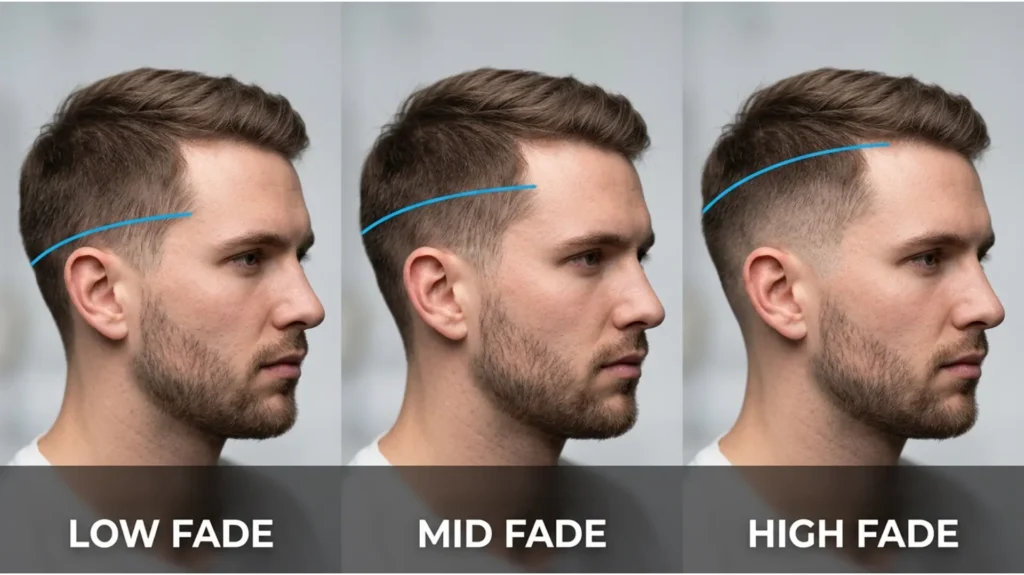
Where your taper starts on your head determines how subtle or noticeable the final look will be. There are three standard heights.
Low Taper
A low taper starts just above your ears, about half an inch to one inch above the top of the ear. It’s the most conservative taper variation, maintaining maximum hair length on the sides.
- Clipper guard range: #3 or #4 on sides, transitioning to #2 at sideburns and neckline
- Contrast level: Minimal
- Maintenance frequency: 5–6 weeks
- Best for: Corporate offices, legal firms, financial institutions, formal events
- Ideal face shapes: Heart-shaped (balances forehead width), oblong (retains side volume)
Mid Taper
A mid-taper starts around the temple area, right where the top of your ear meets. It’s balanced, not too bold, not too subtle, making it the most versatile everyday option.
- Clipper guard range: #3 on sides, transitioning to #2 at edges
- Contrast level: Moderate
- Maintenance frequency: 4–5 weeks
- Best for: Professional and casual environments equally
- Ideal face shapes: Works with virtually every face shape
High Taper
A high taper starts two to three inches above the ears, approaching the parietal ridge (the curved area on the upper side of your head). It creates more dramatic contrast while still tapering.
- Clipper guard range: #2 or #3 at transition, #1 or #2 at neckline
- Contrast level: High for a taper (still lower than any fade)
- Maintenance frequency: 3–4 weeks
- Best for: Side parts, comb-overs, modern offices, creative workplaces
Pro tip: If you’re unsure which taper height to choose, start with a mid taper. It’s the most forgiving and easiest to adjust on your next visit. Your barber can take it higher or keep it the same based on what you think.
Who Should Get a Taper?
Tapers work across a wide range of situations, but they shine brightest in specific scenarios.
Face shapes: Oblong and long faces benefit most, as tapers retain side width without further elongating the face. Heart-shaped faces benefit from the maintained volume that balances a wider forehead. Oval faces work with everything, tapers included.
Hair types: Straight and wavy hair get a clean, natural finish with tapers. Fine and thinning hair types benefit the most because tapers preserve density and don’t expose the scalp the way skin fades do.
Lifestyle fit: Tapers are ideal for corporate professionals, men in formal settings, frequent travelers, and anyone who prefers low-maintenance grooming. You can go four to six weeks between cuts, sometimes longer, and still look sharp.
Celebrity reference: David Beckham, Ryan Gosling, Chris Hemsworth, and Chris Evans have all worn classic tapers in professional and public contexts throughout their careers.
What Is a Skin Fade Haircut?
A skin fade is a haircut where hair blends all the way down to bare skin around the entire perimeter of your head, sides, back, everything.
That’s the defining characteristic. The fade wraps 360 degrees around your head, and at the base, there’s no hair. Just skin. The hair literally disappears into your scalp, which is why it’s also called a bald fade. The two terms are completely interchangeable.
The execution is technical and requires real skill. Barbers start with a longer guard, like a #3 or #4, to establish the top blend line. Then they work down with progressively shorter guards #2, then #1, then #0.5, and finally a zero guard or straight razor right at the skin line. Between guard changes, barbers use something called lever adjustment, which slightly opens the clipper blade lever by millimeters to create in-between lengths. That’s what makes the blend look smooth and “blurry” instead of choppy with visible lines.
Types of Skin Fades: Low, Mid, High, Drop, and Burst
The height at which your fade starts dramatically changes the final look. There are five main variations.
Low Skin Fade
Starts just above the ear. Most conservative fade option. Sometimes called the “gateway fade” because it’s where guys usually start when transitioning from tapers.
- Skin exposure zone: Lower third of sides and back
- Guard progression: #3 → #2 → #1 → #0.5 → #0
- Contrast level: Moderate
- Maintenance frequency: 3–4 weeks
- Professional appropriateness: Acceptable in most corporate settings
Mid Skin Fade
Starts at the temple level. The most requested fade variation in American barbershops. Balanced boldness, enough contrast to look sharp, not so much that it screams for attention.
- Skin exposure zone: Lower half of sides and back
- Guard progression: #3 or #4 → #2 → #1 → #0.5 → #0
- Contrast level: High
- Maintenance frequency: 2–3 weeks
- Professional appropriateness: Creative industries, tech, modern offices
High Skin Fade
Starts near the crown or parietal ridge two to three inches above the ears. Maximum contrast. Maximum boldness.
- Skin exposure zone: Majority of sides and back
- Guard progression: #4 → #3 → #2 → #1 → #0.5 → #0
- Contrast level: Maximum
- Maintenance frequency: Every 2 weeks or less
- Professional appropriateness: Casual and creative settings only
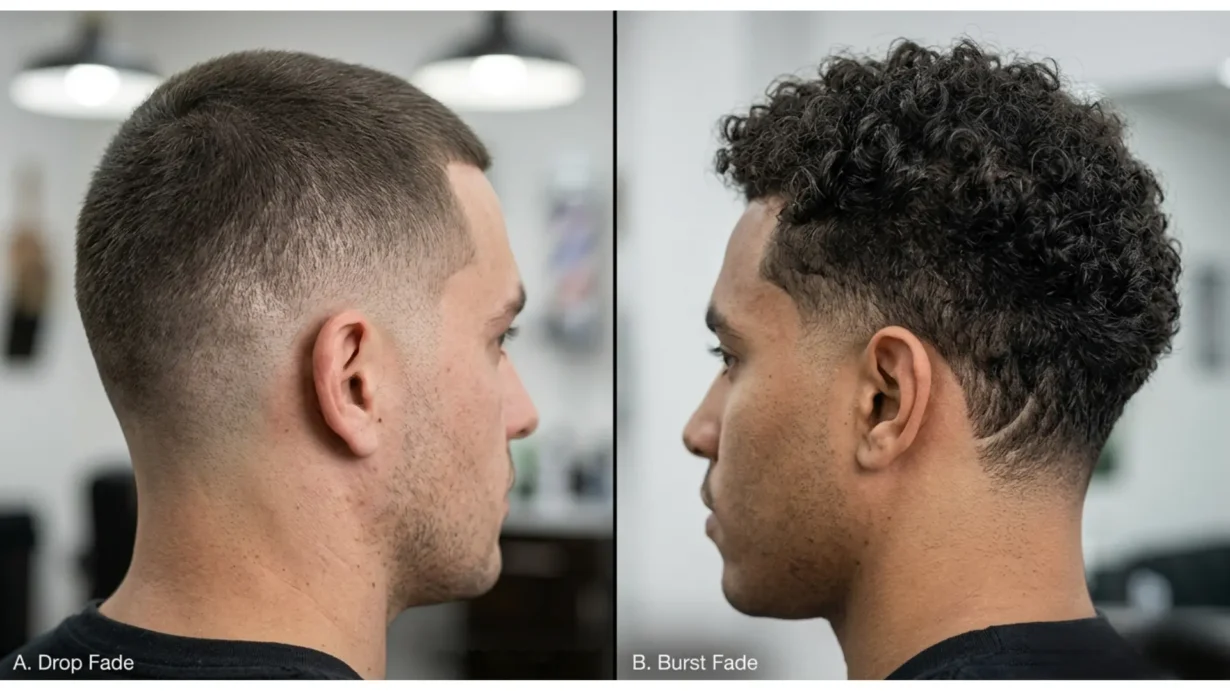
Drop Fade
The fade curves downward behind the ear instead of going straight across. It follows the natural contour of your head, creating a more dimensional, custom silhouette. Drop fades require advanced clipper control and work especially well with wavy and curly hair.
Burst Fade
Creates a semi-circle arc around the ear. Stops at the side of the neck instead of continuing along the nape. Preserves natural texture on top. Hugely popular in Black barbershops, with curly and coily hair types, and with modern mullet and mohawk styles.
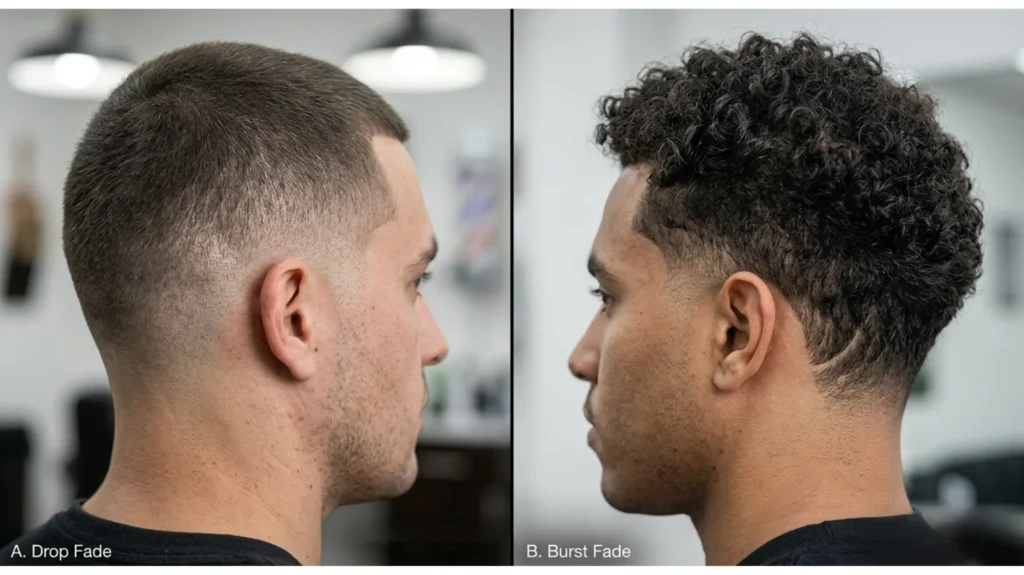
Pro tip: If you have thick or curly hair, ask for a mid skin fade with a drop. It manages bulk while enhancing your natural texture, one of the most flattering combinations in modern barbering.
Who Should Get a Skin Fade?
Face shapes: Round faces benefit most from mid- and high-skin fades, which add vertical height and elongate the face. Square faces get added definition and sharpness. Oval faces work well, too. Avoid skin fades if you have an oblong or long face; they’ll elongate it further.
Hair types: Thick, coarse, curly, and coily hair look incredible with skin fades. The contrast between bare sides and a textured top is visually striking. Fine or thin hair should avoid skin fades, as they expose the scalp and highlight thinning areas.
Lifestyle fit: Skin fades work best for creative professionals, athletes, casual workplaces, and men who want a bold, modern look. They stay sharp even with sweat, require minimal daily styling, and always look intentional.
Celebrity references: Zayn Malik, John Boyega, Ryan Reynolds, Michael B. Jordan, and Brad Pitt all wear skin-fade variations as part of their signature looks.
What Is a Taper Fade?
A taper fade is not a universally defined haircut. The term exists because barbers and clients confused tapers and fades for years, and “taper fade” became a catch-all phrase that means different things to different people.
Technically, all fades are tapers (they involve a gradual reduction in length). But not all tapers are fades (tapers don’t go to skin). The hybrid term “taper fade” blurs that line.
When you ask a barber for a “taper fade,” you’ll get one of three responses. Most commonly, they’ll give you a classic taper with a clean neckline. Sometimes they’ll interpret it as a mid fade that stops at a #1 guard instead of going to skin a softer fade with more length at the base. And sometimes, a professional barber will simply ask, “Do you mean a taper or a fade? How short do you want me to go?”
That third response is actually the best one. It means the barber cares about precision and wants to give you exactly what you want, rather than guessing.
The confusion is historical. In the 1990s and 2000s, “taper” and “fade” were used interchangeably in barbershops across America, especially in areas where technical training wasn’t standardized. Over time, the hybrid phrase stuck.
The solution is simple: don’t rely on the label “taper fade.” Instead, tell your barber three things:
- Height: Low, mid, or high
- Minimum length: To skin, to a #1 guard, or to a #2 guard
- Coverage: All around your head or just at the sideburns and neckline
When you communicate those three details, interpretation variance disappears.
Is a Bald Fade the Same as a Skin Fade?
Yes. Bald fade and skin fade are the same haircut, just called by different names. The terms are 100% interchangeable.
The name “bald fade” comes from the hair fading down to a “bald” (bare skin) finish. Some barbershops and regions prefer one term over the other, but the execution, tools, and result are exactly the same.
Regional usage tends to break down like this:
- “Bald fade” — More common in East Coast and Southern U.S. barbershops
- “Skin fade” — More common on the West Coast and in the Midwest
- “Zero fade” — References the zero guard used at the base
- “Razor fade” — References the straight razor finish at the skin line
All four names describe the same haircut. If you ask for any of them, you’ll get the same result.
Practical tip: Use whichever term your barber uses. If they say “bald fade,” say “bald fade.” If they say “skin fade,” match their language. It builds rapport and shows you speak their terminology.
What Is the Difference Between a Skin Taper and a Skin Fade?
A skin taper goes to bare skin only at the sideburns and neckline. A skin fade goes to bare skin all the way around your head. The difference is scope.
Think of a skin taper as a regular taper with sharper edges. At your sideburns and the very base of your neckline, the barber uses a zero guard or straight razor and takes it to bare skin. But the rest of your sides stay at a #1 or #2 guard; you still have visible hair on most of your sides.
A skin-fade wrap that leaves a bare-skin finish around your entire head. Everywhere the fade touches sides, back, and all of it blends down to zero. The skin exposure is comprehensive, not localized.
| Element | Skin Taper | Skin Fade |
|---|---|---|
| Skin Exposure | Sideburns + neckline only | Entire head perimeter |
| Side Hair Length | #1 or #2 guard visible | Blends to zero |
| Visual Boldness | Medium | High |
| Face Elongation Effect | Minimal | Significant |
| Maintenance | 3–4 weeks | 2–3 weeks |
Some barbers also call a skin taper a “bald taper” or “skin-close taper.” All three terms mean the same thing.
A skin taper is the perfect middle ground for men who want sharper neckline and jawline definition than a regular taper but don’t want the full boldness and maintenance commitment of a skin fade. It works especially well for oblong and long faces because it retains the side width rather than further elongating the face.
What Is a Bald Taper?
A bald taper is a taper that leaves only the sideburns and neckline bare. It’s a synonym for skin taper, same haircut, different name.
Just like bald fade and skin fade, the terminology varies by region and barbershop culture:
- “Bald taper” — Common in Southern U.S. barbershops
- “Skin taper” — Common on the West Coast
- “Skin-close taper” — Used in professional barber training materials
The key characteristic is localized skin exposure. Your sideburn edges and neckline base go to bare skin via zero guard or straight razor. Your sides stay at a #1 or #2 guard, keeping your hair visible and full.
This cut works especially well for two groups: men transitioning from a classic taper who want something more modern without jumping to a full skin fade, and men with long or oblong face shapes who need to retain side width to avoid further elongation.
How to request it: “I want a taper that goes to skin at my sideburns and neckline, only not all the way around. Keep the #2 guard length on my sides.”
What Are Skin Fade Low Taper and Skin Fade Mid Taper?
These are combination terms that describe where a skin fade starts (low or mid) and confirm that it goes to bare skin. They’re not separate haircuts; they’re specific configurations of skin fades.
When someone says “skin fade low taper,” they mean a fade that starts low on the head, just above the ears, and blends all the way to the skin. Technically, that’s a low skin fade. The “taper” in the phrase signals that the client wants a smooth, gradual blend rather than an abrupt transition.
“Skin fade mid taper” means a fade that starts at temple level and tapers to skin level. That’s a mid skin fade. Again, the “taper” part emphasizes blend quality and smoothness.
Professional barbers understand these combination phrases and execute them correctly. The terminology exists because clients naturally combine “taper” and “fade” words to communicate three things at once: fade height, blend quality, and final length.
How to ask for a skin fade low taper: “I want a low skin fade. Start just above my ears and blend it smoothly to skin. Keep the transition gradual and clean.”
How to ask for a skin fade mid-taper: “I want a mid skin fade starting at my temples. Take it all the way to skin with a tight, clean blend.”
A skin fade low taper is the more conservative of the two; it has subtle skin exposure, retains more side length, and works in most professional settings. A skin fade mid-taper is bolder and more versatile, with balanced contrast that works for virtually every face shape and hair type.
The mid version is particularly stunning on curly and coily hair, where the contrast between clean sides and textured top creates maximum visual impact.
Skin Fade vs Taper vs Taper Fade: Complete Comparison
| Feature | Taper | Skin Fade | Taper Fade | Skin Taper |
|---|---|---|---|---|
| Goes to Skin? | No | Yes (full perimeter) | No (usually) | Yes (localized) |
| Coverage Area | Sideburns + neckline | Entire sides and back | Varies | Sideburns + neckline |
| Shortest Length | #2 guard (6mm) | 0mm (bare skin) | #1 guard (3mm) typical | 0mm at edges, #1/#2 sides |
| Primary Tool | Scissors + guards | Clippers + razor | Clippers | Clippers + razor |
| Visual Contrast | Low | High | Medium | Medium-high |
| Maintenance Cycle | 4–6 weeks | 2–3 weeks | 3–4 weeks | 3–4 weeks |
| Annual Visits | 8–12 | 18–26 | 12–17 | 12–17 |
| Best Setting | Corporate, formal | Creative, casual | Versatile | Semi-formal |
| Ideal Face Shapes | Oblong, heart, oval | Round, square, oval | All | Long, oblong, oval |
| Style Vibe | Classic, timeless | Modern, bold | Balanced | Sharp but conservative |
How Do You Choose Between a Taper and Skin Fade?
Your face shape, hair type, and professional setting determine which cut works best. Start with those three factors, and the decision becomes straightforward.
Choose Based on Your Face Shape
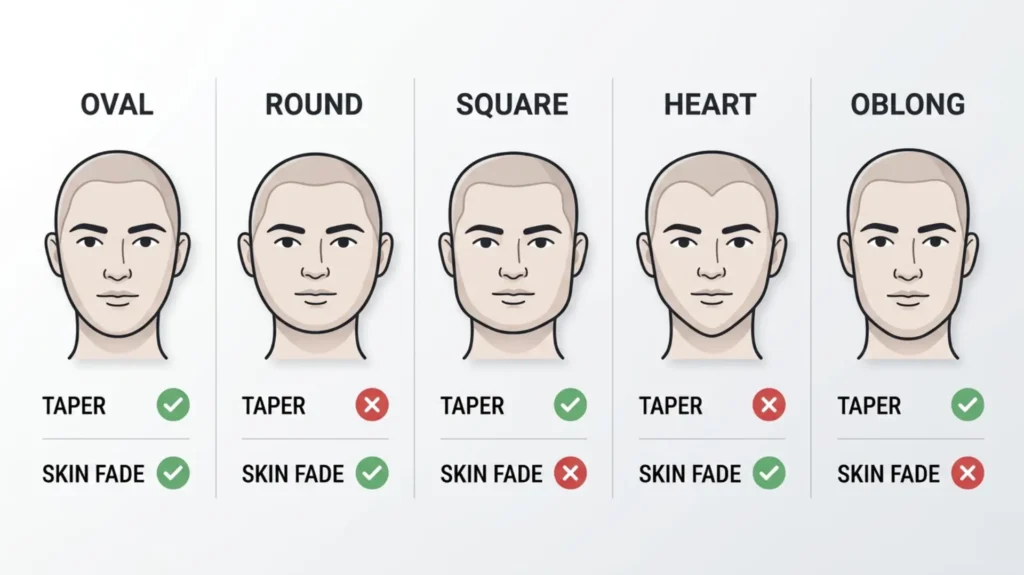
Oval face: Both tapers and skin fades work because your proportions are balanced. Go for a classic, understated look or a mid- or high-skin fade for a modern, bold look. You can’t really go wrong.
Round face: You need vertical height. A high skin fade, or mid skin fade, elongates your face and adds angular definition. Avoid low tapers; they add width to the sides, which makes your face look rounder.
Square face: Either direction works depending on your goal. A taper fade or low skin fade, softens your strong jawline. A high skin fade sharpens it even more.
Heart-shaped face: You need to balance your wider forehead with your narrower chin. A low or mid taper keeps volume on the sides and creates that balance. Avoid high fades—they draw attention upward and emphasize forehead width.
Oblong/long face: Stick with tapers, skin tapers, or bald tapers. They maintain side width and don’t further elongate your face. High skin fades are the worst choice for long faces.
If you aren’t 100% sure about your face shape or hair density, let the platform’s biometric scan handle the measurement for you. It scores your structural geometry to ensure your next cut balances your features perfectly.
Choose Based on Your Hair Type
Straight hair works with both. Tapers give you a natural finish; skin fades give you precise lines. Personal preference call.
Wavy hair also works with both. A mid-taper fade or skin-fade low taper enhances your natural wave movement while keeping sides clean.
Curly hair looks incredible with skin fades. The contrast between clean sides and curly top is visually striking. Ask for a drop fade or burst fade to preserve your curl pattern. Make sure your barber uses a shear-over-comb technique at the transition point.
Coily and afro hair pairs best with skin fades, especially temple fades and burst fades. They preserve your natural volume while creating clean definition. Add a lineup (edge-up) for maximum sharpness.
Thick hair benefits from skin fades because they remove bulk and create a structured profile. Mid- or high-skin fades keep the cut from looking heavy.
Fine or thin hair needs tapers. Tapers preserve density, maintain coverage, and don’t expose your scalp. Low- or mid-tapers with #2 or #3 guards are ideal.
Choose Based on Lifestyle and Setting
Corporate/formal environments (finance, law, consulting, government): Classic taper, low taper, or low taper fade. High skin fades are too bold.
Creative/casual workplaces (tech, design, media, startups): Mid skin fade, high skin fade, drop fade, burst fade. Personal expression is valued.
Athletic/active lifestyle: Skin fades in any height. Low maintenance, stays sharp through sweat, minimal styling needed.
Budget-conscious: Classic taper. Four to six weeks between cuts means 8–12 visits per year. At $40/cut, that’s $320–$480 annually versus $720–$1,040 for skin fade maintenance.
How Do You Ask a Barber for a Taper or Skin Fade?
Give your barber three pieces of information: height, minimum length, and edge finish. Those three details eliminate virtually all miscommunication.
The Three-Part Formula
Part 1 — Height (where the blend starts):
- “Low” = just above ears
- “Mid” = temple level
- “High” = 2–3 inches above ears, near crown
Part 2 — Minimum length (how short at the base):
- “Take it to skin” = skin fade / bald fade (0mm)
- “Keep it at #1” = taper fade (3mm minimum)
- “Use #2 at the shortest point” = classic taper (6mm minimum)
Part 3 — Edge finish (sideburns and neckline treatment):
- “Clean neckline, take sideburns to skin” = skin taper / bald taper
- “Natural neckline, keep some length” = classic taper
- “Squared neckline with a lineup” = sharp, modern edges
Ready-to-Use Barber Scripts
Classic taper: “I want a classic taper with a mid starting point. Keep it natural at the neckline and sideburns. Use #2 at the shortest point. No skin.”
Low skin fade: “I want a low skin fade. Start just above my ears and take it to the skin. Clean neckline and sideburns.”
Mid skin fade: “I want a mid skin fade starting at my temples. Blend it to bare skin. Keep the transition smooth.”
High skin fade: “I want a high skin fade starting near the crown. Take it to skin. Add a lineup for sharp edges.”
Skin fade low taper: “I want a low fade that goes to skin. Keep some length on the sides. Give me a clean neckline.”
Taper fade: “I want a mid taper fade starting at my temples. Don’t take it to skin. Use #1 at the shortest point.”
Skin taper: “I want a taper that goes to skin only at my sideburns and neckline. Keep #2 length on my sides.”
Instead of memorizing scripts, you can simply generate a custom Barber-Ready Brief. It includes the exact technical specs, guard numbers, and blend points to show your barber directly from your phone.
If your barber asks follow-up questions after these scripts, that’s actually a great sign. It means they care about precision.
Always Bring Reference Photos
Even the clearest verbal description gets interpreted differently by different barbers. Bring two to three photos showing the exact look from front, side, and back angles. Show your barber and say, “This is what I’m going for. What do you think?”
Visual communication eliminates about 90% of miscommunication. It’s the single most effective thing you can do to get the haircut you actually want.
What Do Clipper Guard Numbers Mean?
Each clipper guard number corresponds to a specific hair length in millimeters and inches. Knowing these numbers lets you speak your barber’s technical language.
| Guard | Length (mm) | Length (inches) | Common Use |
|---|---|---|---|
| #0 | 1.5mm | 1/16″ | Skin fade base; closest without shaving |
| #0.5 | 2mm | ~1/16″–1/8″ | Transitional in skin fade blending |
| #1 | 3mm | 1/8″ | Low fade baseline; taper fade minimum |
| #1.5 | 5mm | 3/16″ | Mid-taper transition |
| #2 | 6mm | 1/4″ | Classic taper minimum; low fade mid-zone |
| #3 | 10mm | 3/8″ | Taper and taper fade mid-zone |
| #4 | 13mm | 1/2″ | Upper sides in tapers; buzz cut length |
When your barber says, “I’m starting with #3 and blending down to #1,” they’re creating a taper fade with visible length at the base. When they say “I’m taking this to zero and using a razor,” that’s a full skin fade to bare scalp.
Here’s how to apply this knowledge in the chair:
- For a classic taper: “Use #2 or #3 at the shortest point. Don’t go below that.”
- For a skin fade: “Take it to zero and finish with a razor at the skin line.”
- For a taper fade: “Blend it down to #1. No skin.”
This kind of specificity shows your barber you understand what you’re requesting, and it dramatically increases your chances of getting exactly the right result.
How Often Do You Need Haircut Maintenance?
Skin fades need to be cut every two to three weeks. Tapers last four to six weeks. That frequency gap affects your annual cost, time, and flexibility between appointments.
Skin Fade Maintenance
For mid- and high-skin fades, you’re looking at barber visits every two to three weeks. Low skin fades can stretch to three to four weeks. The reason is simple: skin fades lose their sharp contrast fast. Hair regrowth at the skin line creates visible stubble, and the “fade to nothing” effect disappears quickly.
Here’s the week-by-week reality:
- Week 1: Fresh, sharp, maximum contrast
- Week 2: Still sharp but softening at skin line
- Week 3: Noticeably grown out, contrast gone, fade effect fading
- Week 4+: Fully grown out and shapeless
That translates to 18–26 barbershop visits per year. At $40 per cut, you’re spending $720–$1,040 annually. At $60 per cut in a premium shop, that’s $1,080–$1,560. It’s a real time-and-money commitment.
Between visits, a handheld trimmer can clean up neckline edges and buy you a few extra days. But full fade blending can’t be done effectively at home; it requires professional clipper-over-comb skills and lever adjustments.
Taper Maintenance
Tapers last four to six weeks between cuts, and some guys push it to eight weeks without issues. They grow out naturally because there’s no dramatic skin-to-hair contrast to maintain.
Here’s the timeline:
- Weeks 1–3: Fresh and sharp
- Week 4: Still presentable, slight length increase
- Weeks 5–6: Ready for refresh, still acceptable
- Weeks 7–8: Noticeably long, time for a cut
That means 8–12 barbershop visits per year. At $40 per cut, you’re spending $320–$480 annually. Tapers cost 40–60% less than skin fades in total annual grooming expenses.
A well-executed taper at three weeks looks like a man who’s almost due for a cut. A skin fade at three weeks looks like a man who forgot to book two weeks ago. That grow-out difference is one of the biggest practical factors in choosing between the two.
What Products and Aftercare Do Fades and Tapers Need?
Your barber handles the sides and back. Products and aftercare focus on maintaining top-tier style and protecting exposed skin.
Styling Products for the Top
The right product depends entirely on the hairstyle you’re wearing on top:
- Pompadours, quiffs, slick backs: Use pomade (medium-high hold, slight shine). Apply to damp hair. Comb into place.
- Textured crops, French crops, casual styles: Use matte clay or texture clay (strong hold, no shine). Work through dry or slightly damp hair with fingers.
- Natural wave enhancement: Use sea salt spray (light hold, volume boost). Scrunch into damp hair, then air-dry.
- Side parts, daily wear: Use styling cream (light-medium hold, natural finish). Distribute evenly through damp hair.
- Maximum texture and separation: Use molding paste or pliable clay (strong flexible hold, matte finish). Apply to dry hair.
- Fine hair needing volume: Use volumizing dust or styling dust (lift without weight). Apply to dry roots and massage in.
Application rule: Start small; you can always add more. Too much product makes hair look greasy or stiff. Best timing is damp hair, not soaking wet, not fully dry.
Scalp Care After Skin Fades
Skin fades expose your scalp to sun, wind, and cold. Bare skin needs protection that most guys skip entirely.
- UV Protection: Apply scalp SPF spray or UV-protectant before sun exposure. Exposed scalp burns fast and painfully.
- Moisturization: Use tea tree conditioner or scalp moisturizer after washing. Prevents dryness, flaking, and irritation.
- Physical protection: Wear a cap or beanie in extreme heat or cold.
- Sensitive skin: If you notice redness after razor work, ask your barber to apply pre-shave oil next time. It reduces friction significantly.
What Hairstyles Pair Best with Tapers and Skin Fades?
Certain top styles are designed for tapers. Others come alive with skin fades.
Best Hairstyles for Tapers
- Side part: Classic pairing. Refined, professional, timeless.
- Comb over: Traditional elegance. Perfect for formal settings.
- Ivy League: Preppy, clean-cut, polished. Corporate-appropriate.
- Slick back: Old-school cool with modern appeal. Needs pomade.
- Textured crop with low taper: Balanced casual style. Modern without being bold.
Best Hairstyles for Skin Fades
- Pompadour: Maximum contrast. Bold and dramatic.
- Quiff: Modern elegance with volume. Works with mid or high fades.
- Faux hawk: Subtle height and edge without full mohawk commitment.
- Buzz cut: Ultra-low-maintenance. Clean and minimal.
- Textured fringe: Relaxed and youthful. Pairs with mid fades.
- Afro with temple fade or burst fade: Preserves volume, adds definition.
- Modern mullet with burst fade: Trending in 2024–2025.
- Waves with low skin fade and a sharp, clean, culturally iconic lineup.
Frequently Asked Questions
Which is more professional, a skin fade or a taper?
A classic taper is the most universally professional option, suitable for corporate, legal, and formal settings. Low skin fades work in modern offices and creative industries. High skin fades are generally too bold for traditional corporate environments.
Does a skin fade work on every face shape?
No. Skin fades work best on round, square, and oval faces. If you have an oblong or long face, avoid skin fades; they’ll elongate your face further. Tapers or skin tapers are better choices for longer faces.
Can you get a fade with curly hair?
Absolutely. Skin fades look stunning on curly hair because of the contrast between clean sides and a textured top. Ask for a drop fade or burst fade to preserve your curl pattern, and request the shear-over-comb technique at the transition.
How much does annual fade maintenance cost vs. taper maintenance?
Skin fades cost $720–$1,040 annually (18–26 visits at $40/cut). Tapers cost $320–$480 annually (8–12 visits at $40/cut). Tapers save 40–60% in annual grooming costs.
What’s the difference between a drop fade and a regular fade?
A drop fade curves downward behind the ear, following your head’s natural contour. A regular fade goes straight across at a consistent horizontal line. Drop fades create a more dimensional, custom silhouette.
Should you start with a taper or fade for your first short haircut?
Start with a taper. It’s more forgiving, grows out gracefully, and lets you see how your hair responds. Going from taper to fade is instant. Going from fade back to taper requires four to six weeks of growth.
Can you maintain a fade at home?
Neckline edges can be cleaned with a handheld trimmer. Full fade blending cannot be done effectively at home; it requires professional clipper-over-comb skills and lever adjustments. DIY attempts usually create visible lines and uneven results.
What’s the difference between taper fade and mid fade?
A mid fade is clearly defined, starting at the temple level and blending to a specified length. “Taper fade” is ambiguous and varies by barber’s interpretation. For consistent results, ask for “mid fade” and specify how short.
Do skin fades work with thin or thinning hair?
No. Skin fades, exposing the scalp and highlighting areas of thinning. If you have fine or thinning hair, tapers are far better; they preserve density and maintain coverage where you need it most.
How long does a skin fade stay looking fresh?
High fades stay sharp for about two weeks. Mid fades last two to three weeks. Low fades can stretch three to four weeks. After those windows, the contrast fades and the sharp appearance is gone.