

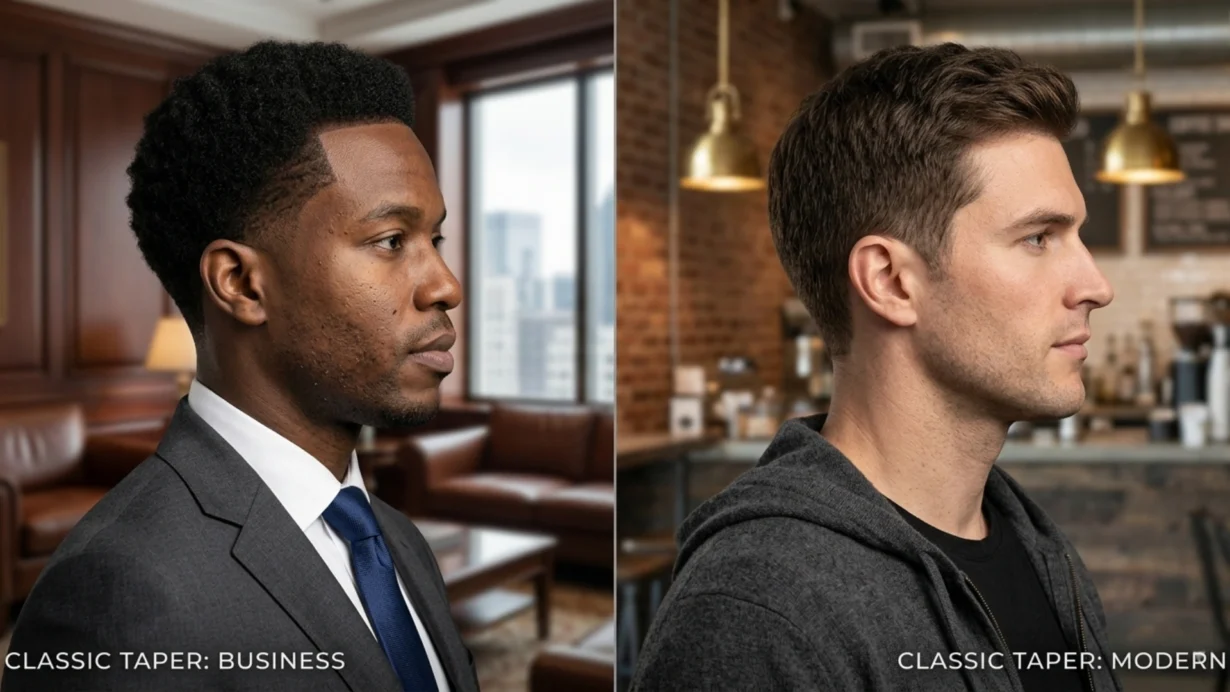

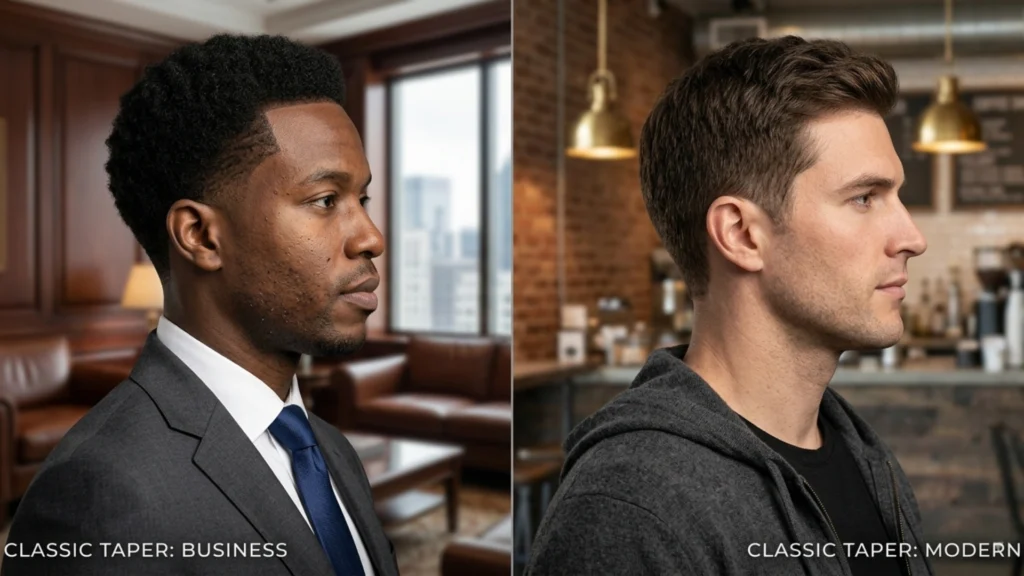
The classic taper haircut has been the foundation of men’s grooming for over 80 years. While trends come and go, fade, undercut, hard parts, and designs change, the classic taper remains the most requested haircut in American barbershops.
Why? Because it works everywhere: the boardroom, the classroom, the courtroom, and every formal event in between. It grows out gracefully, requires minimal daily styling, and suits men from age 15 to 75.
This guide covers everything: what a classic taper is, how to ask your barber for one, the difference between a taper and a fade, 60+ style variations, face shape recommendations, maintenance schedules, and expert styling tips. Whether you’re getting your first taper or your hundredth, you’ll find exactly what you need here.
What Is a Classic Taper Haircut and Is It Still Worth Getting in 2026?
A classic taper haircut is a men’s cut where the hair stays longest on top and gradually shortens down the sides and back toward the neckline without ever exposing the skin. It is the most universally professional and low-maintenance men’s haircut available, fitting every face shape, hair type, and setting from the boardroom to everyday life. It has been the most requested barbershop cut in America for over 80 years for good reason.
KEY POINTS:
- The hair never blends with the the skin; and the natural hairline is always preserved
- Lasts 4 to 6 weeks between cuts, longer than any fade variation
- Works for straight, wavy, curly, coily, thick, and fine hair
- Low, mid, and high placement options let you control how bold the contrast is
- The safest and most versatile choice for corporate, formal, and everyday wear
Table of Contents
Already know you want a classic taper? Now make sure you get it exactly right.
A classic taper has more variations than most men expect. The Taper Style Tool matches your face shape and hair type to the right classic taper style before you sit in the chair.
What is a classic taper haircut?
A classic taper haircut is a man’s haircut in which the hair on top remains the longest (typically 2 to 4 inches) and gradually shortens as it moves down the sides and back toward the neckline and around the ears. The barber uses clippers and scissors to create a smooth, blended transition without exposing the skin.
The three key structural features are:
- Longer top: enough length to comb, part, or style (2–4 inches is standard)
- Graduated sides: hair gets progressively shorter from the temple down to the ear
- Preserved hairline: the natural neckline and sideburns remain intact no skin fade
Fact: The classic taper is commonly referred to as a “businessman’s cut,” where the hair is cut short enough to comb on top, then cleanly tapered down to 1/8 inch around the neck and ears, making it a traditional men’s haircut for any lifestyle and face shape.
The technique involves clipper blending (using guard numbers like #4, #3, #2, and #1 in descending order) combined with scissor work on top for precision and natural texture. The result is a clean-cut finish with sophistication and class.
What does “classic” mean in the classic taper?
The word “classic” distinguishes this haircut from modern variations such as the taper fade, skin taper, or high-contrast undercut.
“Classic” signals three things:
- No extreme contrasts: the taper is gradual, not dramatic
- No skin exposure: the hairline stays natural (traditional approach)
- Timeless proportions: the style has remained unchanged since the 1940s
This is the haircut your grandfather likely wore, the same cut executives wear today, and the same style that will look appropriate 20 years from now. That’s the power of “classic.”
Is a regular taper the same as a classic taper?
Yes. A regular taper and a classic taper are the same haircut.
“Regular taper” is the informal, everyday barbershop term. It means the standard, traditional taper that men requested before the fades became popular in the 1980s. If you walk into any barbershop in America and say, “I want a regular taper,” the barber will give you a classic taper.
Fact: The term “regular taper” predates “classic taper” in barbering history. It was the default men’s haircut requested at American barbershops from the 1940s through the 1970s, before the fade rose to prominence in the 1980s. This style gained mass commercial adoption during the 1950s as the standard “businessman’s cut” that aligned with professional dress codes of corporate America.
The words are interchangeable. Use whichever feels more natural to you.
Classic taper vs. fade vs. taper fade: Key differences explained
This is the most searched question in the entire taper haircut category. Here’s the clearest breakdown:
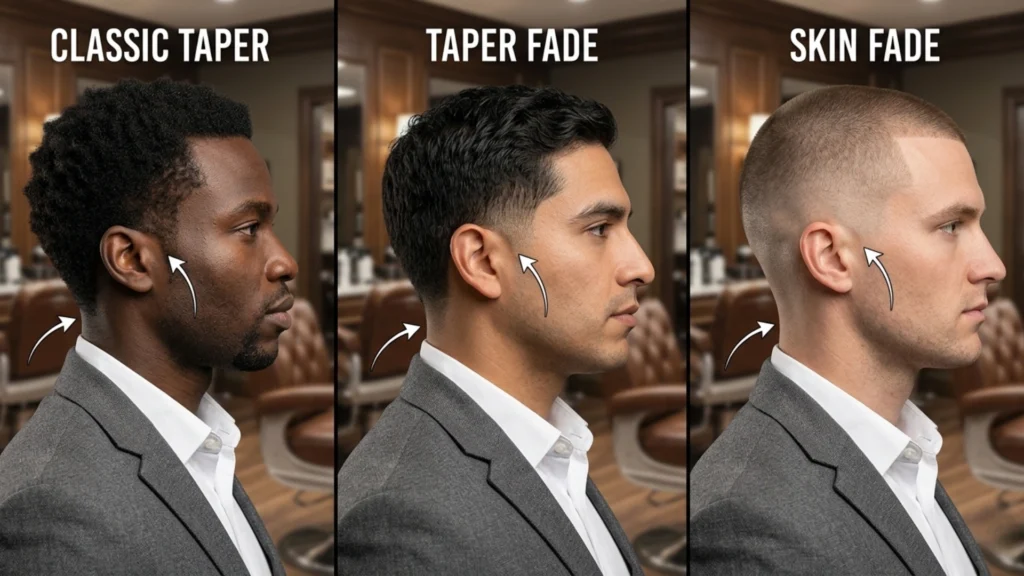
The core difference
A classic taper keeps hair at the bottom (around the neckline and sideburns), while a fade removes it completely, blending hair down to the skin.
Fact: A key distinction experts repeat is this: a taper is a haircut in which the back and sides are gradually shortened around the sideburns and neckline, while a fade is a haircut in which the back and sides are faded from the temples downward to a length that often reaches the skin.
Quick comparison table
| Feature | Classic Taper | Taper Fade | Skin Fade / Bald Fade |
|---|---|---|---|
| Hairline preserved? | Yes | Partially | No (goes to skin) |
| Lowest hair length | 1/8 inch (#1 guard) | Very short or skin | Shaved to skin |
| Maintenance frequency | Every 4–6 weeks | Every 3–4 weeks | Every 2–3 weeks |
| Formality level | High (boardroom-ready) | Medium | Casual/trendy |
| Technique | Scissors + clippers | Clippers (blending) | Clippers + foils/razor |
| Grow-out appearance | Graceful, natural | Noticeable after 3 weeks | Loses shape quickly |
| Best for | Professional settings, all ages | Modern but not extreme | Fashion-forward, younger men |
Fact: Tapers require fewer trips to the barbershop. Fades typically require regular maintenance; if you opt for a fade haircut, expect to visit your barber every 2–3 weeks. A classic taper lasts 4–6 weeks if executed properly.
What is a classic taper fade?
A classic taper fade is a hybrid style. It combines the structure of a classic taper (longer top, graduated sides) with a fade finish at the very bottom, specifically at the neckline and the lower edge of the sideburns.
Unlike a full fade (which starts the skin exposure high on the head), the classic taper fade keeps most of the taper intact and only “fades” the last inch or two near the edges. This creates clean, sharp definition while maintaining the traditional silhouette.
Who it’s for: Men who want the timeless look of a classic taper but prefer sharper, more defined edges. It’s the sweet spot between conservative and modern.
How to ask for it: Say, “I want a classic taper with a low fade finish at the neckline.”
The history of the classic taper haircut: Why it has lasted over 100 years
The classic taper evolved from early 20th-century military grooming standards. Soldiers needed haircuts that were neat, functional, and non-distracting, short on the sides, controllable on top, and requiring no daily maintenance.
After World War II, returning servicemen brought military grooming habits into civilian life. Barbershops standardized the look as the “regulation cut” or “businessman’s cut.” It became the grooming standard for professionals in post-war corporate America.
During the Golden Age of Hollywood (1940s–1960s), actors like Cary Grant, James Dean, and Paul Newman popularized the side-parted taper as the symbol of masculine refinement. The clean taper with a defined side part became the visual shorthand for “leading man.”
Fact: The classic taper gained mass commercial adoption in the United States during the 1950s, when barbershops standardized the look as the “businessman’s cut,” a style that aligned with the professional dress codes of growing corporate America.
Why it hasn’t been replaced by the fade: The taper is defined by what it preserves (the hairline), while the fade is defined by what it removes. The classic taper signals tradition, professionalism, and timelessness qualities that never go out of style.
60+ classic taper haircut styles for men
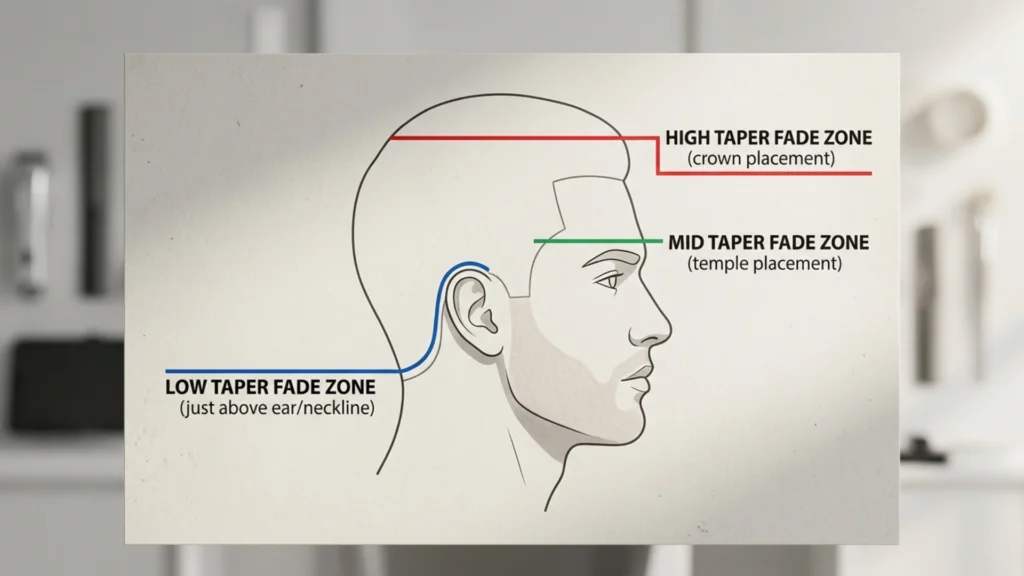
The classic taper is not a single look it’s a foundation. You can pair it with dozens of top styles, from conservative side parts to bold pompadours. Here are the most popular variations, organized by taper height and styling approach.
Low classic taper haircut styles
A low taper keeps the graduation near the bottom of the head just above the ears and at the very base of the neckline. It’s the most conservative, formal version of the classic taper.
Best for: Business professionals, older men, formal occasions, conservative workplaces (law, finance, medicine, government).
Top styles that pair well:
1. The Executive Low Taper
Short, neat top (2 inches), low taper on sides, natural neckline. The safest, most universal business haircut.
2. Low Taper + Side Part
Clean side part with a comb, glossy pomade finish. The signature “gentleman’s haircut.”
3. Low Taper + Comb Over
Hair combed to one side for fullness. Great for fine hair or men with slightly receding hairlines.
4. Low Taper + Slicked Back
Hair combed straight back with high-shine pomade. Formal, polished, timeless.
5. Low Taper for Thick Hair
Uses point cutting or thinning shears on top to remove bulk while keeping the tapered sides tight.
6. Low Taper + Ivy League
A short, preppy style where the front is slightly longer than the back, clean and collegiate.
7. Low Taper + Natural Texture
Minimal product, air-dried, with a matte finish. Modern but still professional.
8. Low Taper with Beard (Beard Taper)
The sideburns blend seamlessly into a shaped beard, creating a continuous flow of facial hair.
Mid classic taper haircut styles (Medium taper)
A mid-taper starts the length reduction near the temples. It offers a balanced look more modern than a low taper, but is still clean and workplace-appropriate.
Best for: everyday wear, versatile styling, creative professionals, younger men, all face shapes.
Top styles that pair well:
9. Medium Taper + Textured Top
Hair on top is left natural with movement, styled with matte clay or styling paste.
10. Mid Taper + Textured Crop
Short textured top with a slightly messy finish casual, low-maintenance, stylish.
11. Mid Taper + Pompadour
Hair swept upward and back for volume. Requires blow-drying and strong-hold pomade.
12. Mid Taper + Quiff
Similar to a pompadour but shorter and less dramatic. Great for wavy or thick hair.
13. Mid Taper + Messy Quiff
A casual, “styled but not too styled” version using texture paste and fingers.
14. Mid Taper + Natural Curls
Curly hair on top with tight, clean sides. The taper controls volume beautifully.
15. Mid Taper + Slick Back
Longer on top (3–4 inches), combed straight back with a natural or glossy finish.
16. Mid Taper for Wavy Hair
Wavy texture on top with sea salt spray, tapered sides for structure.
17. Mid Taper + French Crop
Short, horizontal fringe with a textured finish, modern and European-inspired.
18. Mid Taper + Two Block
Distinct separation between the long top and short sides (popular in Korean and Japanese men’s styles).
High classic taper haircut styles
A high taper starts the graduation near the crown. It creates maximum contrast between the top and sides, resulting in a bold, fashion-forward look.
Best for: Men who want a modern edge while keeping the classic structure, younger professionals, creative industries.
Top styles that pair well:
19. High Taper + Crew Cut
Very short top with a high taper, clean, military-inspired, ultra-low maintenance.
20. High Taper + Flat Top
Hair on top is cut flat and stands upright, bold and retro.
21. High Taper + Textured Spikes
Short spiky hair on top with a high taper for sharp contrast.
22. High Taper for Curly Hair
Curls stay full on top while the high taper keeps the sides and back extremely clean.
23. High Taper + Faux Hawk
Hair on top is styled upward in the center, creating a subtle mohawk effect.
24. High Taper + Undercut Blend
The taper is high enough to visually resemble an undercut, but it’s still blended (not disconnected).
Short classic taper haircut
A short classic taper means the top is kept very short (1–2 inches), while the sides maintain the classic taper structure. This is the ultimate low-maintenance, no-fuss version.
Best for: Hot climates, active lifestyles, men who don’t want to style their hair daily, thick hair.
Barber specifications:
- Top: 1 to 1.5 inches
- Sides: #2 guard (1/4 inch)
- Neckline transition: #1 guard (1/8 inch)
- Neckline style: Tapered (natural, no hard line)
Top styles:
25. Buzz Cut Taper
Entire head buzzed short, with a tapered neckline for polish.
26. Crew Cut Taper
Slightly longer in front, tapered on the sides, the classic American haircut.
27. Butch Cut Taper
Extremely short and uniform on top, with a subtle taper for definition.
28. Short Taper + Hard Part
A shaved line creates a defined part on a short top.
Pro Barber Tip: For a short classic taper, ask for “1.5 inches on top, #2 on the sides blending to #1 at the neckline, with a natural tapered neckline.” This specification keeps it professional and clean.
Long classic taper haircut
A long classic taper means the top is left between 3 and 5 inches, giving you maximum styling versatility. The sides remain tapered, but the contrast between the long top and short sides becomes the defining visual feature.
Best for: Men who enjoy styling their hair, wavy or curly hair types, heart/oval/oblong face shapes, creative professionals.
Top styles:
29. Long Slicked Back Taper
Hair is combed straight back with pomade or styling cream. Elegant and timeless.
30. Long Comb Back
Similar to slicked-back but with less shine and more natural movement.
31. Long Side Part Taper
Classic side-parted style with enough length for a dramatic sweep.
32. Long Pompadour Taper
High-volume pompadour on top with clean tapered sides for maximum impact.
33. Long Flow Taper
Hair flows naturally backward and to the side. Works beautifully with wavy hair.
34. Long Wavy Taper
Natural waves on top with clean sides. Styled with sea salt spray or light cream.
35. Long Textured Fringe Taper
Long fringe pushed forward or to the side, with tapered back and sides.
Styling Tip: Long classic tapers need medium-hold products. Try styling cream for natural movement or pomade for a combed, polished finish.
Classic taper fade styles
These variations incorporate a fade (going closer to or down to the skin) while maintaining the classic taper structure in the upper portions.
36. Classic Low Taper Fade
Low taper structure with a fade finish only at the very bottom of the neckline.
37. Classic Low Taper Fade + Side Part
The most popular business-casual hybrid is clean, professional, and slightly modern.
38. Classic Mid Taper Fade
Mid-height taper with a fade that starts around ear level.
39. Classic Taper Fade + Curls
Curly hair on top with a clean taper fade on the sides is extremely popular with Black men.
40. Classic Taper Fade for Black Men
Often paired with waves, twists, or natural texture. The taper fade keeps edges sharp while the top showcases texture.
41. Classic Taper Fade + Waves
Brushed-in wave pattern on top with a clean taper fade on the sides.
42. Drop Taper Fade
The fade “drops” down behind the ear, following the natural curve of the head.
43. Temple Taper Fade
Taper fade focused specifically around the temples and sideburns for a clean, defined look around the edges.
Classic taper haircut with beard
The beard taper (also called a sideburn blend) is when the barber connects the tapered sideburns directly into your beard, creating a continuous line.
44. Low Taper + Full Beard
Clean taper on the sides with a shaped, full beard. The sideburns blend seamlessly.
45. Mid Taper + Short Stubble
Casual, masculine, easy to maintain.
46. High Taper + Shaped Beard
High contrast on the head with a sharp beard line for a bold, defined look.
Grooming Tip: If you wear a beard with a taper, maintain both at the same time. If the taper grows out but the beard stays sharp (or vice versa), the connection breaks and looks uneven.
Classic taper for Black men
The classic taper is one of the most versatile haircuts for Black men because it works with every hair texture from loose curls (Type 3) to tight coils (Type 4).
47. Classic Taper + Afro Top
Full afro on top with clean tapered sides. The taper controls volume while the top stays natural.
48. Classic Taper + High Top
A tall, flat top with tapered sides bold and retro.
49. Classic Taper + Waves
Brushed-in 360 waves on top with a low or mid taper on the sides.
50. Classic Taper + Twist-Out
Natural twists on top with a clean taper for structure.
51. Classic Taper + Short Dreads
Locs on top with tapered sides for a modern, clean look.
52. Classic Taper + Cornrows
Braided top with a low taper fade, clean, protective, and stylish.
53. Classic Taper + Braids (Long)
Longer braids on top with tight tapered sides.
54. Temp Fade Taper
A variation where the fade is focused on the temples, popular in Black barbershop culture.
Texture Tip: If you have Type 4 hair, make sure your barber is experienced with natural hair textures. The blending technique for coarse, coily hair is different from that for straight or wavy hair.
Additional classic taper variations
55. Classic Taper + Top Knot
Long hair on top tied into a knot with tapered sides.
56. Classic Taper + Man Bun
Similar to top knot but with a full bun.
57. Classic Taper + Faux Hawk
Hair styled upward in the center with short tapered sides.
58. Classic Taper + Mohawk
More dramatic than a faux hawk, a true mohawk with tapered sides.
59. Classic Taper + Blowout
Voluminous, blown-out top with tight tapered sides.
60. Classic Taper with Design
Shaved lines, patterns, or geometric shapes are added to the tapered sides.
Classic taper haircut for every face shape: Which style is right for you?
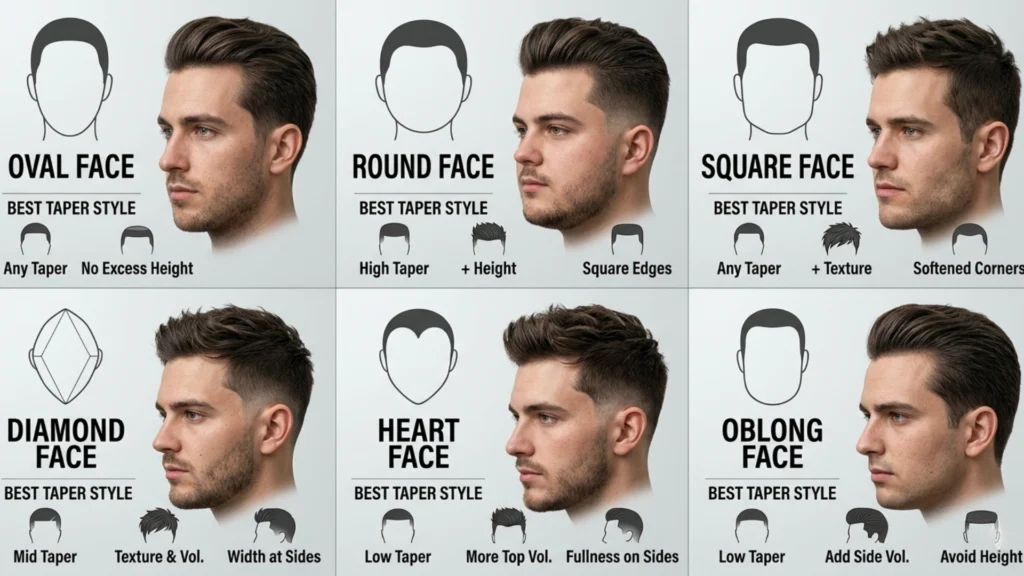
| Face Shape | Best Classic Taper Style | Avoid |
|---|---|---|
| Oval | Any variation most versatile | Nothing all styles work |
| Round | High taper + textured top (adds height) | Low taper + flat top (emphasizes roundness) |
| Square | Low taper + soft texture on top | Hard parts + high taper (over-angularizes jaw) |
| Diamond | Low-mid taper + side part | High taper (widens forehead visually) |
| Heart | Low taper + volume at crown (not temples) | Heavy pompadour (exaggerates forehead) |
| Oblong/Long | Low taper + flat or textured top (adds width) | Pompadour or high quiff (adds too much length) |
Classic taper for a round face
Recommended style: High taper + textured quiff or pompadour
Why it works: Adding height on top visually lengthens the face, while the high taper reduces bulk on the sides.
Celebrity example: Jonah Hill has been seen with textured tops and tapered sides to add definition.
Classic taper for square face
Recommended style: Low or mid taper + soft, natural texture on top
Why it works: A square face already has strong angles. A low taper with a softer top balances the sharp jawline without over-angularizing.
Celebrity example: David Beckham (square/oval hybrid) often wears a mid taper with a slicked-back or textured top.
Classic taper for oval face
Recommended style: Literally any classic taper variation
Why it works: Oval is the most balanced face shape. All taper heights and all top styles work.
Celebrity example: Ryan Gosling (oval face) wears a classic low taper with a side part, sleek, timeless, and universally flattering.
Classic taper for diamond face
Recommended style: Low to mid taper + side part
Why it works: Diamond faces have a narrow forehead and chin with wider cheekbones. A side part adds width to the forehead, and a low-mid taper balances the cheekbones.
Classic taper for a heart-shaped face
Recommended style: Low taper + volume at the crown (not the temples)
Why it works: A heart-shaped face has a wider forehead and a narrow chin. Avoid adding too much width at the temples. Keep the taper low and the top balanced.
Classic taper for oblong/long face
Recommended style: Low taper + flat top, textured crop, or side part
Why it works: Oblong faces need width, not height. Avoid tall pompadours or quiffs. Keep the silhouette horizontal and balanced.
Every face shape recommendation above is a starting point. For a result tailored to your exact jaw angle, facial width, and symmetry, TaperMatch runs a structural scan and returns the specific classic taper variation built for your geometry.
Classic taper haircut for every hair type
Classic taper for straight hair
Straight hair shows the taper’s clean lines most clearly. It works best with side parts, comb-overs, and slicked-back styles.
Product recommendation: Use pomade for shine or matte paste for a natural finish.
Classic taper for wavy hair
Wavy hair adds natural movement and texture. The taper removes bulk on the sides while the top keeps its wave pattern.
Product recommendation: Use sea salt spray or light styling cream to enhance the wave without weighing it down.
Classic taper for curly hair
Curly hair benefits from the classic taper because the tapered sides control volume and prevent the “mushroom” shape. The top can stay full and curly.
Product recommendation: Use curl-defining cream or light mousse to enhance natural curls.
Fact: Barbers recommend that men with thick or curly hair request a “point cut” technique on top during their classic taper appointment. This removes bulk from the tips without reducing length, resulting in lighter, more manageable hair.
Classic taper for thick hair
Thick hair can look “puffy” on the sides if not tapered properly. The classic taper removes weight and creates a clean structure.
Barber instruction: Ask for blending or thinning shears on the sides to avoid bulk at the corners.
Classic taper for fine/thin hair
Fine hair can look thicker if the sides are kept very short and the top is left slightly longer. The contrast makes the top appear fuller.
Product recommendation: Use volumizing mousse or texture powder for lift.
Business classic taper haircut: The professional man’s guide
The business classic taper haircut is the most conservative, office-safe version of the classic taper. It is the gold standard for professional grooming in corporate environments.
Why the classic taper is the ultimate business haircut
- It meets every corporate dress code (even the strictest)
- It looks polished without looking “styled”
- It ages gracefully (works from entry-level to executive)
- It requires minimal daily maintenance
- It works in every industry: law, finance, medicine, government, military, and education
The Business Classic Taper Specification:
- Top length: 2 to 2.5 inches (long enough to comb/part, short enough to stay structured)
- Side guard: #3 upper, #2 lower (conservative, non-dramatic taper)
- Neckline: Tapered (natural) NOT squared (too sharp) or rounded (too casual)
- Part: Side part or no part (both boardroom-appropriate)
- Product: Low-shine matte pomade or styling paste for a natural, professional finish
- Maintenance: Every 4 to 5 weeks
Business classic taper vs. business casual taper
Business formal (boardroom): Low taper, side part, natural neckline, matte or low-shine finish.
Business casual (tech, creative offices): Mid taper, textured top, natural finish, more relaxed styling.
How to style the business classic taper for a job interview
- Get your haircut 2 to 3 days before the interview (not the same day or the day before). This allows the cut to “settle” and look natural rather than freshly cut.
- Use a matte-finish product (never glossy or wet-looking) for interviews.
- Style with a side part or comb it straight back; both are safe, professional choices.
- Avoid texture, spikes, or messy finishes for formal interviews.
Pro Barber Tip: Never get your haircut the day before an important interview or event. Get it 2 to 3 days before this allows any slight redness, marks, or newness to settle, making the haircut look naturally polished rather than freshly cut.
Walking into an interview with the right cut starts with knowing which classic taper variation suits your face structure. TaperMatch identifies that in under 60 seconds and gives you the verbatim brief to hand your barber before the appointment.
Why the classic taper is the best low-maintenance haircut for men
The classic taper is the ultimate low-maintenance haircut because it grows out gracefully. The natural hairline is preserved, so there’s no “line” that suddenly appears after two weeks, like there is with a fade.
Maintenance comparison table
| Haircut Style | Barbershop Frequency | Daily Styling Time | Difficulty |
|---|---|---|---|
| Classic Taper | Every 4–6 weeks | 2–5 minutes | ⭐ Easy |
| Taper Fade | Every 3–4 weeks | 3–7 minutes | ⭐⭐ Easy-Moderate |
| Full Fade (Bald) | Every 2–3 weeks | 1–3 minutes | ⭐ Easy |
| Undercut | Every 3–4 weeks | 5–10 minutes | ⭐⭐⭐ Moderate |
| Pompadour | Every 4–5 weeks | 10–15 minutes | ⭐⭐⭐⭐ High |
Fact: A classic taper haircut lasts approximately 4 to 6 weeks before requiring a professional refresh, significantly longer than a bald fade (2 to 3 weeks) because the gradual length transition grows out proportionally rather than visibly losing its shape at the neckline.
How long does a classic taper last?
A classic taper stays sharp for 4 to 6 weeks on average. After that, the neckline may start to look slightly grown out, but it won’t look messy or unkempt like a fade would.
Fact: Average hair grows about half an inch per month. A taper fade, or skin taper, may require a touch-up every 2 weeks to keep the edges sharp.
At-home maintenance between barbershop visits
You can extend the life of your taper by doing light touch-ups at home:
- Buy a small trimmer (Wahl, Andis, or similar)
- Trim the neckline lightly (follow the natural line, don’t try to reshape it)
- Clean up sideburns if they grow past the ear
- Don’t touch the upper taper area; leave that to your barber
Pro Barber Tip: To extend the life of your classic taper between visits, ask your barber for a “tighter taper” on the neckline. This means the graduation is set shorter initially, giving you more grow-out runway before the neckline looks unkempt.
How to make your classic taper last longer
- Wash your hair 2 to 3 times per week (not daily). Over-washing strips natural oils and can disrupt the taper’s structure.
- Avoid heavy products that cause scalp buildup. Use water-based pomades or light pastes.
- Sleep on a satin pillowcase (reduces friction and prevents hair from getting “mashed” overnight).
- Use a fine-tooth comb to keep the shape intact between washes.
How to ask your barber for a classic taper haircut
Bringing a reference photo is always the safest option. Photos eliminate ambiguity. But if you want to use words, here’s the exact script:
Step-by-step: How to ask for a classic taper
Step 1: Start with the style name
Say: “I’d like a classic taper, please” (or “a regular taper”).
Step 2: Specify the top length
Say: “Leave about [X inches] on top.”
- For business: 2 to 2.5 inches
- For medium style: 2.5 to 3 inches
- For longer style: 3 to 4 inches
Step 3: Specify the taper position
Say: “I’d like a [low / mid / high] taper on the sides.”
- Low starts at the ear
- Mid starts at the temple
- High starts above the temple
Step 4: Confirm the neckline style
Say: “Tapered neckline, please” (natural, feathered finish).
Avoid saying “squared neckline” unless you specifically want a hard line.
Step 5: Show a reference photo
Bring one image from this guide or your preferred reference. This ensures you get exactly what you want.
Classic taper clipper guard reference table
| Head Area | Guard Number | Length | Effect |
|---|---|---|---|
| Top (if clipper used) | #4–#6 | 1/2″–3/4″ | Base top length |
| Upper sides | #3 | 3/8″ | Full side length start |
| Mid sides | #2 | 1/4″ | Transition zone |
| Lower sides | #1 | 1/8″ | Lower blend |
| Neckline / Sideburns | #0–#0.5 | 1/16″–3/32″ | Final taper close |
Key Fact: Each clipper guard number represents 1/8 inch of hair length. Guard #0 = 1/16 inch (near skin), Guard #1 = 1/8 inch, Guard #2 = 1/4 inch, Guard #3 = 3/8 inch, Guard #4 = 1/2 inch. Understanding this system helps you communicate precisely with any barber.
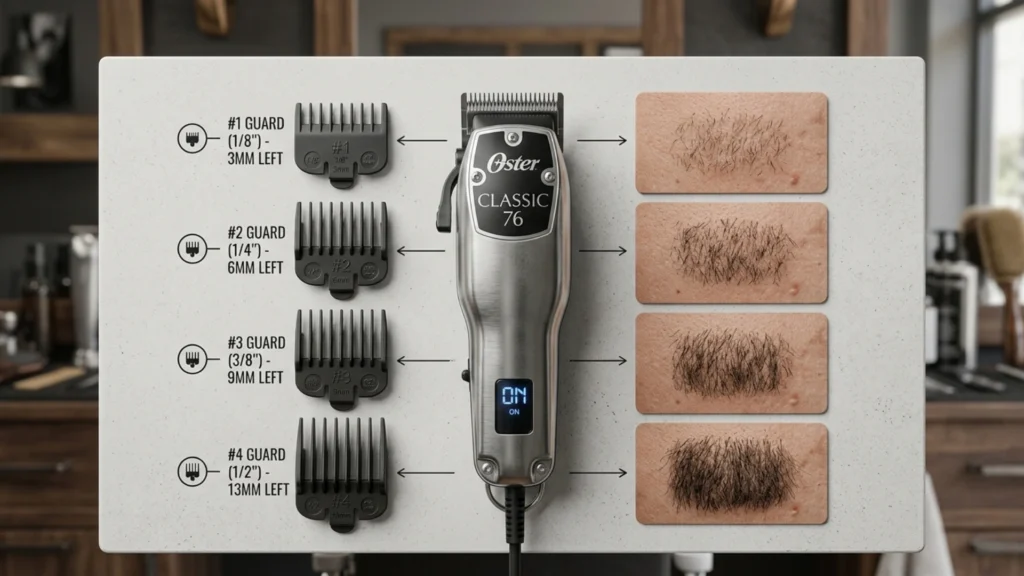
The guard numbers and scripts above give you the language. TaperMatch takes it further, it generates a complete Barber-Ready Brief with your specific guard progression, blend points, and neckline preference already filled in, based on your facial geometry.
How to style a classic taper haircut: Step-by-step
Styling a classic taper depends on your top length and desired finish. Here’s the universal process that works for most styles:
Step-by-step styling guide
- Start with clean, towel-dried hair (not soaking wet or completely dry).
- Apply a thumbnail-sized amount of product to your palms distribute evenly between both hands.
- Work product through hair from root to tip don’t apply product directly to your scalp.
- Comb or use fingers to set the direction:
- Side part: Use a fine-tooth comb to create a clean part
- Slicked back: Comb straight back
- Textured: Use fingers to create natural movement
- Use a hair dryer on medium heat + round brush (optional for longer tops like pompadours or quiffs).
- Finish with a light texture spray for casual styles or a fine-tooth comb for formal styles.
Styling Pro Tip: Apply product to slightly damp hair (not soaking wet or completely dry). Damp hair allows products like pomade and paste to distribute evenly, giving maximum hold and a natural-looking finish without clumping.
Best styling products for a classic taper (by finish type)
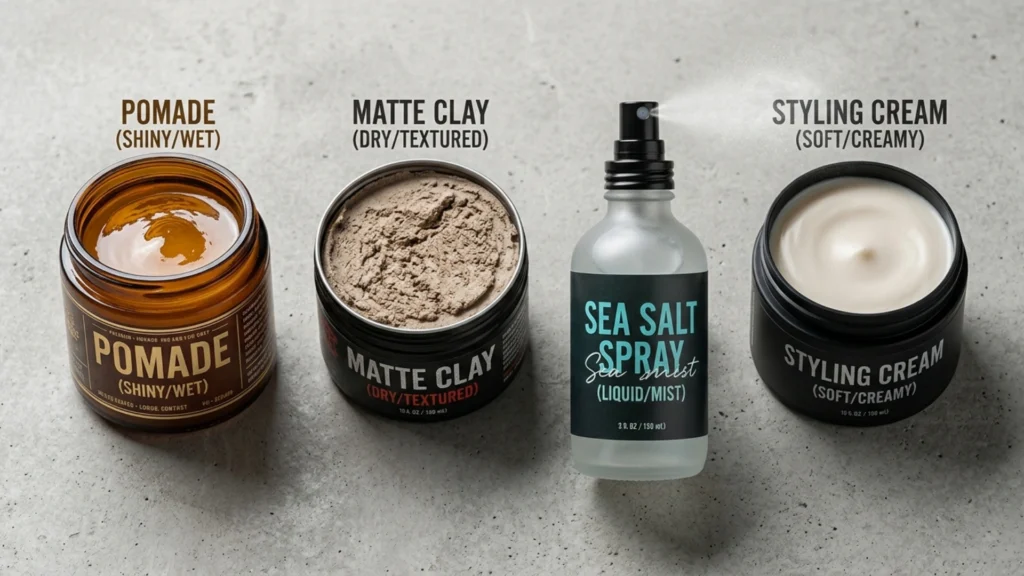
| Look/Finish | Product Type | Best For | Hold Level |
|---|---|---|---|
| Natural/Matte | Matte clay or paste | Business settings, natural look | Medium–High |
| Glossy/Sleek | Pomade (water-based) | Side part, slick back, formal | High |
| Textured/Casual | Sea salt spray + texture paste | Casual, wavy hair, relaxed styling | Light–Medium |
| Volume | Volumizing mousse | Fine hair, pompadour, added height | Light |
| Strong Hold | Hair wax | Thick hair, all-day hold needed | Very High |
Product entity examples:
- Pomade: Creates a glossy, combed finish. Best for formal events and side parts.
- Matte clay: No shine, natural finish. Best for textured crops and everyday business styles.
- Styling paste/putty: Flexible hold, slightly textured. Great for casual styles.
- Sea salt spray: Adds texture and volume to wavy hair without weight.
- Styling cream: Soft hold for longer classic taper styles with natural movement.
Classic taper haircut: Celebrity inspiration and reference guide
Celebrities provide visual proof that the classic taper works at every age, face shape, and styling preference.
Ryan Gosling: Classic low taper + side part
Style: Classic low taper with a sleek side part and glossy pomade finish
Face shape: Oval
Why it works: The side part with a glossy finish defines his signature, refined, “leading man” look. The low taper keeps it timeless.
David Beckham: Classic mid taper + slick back
Style: Classic mid taper with a slicked-back top (varies in length over the years)
Face shape: Square
Why it works: The slicked-back style adds height, which balances his strong jawline. The mid taper softens the angles.
Chris Evans: Classic low taper + textured matte top
Style: Classic low taper with a short, textured top and matte finish
Face shape: Square/oval
Why it works: Clean, military-inspired, boardroom-ready. The matte finish keeps it modern without being trendy.
Brad Pitt: Classic mid taper + natural texture
Style: Classic mid taper with unstyled, natural texture on top
Face shape: Oval (adapts across various styles)
Why it works: The effortless, “I didn’t try” masculine look. Often worn with minimal product for a natural finish.
George Clooney: Classic low taper (silver hair)
Style: Classic low taper with short, controlled top (often styled with a side part)
Face shape: Oval
Why it works: The age-appropriate classic taper, demonstrating the cut works at all ages. The salt-and-pepper color enhances the sophisticated look.
The Celebrity Takeaway: Notice that all classic taper styles worn by these celebrities share one common feature a clean, tapered neckline with no exposed skin. This is the defining characteristic that makes the classic taper eternally relevant across all generations.
Frequently Asked Questions
What is a classic taper haircut?
A classic taper haircut is a men’s hairstyle in which the hair gradually shortens from the top to the sides and back, ending in a clean, tapered finish at the neckline and sideburns without exposing the skin.
What is the difference between a classic taper and a fade?
A classic taper keeps short hair at the neckline and sideburns (around 1/8 inch), while a fade blends the hair down to the skin. A taper is more conservative and professional; a fade is more modern and high-contrast.
Is a regular taper the same as a classic taper?
Yes. A regular taper and a classic taper are the same haircut. “Regular taper” is the informal barbershop term for the traditional, non-faded version of the taper.
How often should I get a classic taper haircut?
A classic taper stays sharp for 4 to 6 weeks on average. If you want it to look consistently fresh, visit your barber every 3 to 4 weeks.
What face shapes suit a classic taper?
All face shapes suit a classic taper. The taper provides consistent structure on the sides, while the top can be customized to balance your specific face shape (height for round faces, width for oblong faces, etc.).
Is the classic taper good for curly hair?
Yes. The classic taper is excellent for curly hair. It removes bulk on the sides and prevents the “mushroom” shape while letting curls stay full and natural on top.
How do I ask my barber for a classic taper?
Say: “I want a classic taper [low/mid/high] keep the top about [X inches], and give me a natural tapered neckline.” Bring a reference photo for best results.
What is a business classic taper?
A business classic taper is a conservative version of the classic taper, typically featuring a low taper, 2 to 2.5 inches on top, a natural neckline, and a side part or simple combed style. It’s the safest choice for corporate environments.
Is the classic taper a low-maintenance haircut?
Yes. The classic taper is one of the most low-maintenance haircuts because it grows out gracefully and doesn’t require frequent barbershop visits (every 4 to 6 weeks is typical).
What is the difference between a short and a long classic taper?
A short classic taper has 1 to 2 inches on top (buzz cut, crew cut), while a long classic taper has 3 to 5 inches on top (slick back, pompadour, flow). Both keep the same tapered sides; only the top length changes.

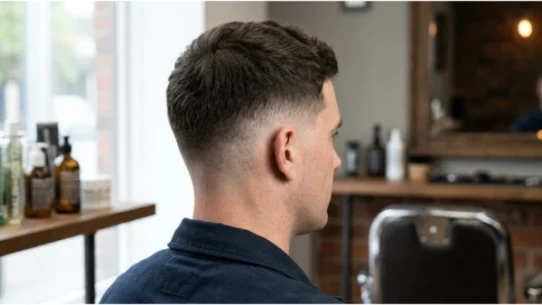
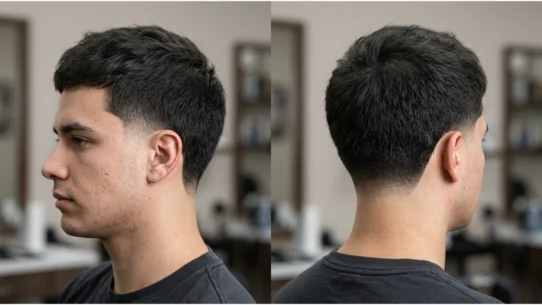
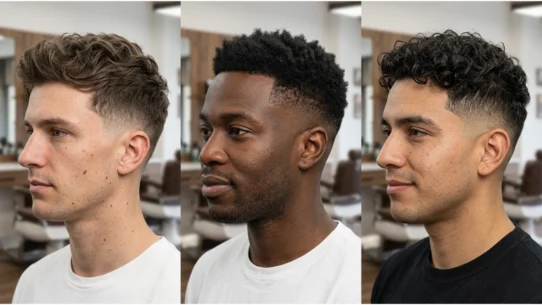
[…] clean fade will define the angular jawline and add a sharp, high-fashion look. In contrast, a classic taper or low taper fade softens the edges for a more understated, refined appearance. Both approaches […]