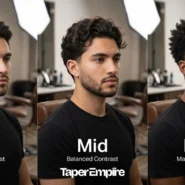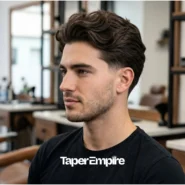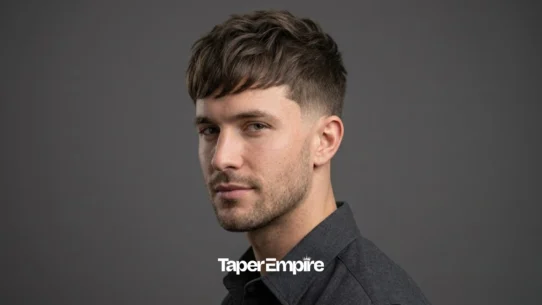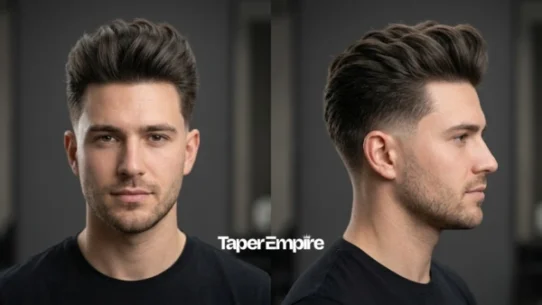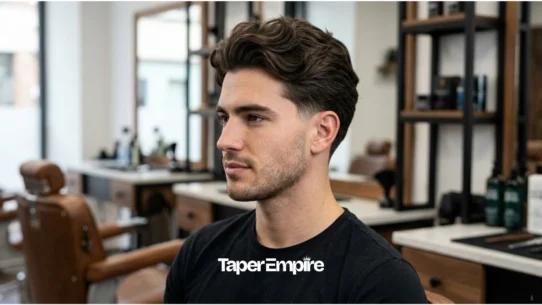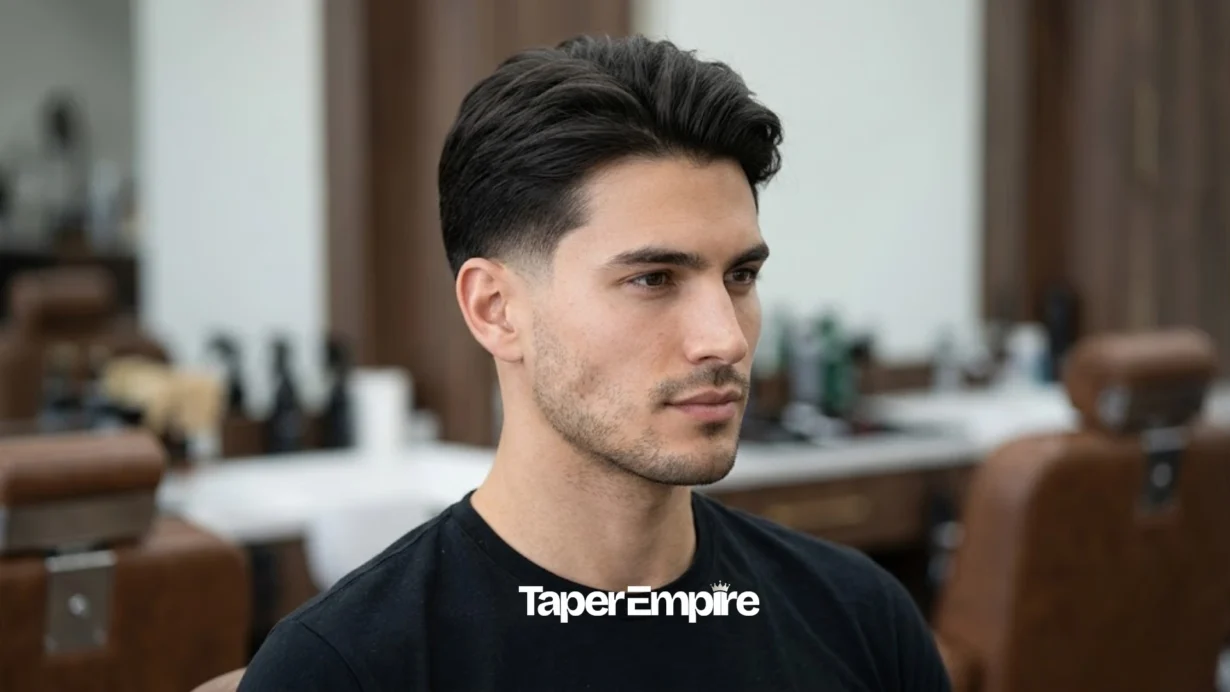

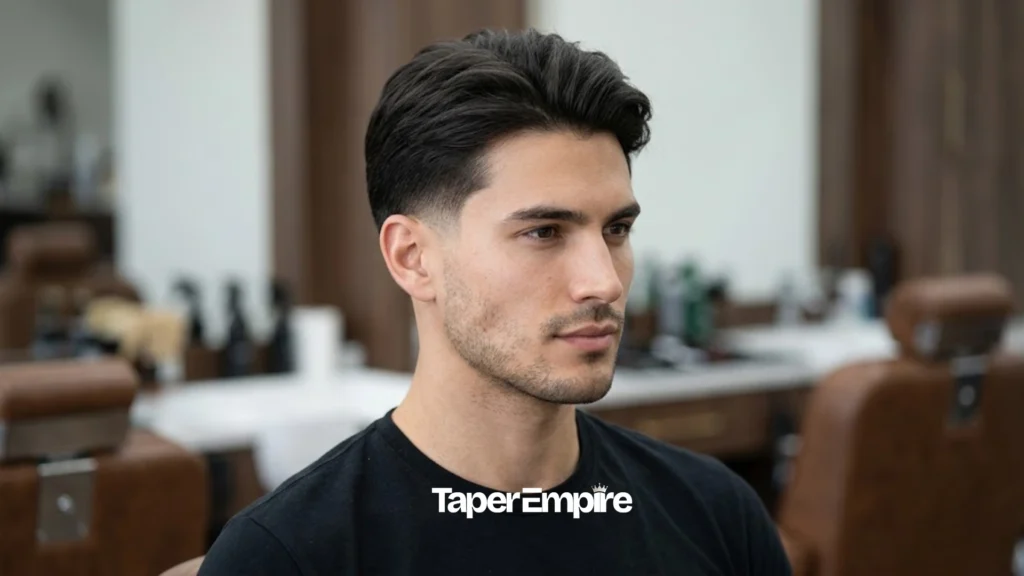
A low taper blowout is a men’s haircut that pairs a soft, low-sitting taper clipped close only at the sideburns, above the ears, and at the neckline with a top section blow-dried upward and outward into full, lifted volume. The taper stays below the temple line, keeping the sides mostly intact. The blowout supplies the shape on top.
This guide covers the exact definition, how it differs from a taper fade, whether it works for your hair type, and the specific words to use at your next appointment.
What is a low taper blowout?
A low taper blowout pairs a soft taper clipped only at the sideburns, above the ears, and neckline with a top section blow-dried up and outward for full volume. The sides stay mostly intact. It is the most conservative and work-friendly height in the blowout taper family.
Key Points
- The taper sits below the temple line
- No skin exposure at the sides
- Blow-dried top creates the volume
- Most forgiving maintenance schedule
Table of Contents
What Is a Low Taper Blowout?
The low taper blowout combines two distinct haircut concepts into one cohesive look. The taper is the clipper work: a gradual length reduction that stays within a narrow band running along the sideburns, above the ear, and across the neckline. The blowout is what happens on top hair that is long enough to be blow-dried upward and backward into a full, rounded shape with lift at the roots and volume at the crown.
What makes this version “low” is the height at which the taper begins and ends. The clipper work stays below the temple line, confined to a zone roughly two finger widths wide around the natural hairline. Everything above that line, the sides, the occipital area, and the top retains most of its natural length.
| Component | Description | Key Attribute |
|---|---|---|
| Taper zone | Sideburns, above ear, neckline | Below the temple line; no skin exposure |
| Sides | Mostly full length | No aggressive blending above the ear |
| Top | 3–5 inches, textured | Blow-dried up and outward for volume |
| Skin exposure | Minimal to none | Distinguishes it from a skin fade |
| Guard range at base | #1 or #2 | Soft graduation, not a skin blend |
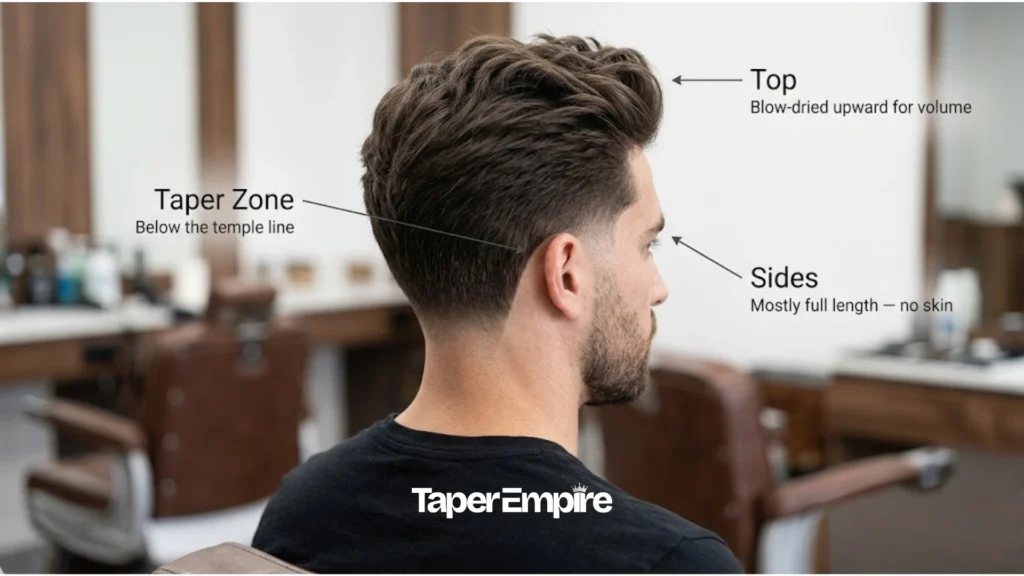
The result is a haircut that reads as clean and well-groomed in any setting, professional enough for an office, expressive enough for a night out. The sides stay full, the top does all the visual work, and the taper gives the overall shape a polished finish without announcing itself.
That balance is why the low taper blowout is the most conservative entry point in the blowout taper family. The broader blowout taper style family includes mid and high variants that sit progressively higher, expose more skin, and create sharper contrast, but none of them grow out as cleanly as the low version.
What Does a Low Taper Blowout Look Like?
The defining visual of this cut is a full, rounded top that transitions almost seamlessly into the sides. There is no dramatic contrast line. No sharp demarcation between the blended zone and the natural-length hair above it. The sideburns fade softly into the ear-level hair, and the neckline tapers to a clean edge without going to skin.
From the front, the blowout shape dominates volume at the crown, a soft rounded silhouette, and either a natural part, a textured fringe, or a swept-back style depending on the finish. From the side, the taper zone is visible but subtle. From the back, the neckline is clean and tapered rather than blocked or shaved.
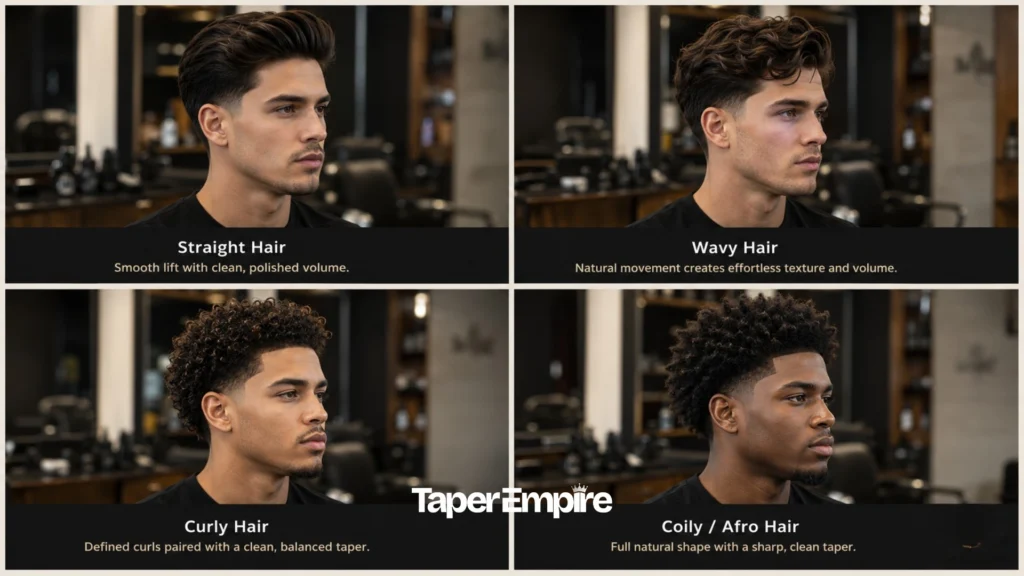
The look changes considerably across hair textures:
- Straight hair: A smooth, lifted shape with slight backward flow. Volume comes from directional blow-drying rather than natural curl.
- Wavy hair: A fuller, softer shape with more natural movement. The wave pattern adds volume without extra product.
- Curly hair: The highest visual impact. The curl pattern holds the blowout shape naturally and creates a round, dense silhouette.
- Coily / afro hair: Maximum volume with the most structural definition. The taper below the ear makes the top appear even larger by contrast.
Across all four textures, the taper zone stays the same. Only the top changes.
Low Taper Blowout vs. Low Taper Fade: What Is the Real Difference?
The key distinction is in the blending technique used at the sides and neckline, not the height. Both cuts place the transition zone low on the head. The difference is how the hair transitions from short to long within that zone.
A low taper uses a graduated length reduction guard sizes increase progressively from the hairline upward, creating a soft blend that leaves no visible skin. A low taper fade uses a zero or skin-level clipper pass at the base of the blend zone, then graduates upward from there. The starting point is skin rather than a short guard length, which creates a more visible contrast line.
| Attribute | Low Taper Blowout | Low Taper Fade Blowout |
|---|---|---|
| Blend technique | Guard graduation only (e.g., #1 → #2 → #3 → natural) | Skin or zero-guard base, then graduating upward |
| Skin exposure | None | Visible at the base of the blend |
| Contrast level | Soft, subtle | Crisper, more defined |
| Regrowth appearance | Grows out cleanly; sides look full longer | Regrowth line appears faster at the blended zone |
| Maintenance schedule | Full cut every 3–4 weeks | Full cut closer to 2–3 weeks before growth shows |
| Best for | Conservative settings, fine or thinning hair | Higher contrast preference, thicker side hair |
| Office compatibility | High | Medium-high |
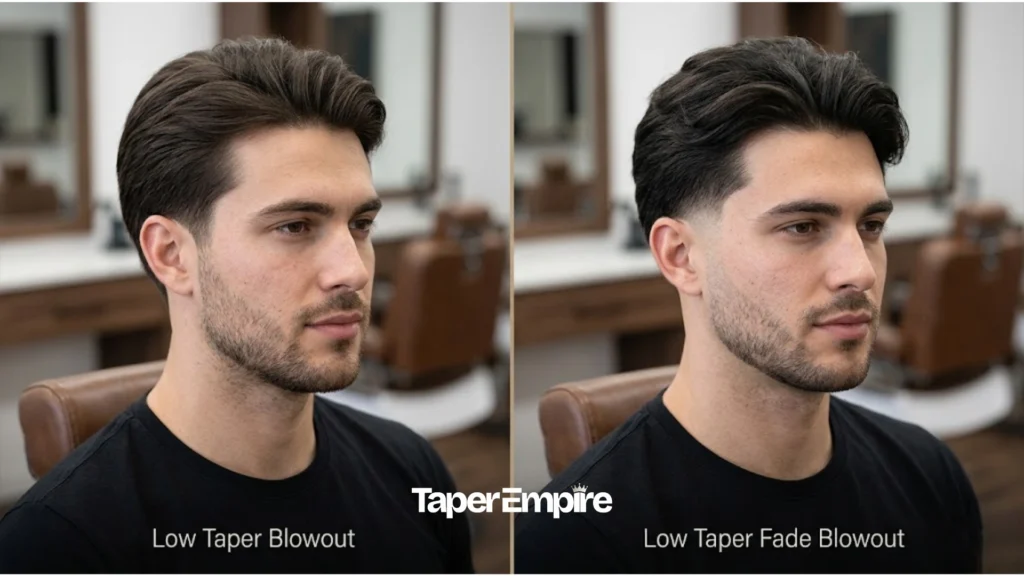
The blowout taper fade is a harder, sharper execution. It looks more precise immediately after the cut, but the skin-level base reveals regrowth faster. The pure taper version trades some of that sharpness for a longer clean window — which is why it is the go-to choice for men who visit their barber every three weeks rather than every two.
Neither version is objectively better. The fade suits men who want visual impact and maintain a frequent barber schedule. The taper suits men who prioritize versatility, office wearability, and a forgiving growth cycle.
Understanding this distinction starts with knowing what separates a taper from a fade as techniques. The taper vs. fade difference extends across the full spectrum of men’s haircuts, and the blowout versions simply apply that same logic at a specific height.
Is a Low Taper Blowout the Same as a Low Taper Fade?
No but they are frequently confused, including at the barber chair. Both sit at the same height. Both pair a blowout top with a low-sitting transition on the sides. The distinction is technical: a low taper blowout uses graduated guards only, leaving no skin exposed. A low taper fade reaches zero or skin at the base. The fade delivers sharper contrast; the taper delivers a softer, longer-lasting finish. Using either term without a reference photo risks getting the wrong blend technique.
For a more detailed breakdown of what separates these two techniques across every hair length, the low taper vs. low fade comparison covers the full distinction, including which suits different hair densities, face shapes, and maintenance preferences.
Does a Low Taper Blowout Work With Your Hair Type?
Every hair texture can carry a low taper blowout, but the technique used to achieve it differs by texture. Straight hair requires directional blow-drying and the right in-chair cut to generate lift. Wavy hair benefits from the natural wave pattern that holds volume without much effort. Curly and coily hair delivers the most dramatic visual result because the natural curl pattern amplifies the blowout shape automatically.
The four sections below give technique-level guidance for each texture not just a label, but the specific approach that makes the cut work.
Straight Hair: How to Get Real Volume Without the Mushroom Effect
Straight hair has no natural curl to hold the blowout shape, which means two things have to happen correctly: the cut itself and the styling routine. Most guides focus on the home blow-dry and skip the in-chair instruction which is why straight-hair blowout tapers frequently fall flat by noon.
The critical in-chair request is weight control. When straight hair is left full on the sides without any internal weight removal, blow-drying the top upward pushes the sides outward instead. The result is a wide, rounded silhouette that puffs at the sides rather than lifting at the crown — the mushroom effect. Asking the barber to remove weight from the lower sides (not the length, just internal bulk) redirects the volume upward.
Styling steps for straight hair:
- Towel-dry until damp not dripping. Wet hair takes longer to blow-dry and falls flat faster.
- Apply a heat protectant from roots to mid-length.
- Clip or push the sides away. Work the top section only.
- Aim the dryer nozzle at the roots, angled upward. Use a round brush to pull the hair backward and upward simultaneously.
- Move from the front hairline toward the crown in sections.
- Work a small amount of molding paste or texture clay through the top while still warm.
- Finish with a 10-second cool-air pass to lock the volume in place.
For straight-hair low taper fade styles without the blowout top, the same taper geometry applies only the styling approach on the top differs.
Wavy Hair: The Path of Least Resistance
Wavy hair sits in the most convenient position for a low taper blowout. The natural wave pattern creates volume without requiring a round brush or significant directional heat work. The wave holds lift at the roots naturally, and the blowout technique enhances what is already there rather than engineering it from scratch.
The main goal with wavy hair is frizz control, not volume creation. A lightweight texturizing spray or pre-styler applied to damp hair before blow-drying keeps the wave defined rather than spreading into a frizzy halo. Finger-drying works well; using a round brush is optional rather than essential.
A molding paste or light wax on the dry finish controls individual sections without weighing the wave down. Wavy hair also holds the blowout shape through the day with minimal touch-ups because the wave pattern resists gravity better than straight hair.
For wavy-hair low taper styling options beyond the blowout top, the same taper zone applies across all wavy-hair variants.
Curly Hair: The Most Visual Payoff of Any Texture
Curly hair is structurally built for the blowout taper. The natural curl pattern holds volume without blow-drying force, creates a defined rounded shape on its own, and maintains lift throughout the day. The low taper underneath makes the curly top appear even more voluminous by contrast the tight taper zone below the ear frames the full top and amplifies its size visually.
The technique for curly hair prioritizes definition over raw volume. Start with clean, damp hair and apply a curl cream from roots to ends before touching the dryer. Use a diffuser attachment; the wide basket distributes airflow without disturbing the curl pattern. Scrunch upward rather than pulling downward. Set heat to low to medium, not high.
Overnight care for curly hair: The blowout shape is most at risk during sleep. Friction against a cotton pillowcase disrupts the curl pattern and flattens the top by morning. According to board-certified dermatologist Dr. Annie Gonzalez of Riverchase Dermatology, silk and satin pillowcases “stop the friction between skin/hair and the pillow,” preventing knotting and frizz. Sleeping on a satin or silk pillowcase or wrapping the hair loosely in a satin bonnet preserves the shape. A 60-to-90-second re-diffusion on low heat in the morning re-activates the curl structure and restores the blowout shape without a full wash.
For curly-hair low taper fade styles that use a fade blend rather than a soft taper, the visual result is similar the key difference is the sharpness of the transition zone at the sides.
Coily / Afro Hair: Volume Built In, Shape Is the Job
Coily and afro hair carries natural volume that most other textures have to engineer. The blowout taper on coily hair is less about generating lift and more about shaping the existing volume into a clean, intentional silhouette. The taper below the ear creates a defined boundary that makes the afro shape above it look structured rather than overgrown.
Apply a leave-in cream to damp hair to define the coil pattern and reduce shrinkage. A curl sponge on dry or slightly damp hair encourages the coils to clump into a cohesive shape rather than dispersing unevenly. Diffuse on low heat if more definition is needed.
Barber instruction for coily hair: “Keep the weight on top. Taper below the ear only don’t bring it up into the sides. I want the top to look full and rounded.”
For coily and afro textures, the low taper fade styles for Black men page shows the same taper height applied across a wide range of top styles useful for seeing the full variation before deciding on the blowout shape specifically.
What Face Shapes and Lifestyles Does It Suit?
The low taper blowout is the most broadly wearable variant in the blowout taper family and that versatility comes directly from its low height and soft blend.
By face shape:
| Face Shape | Low Taper Blowout Suitability | Styling Note |
|---|---|---|
| Square / Angular | Excellent | The rounded blowout top softens hard jaw and temple lines |
| Oval | Universal | Any top style works; no corrections needed |
| Round | Good with adjustments | Use a textured fringe or add height at the crown to lengthen the face visually |
| Oblong / Long | Use with restraint | Keep the top volume controlled; avoid extreme height that elongates further |
By lifestyle and setting:
The low taper blowout produces no visible skin fade, no dramatic contrast line, and no hard geometric shaping. In professional settings, offices, client-facing roles, and formal dress codes, it reads as a standard, well-groomed haircut rather than a statement cut. That is its primary lifestyle advantage over the mid and high versions.
The tradeoff is clear: the low version’s conservatism is its main strength in formal settings and its main limitation for men who want heads-turning contrast. If maximum visual impact is the goal, the mid or high taper blowout delivers it. The low version trades drama for wearability, a longer clean window, and fewer barber visits.
For a direct comparison of how the three height levels differ in appearance, maintenance, and face-shape compatibility, the low vs. mid vs. high taper breakdown covers the decision framework in full.
How Do You Ask Your Barber for a Low Taper Blowout?
The most common reason a blowout taper goes wrong is not the barber’s technique; it is incomplete communication. Naming the cut and assuming your barber’s interpretation matches yours is the most avoidable mistake in the chair.
A complete barber request covers four elements:
Step 1 — Name the taper height. Say “low” explicitly. This tells the barber the transition zone stays below the temple line, above the ear. It distinguishes this cut from a mid or high version.
Step 2 — Describe the sides. Specify that the sides stay mostly full, with no skin exposure, and a soft blend only. If you want weight removed from the lower sides (especially on straight hair), say it directly: “Take some weight out of the lower sides but keep the length.”
Step 3 — Describe the top. Use words like “textured,” “volume on top,” and “long enough to blow-dry.” If you want a specific top-style fringe, swept back, middle part, name it. If you want no fringe, say “no fringe.”
Step 4 — Show a reference photo. The verbal script names the structure. The photo confirms the volume shape and blend style simultaneously. Both are needed. A photo eliminates the single most common source of interpretation error between what “low taper blowout” means to you and what it means to the person holding the clippers.
What to say exactly: “I want a low taper blowout. Taper just above the ear and at the neckline no skin, keep the sides full. Leave the top long with texture so I can blow it out. Here’s a reference photo.”
For straight hair, add: “Can you take some internal weight out of the lower sides? I want the volume to go upward, not outward.”
Quick Tip
If you are unsure which blowout taper height suits your face shape or want a photo to show your barber before the appointment, Taper Empire’s AI haircut tool previews the style on your own photo and generates the exact language to use at the chair.
Find My StyleGuard Numbers for a Low Taper Blowout: What Do They Mean?
Guard numbers tell the barber how short to cut at each point in the blend zone. On their own, they don’t specify where on the head that zone sits. This is why quoting numbers without a taper height (“low,” “mid,” or “high”) gives the barber half the information.
For a low taper blowout, the standard guard progression runs from a short length at the sideburn and neckline upward into the natural hair. No skin pass is made in a pure taper version; the sequence starts at a short guard rather than zero.
| Guard Number | Length | Role in a Low Taper Blowout |
|---|---|---|
| #0 | 1/16 inch | Skin-close; NOT used in a pure low taper blowout |
| #1 | 1/8 inch | Used at the sideburn base in some low taper executions |
| #2 | 1/4 inch | Standard low taper base guard |
| #3 | 3/8 inch | Transition guard blending from #2 into natural length |
| #4 | 1/2 inch | Upper transition guard blending into full natural length |
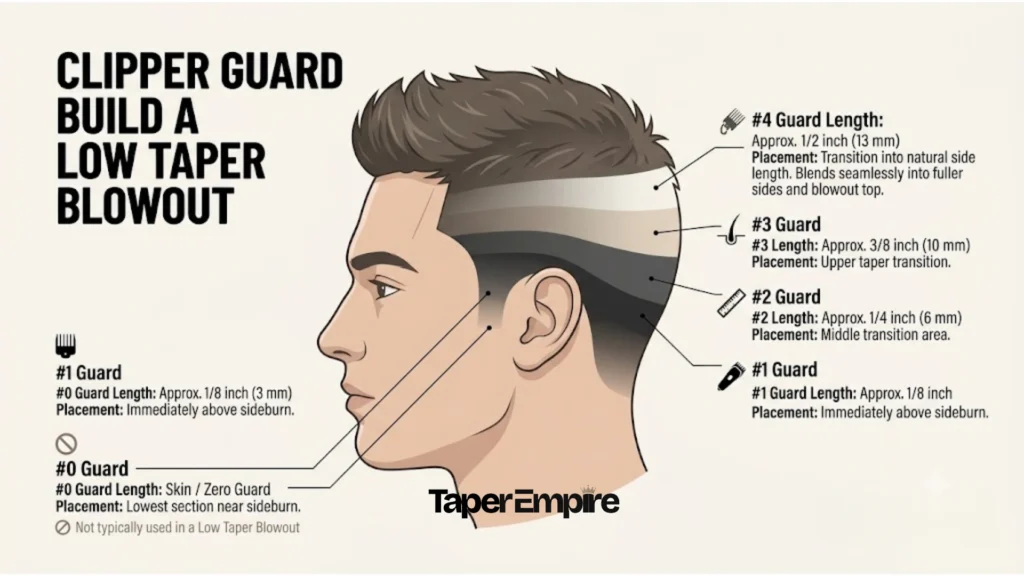
A typical low taper blowout runs #2 → #3 → #4 → natural length, creating a soft graduation without skin exposure. Some barbers start at #1 at the sideburn for a slightly tighter base without going to skin.
The critical rule: guard numbers without a taper height label tell the barber how short to cut, not where the blend zone starts and stops. Always pair your guard preference with “low taper” in the request not just the number sequence.
How Do You Style a Low Taper Blowout at Home?
Clipping always requires a professional barber. Attempting to self-clip the taper zone without training produces uneven blend lines that cannot be fixed without a full recutting session. The styling routine below is fully DIY-executable.
Step-by-step styling routine:
- Towel-dry until damp. Dripping-wet hair takes significantly longer to blow-dry and is more likely to fall flat as it dries under gravity.
- Apply heat protectant from roots to mid-length on the top section. Bypass the sides they are not getting heat work.
- Section the top hair upward. Use a clip or simply push the sides back with your hand. Working only the top section gives the dryer maximum access to the roots.
- Blow-dry upward toward the crown. Use a round brush for straight or wavy hair; pull upward and backward simultaneously. Use a diffuser for curly or coily hair; scrunch upward on low heat.
- Concentrate heat at the roots first. Start at the front hairline and move toward the crown in sections. Root lift determines the final shape; the ends follow.
- Style while warm. Work a small amount of molding paste or texture clay (straight/wavy) or curl cream (curly/coily) through the top while the hair is still warm. Product sets as the hair cools.
- Finish with cool air. A 10-second cool pass locks the volume in place and helps the shape last through the day.
The most common mistake is applying product to fully dry hair. Product on dry hair adds shine and hold but does not contribute to the shape. Volume is built in steps 4 and 5; the product in step 6 maintains it.
How Often Does a Low Taper Blowout Need a Trim?
A full cut every 3–4 weeks keeps the low taper blowout looking intentional. The neckline and sideburns are the first zones to show growth a quick neckline cleanup at around the two-week mark can stretch the clean appearance by several days without requiring a full appointment.
The low taper grows out more cleanly than either the mid or high version because the blend zone starts higher up from the skin. There is no zero-guard line exposed to reveal a distinct regrowth boundary. Growth softens the blend rather than exposing a hard contrast line.
| Taper Height | Full Cut Interval | Optional Cleanup | Regrowth Appearance |
|---|---|---|---|
| Low | 3–4 weeks | ~2-week neckline trim | Grows out cleanly; most forgiving schedule |
| Mid | 2–3 weeks | ~10–14 days | More visible growth line at the temple |
| High | ~2 weeks | ~1 week | Fastest visible regrowth; highest maintenance demand |
Men on a once-a-month barber schedule will find the low taper blowout the most forgiving option. The mid- and high-taper haircut styles start to look noticeably grown-out before a monthly visit is due.
Low Taper Blowout Variations: Which Style Fits You?
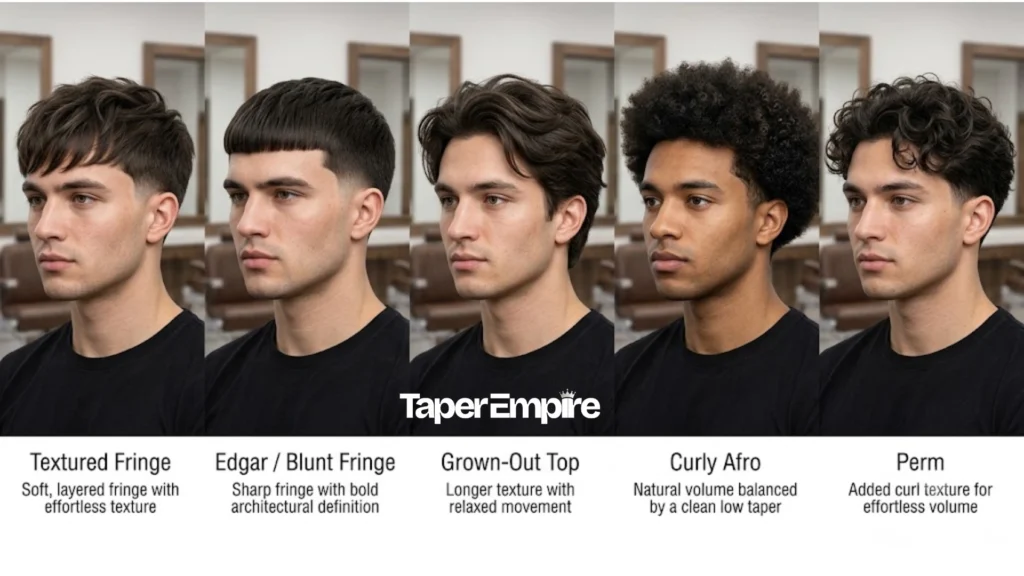
Every variation of the low taper blowout shares the same foundation: the taper zone stays below the temple line, and the top is long enough to blow-dry. What changes is the top style how the hair is cut, shaped, and finished above the taper zone.
Five distinct top styles emerge consistently across this cut, each suited to a different face shape, hair texture, or aesthetic preference.
Textured Fringe Low Taper Blowout
A softly rounded fringe falls forward across the forehead, following the curve of the blowout shape. The fringe is not hard-cut or blunt it feathers into the natural hairline and carries the same blown-out volume as the rest of the top.
This variation suits oval and square face shapes best. The fringe adds horizontal weight at the forehead, which softens angular jaw lines on square faces and creates a balanced proportion on oval shapes. It is also the most natural-looking finish because the fringe direction aligns with the forward-falling hairline.
Styling note: blow-dry the fringe forward and slightly downward while directing the crown upward. The result is a shape that moves from front-falling fringe to lifted crown, adding depth to the silhouette rather than a single flat plane of volume.
Edgar / Blunt Fringe Low Taper Blowout
The Edgar version replaces the soft textured fringe with a hard horizontal cut line across the forehead. The fringe ends sharply, creating a flat geometric edge that sits directly at eyebrow level or just below.
The contrast between the blunt fringe and the soft low taper on the sides creates most of the visual interest. This variation pushes toward the high-impact end of the low taper spectrum still technically conservative in the taper zone, but visually assertive in the top shape.
This style suits angular and square face shapes. The horizontal fringe line adds width at the forehead, which complements strong jaw structure. Styling note: the blunt fringe line must be blow-dried perfectly flat; any wave or lift at the fringe ends undermines the hard geometric effect.
Grown-Out / Longer Top Low Taper Blowout
The grown-out version simply extends the top length beyond the standard 3–6 inch range. More hair on top means more volume potential, but it also means more weight, which can pull the blowout shape downward if the sides are not balanced correctly.
This variation works best for men between haircuts who want to maintain the low taper shape while the top grows. It also suits men who prefer a longer, more relaxed aesthetic less structured, more effortless.
The barber needs to account for the added weight by removing internal bulk from the top section rather than reducing length. Without this, the extra length collapses the volume rather than contributing to it. For low taper fade styles built around longer top lengths, the same principle applies across all grown-out variants.
Curly Afro Low Taper Blowout
The curly afro low taper blowout is the natural evolution of the standard curly version. The taper stays below the ear, which preserves the full circumference of the afro shape. The result is a cut that looks simultaneously shaped and unrestrained the taper provides structure at the boundary without reducing the volume above it.
This variation works best when the barber understands afro hair geometry. The taper should run tight below the ear and then step away from the head quickly as it transitions into the natural curl mass above. A harsh taper that runs too high into the afro shape undercuts the visual impact of the top.
Barber instruction: “Keep the weight on top fully intact. I want the taper tight below the ear; only the curl should look round and full above the transition.”
Perm Low Taper Blowout
A perm low taper blowout applies a chemical wave treatment to straight or loosely wavy hair before cutting the taper and styling the top. The result gives straight-haired men access to the curly blowout aesthetic without relying on a natural curl pattern.
The perm adds texture and volume to hair that would otherwise require significant heat and product work to achieve a similar shape. The low taper complements the permed top by providing a clean boundary at the sides while allowing the induced curl pattern to dominate the silhouette.
This is a brief treatment here the perm process, maintenance, and chemical considerations belong to their own dedicated guide rather than this page.
What You Need Before Getting a Low Taper Blowout
Three practical questions often go unanswered before a first appointment: how long hair needs to be, what it costs, and whether this cut works for thinning or fine hair.
Minimum hair length:
The top section needs a minimum of 3 inches of length for the blow-dried volume shape to hold. Below that, the hair is too short to be directed upward and hold lift after the dryer is removed. Men growing out a buzz cut or short crop typically need 6–8 weeks of growth before the top is long enough for the blowout shape to work. If the top is currently too short, a low taper fade on short hair uses the same taper height on a shorter top as a practical option while growing toward blowout length.
Cost:
A low taper blowout typically costs $30–$60 at most US barbershops, according to Booksy and Yelp marketplace data. The range reflects city, barber experience level, and whether a beard service is added. It runs slightly higher than a plain taper cut at the same shop because the blow-dry and styling step adds chair time to the appointment.
Thinning hair and receding hairlines:
The low taper blowout is the most compatible blowout-taper height for fine or thinning hair. No skin exposure means the scalp is not visible at the sides, which is the primary risk for men with thinning side hair who choose a fade. The full sides also create the visual impression of density rather than exposing hair sparseness at the blend zone.
For receding hairlines, the barber instruction is specific: “Taper behind the recession zone, not through it.” Running the taper through a recession area highlights the recession by creating a hard line across already-sparse hair. Stopping the taper behind the recession treats the hairline as its natural boundary and avoids drawing attention to the sparse zone.
Volume styling with a round brush and light molding paste reinforces the density illusion on the top for fine hair the blow-dried lift creates perceived fullness that flat-lying fine hair cannot achieve on its own.
A low taper fade vs. skin taper comparison shows clearly what skin exposure looks like at the low height, useful for men evaluating whether a fade or a pure taper is the right call given their hair density.
Quick Tip
Not sure whether the low taper blowout suits your face shape or want a ready-made reference photo to show your barber? Taper Empire’s AI tool analyzes your features and delivers a styled preview in under 60 seconds, including your maintenance plan and exact barber script.
Frequently Asked Questions
Is a low taper blowout the same as a low taper fade?
No. Both sit at the same height, but the blending technique differs. A low taper blowout uses graduated guards only no skin exposure. A low taper fade starts at the skin or zero guard before graduating upward. The fade creates sharper contrast; the taper produces a softer, longer-lasting finish.
How much does a low taper blowout cost?
According to Booksy marketplace data, a low taper blowout typically costs $30–$60 at most US barbershops. The price varies by city and barber experience. It runs slightly higher than a plain taper cut because the blow-dry and styling step adds time to the appointment.
How long does hair need to be before getting a low taper blowout?
The top section needs at least 3 inches of length for the blow-dried shape to hold. Below that, the hair cannot sustain lift after the dryer is removed. Men growing out a buzz cut typically need 6–8 weeks of top growth before the blowout shape is achievable.
Does a low taper blowout work on thinning or fine hair?
Yes, it is the best blowout-taper height for fine or thinning hair. No skin exposure prevents the scalp from showing at the sides. Blow-drying the top upward with a round brush and light molding paste creates the appearance of density where flat-lying fine hair would otherwise look sparse.
Can I style a low taper blowout at home?
The blow-dry styling is fully doable at home: start on damp hair, apply heat protectant, blow-dry upward with a round brush or diffuser, style while warm, and finish with cool air. The clipper taper itself requires a professional barber; attempting to self-clip the taper zone reliably produces uneven results.
How often should I get a low taper blowout trimmed?
A full cut every 3–4 weeks keeps the shape intact. An optional neckline cleanup at around 2 weeks extends the clean appearance without a full appointment. The low taper grows out more cleanly than a mid or high version, making it the most forgiving option for men on a monthly barber schedule.
Key Takeaways
The low taper blowout is a single, coherent haircut with two working parts: a soft taper that stays below the temple line, and a blow-dried top that does the visual work. It suits every hair texture with the right technique adjustments, works across face shapes from square to oval, and remains professional enough for any setting that a mid or high blowout taper would not survive.
Three things determine whether it works for you: the current length of your top hair (minimum 2–3 inches), the right in-chair instruction (especially for straight hair with the weight-control request), and the correct maintenance schedule (full cut every 3–4 weeks, optional neckline cleanup at week two).
The barber script is the simplest part: name the height, describe the sides, describe the top, and show a photo. Every other detail in this guide supports those four steps.
To see the style on your own face before the appointment and walk in with a barber-ready reference image, Taper Empire’s AI tool generates a personalized preview in under 60 seconds.