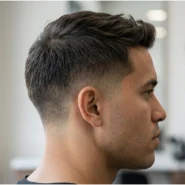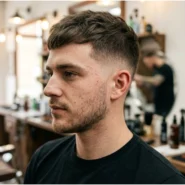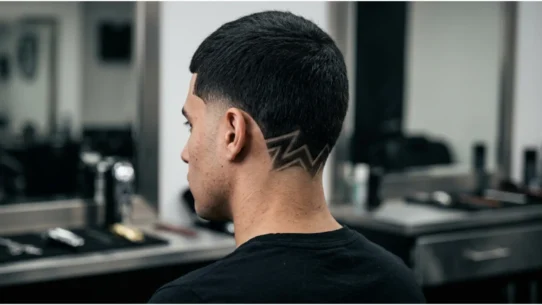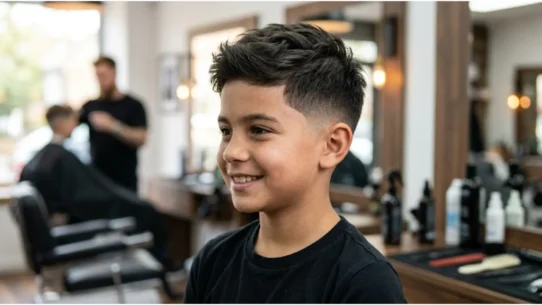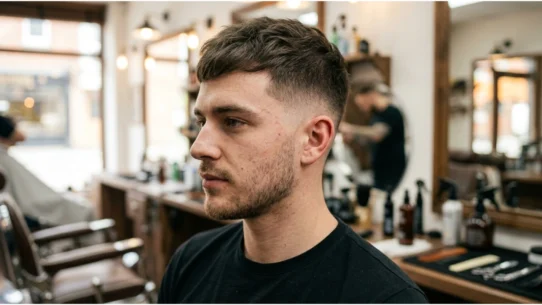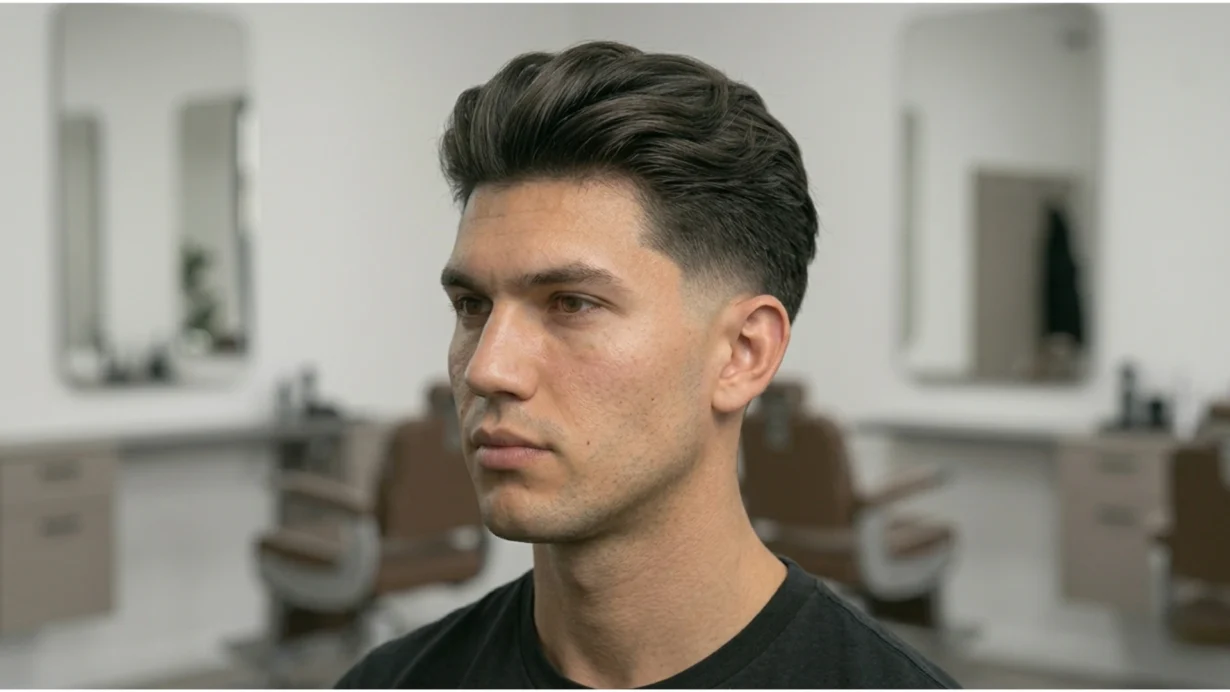

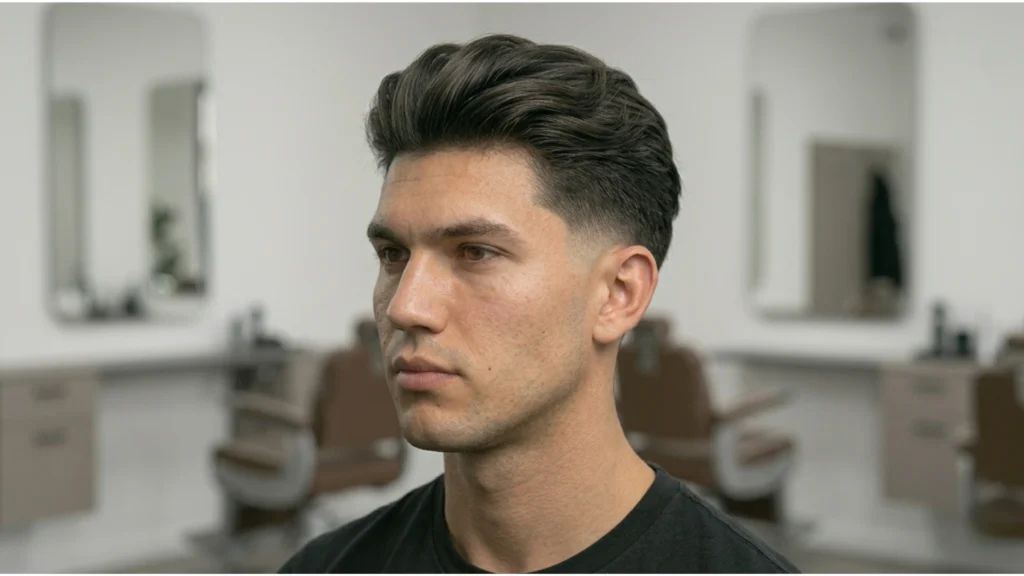
A low taper fade long hair is a men’s haircut in which the top is kept long, straight, wavy, or curly, while the sides and back are gradually faded, starting just above the natural hairline. The fade begins at the ear level and blends smoothly toward the neckline, creating a clean, polished transition without cutting into the length on top.
The word “low” defines exactly where the taper starts. Unlike a mid fade that begins at the temples or a high fade that climbs above them, the low taper stays within one to two inches of the ear. This placement makes the style subtle, professional, and universally wearable from the office to the weekend.
The right haircut boosts your confidence and changes how you present yourself. A clean, low-taper fade with long hair can enhance your look, but choosing the right style for your face and lifestyle requires some knowledge. This guide will help you master your style, barber script, and product lineup like a pro.
Table of Contents
What Is a Low Taper Fade with Long Hair, and Who Does It Work Best For?
A low taper fade with long hair keeps the top section at full length while the sides and back gradually blend down starting just above the ears. The low placement makes it subtle and professional enough for any setting while letting your natural texture shine on top. It works on straight, wavy, curly, and coily hair across all face shapes.
KEY POINTS:
- The fade starts 1 to 2 inches above the ears and blends toward the neckline
- The top stays completely untouched so your full length is preserved
- Needs a fade touch-up every 2 to 3 weeks with top trims every 4 to 6 weeks
- Works on straight, wavy, curly, coily, fine, and thick hair types
- Oval faces suit any variation while round faces benefit most from height on top
What Is a Low Taper Fade with Long Hair?
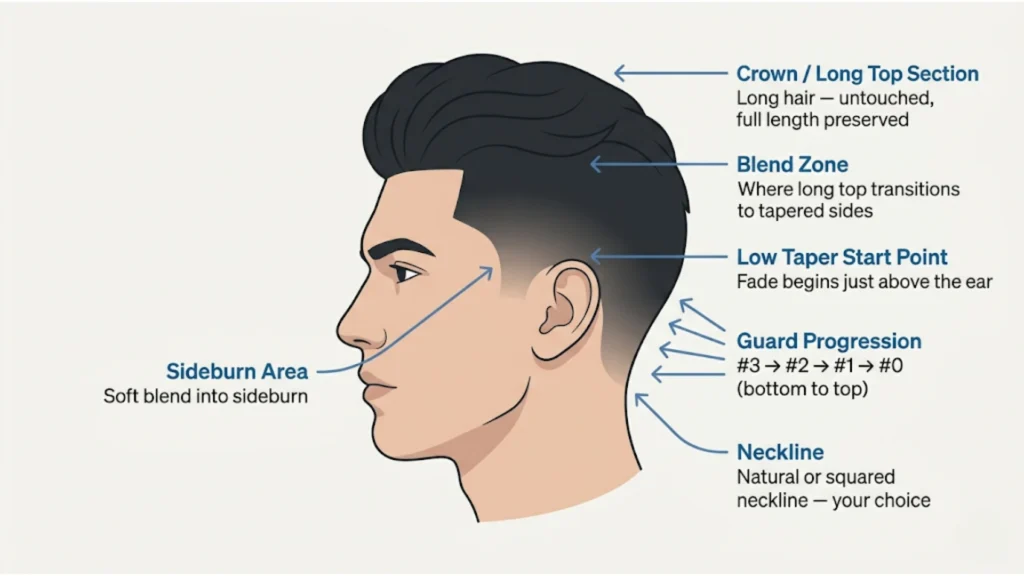
A low taper fade with long hair is a men’s haircut that keeps the top section long while the sides and back are gradually cut shorter using a blending technique. The fade starts just above the ears at the natural hairline and blends smoothly down toward the neckline. The top stays completely untouched, so your length, your curls, or your waves are fully preserved.
The word “low” is the key here. It tells you exactly where the fade begins. A low taper fade sits right at the natural hairline, starting around the temples and ears the perfect zone that works for almost every face and profession.
The result is a clean, polished look that doesn’t feel too dramatic. You get neat sides without losing what makes your hair unique on top.
Featured Snippet Answer: A low taper fade long hair is a men’s haircut in which the top is kept long, while a gradual, subtle fade starts just above the ears and blends into the neckline. Unlike mid or high fades, the low placement keeps the look refined, professional, and versatile for all settings and hair types.
How Is a Low Taper Fade Different from a Regular Taper?
A lot of guys use the words “taper” and “fade” like they mean the same thing. They don’t and knowing the difference will help you get exactly the cut you want.
A taper means the hair gradually gets shorter as it moves toward the neckline and ears, but it still leaves some length. It doesn’t go all the way down to the skin. A fade goes shorter sometimes all the way to the skin using clipper guards like a #0, #1, or #2, blended upward with precision. Think of a taper as a subtle blend in which the hair gradually gets shorter from top to bottom. A fade goes bolder, cutting down to skin or near-skin using clipper guards, then blending upward with precision.
A low taper fade combines both; it’s a fade, but it’s placed low, right at the natural hairline, so it looks subtle and clean rather than dramatic.
Here’s a quick comparison to help you choose:
| Style | Starts At | Goes To | Best For |
|---|---|---|---|
| Low Taper Fade | Just above the ears | Near-skin (#0–#1) | Professional, everyday wear |
| Mid Taper Fade | Temple level | Skin or #0 | Modern, balanced contrast |
| High Taper Fade | Above temples | Skin | Bold, dramatic statement |
| Skin Fade | Any point | Completely bald | Maximum contrast, edgy |
| Classic Taper | Occipital bone | Leaves some length | Conservative, traditional |
| Drop Fade | Curves behind ear | Near-skin | Modern curved aesthetic |
| Shadow Fade | Varies | Near-skin blur | Ultra-subtle, blended |
Unlike a skin fade, which tapers down to reveal the scalp for a more dramatic effect, the low taper fade retains some hair at the bottom, offering a softer, more refined appearance.
Where Exactly Does a Low Taper Fade Start?
This is one of the most common questions guys ask before sitting in the barber chair, and it’s a smart one.
A low taper fade starts just above the ears and runs along the natural hairline. It blends down toward the neckline and around the sideburns. The fade stays within roughly 1-2 inches of the ear. That’s what makes it “low” it doesn’t creep up toward the temples like a mid fade, and it certainly doesn’t reach the top of the sides like a high fade.
The neckline is the finishing point. Your barber will clean it up with a straight razor, either leaving it natural (rounded) or squared off, your choice.
Why Is the Low Taper Fade Long Hair So Popular in 2026?
The short answer? It works for everyone.
It’s clean, versatile, and works with almost every hair type curly, wavy, or straight. It looks good in a boardroom and at a backyard cookout. It suits guys with oval, square, and round faces, and everything in between.
But there’s also a cultural moment driving this style’s popularity right now.
According to Google Trends, searches for “low taper fade” have jumped 200% in the past 12 months, fueled by TikTok tutorials, NBA players, and even the viral “Ninja low taper fade meme.” The meme, which swept social media in 2024, put this haircut in front of millions of people overnight, turning it from a barbershop staple into a cultural touchstone. In 2026, the low taper fade long hair is everywhere. Think Timothée Chalamet’s effortless waves with subtle sides, and
Harry Styles’ retro-inspired volumes. These celebrities helped show the world that long hair doesn’t have to look messy or unkempt, especially when paired with a clean, low taper fade.
The Gen Z influence is massive here, too. The curtain fringe is back with a vengeance and not just for K-pop stars. This center-parted style offers soft, face-framing texture that complements longer tops and even mullets.
Meanwhile, the barbering industry is booming. Today, barbering is experiencing a renaissance, with a renewed focus on craftsmanship and quality. That means better fades, cleaner blends, and more men investing in their grooming than ever before.
Key Fact #1: Taper fades originated in the 1940s as part of U.S. military grooming standards. During World War II and the Korean War, American soldiers were required to keep their hair short, neat, and uniform both for hygiene and discipline. The Army Regulation 600-20 (1941) specified hair should be “tapered from zero length at the hairline on the lower portion of the head to the required length at the top of the head.” This created the first standardized taper fade haircut.
35 Best Low Taper Fade Long Hair Styles for Men
Below are 35 of the best styles organized by category so you can find your perfect match fast. Each style includes a description, who it works best for, what to tell your barber, which products to use, and a pro tip.
Classic Long Hair Styles
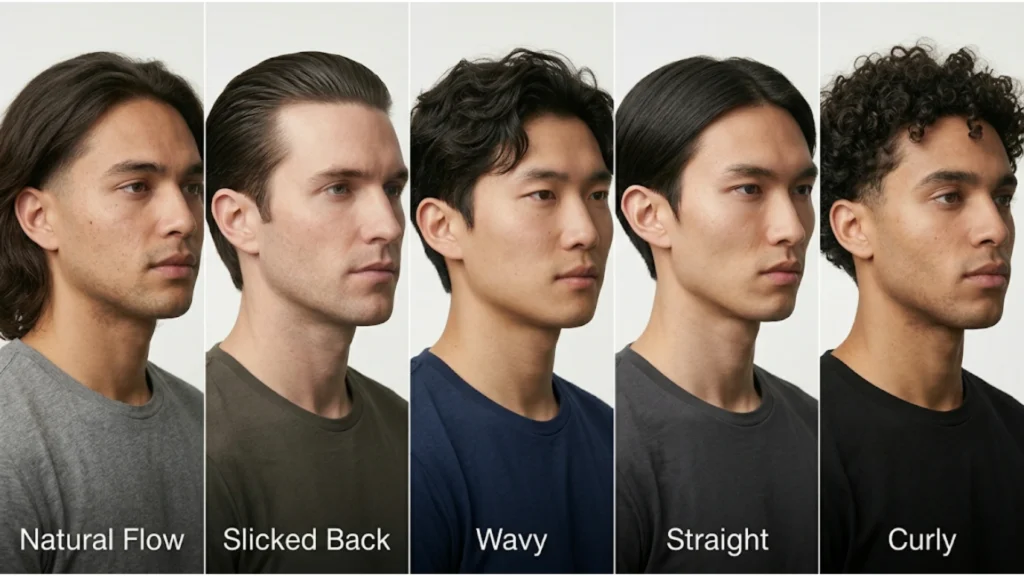
1. Long Hair with Low Taper Fade (The Classic)
This is the one that started it all. Long hair flows freely on top, whether that’s shoulder-length waves, straight strands, or loose curls while the sides and back are neatly faded, starting just above the ears. The blend is gradual, natural, and clean without being severe.
A low taper fade gradually shortens the hair around the neckline and sides while keeping the top long. It creates a clean, subtle transition that frames the face nicely without removing length, making it perfect for people who want neat edges with flowing hair.
- Best For: Oval and rectangular faces; straight to wavy, medium to thick hair
- What to Tell Your Barber: “I want a low taper fade starting just above my ears. Leave the top completely untouched for length. Give me a natural neckline in the back.”
- Products: Medium-hold pomade, sea salt spray, leave-in conditioner
- Pro Tip: Ask your barber for a clipper-over-comb technique at the upper blend zone; it creates a softer, more seamless transition than clippers alone
2. Low Taper Fade with Long Slicked Back Hair
This style is all about sleek sophistication. The long top section is pulled straight back, lying flat and smooth against the scalp. The low taper frames the look from the sides with clean lines, creating a polished, boardroom-ready aesthetic that still has plenty of personality.
The hair is swept to the side from a defined part, creating a polished and professional look. The low taper fade adds a subtle contrast, keeping the sides clean and sharp while maintaining a timeless appeal.
- Best For: Oval and angular faces; straight to wavy hair
- What to Tell Your Barber: “Low taper fade on the sides starting at the ears. Keep the top long enough to slick back fully. Clean line-up on both sides.”
- Products: High-shine pomade, strong-hold gel, vent brush
- Pro Tip: Blow-dry the top backward while applying pomade to damp hair. This sets the direction into the hair before it dries, giving you longer-lasting hold
3. Low Taper Fade with Long Wavy Hair
This one leans into natural texture. The top section moves with organic wave patterns that create real visual energy, while the low taper underneath gives everything a structured base. It’s the perfect blend of laid-back and intentional.
Mid-length cuts with natural waves, choppy ends, and a center part are gaining popularity as clients move away from tight fades and toward more expressive lengths.
- Best For: Square and triangle faces; medium to thick wavy hair
- What to Tell Your Barber: “Low taper fade starting above the ears. Leave the top long and keep the natural wave texture completely intact.”
- Products: Sea salt spray, light mousse, texturizing paste
- Pro Tip: Apply sea salt spray to towel-dried hair and scrunch upward, never downward, for wave definition without frizz
4. Low Taper Fade with Long Straight Hair
This is the sharpest, most precision-driven version of the style. Straight hair creates a mirror-smooth top that contrasts cleanly with the tapered sides. Every strand lies flat, every line looks intentional, and the overall result is sleek and modern, with real impact.
Straight hair works particularly well with the low taper fade because the clean follicle structure reflects light evenly, making the blend line look ultra-precise. For those with straight hair, options abound from long-on-top flows to crisp cuts that suit any face shape.
- Best For: Oval, heart, and diamond faces; naturally straight, fine to medium hair
- What to Tell Your Barber: “Low taper fade starting at the natural hairline above my ears. Keep the top fully straight and long; no texture cutting on top at all.”
- Products: Matte clay, medium pomade, blow dryer with round brush
- Pro Tip: Use a ceramic flat iron on low heat for a glass-smooth finish on the top section. Always apply a heat protectant first to protect long hair from breakage
5. Low Taper Fade with Long Curly Hair
Curly long hair with a low taper fade is one of the most visually striking combinations in men’s grooming. The natural curl pattern springs upward with volume and definition, while the tapered sides create a clean perimeter that lets the curls shine without looking overgrown.
Individuals with curls can rock stunning variations such as blowout fades or curly mullet cuts that highlight natural texture while keeping things tidy at the sides.
- Best For: Round and square faces; medium to coarse curly hair
- What to Tell Your Barber: “Low taper fade starting just above the ears. Leave the top long and untouched. I want my full curl pattern on top preserved.”
- Products: Curl cream, anti-frizz serum, leave-in conditioner, diffuser attachment
- Pro Tip: Never towel-rub curly long hair squeeze moisture out by pressing with a microfiber towel to preserve the curl structure
Tied & Pinned Up Styles
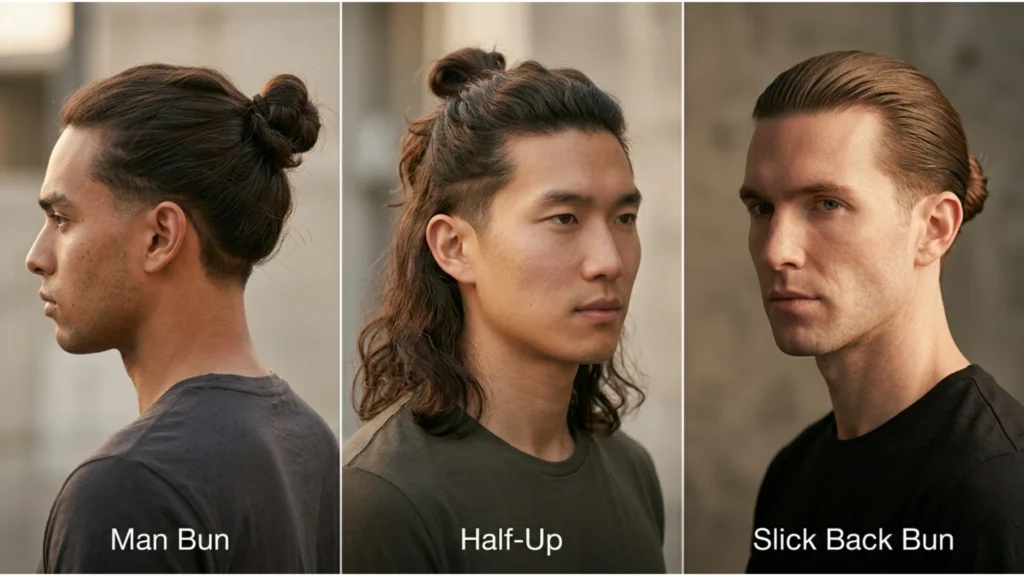
6. Low Taper Fade with Man Bun
The man bun with a low taper fade is one of the most requested long hairstyles in barbershops right now. The low-taper man bun is a trendy haircut with short, clean sides that fade gently near the ears, while the top stays long enough to tie into a bun. It gives a fresh, simple look with a cool and relaxed style.
The contrast between the high, gathered bun and the clean, faded sides is what makes this look so powerful. It works just as well at the gym as it does at a dinner party.
- Best For: Square and oval faces; thick, straight to wavy hair
- What to Tell Your Barber: “Low taper fade starting just above the ears. Keep the top long enough for a full bun at least 4 to 5 inches. Soft blend into the sideburns.”
- Products: Styling cream, light wax, hair tie, finishing spray
- Pro Tip: For a tighter, more polished bun, apply a small amount of styling cream to damp hair, comb back smooth, then tie the cream helps control any flyaways
7. Low Taper Fade with Half-Up Long Hair
This style strikes a middle ground between casual and styled. The top half of the hair gets pulled up and secured either as a half-bun or a loose knot while the lower half falls freely around the neck and face. The low taper keeps the sides looking intentional rather than just grown-out.
- Best For: Triangular and oval faces; medium to thick hair
- What to Tell Your Barber: “Low taper fade from the ears down. Keep the top long enough for a half-up style blend the sides naturally into the neckline.”
- Products: Light wax, hair tie, finishing spray, flyaway serum
- Pro Tip: Vary the height of the half-up bun each time you style it using the same spot every day causes breakage at the elastic point over time
8. Low Taper Fade with Slick Back Bun
This is the power move. The entire top section gets slicked back with product, combed flat, and secured in a low bun at the nape of the neck. The low taper on the sides makes the whole silhouette look deliberate and sharp from every angle.
- Best For: Square and oval faces; straight, thick hair
- What to Tell Your Barber: “Low taper fade from the ears down. Keep enough length on top to pull back into a low bun at the nape. Clean, natural neckline.”
- Products: Strong pomade, high-shine gel, edge control
- Pro Tip: Apply the product to damp hair, comb it straight back, and secure it with a clear elastic before the hair dries. This locks the direction in place for all-day hold
Parted & Framed Styles
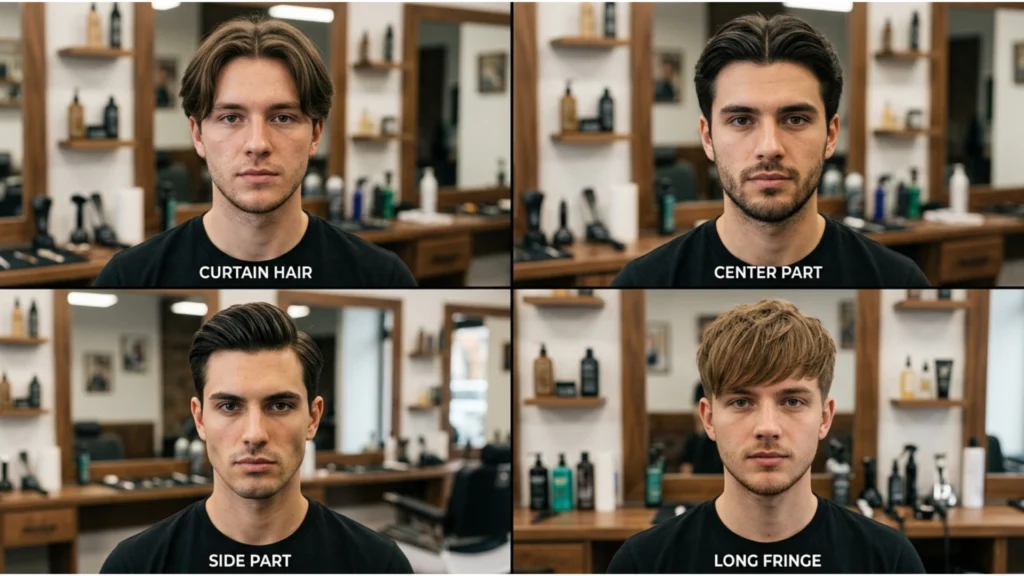
9. Low Taper Fade with Curtain Hair
Curly hair is having a massive moment in 2026 and for good reason. The hair is parted in the center and swept to either side, framing the face like a pair of curtains. The low taper underneath keeps the look clean without competing with the soft, natural drape of the parted top.
The curtain fringe is back with a vengeance, not just for K-pop stars or throwback posters. This center-parted style offers soft, face-framing texture that complements longer tops and even mullets. It’s particularly popular with younger clients and those wanting to grow their hair out while keeping it sharp and styled.
- Best For: Heart and diamond faces; straight to wavy hair
- What to Tell Your Barber: “Low taper fade just above the ears. Keep the top long for a center part. I want a curtain-style flow on each side of my face.”
- Products: Lightweight cream, medium-hold wax, round brush
- Pro Tip: Blow-dry the top in opposing directions, left then right, before releasing into the center part. This trains the hair into the curtain shape naturally and makes it last longer
10. Low Taper Fade with Center-Parted Long Hair
Similar to curtain hair but with a more deliberate, symmetrical part line, this style creates a balanced, mirror-image look that feels both classic and fresh. The low taper fade gives the sides intentional definition, while the center part does all the style talking on top.
- Best For: Heart and diamond faces; straight to slightly wavy hair
- What to Tell Your Barber: “Low taper fade starting above my ears. Leave the top long for a clean center part. I want a symmetrical look.”
- Products: Light pomade, fine-tooth comb, finishing spray
- Pro Tip: Use a fine-tooth comb dipped in water to create a razor-sharp center part, then set with a tiny amount of light pomade, zero clumping, maximum definition
11. Low Taper Fade with Side Part
A side part gives direction and structure to long, flowing hair. The low taper on the opposite side creates a strong directional pull, making the whole look feel coordinated and deliberate. It’s one of the most timeless combinations in men’s grooming.
- Best For: Oval and rectangular faces; straight, medium hair
- What to Tell Your Barber: “Low taper fade from the ears down. Leave the top long I want a side part, and we can discuss whether to add a hard part if possible.”
- Products: Medium pomade, hard-part comb, firm hold spray
- Pro Tip: A razor-cut hard part is a bold graphic detail. Request it specifically if you want the part line to really stand out
12. Low Taper Fade with Long Fringe
An extended fringe sweeps down across the forehead, creating a bold, face-framing front that immediately draws the eye. The low taper on the sides balances out the dramatic front without taking attention away from it.
- Best For: Round and heart faces; thick, straight to slightly wavy hair
- What to Tell Your Barber: “Low taper fade above the ears. Leave the top long with a distinct front fringe. I want it to fall just below the eyebrow level.”
- Products: Styling cream, blow dryer with paddle brush, light-holding spray
- Pro Tip: Blow-dry the fringe downward while the hair is still damp. This trains the direction into the hair and makes styling faster every morning after
Volume & Statement Styles
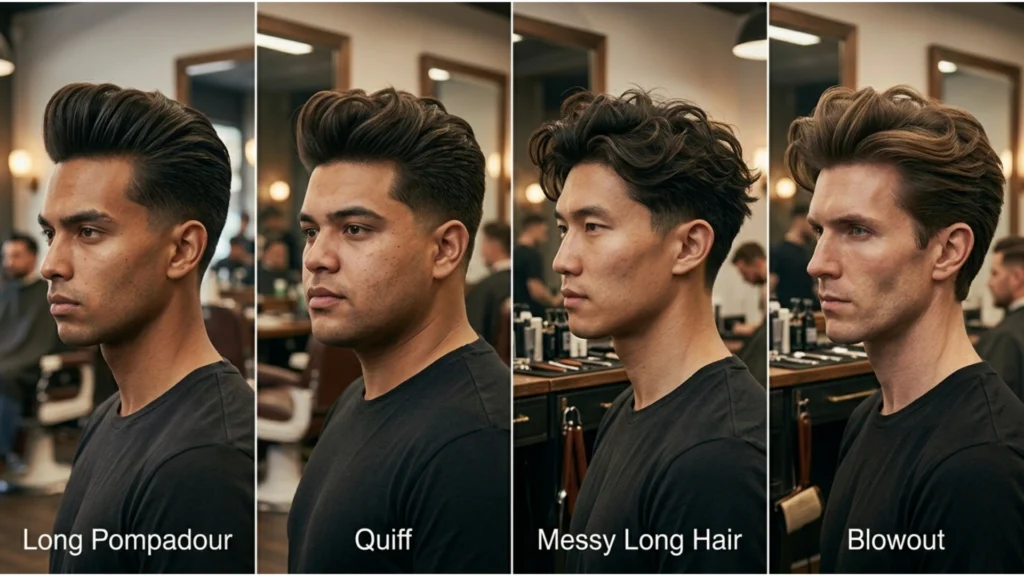
13. Low Taper Fade with Long Pompadour
The long pompadour is all about drama and presence. The front section sweeps upward and backward in a voluminous wave, creating instant height and visual impact. The low taper supports all of that energy by keeping the sides understated and clean.
The low taper pompadour is a bold, stylish haircut with short sides that fade softly near the ears and neckline, while the top stays long and full. The front lifts high and flows back, creating strong volume and smooth movement.
- Best For: Rectangular and square faces; straight to finely textured hair
- What to Tell Your Barber: “Low taper fade from the ears down. Leave the front section longer than the back I want height and volume at the front for a pompadour shape.”
- Products: Volumizing mousse, medium-hold pomade, round brush, blow dryer
- Pro Tip: Blow-dry the front section upward and backward over a round brush. The direction of the root determines how long your pompadour holds throughout the day
14. Low Taper Fade with Quiff
The quiff is the laid-back cousin of the pompadour. The top lifts upward with natural movement and a slight backward sweep, less rigid, more relaxed, but still stylized and intentional. The low taper keeps it from looking too casual.
- Best For: Round and heart faces; wavy, medium hair
- What to Tell Your Barber: “Low taper fade from the ears down. I want the top along with some lift at the front a relaxed quiff, not a stiff pompadour.”
- Products: Medium clay, texturizing paste, blow dryer
- Pro Tip: Apply clay to dry hair not wet for maximum texture and hold on the quiff. Wet application reduces the matte finish and makes the clay feel heavy
15. Low Taper Fade with Messy Long Hair
Intentional messiness is an art form. This style uses the natural texture and movement of long hair to create a tousled, lived-in look that still feels groomed because of the clean, low taper on the sides.
- Best For: Oval and oblong faces; medium to thick hair of any texture
- What to Tell Your Barber: “Low taper fade starting above the ears. Leave the top long and layered; I want a textured, lived-in look, not something stiff or polished.”
- Products: Texturizing paste, matte clay, sea salt spray, grooming cream
- Pro Tip: Apply texturizing paste through towel-dried hair using only your fingers skip the comb entirely. Air-dry or diffuse for authentic, effortless messiness
16. Low Taper Fade with Blowout Long Hair
Maximum volume, maximum confidence. The long top section is blow-dried upward with product, creating dramatic, cloud-like volume that turns heads. The low taper balances the bold top with a structured, clean perimeter.
- Best For: Round and oval faces; fine to medium straight hair
- What to Tell Your Barber: “Low taper fade from the ears down. Leave the top very long, I want to blow-dry it up for serious volume and height.”
- Products: Volumizing mousse, strong-hold spray, round brush, blow dryer
- Pro Tip: Use the concentrator attachment on your blow dryer for directional volume. The diffuser creates body, but not direction
Retro & Bold Styles
17. Low Taper Fade with Mullet
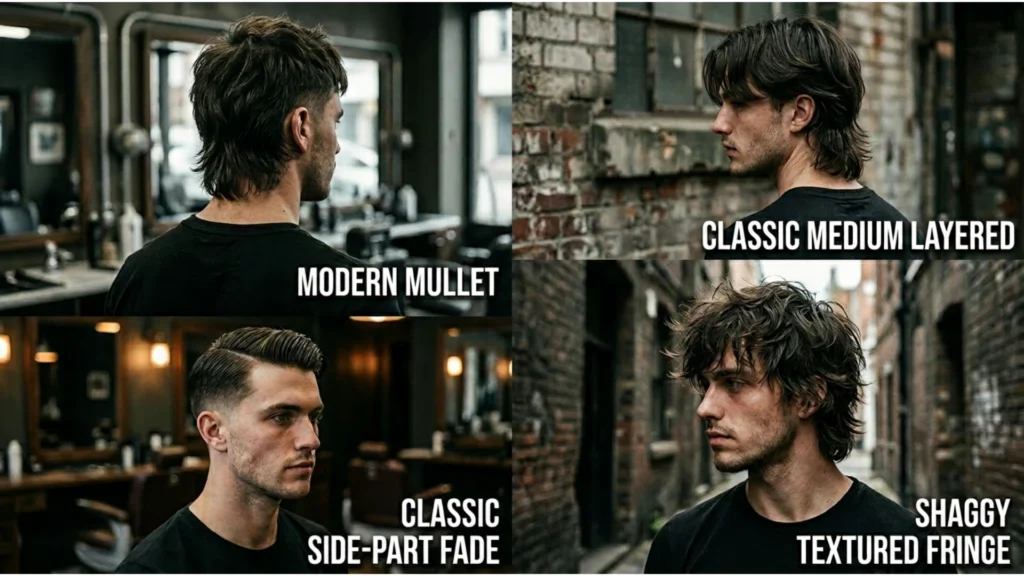
The mullet is back, and it’s not going anywhere. Still one of the boldest and most requested styles of 2026, the modern mullet isn’t going anywhere. Far from its dated origins, today’s version is clean, edgy, and surprisingly versatile. Shorter on the sides, longer at the back, and often paired with fades, textured tops, or even curtain fringes, this cut works with a wide range of hair types.
The low-taper fade softens the sides, so the mullet’s long back section gets all the attention it deserves.
- Best For: Oval, round, and heart faces; all hair types
- What to Tell Your Barber: “Low taper fade on the sides from the ears down. Keep the top medium length and leave the back long. I want a modern mullet shape.”
- Products: Sea salt spray, light texturizing paste, light-hold mousse
- Pro Tip: The mullet works best with natural texture, avoiding over-smoothing the top section, which flattens the retro energy that makes this style so distinctive
18. Low Taper Fade with Curtain Mullet
This hybrid is exactly what 2026 looks like. You get the Gen Z center-part curtain at the front and the retro mullet length at the back all framed by a clean low taper on the sides. It’s bold, it’s social-media-ready, and it works better than it has any right to.
- Best For: Oval and heart faces; wavy to straight hair
- What to Tell Your Barber: “Low taper fade on the sides. Center part in the front with curtain styling, and leave the back longer in a curtain mullet style.”
- Products: Light cream, sea salt spray, light wax
- Pro Tip: The profile view shows the full curtain-to-mullet transition most dramatically this is the most Instagram-worthy angle for this style
19. Low Taper Fade with Comb Over
Long hair combed dramatically to one side, with the low taper keeping the opposite side clean and minimal. A sleek, professional option, the low-taper comb-over is ideal for both formal and casual settings. The hair is combed over from a deep part, creating a voluminous, structured look. The low taper fade ensures a clean finish, complementing the length on top and beautifully framing the face.
- Best For: Oval and square faces; straight to fine hair
- What to Tell Your Barber: “Low taper fade from the ears down. Keep the top long on one side I want a defined comb over to the left/right. Can we discuss a hard part?”
- Products: Strong pomade, fine-tooth comb, strong-hold spray
- Pro Tip: Always comb in the direction of natural hair growth, fighting the natural direction causes the style to collapse faster throughout the day
20. Low Taper Fade with Long Wolf Cut
The wolf cut is layered, shaggy, and full of personality. When you add a low taper fade to the sides, you get a style that combines grunge-inspired texture with barbershop-level precision the perfect hybrid for 2026.
Barbers have a front-row seat to the evolution of men’s hair trends in 2025, with strong moves toward more expressive shapes, natural finishes, and nostalgic nods to iconic eras. The wolf cut with a low taper fade perfectly captures all three.
- Best For: Oval and heart faces; wavy to textured hair
- What to Tell Your Barber: “Low taper fade from the ears down. On top, I want a wolf cut with lots of layers, texture, and movement. Not a clean, polished cut on top.”
- Products: Sea salt spray, light mousse, texturizing powder, diffuser
- Pro Tip: The wolf cut grows out beautifully between barber visits; it’s one of the best low-maintenance long styles for guys who can’t get in every two weeks
Textured & Cultural Styles
21. Low Taper Fade with Braided Top
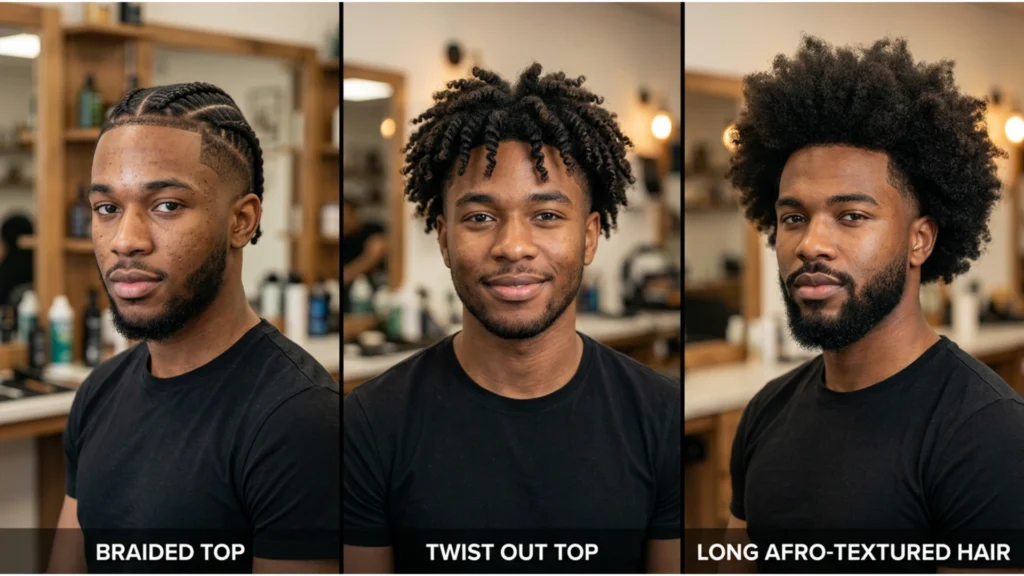
The braided top with a low taper fade is a celebration of both cultural identity and barbering precision. Cornrows, box braids, or single braids occupy the long top section while the clean, tapered sides create a defined perimeter that makes the braids pop.
- Best For: Square and oval faces; thick, coily, or textured hair
- What to Tell Your Barber: “Low taper fade starting just above the ears. Keep the top long enough for braids. I’ll discuss the braid pattern with my stylist separately.”
- Products: Edge control, braid spray, leave-in conditioner, argan oil
- Pro Tip: Moisturize the scalp with argan oil weekly during braided periods. The low taper perimeter still needs a touch-up every 2 to 3 weeks, even while braided
22. Low Taper Fade with Twist Out Top
The twist-out technique creates a defined, spiral-textured top section full of bounce and personality. The low taper fade gives it a proportionate frame that beautifully balances the natural volume.
- Best For: Round and oval faces; coily, afro-textured hair
- What to Tell Your Barber: “Low taper fade on the sides starting just above the ears. The top is styled as a twist-out; leave it fully intact and untouched.”
- Products: Twisting butter, leave-in conditioner, curl cream
- Pro Tip: Do your twist-out the night before your barber visit so the definition is fully set and your barber can see the shape when discussing the cut
23. Low Taper Fade with Long Afro-Textured Hair
Coily, afro-textured hair paired with a low taper fade creates one of the most visually impactful looks in men’s grooming. The tight coils on top build height and volume, while the gradual fade on the sides creates a contrast that feels both bold and intentional.
- Best For: Oval and round faces; coily, type 4 hair
- What to Tell Your Barber: “Low taper fade below the natural afro shape. Keep the top completely untouched and full I want the height preserved.”
- Products: Defining gel, leave-in conditioner, argan oil, wide-tooth comb
- Pro Tip: Pick out the afro upward before your barber visit this shows the true shape and helps your barber see the natural growth pattern clearly
2026 Trending Styles
24. Low Taper Fade with Two-Block Cut
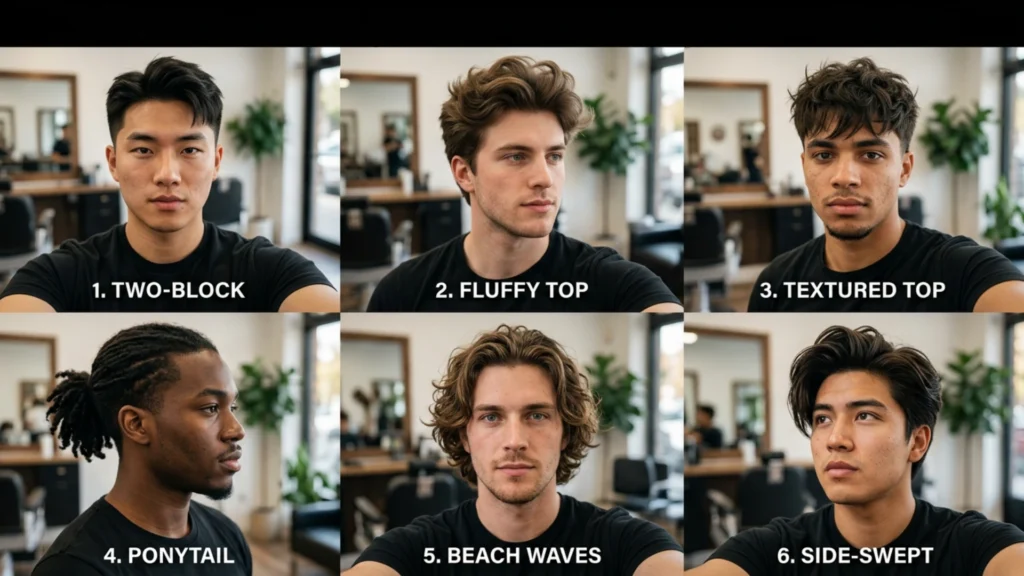
The two-block cut, hugely popular in Korean barbering and now taking over American barbershops, features a dramatically long top that sits disconnected from short, clean sides. Adding a low taper instead of a hard disconnect softens the transition and makes it more wearable for everyday life.
- Best For: Oval and diamond faces; straight to wavy hair
- What to Tell Your Barber: “I want a two-block style, but instead of a hard disconnect, use a soft low taper on the sides. Keep the top very long.”
- Products: Light cream, blow dryer, round brush
- Pro Tip: The two-block low taper is the most face-framing variation in this list ask your barber to keep the sideburn connection very soft for the most natural look
25. Low Taper Fade with Fluffy Long Top
A voluminous, soft, almost cloud-like top that moves with every step. The long hair is styled for maximum body and bounce and the low taper keeps the outline clean without robbing the top of any of its volume.
- Best For: Round and oval faces; fine to medium wavy hair
- What to Tell Your Barber: “Low taper fade above the ears. Leave the top long and layered I want it to look full and fluffy when blow-dried.”
- Products: Volumizing mousse, blow dryer, diffuser, finishing spray
- Pro Tip: Apply mousse to soaking-wet hair and diffuse immediately if you let it air-dry first, you lose the volume that the mousse was building
26. Low Taper Fade with Textured Long Top
The point-cutting technique creates movement, dimension, and life in the long top section. The hair looks like it has its own energy, individual pieces catching the light differently while the low taper on the sides brings everything back to a clean, organized whole.
- Best For: All face shapes; medium to thick hair of any texture
- What to Tell Your Barber: “Low taper fade from the ears down. Use point cutting on the top to add texture and movement, keep it long overall.”
- Products: Matte clay, texturizing paste, sea salt spray
- Pro Tip: Point cutting, not blunt cutting on the long top section is essential for this style. It removes bulk without removing length, which is exactly what you want
27. Low Taper Fade with Ponytail
Simple, functional, and surprisingly stylish. The long top gets pulled back into a neat ponytail, low, medium, or high, while the low taper on the sides makes the overall look intentional rather than just utilitarian.
- Best For: All face shapes; any hair type with sufficient length
- What to Tell Your Barber: “Low taper fade from the ears down. Keep enough top length for a ponytail at least 3 to 4 inches for a basic tie-back.”
- Products: Styling cream, clear elastic, finishing spray
- Pro Tip: Secure with a seamless elastic regular rubber bands cause breakage in long hair over time, especially at the nape of the neck
28. Low Taper Fade with Beach Waves
Relaxed, effortless, and sun-kissed. The long top section is styled with sea salt spray to create loose, casual waves that look like you just got back from the ocean. The low taper grounds the look with clean sides.
- Best For: Oval and square faces; naturally wavy or straight hair
- What to Tell Your Barber: “Low taper fade just above the ears. Keep the top long I want to style it with sea salt spray for a beachy, wavy look.”
- Products: Sea salt spray, light texturizing cream, diffuser
- Pro Tip: Spray sea salt on slightly damp hair, scrunch, and then leave it alone the less you touch beach waves while drying, the better they set
29. Low Taper Fade with Long Side Swept Hair
A sweeping side motion carries the long top section dramatically to one side. The low taper on the other side creates a strong asymmetrical contrast that feels bold but still professional.
- Best For: Oval and rectangular faces; straight to wavy hair
- What to Tell Your Barber: “Low taper fade from the ears down. Leave the top long enough for a dramatic side sweep. I want movement and direction.”
- Products: Medium pomade, round brush, blow dryer, light spray
- Pro Tip: Blow-dry the side sweep against gravity, and in the sweep direction simultaneously; it builds volume and direction at the same time
30. Low Taper Fade with Long Shag Cut
The shag gives the long top plenty of layering, movement, and a slightly rebellious energy. The low taper fade brings it back from the edge, making it work in real-world settings while still standing out.
- Best For: Oval and heart faces; wavy to straight, medium to thick hair
- What to Tell Your Barber: “Low taper fade on the sides. On top, a shag cut has lots of layers, face-framing pieces, and movement. Long overall.”
- Products: Texturizing spray, light mousse, styling cream
- Pro Tip: A shag with a low taper requires an experienced barber for the layering ask to see their previous shag work before committing
31. Low Taper Fade for Coily Long Hair
Coily hair with real length creates jaw-dropping visual impact. The tightly coiled strands spiral upward and outward from the long top section, and the low taper underneath provides a clean, proportional base that makes the whole look deliberate.
- Best For: Round and oval faces; type 3C to 4C coily hair
- What to Tell Your Barber: “Low taper fade on the sides. Keep all my coily length on top, do not touch the top section.”
- Products: Leave-in conditioner, defining cream, argan oil, wide-tooth comb
- Pro Tip: Detangle coily long hair only while wet and loaded with conditioner. Dry detangling causes breakage, especially in the longer sections
32. Low Taper Fade with Flow Hairstyle
The flow is exactly what it sounds like long hair that simply flows naturally, with no rigid style imposed on it. Add a low taper, and suddenly the flowing length feels intentional rather than overgrown.
As part of the wider 2026 curly hair trends for men coming into the mainstream, the flow haircut is all about embracing movement, length, and layered volume. Today’s version is structured, shaped, and styled to bring out the best in your natural texture.
- Best For: All face shapes; medium to long straight or wavy hair
- What to Tell Your Barber: “Low taper fade on the sides. Leave the top as natural and long as possible. I want a flow, not a sculpted style.”
- Products: Leave-in conditioner, light cream, sea salt spray
- Pro Tip: The flow grows out beautifully. Schedule fade touch-ups every 3 weeks, but only trim the top every 6 to 8 weeks to maintain the length
33. Low Taper Fade with Long Faux Hawk
The faux hawk gives the long top section a subtle central ridge hair styled slightly upward in the middle, tapering down on each side. The low taper makes the whole thing feel polished rather than punk.
- Best For: Oval and square faces; medium to thick hair
- What to Tell Your Barber: “Low taper fade on the sides. Keep the top long, I want to style a faux hawk down the center without going too dramatic.”
- Products: Medium clay, texturizing paste, light spray
- Pro Tip: Use two products here, clay for hold at the roots and sea salt spray through the lengths for texture. The combination creates lift without stiffness
34. Low Taper Fade with Sleek Long Top
Think of this as the no-frills, maximum-polish version. Long hair is styled perfectly straight and smooth, lying flat and controlled. The low taper makes every angle look precise. It’s the go-to for men who want a very clean, very minimal aesthetic.
- Best For: Oval and heart faces; straight, fine to medium hair
- What to Tell Your Barber: “Low taper fade starting above the ears. Keep the top long and straight, with no texture, no layers. Just clean and smooth.”
- Products: High-shine pomade, flat iron, heat protectant, fine-tooth comb
- Pro Tip: Apply high-shine pomade through a flat-ironed top for a mirror-smooth finish that lasts all day. Add a light mist of finishing spray to lock it in
35. Low Taper Fade with Long Natural Texture
This one is for the guy who wants to look great without working too hard for it. Natural texture is embraced entirely on the long top, no fighting the hair’s natural pattern, just enhancing what’s already there. The low taper gives it a clean, finished feel.
- Best For: All face shapes; any hair texture in its natural state
- What to Tell Your Barber: “Low taper fade on the sides. Leave the top long, and let’s work with my natural hair pattern, whatever it naturally does, I want to embrace it.”
- Products: Light leave-in conditioner, curl cream (for texture), sea salt spray (for waves)
- Pro Tip: The best product for natural texture is usually the least product. Start with a fingertip-sized amount and build only if needed. Less is almost always more
With 35 different ways to wear a long-hair taper, picking the one that actually fits your geometry is the hardest part. TaperMatch scans your facial structure and narrows this list down to the three styles most likely to suit you.
Which Low Taper Fade Long Hair Style Suits Your Face Shape?
The right style depends on more than just what looks good in pictures. It depends on what works with your specific face shape. Here’s how to match the two:
Featured Snippet Answer: The best low-taper fade long hairstyle for your face shape depends on your proportions. Oval faces suit any variation. Round faces need height on top. Square faces benefit from length that softens the jawline. Heart faces look best with center parts or curtain hair. Diamond faces shine with volume on top.
What Hairstyle Works Best for Oval Face Shape?
Great news oval is the most versatile face shape. Almost every style in this list works. Your best move is to choose based on your hair type and personal style rather than face shape restrictions. Add volume for personality, or go sleek for professionalism. You genuinely can’t go wrong.
What Hairstyle Works Best for a Square Face Shape?
The strong, angular jawline of a square face is actually an asset here. As one barber on Reddit’s r/Barber community explained, “the taper is a softer fade that works for almost anyone,” and it especially suits square or oval faces where the clean neckline highlights the jawline. Go for a slick back, man bun, or long pompadour. Avoid blunt, disconnected sides; the gradual low taper blends better with your natural bone structure.
What Hairstyle Works Best for a Round Face Shape?
Round faces need height and length on top to create vertical proportion. Leaving 2 to 3 inches on top balances proportions for round face shapes. Curtain hair, a quiff, or a center part are ideal. Avoid styles that add width at the sides. The low taper is already helping you there by keeping the sides minimal.
What Hairstyle Works Best for a Heart Face Shape?
Heart faces have a wider forehead and a narrower chin. Curly hair and center-parted styles are your best friends; they balance a wide forehead by framing the face symmetrically. Avoid very heavy fringes, which can make the forehead appear even wider.
What Hairstyle Works Best for Diamond Face Shape?
Diamond faces are narrow at the forehead and chin, with the cheekbones being the widest point. Volume on top, like the pompadour, quiff, or fluffy top, complements this naturally. For diamond faces, tapering reduces focus on cheekbones for a softer overall look.
What Hairstyle Works Best for a Long or Oblong Face Shape?
With long faces, avoid adding extra height it makes the face look even longer. Instead, let the hair flow naturally sideways with waves or a tousled texture. The low taper is preferred over a high fade here because it keeps width in the sides without dramatically elongating the face.
Identifying your own face shape in the mirror is notoriously difficult. Skip the guesswork and use a structural biometric scan to map your jaw angle and symmetry for a face-optimized recommendation.
| Face Shape | Best Style | Avoid |
|---|---|---|
| Oval | Any variation | Nothing most versatile |
| Square | Slick back, man bun, pompadour | Hard disconnected sides |
| Round | Curtains, quiff, center part | Volume at the sides |
| Heart | Curly hair, center part | Heavy fringe |
| Diamond | Wavy flow, pompadour, quiff | Too much width on the sides |
| Rectangular | Textured waves, messy top | Extra height on top |
| Oblong | Wavy, tousled, half-up bun | High pompadour, skin fades |
How Does the Low Taper Fade Work for Different Hair Types?
One of the biggest reasons this style is so popular is that it genuinely works for every hair type. But the approach differs depending on your natural texture.
Low Taper Fade Long Hair for Straight Hair
Straight hair is the sharpest canvas for a low taper fade. Every line looks precise, every blend looks intentional, and the contrast between the smooth top and the faded sides is at its most defined. For those with straight hair, options abound from long-on-top flows to crisp cuts that suit any face shape.
Products to use: pomade for shine, matte clay for a modern matte finish, or a blow dryer with a round brush for directional volume. The key is to choose a finish, glossy or matte, and commit to it. Mixing both often creates an inconsistent look.
Key Fact #2: According to Andis educator and professional barber Tone McGill, “Not using clippers designed for a client’s natural hair texture can ruin a potentially good fade. It’s all about the seamless progression of hair, the transition from lighter to darker. For straight hair, a rotary motor clipper like the Andis Supra ZR gives the cleanest result.”
Wavy hair creates natural movement that the low taper complements beautifully. The waves draw the eye upward and outward, while the clean sides give the look structure. Ask for face-framing layers and soft texturizing through the ends to avoid bulk. This keeps the wave pattern expressive without looking overly heavy.
Products to use: sea salt spray for texture, light mousse for volume, or texturizing paste for definition. Apply to damp hair and scrunch; never flat-brush wavy hair before it’s fully dry.
Low Taper Fade Long Hair for Curly Hair
Curly long hair works exceptionally well with the low taper fade. The curl pattern creates a natural blurring effect at the blend line, making the transition from long top to tapered sides look especially organic. A taper fade with curly hair keeps curls defined on top while reducing bulk on the sides.
Products to use: curl cream to define the curl pattern, leave-in conditioner for moisture, and a diffuser attachment on the blow dryer to build volume without frizz.
Low Taper Fade Long Hair for Coily or Afro-Textured Hair
The contrast between coily hair and a low taper fade is the most dramatic of all hair types, and it looks incredible. The tight coils rise from the long top section, creating a visual separation from the tapered sides that no other hair type can match.
Products to use: argan oil for shine and moisture, defining gel for coil structure, and a wide-tooth comb for detangling while wet.
Low Taper Fade Long Hair for Fine or Thin Hair
Fine hair benefits enormously from the low taper fade. The taper removes bulk from the sides without making the top appear thinner, and with the right styling on top, you can build the appearance of much fuller hair. Straight or fine hair benefits from the definition and contrast the taper creates, preventing a flat, one-dimensional look.
Products to use: volumizing mousse, thickening spray, and a round brush with a blow dryer to lift at the roots.
What Should You Tell Your Barber for a Long-Hair Low-Taper Fade?
This is where most guys mess up. They get into the chair; they know roughly what they want, but they can’t find the words, and they end up with a haircut that’s close but not quite right.
Here’s everything you need to say, clearly and confidently.
What Is the Exact Script to Ask for This Cut?
Featured Snippet Barber Script: “I want a low taper fade starting just above my ears. The fade should blend gradually down toward the neckline. Keep it natural, not squared. Leave the top completely untouched for length. Blend softly into the sideburns. A #2 on the sides transitioning to a #1 near the base.”
That’s it. Those sentences will get you the right haircut in any barbershop across the USA.
Tell your barber you want the fade to start low, just above the ears, while keeping the top long and untouched. Bring a reference photo, mention how sharp or blended you prefer the sides, and clarify your neckline and sideburn style.
Which Clipper Guard Sizes Are Used for a Low Taper Fade?
| Zone | Guard Size | Length | Purpose |
|---|---|---|---|
| Base / Neckline | #0 or #0.5 | Near skin | Lowest fade point |
| Low sides | #1 | 3mm | Beginning of blend |
| Mid sides | #2 | 6mm | Mid-transition zone |
| Upper sides | #3 | 10mm | Approaches longer top |
| Top (long hair) | Scissors | Maintained length | Preservation zone |
Key Fact #3: “Specify your fade height in inches. ‘Low’ means different things to different barbers. Ask about their clipper guards; a #1 guard at one shop might be a #2 at another.”
What Reference Photos Should You Bring to the Barber?
Always bring three photos front angle, side profile, and back neckline. One photo is never enough. Different barbers interpret “long on top” and “low fade” differently, depending on who they’re used to cutting. Showing three angles removes all ambiguity.
Also note the hair type and face shape of the person in your reference photo. If they look different from you, tell your barber which specific elements you want to replicate and which you want adjusted.
When Is the Best Time to Book a Barber Appointment?
Book morning appointments, your barber’s steadiest hand comes before noon, not after six clients. Fresh blades, a fresh mind, and a steady hand make a real difference in the quality of a fade.
Also, before you leave the shop, book your next appointment. It’s that simple. The hardest part of maintaining a great low taper fade is remembering to go back every 2 to 3 weeks.
Instead of trying to memorize a script, you can generate a custom Barber-Ready Brief. It includes the exact technical specs, guard numbers, and verbatim instructions to show your barber directly from your phone.
How to Pair a Low Taper Fade Long Hair and a Beard
Here’s the thing no competitor talks about a great beard can make your low taper fade long hair look twice as good. The taper from your sideburns can blend directly into a well-groomed beard, creating a seamless, cohesive transition from scalp to chin.
Which Beard Style Complements a Low Taper Fade with Long Hair?
| Beard Style | Best Paired With | Effect |
|---|---|---|
| Stubble (3–5mm) | All long styles | Masculine, casual balance |
| Full Beard | Man bun, slick back | Dramatic, powerful contrast |
| Clean Shave | Pompadour, curtains, center part | Maximum contrast, sleek |
| Chinstrap | Long pompadour | Sharp, architectural framing |
| Beard Fade | All styles | Seamless taper-to-beard blend |
A taper fade with a beard creates balance between head and facial hair. When your barber fades the taper into the beard line, it removes the hard stop between the fade and your facial hair, making the whole look feel like one intentional style rather than two separate grooming decisions.
Key Fact #4: A study published in the Journal of Evolutionary Biology by Dixson and Brooks (2013) found that men with heavy stubble were rated as most attractive by women in studies measuring facial hair preference. The combination of heavy stubble, a clean, low-taper fade, and long hair represents a high-effort grooming aesthetic that signals both masculinity and attention to detail.
How to Style Low Taper Fade Long Hair: Step-by-Step
How to Style Long Straight Hair with a Low Taper Fade
- Apply a pea-sized amount of heat protectant to damp hair
- Blow-dry backward with a round brush, lifting slightly at the roots for volume
- Apply pomade or clay to your fingertips and work it through the mid-lengths to ends
- Use a fine-tooth comb or vent brush to set the final direction
- Finish with a light-hold spray to lock the style in place
Styling time: 8–10 minutes
How to Style Long Wavy Hair with a Low Taper Fade
- Towel-pat the hair gently to remove excess water never rub
- Apply sea salt spray throughout the hair, scrunching upward from the ends
- Work a small amount of texturizing paste through the lengths with your fingers
- Air-dry or diffuse on low heat keep the diffuser moving in small circles
- Once dry, shake the roots gently to separate and add volume
Styling time: 10–15 minutes (mostly drying time)
How to Style Long Curly Hair with a Low Taper Fade
- Wash with a sulfate-free shampoo to preserve natural curl moisture
- Apply leave-in conditioner while the hair is still soaking wet section by section
- Layer curl cream over the top, pressing it in with a prayer-hands motion
- Diffuse on medium heat using a scrunching motion bring the diffuser upward toward the scalp
- Do not touch the curls until fully dry this is the golden rule for perfect curl definition
Styling time: 15–20 minutes (including diffuse time)
Best Products for Low Taper Fade Long Hair
Choosing the wrong product is one of the most common mistakes guys make after getting a great haircut. Here’s a quick guide to help you pick what’s right for your hair type and desired finish.
| Hair Type | Goal | Best Product | Hold | Finish |
|---|---|---|---|---|
| Straight | Sleek and shiny | High-shine pomade | Medium-high | Glossy |
| Straight | Modern, matte | Matte clay | Medium | Matte |
| Wavy | Natural texture | Sea salt spray | Light | Gritty |
| Wavy | Controlled definition | Texturizing paste | Medium | Matte |
| Curly | Defined curls | Curl cream | Light-medium | Natural |
| Curly | Anti-frizz | Leave-in conditioner | None | Smooth |
| Coily | Moisture and shine | Argan oil + gel | High | Glossy |
| Fine | Volume and body | Volumizing mousse | Light | Soft |
| All types | Texture and lift | Texturizing powder | Light | Matte |
| All types | All-day hold | Strong-hold spray | High | Various |
Always start with less product, then build up. Too much can weigh your taper down or make the fade line look greasy. Students and quick stylists: go with texture powder. Professionals who need a sharp finish: matte clay keeps it clean and understated.
How to Maintain a Low Taper Fade with Long Hair
Getting the cut is the easy part. Keeping it looking sharp takes a bit of consistency but it’s nowhere near as hard as most guys think.
How Often Should You Get a Low Taper Fade with Long Hair?
Featured Snippet Answer: A low-taper fade with long hair requires fade maintenance every 2 to 3 weeks to keep the blend sharp. The top section only needs a trim every 4 to 6 weeks to remove split ends and maintain its shape. Without regular touch-ups, the fade blurs and the contrast fades within 3 weeks.
Every 2 to 3 weeks is the standard to keep the fade sharp and clean. The long top section is more forgiving you only need to visit your barber every 4 to 6 weeks for a light trim to remove split ends and keep the shape.
Key Fact #5: Research published in the International Journal of Trichology confirms that regular trims significantly reduce split-end travel up the hair shaft protecting the health and integrity of long hair over time. Trimming every 6 weeks prevents split ends from traveling more than 2mm up the hair shaft, where they would otherwise continue to split and weaken the strand.
At-Home Maintenance Tips Between Barber Visits
Keeping your low taper fade looking good between appointments doesn’t require much just a few smart habits:
- Pat dry, never rub. Rough towel-rubbing the fade zone creates friction that can make the blend line look fuzzy faster
- Silk or satin pillowcase. Cotton creates friction that dulls the fade definition overnight. Silk and satin preserve the clean edges longer
- Avoid hot showers in the fade zone. Very hot water swells the hair cuticle and blurs the blend line. Warm water is fine; scalding isn’t
- Use a sulfate-free shampoo. Sulfates strip natural oils, causing the scalp to overproduce oil and make the fade zone appear greasy sooner than it should
- Go easy on the product near the fade. Heavy wax or thick pomade applied directly to the tapered sides clumps and visually blurs the transition, keeping the product focused on the top section
- Comb long hair from ends to roots. Always detangle from the tips upward, starting at the roots, to prevent breakage in the long section
Common Mistakes to Avoid with a Low Taper Fade Long Hair
What Are the Most Common Mistakes Men Make with This Haircut?
Most guys don’t ruin the look at the barbershop they ruin it at home. Here are the six most common mistakes to avoid:
- Waiting too long between barber visits. The fade blurs after about 3 weeks. Waiting 6 or 8 weeks makes the sides look like a grown-out mess rather than a clean fade
- Overloading the product on the taper zone. Heavy wax and thick pomade applied to the sides create clumping that visually blurs the blend line
- Not specifying the neckline type. Squared vs. natural neckline dramatically changes the overall feel of the cut always tell your barber which you want
- Showing one reference photo. Always bring front, side, and back reference photos one angle isn’t enough for a barber to fully understand what you’re after
- Skipping heat protectant. Long hair on top is vulnerable to blow-dryer and flat-iron damage never skip this step if you use heat
- Over-layering the top section. Too many layers remove volume. If you want texture without losing length, always ask specifically for point cutting rather than standard layering
Is the low-taper fade with long hair suitable for professional settings?
Yes and this is one of the style’s biggest strengths.
Classy taper fade styles are perfect for office environments. The “low” placement of the fade is the reason why. It stays close to the natural hairline, so it reads as clean and refined rather than edgy or bold. It’s the difference between a style that says “I take care of myself” and one that says “I’m making a statement.” The low taper fade remains the MVP of men’s haircuts in 2026. It’s clean enough for your boss, cool enough for your weekend, and doesn’t require daily babying.
How to Style Low Taper Fade Long Hair for Different Occasions
| Occasion | Best Style | Product | Time |
|---|---|---|---|
| Office / Professional | Slicked back, comb over, side part | Pomade or clay | 10 minutes |
| Date Night | Slick back bun, wavy flow, curtains | High-shine pomade | 10–15 minutes |
| Casual / Everyday | Messy top, tousled waves, half-up | Sea salt, light wax | 5 minutes |
| Formal Event | Pompadour, slick back | Strong pomade | 15–20 minutes |
| Beach / Outdoors | Natural wavy flow, messy top | Sea salt spray | 3–5 minutes |
| Gym / Active | Man bun, half-up | Styling cream | 2 minutes |
The Low Taper Fade Long Hair in 2026: History, Culture & Modern Influence
The low taper fade isn’t a new invention. It has deep roots and understanding where it came from makes you appreciate it even more.
Key Fact #6: Taper fades originated in the 1940s as part of U.S. military grooming standards. During World War II and the Korean War, American soldiers were required to keep their hair short, neat, and uniform. The Army Regulation 600-20 (1941) specified hair should be “tapered from zero length at the hairline on the lower portion of the head to the required length at the top.” Then, Black barbers in the 1950s–70s transformed the military taper into an art form. They introduced more dramatic contrasts in length, creative temple designs, and personalized variations based on hair texture. The Black barbershop became a cultural hub for the development of new fade techniques.
While the fade was dominant in the military through the mid-20th century, it didn’t truly explode in mainstream fashion until the late 1980s and early 1990s. This era marked the haircut’s revival, fueled by African American and hip-hop culture. The iconic high-top fade became synonymous with hip-hop artists and athletes, influencing mainstream media and fashion. You could see it on everyone from rappers like Big Daddy Kane to basketball stars like David Robinson.
By 2026, the low taper fade haircut is a bold trend for men looking to wear a smart, flexible cut. The longer hair on top, with gradually shorter sides and back, is perfect for all occasions, such as work meetings and music events.
Every single fade has a story behind it, whether it’s a student in New York getting a clean low taper for graduation or a Miami barber perfecting a beard fade before a night out. These everyday moments highlight that the taper fade is about much more than just the haircut itself; it’s confidence, culture, and identity all captured in one look.
Low Taper Fade vs. Mid Taper Fade with Long Hair: Which Is Better?
This is one of the most common questions guys ask before booking their appointment, and the answer depends on what you want your overall look to communicate.
Featured Snippet Answer: For long hair, the low taper fade is the better choice in most cases. It creates a more natural transition, works better during grow-out periods, and is more universally professional. A mid-taper fade creates stronger contrast and is better suited to bold styles like the mullet or pompadour, but is less versatile day-to-day.
Here’s a simple breakdown:
- Low taper fade + long hair = subtle, refined, professional-friendly, works in every setting
- Mid taper fade + long hair = stronger contrast, bolder visual, better for statement styles
- High taper fade + long hair = dramatic, high-contrast, best for very bold personalities and styles
A mid taper fade offers a balanced option, sitting between the low fade and high fade. It starts around the middle of the head, providing a balanced and diverse look. It’s ideal for those who want a more modern, stylish edge without the extreme contrasts of the high fade.
For long hair specifically, the low taper is almost always the smarter choice. The long top already creates significant visual interest on its own, you don’t need aggressive contrast from a high fade to make the style work.
Expert Barber Tips for the Perfect Low Taper Fade Long Hair
What Do Professional Barbers Recommend for This Style?
These are the insights that separate a good fade from a perfect fade: things your barber knows but may not always tell you:
- Book morning appointments. Your barber’s steadiest hand comes before noon, not after six clients. Precision fades require steady hands morning is always better.
- Specify “soft blend” vs. “hard contrast” upfront. These two phrases mean very different things to a barber. A soft blend creates a gradual, almost invisible transition. A hard contrast creates a more defined line. Neither is wrong but your barber needs to know which you want before the clippers come out.
- Ask about guard calibration. A #1 guard at one shop might be a #2 at another. Always ask your barber to describe what each guard size means in terms of length at their specific shop.
- Request a natural neckline for professional settings. A natural (rounded) neckline is more conservative and grows out cleaner. A squared neckline looks sharper but requires more frequent maintenance. Choose based on your lifestyle.
- Ask for scissor-over-comb on the upper fade zone. This technique creates a seamless transition between the long top and the tapered sides that clippers alone cannot achieve. It’s the mark of a skilled barber, and it’s absolutely worth requesting.
- For thick hair, request thinning shears for the lower-top section. This reduces bulk at the blend line without removing any visible length. The result is a cleaner, more seamless transition from long top to tapered side.
Frequently Asked Questions
Can you have a low taper fade with long curly hair?
Yes absolutely. Long curly hair and a low taper fade work exceptionally well together. The natural curl volume on top creates a striking contrast with the clean tapered sides. Use a curl cream, leave-in conditioner, and a diffuser to define and maintain your curls after the cut.
What guard size is used for a low taper fade?
A low taper fade typically uses a #0 or #0.5 at the neckline, graduating upward to #1, #2, and #3 toward the longer top section. The exact progression varies by barber, so always confirm the guard sizes at your specific barbershop.
Is a low taper fade suitable for a professional work environment?
Yes. The low taper fade is one of the most office-appropriate fade styles available. Its subtle placement and gradual blend create a polished, refined look that works in business, formal, and casual settings alike. Low fade is subtle and clean, making it ideal for professional settings.
How often should I get a low taper fade with long hair?
Get the fade touched up every 2 to 3 weeks to maintain its sharp appearance. The long top section only needs trimming every 4 to 6 weeks to stay healthy and well-shaped. Book your next appointment before leaving the shop to stay consistent.
What products should I use for long hair with a low taper fade?
It depends on your hair type. Use pomade or clay for straight hair. Use sea salt spray or texturizing paste for wavy hair. Use curl cream and leave-in conditioner for curly hair. Always start with a small amount and build up too much product near the taper zone blurs the blend lines.
What is the best low taper fade style for a round face?
For a round face, the best styles are curtain hair, a quiff, or a center part. These styles add height at the top and reduce visual width on the sides, elongating the face and creating better proportions.
What is a mullet with a low taper fade?
A mullet with a low taper fade features medium-length hair on the front and top, clean tapered sides, and a dramatically longer back section.The mullet with low taper fade is back in 2025. The taper fade softens the sides while the mullet keeps that bold, edgy vibe. It’s a retro-modern style that’s one of the most requested cuts in American barbershops right now