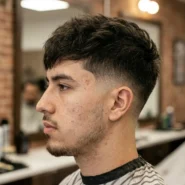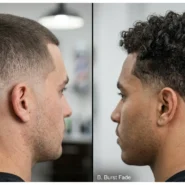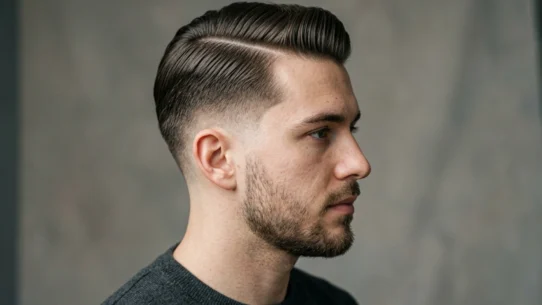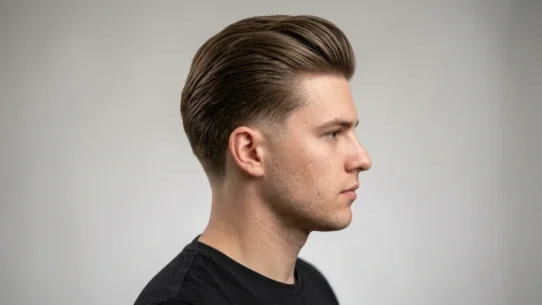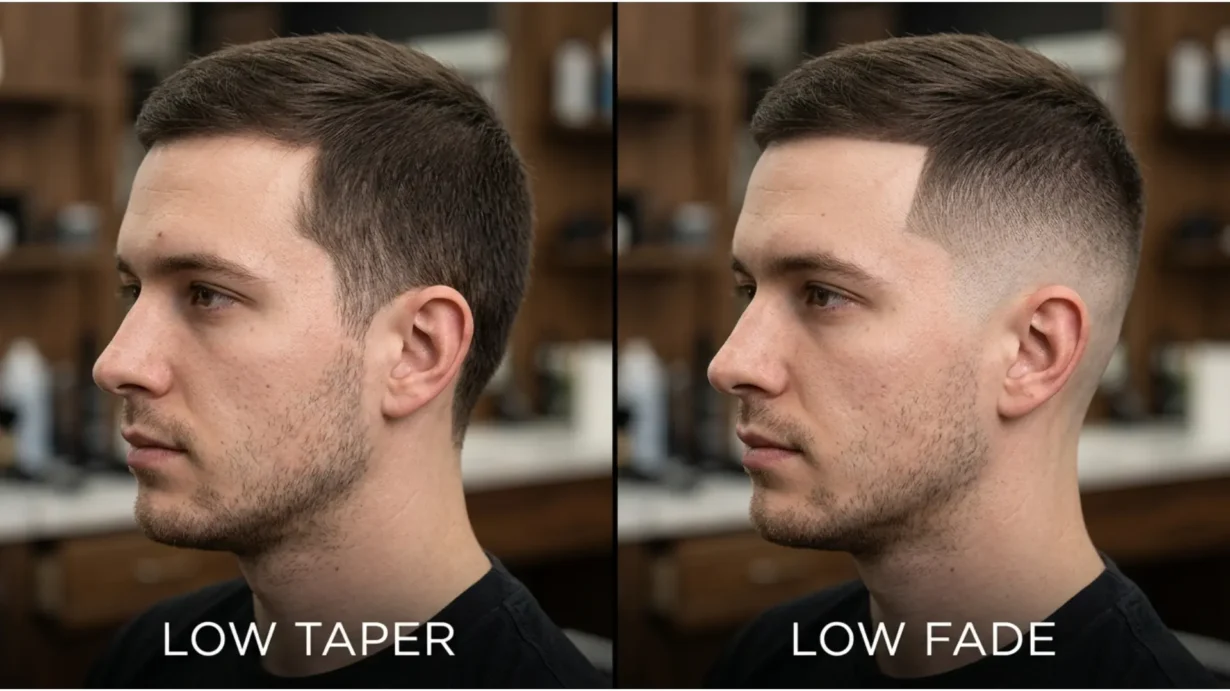

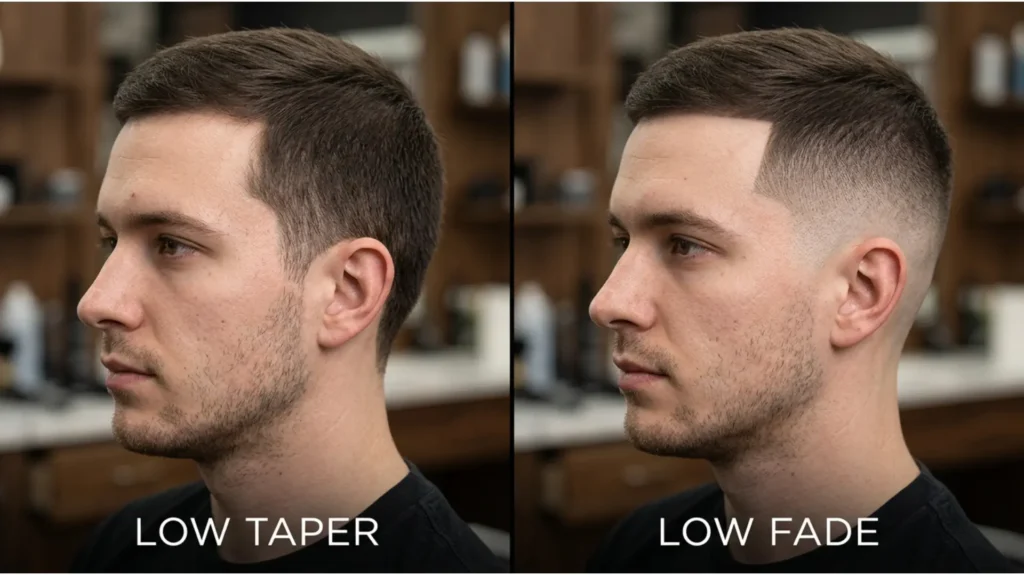
The real difference between a low taper and a low fade is skin exposure. A low taper gradually shortens hair just above the ears and neckline while keeping hair visible; your scalp never shows. A low fade starts in that same zone but blends all the way down to bare skin using a #0 or #0.5 clipper guard, creating sharp, bold contrast.
Both cuts begin at the same spot on your head. That’s why guys, and even barbers, mix up these terms all the time, leading to bad haircuts and frustrated clients. This guide covers the exact differences between a low taper, a low fade, and the hybrid low taper fade, including which one suits your face shape, hair type, and grow-out timeline, as well as the precise terms to use with your barber.
Stick around, you’re about to know more than most guys sitting in the chair.
What’s the Real Difference Between a Low Taper and a Low Fade?
Both cuts start just above the ears but differ in the amount of skin exposed. A low taper gradually shortens hair while keeping it visible at every point. A low fade blends all the way down to bare skin using a #0 guard for sharp, bold contrast. A low taper fade sits between both with moderate contrast and minimal scalp show.
KEY POINTS:
– Low tapers use a #2–#3 guard, while low fades go to #0 or skin
– Low tapers last 4–6 weeks, but low fades need touch-ups every 1–2 weeks
– Low fades suit round faces, while low tapers work best for long faces
– The low taper fade is the safest starting point for beginners
Table of Contents
Heading to the barbershop and not sure which one to ask for?
A low taper and a low fade sound similar but produce different results. The Taper Style Tool helps you identify the right one for your face shape and hair type so you walk in knowing exactly what to say.
What Is a Low Taper?
A low taper is a haircut in which hair gradually shortens, starting just above the ears and around the neckline. The hair gets shorter as it moves downward, but it remains visible at every point. The scalp does not show.
Barbers use scissors or clipper guards #2 and #3 to create a low taper. These guards are long enough to create a smooth, even gradient from the longer top hair to the shorter sides, without exposing any skin.
A low taper functions like a dimmer switch on a light; it reduces the brightness gradually but never turns it off completely. The hair follows the same principle. Length decreases gradually, but hair coverage stays intact from top to bottom.
The result is a defined, visible hairline around the ears. The sideburns transition cleanly into the sides. The neckline stays neat without harsh edges or abrupt changes in length.
Key Point: A low taper preserves a strong, visible hairline around the ears. Hair shortens progressively but never disappears, and that single characteristic is what separates it from every type of fade.
A low taper suits corporate environments, job interviews, weddings, and formal events. The cut is conservative and refined, requiring minimal upkeep compared to fades.
According to Kingsman grooming studio, “A taper haircut is a classic men’s style where the hair gradually gets shorter as it moves down the sides and back of your head, but it never fully disappears.”
What Is a Low Fade?
A low fade starts just above the ears, the same starting point as a low taper. The difference is how far it goes. A low fade reduces hair all the way down to the skin or near-skin level using a #0 or #0.5 clipper guard. That means hair at the lowest point measures approximately 0.5mm or less. The scalp becomes visible.
The transition from longer hair on top to bare skin creates a high-contrast, dramatic gradient. The change in length is abrupt compared to a taper. Hair is present at the top of the fade zone and absent at the bottom.
A low fade operates like a light switch: on at the top, off at the bottom. There is no in-between state where hair is simply shorter. It goes from hair to no hair.
The visual outcome is a modern, angular silhouette with clean sides, exposed scalp at the base, and a strong upward pull of attention toward whatever style sits on top.
Key Point: A low fade uses a #0 or #0.5 clipper guard at its shortest section, cutting hair to 0.5 mm or less and exposing the scalp. That skin exposure is the primary visual difference between a low fade and a low taper.
Low fades pair well with crew cuts, buzz cuts, textured crops, pompadours, faux hawks, and comb-over styles that benefit from high-side contrast.
Style seat says, “A low fade looks similar to a low taper since they both start above the hairline. The major difference is that a fade abruptly changes hair lengths.”
What Is a Low Taper Fade? (The Hybrid Most People Confuse)
A low taper fade combines both cutting techniques into one haircut. It starts as a gradual taper near the ears and neckline, then transitions into a fade-like finish that brings hair closer to the skin at the very bottom — without reaching full skin exposure.
Barbers use a #1 or #2 clipper guard at the shortest point of a low taper fade. That produces more contrast than a pure low taper but less skin visibility than a full low fade.
A structural difference separates the low taper fade from a standard fade: a low taper fade often distributes the blending across two areas, the sides and the back of the head, rather than creating a single, continuous, blurred transition from the top to the skin.
Key Point: A low taper fade is a distinct cut from both the low taper and the low fade. It occupies the middle of the spectrum, with moderate contrast, minimal scalp exposure, and a balanced appearance that functions in both professional and casual settings.
Barbers frequently recommend the low taper fade for first-time fade clients and beginners who want visible contrast without committing to full skin exposure.
The taper gives you a subtle decrease in hair length…often containing the ‘blurriness’ and transition separately in 2 areas: the sides and back of the head. Fades, on the other hand, have a single, connected, blurry transition.
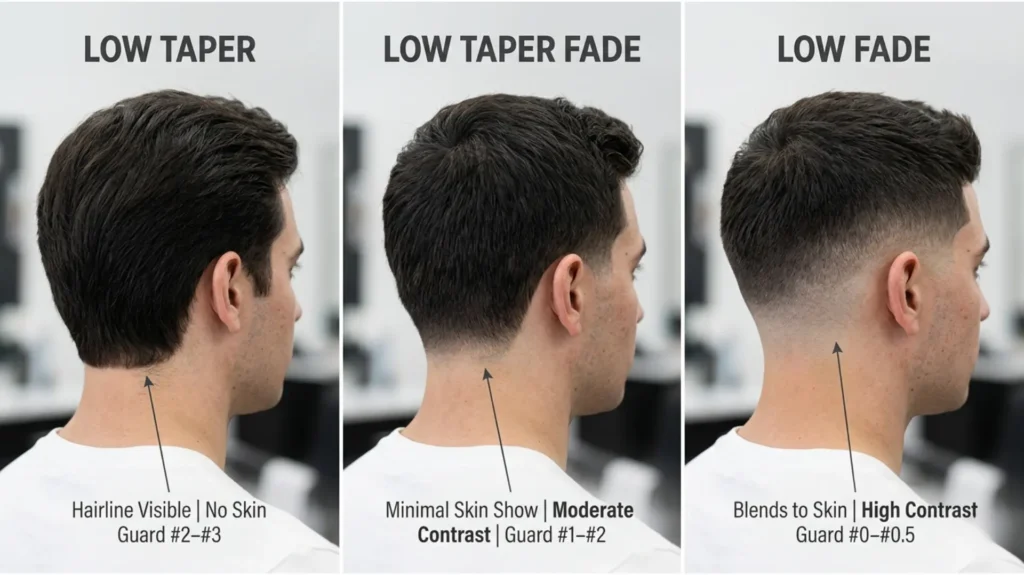
Low Taper vs Low Fade vs Low Taper Fade: Side-by-Side Comparison
All three cuts originate in the same zone on the head. From a distance, they can appear similar. A feature-by-feature breakdown clearly reveals the differences.
| Feature | Low Taper | Low Fade | Low Taper Fade |
|---|---|---|---|
| Starting Point | Just above the ears | Just above the ears | Just above the ears |
| Skin Exposure | None, hair stays visible | Yes, blends with skin | Minimal, slight scalp show |
| Clipper Guard | #2–#3 | #0–#0.5 | #1–#2 |
| Contrast Level | Soft and subtle | Sharp and bold | Moderate, between both |
| Hairline Treatment | Maintained and defined | Dissolved into the skin | Partially maintained |
| Blending Method | One smooth gradient | One dramatic transition | Two separate blend zones |
| Touch-Up Frequency | Every 3–4 weeks (up to 6) | Every 1–2 weeks | Every 2–3 weeks |
| Grow-Out Behavior | Natural and gradual | Loses sharpness fast | Noticeable after 3 weeks |
| Best Setting | Corporate, formal | Trendy, casual, bold | Both settings |
| Analogy | Dimmer switch | Light switch off | Dimmer with a final click |
The defining variable across all three cuts is the extent of hair reduction. A low taper stops at short hair. A low fade continues on the skin. A low taper fade stops between those two endpoints.
Charts are great for theory, but TaperMatch handles the application. Let the platform scan your facial geometry and hair texture to tell you which of these three cuts is structurally designed for you.
Is a Taper the Same as a Fade?
No. A taper and a fade are related techniques with a hierarchical relationship, not synonyms.
Every fade contains a taper. Fading requires gradual length reduction which is tapering by definition. But not every taper qualifies as a fade. A taper reduces hair length while maintaining visible coverage at all points. A fade extends that reduction to the skin.
The relationship is categorical: a taper is the parent technique, and a fade is a more extreme application of that technique. All fades taper. Not all tapers fade to skin.
Fact: According to kingsmangroomingstudio.com, “A fade haircut takes the concept of tapering and turns up the intensity.”Instead of a slow and natural transition, a fade involves a much sharper change in length, often going all the way down to the skin. “
Which Cut Suits Your Face Shape Best?
Face shape determines how each cut interacts with your bone structure. The contrast level and starting point of the cut create optical effects that elongate, widen, or sharpen your face, depending on the combination.
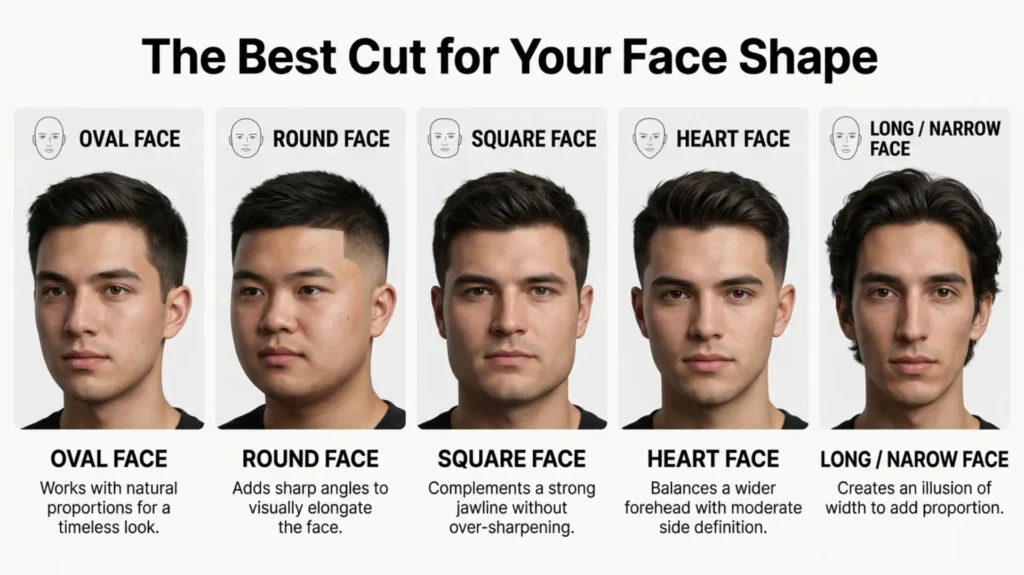
Oval Face
Both low tapers and low fades complement oval faces. Oval is the most proportionate face shape, meaning most cuts work without adjustment. A low fade adds a contemporary edge. A low taper maintains a classic, traditional frame.
Round Face
A low fade is the stronger choice for round faces. The sharp side contrast creates angular lines that visually elongate the face and reduce its apparent width. A low taper produces a softer result with less structural correction.
Square Face
A low taper complements square faces by working with an already-defined jawline rather than competing with it. The subtle transition avoids over-sharpening. A low fade also works for a more aggressive, defined look.
Heart Face
The low taper fade is the most effective option for heart-shaped faces. It balances a wider forehead with moderate side contrast enough definition without overwhelming the narrower chin.
Long or Narrow Face
A low taper is the safer choice for longer faces. A fade’s exposed skin on the sides adds vertical emphasis, which can make a long face appear even longer. The fuller side coverage of a taper creates width and proportion.
Tip #1: Identifying your face shape requires a straight-on photo of your face. Oval faces are longer than they are wide, with curved edges. Round faces have roughly equal width and length. Square faces show a strong, angular jawline. Heart faces are wider at the forehead and narrower at the chin.
Tracing your face in a mirror is a start, but a structural biometric scan is better. TaperMatch reads your jaw angle and symmetry to identify your face shape and the taper that balances it perfectly.
Which Cut Works Best for Your Hair Type?
Hair type affects the visual outcome, grow-out pattern, and daily styling demands of each cut.
Straight Hair
Both cuts produce clean results on straight hair. A low fade creates crisper, more defined lines. A low taper delivers a smoother, more understated transition.
Curly Hair
A low fade enhances curl definition by creating strong contrast between the textured top and the clean, faded sides. A low taper preserves more curl volume on the sides, producing a fuller, more natural shape.
Wavy Hair
A low taper fade is the most effective match for wavy hair. It allows wave texture to remain visible on top while the sides stay structured and controlled.
Thick Hair
Both cuts manage thick hair effectively. A low fade removes more bulk from the sides, reducing weight and producing a sharper visual result on dense hair.
Thin or Fine Hair
A low taper is the recommended option for thin hair. A low fade exposes more scalp surface area on already-thin hair, which can amplify the appearance of thinness rather than disguise it.
Tip #2: Curly and textured hair types benefit from diffuser drying after a cut. A diffuser enhances curl definition on top and increases the contrast effect against tapered or faded sides.
How Long Does Each Cut Last Before Needing a Touch-Up?
Maintenance frequency is one of the most practical differences between these three cuts. The governing principle is straightforward: the shorter the initial cut, the faster regrowth becomes visible.
A low fade cuts hair to skin level. Any regrowth in that zone is immediately noticeable because it disrupts the clean skin-to-hair transition. A low taper leaves more hair at the shortest point, so regrowth blends in naturally and takes longer to look overgrown.
Week-by-Week Grow-Out Timeline
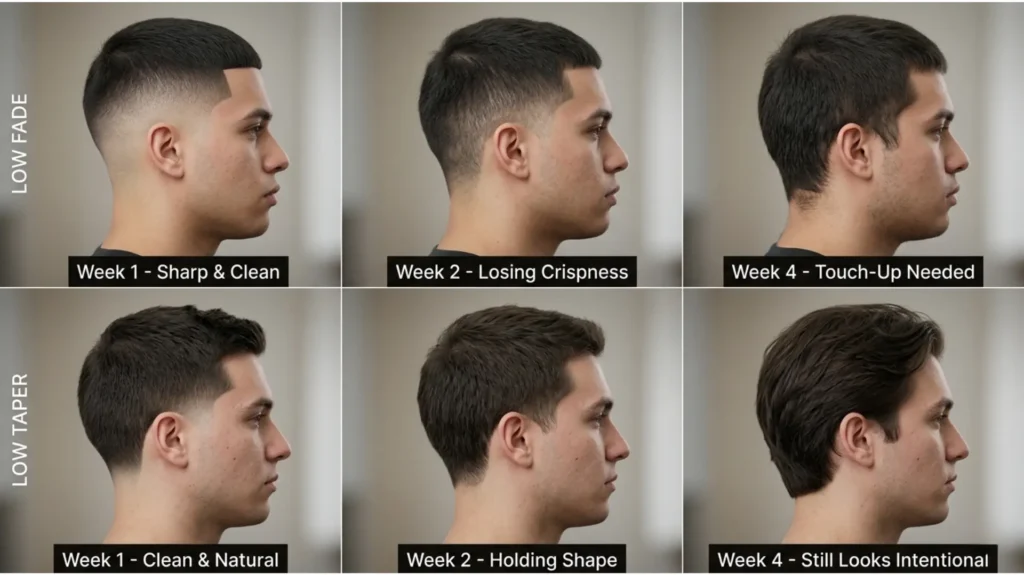
Fact: According to rustybladebarber.com, a low taper fade requires maintenance every 3 to 4 weeks, while higher fades need touch-ups every 1 to 2 weeks because the contrast shows regrowth faster.
Tip #3: A low taper offers the longest interval between barber visits. It grows out smoothly because hair was never fully removed. A low fade maintains its sharpness for roughly one week before the skin-level section starts to show visible stubble.
What Hairstyles Pair Best with Each Cut?
The top hairstyle and the side cut need to match in contrast level and formality. A subtle taper pairs with traditional styles. A bold fade pairs with modern, high-contrast styles.
Best Hairstyles with a Low Taper
- Classic side part — clean, professional, structured
- Natural flow — relaxed layers with movement
- Slicked-back style — polished and refined
- Pompadour (traditional version) — controlled volume
Best Hairstyles with a Low Fade
- Crew cut — minimal and sharp
- Buzz cut — clean and low-maintenance
- Textured crop — modern with movement
- Faux hawk — bold and angular
- Comb over — high contrast with definition
- Low fade undercut — dramatic separation between top and sides
- Afro with low fade — natural texture with defined edges
Best Hairstyles with a Low Taper Fade
- Slicked-back with volume — refined with a modern edge
- Curly top / sponge texture — natural and structured
- Messy fringe brushed forward — casual with controlled chaos
- French crop — structured with subtle contrast
Fact: According to forteseries.com, the low taper fade pairs with over 50 different top styles, including crew cuts, textured crops, side-swept styles, spiky hair, afros, man buns, and longer slicked-back looks, making it one of the most versatile foundation cuts available.
How to Ask Your Barber for the Exact Cut You Want
Miscommunication between the client and the barber is the primary reason men receive the wrong cut. The terms “low taper” and “low fade” have different meanings among barbers. Specific language eliminates ambiguity.
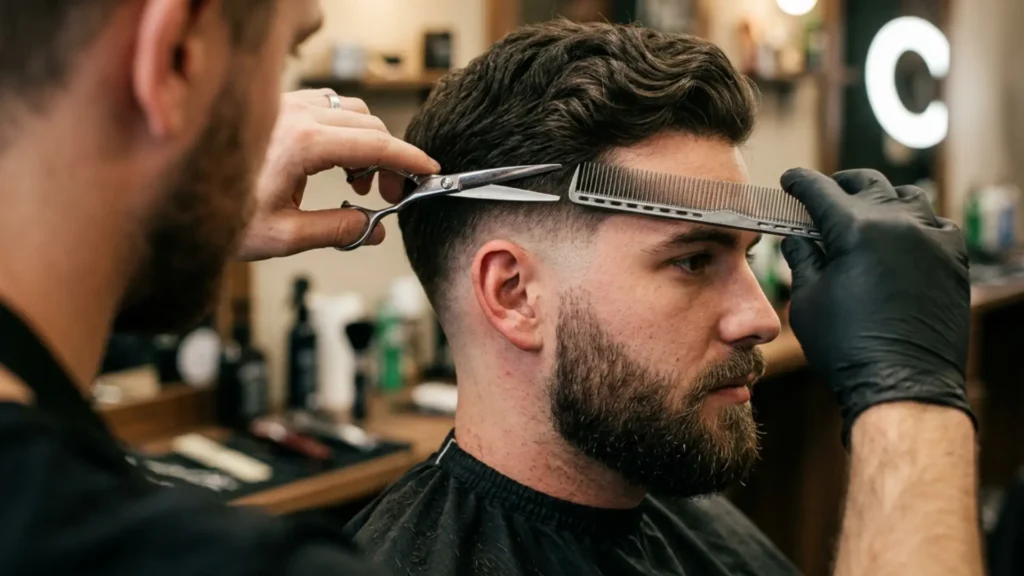
For a Low Taper:
“I want a low taper starting just above my ears. Keep hair visible on the sides no skin showing. Blend it gradually into my neckline. Use a #2 or #3 guard at the shortest section.”
For a Low Fade:
“I want a low fade starting just above my ears, blending all the way down to my skin. Take it to a zero guard at the bottom. I want a sharp, clean contrast between the top and the sides.”
For a Low Taper Fade:
“I want a low taper fade, starting with a taper above my ears, but fade it shorter near my neckline. Not all the way to skin, but close. Use a #1 guard at the shortest part.”
Tip #4: Bring 2–3 reference photos from different angles, front, side, and back. A single photo can create room for misinterpretation due to lighting and camera angle. Multiple reference images eliminate approximately 90% of barber miscommunication.
Tip #5: When your barber asks “taper or fade?” specify three things: the shortest guard number you want, whether skin should be visible, and where the blending should start. Those three details remove all ambiguity.
Don’t leave it to chance. Generate a custom Barber-Ready Brief with exact guard numbers and verbatim instructions you can show your barber directly from your phone.
Low Taper vs Low Fade: Which One Should You Get?
The right choice depends on your work environment, maintenance tolerance, face shape, and hair type.
A low taper is the better fit if you:
- Work in a corporate, formal, or conservative environment
- Prefer cuts that stay presentable for 4–6 weeks between visits
- Want a classic, timeless appearance with no scalp exposure
- Have thin or fine hair that needs visible coverage on the sides
A low fade is the better fit if you:
- Want a bold, modern, high-contrast style
- Accept visiting the barber every 1–2 weeks for touch-ups
- Want to add sharp angles to a round face shape
- Have thick or curly hair that benefits from strong side contrast
A low taper fade is the better fit if you:
- Want moderate contrast without full skin exposure
- Are you trying a fade for the first time
- Need one cut that functions in both professional and casual environments
Tip #6: The low taper fade is the safest starting point for undecided clients. It sits between both extremes. A barber can always take it shorter on the next visit to increase contrast, but removed hair cannot be restored.
Low Taper vs Mid Taper: What About Placement Height?
The words “low” and “mid” describe where on the head the cut begins, not how dramatic the cut is.
- Low placement starts just above the ears. It produces a subtle, conservative result with more hair remaining on the sides.
- Mid placement starts around the temple area. It creates more visible contrast and a more contemporary appearance.
A low taper is the most understated option in the taper family. A mid-taper provides a stronger visual impact while still remaining less aggressive than any fade. A high taper removes the most side hair and creates maximum contrast within the taper category.
Low placement produces subtlety. Midplacement produces balance. High placement produces maximum impact.
Frequently Asked Questions
Is a low taper fade the same as a low fade?
No. A low taper fade is a hybrid cut that combines gradual taper blending with fade-level contrast. A low fade reduces hair all the way to bare skin at the bottom. A low taper fade approaches the skin but typically stops at a #1 guard, maintaining a thin layer of visible hair.
Which lasts longer, a low taper or a low fade?
A low taper lasts significantly longer. Hair was never fully removed, so regrowth blends in naturally, and the cut stays presentable for 4–6 weeks. A low fade requires touch-ups every 1–2 weeks because the skin-level section shows stubble within days.
Can I get a low taper on curly hair?
Yes. Both low tapers and low fades produce strong results on curly hair. A low fade emphasizes curl definition through high contrast between the textured top and faded sides. A low taper preserves curl volume on the sides for a fuller, more natural shape.
What clipper guard is used for a low fade?
A low fade uses a #0 or #0.5 guard at its shortest point, approximately 0.5mm or less. A low taper uses a #2 or #3 guard. A low taper fade sits between both at a #1 or #2 guard.
Is a low fade unprofessional?
No. A low fade is the most conservative fade option. It starts at the lowest point on the head and produces less visible contrast than mid- or high-fade styles. A low taper is perceived as slightly more formal in strict corporate environments, but a low fade is appropriate for most professional settings.
What is the difference between a taper and a fade?
A taper gradually shortens hair length while keeping hair visible at all edges. A fade extends that reduction further, often to bare skin. Every fade contains a taper as part of its structure, but not every taper reaches fade-level reduction.
Should I get a low fade or a mid fade?
A low fade starts just above the ears and produces subtle, professional-looking contrast. A mid-fade starts at the temples and creates a sharper, more visible transition. A low fade suits conservative settings. A mid fade suits bolder style preferences.
How do I maintain a low fade at home between barber visits?
Use a trimmer to clean up the neckline and ear area every 5–7 days. Do not cut into the blended gradient that transition requires professional precision. Maintain the edges only and leave the full blend for your barber.
Can I switch from a low taper to a low fade?
Yes. Switching from a low taper to a low fade is straightforward because it only requires cutting hair shorter. Tell your barber you want to take your current low taper down to skin using a #0 guard. The reverse is not possible; switching from a low fade to a low taper requires waiting for hair to grow back. A low taper requires visible hair length at the edges, which takes approximately 2–4 weeks to grow after a skin fade.
Which is better for hot weather, a low taper or a low fade?
A low fade is better for hot weather. The exposed skin at the sides allows more airflow and keeps the head cooler. A low taper retains more hair on the sides, which traps heat. Men living in warm climates or spending time outdoors often prefer low fades during the summer months. The trade-off is more frequent barber visits; low fades require touch-ups every 1–2 weeks to maintain a clean, sharp appearance.