

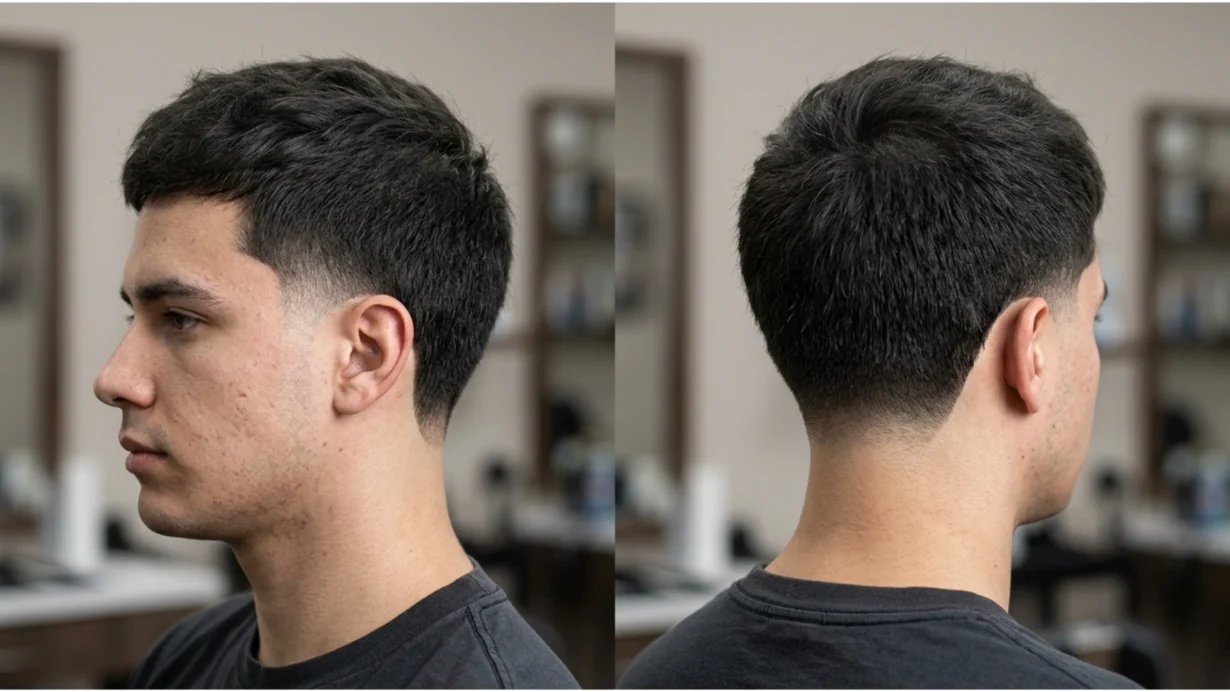

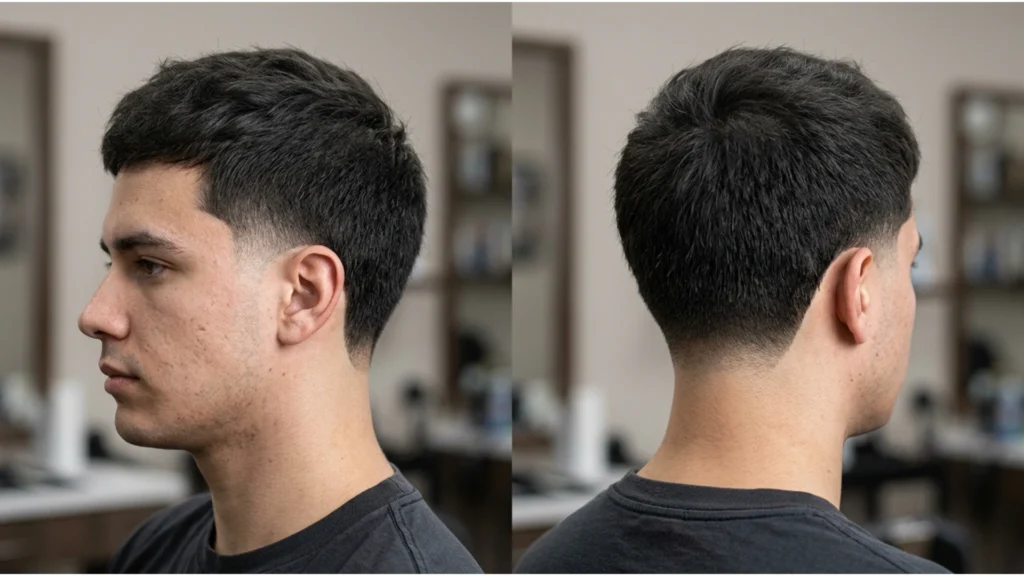
A drop taper fade is a modern haircut where the fade line curves downward behind the ears, following the head’s natural shape. It blends the gradual blending of a taper with the curved arc of a drop fade, creating a bold, sculpted finish that works on curly, wavy, straight, and textured hair.
If you’ve walked into a barbershop unsure whether to ask for a drop fade or a taper fade, you’re not alone. The difference matters and getting it right means the difference between a good cut and a great one.
This complete guide covers everything: what a drop taper fade is, how low, mid, and high variations differ, drop fade vs taper fade comparisons, the best styles for your face shape and hair type, and exactly what to tell your barber.
What Is a Drop Taper Fade, and How Is It Different from a Regular Taper?
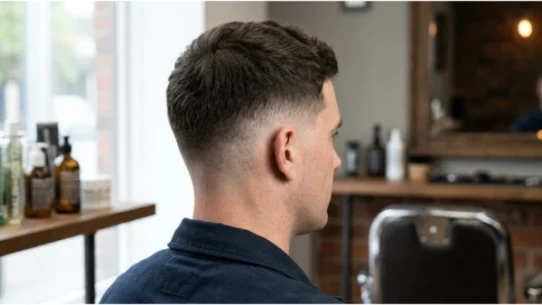
A drop taper fade is a men’s haircut in which the fade line curves downward behind the ears rather than running straight across the head. That curved arc follows your skull’s natural shape, creating a sculpted, three-dimensional finish that a standard taper can’t match. It comes in low, mid, and high variations, depending on how bold you want the contrast to be.
KEY POINTS:
- A regular taper is straight, while a drop taper curves downward behind the ear.
- Low drop fades last 3 to 4 weeks and are the easiest to maintain
- Mid drop fades start at the temple and offer the best balance of style and upkeep
- Works on all hair types but looks especially striking on curly and textured hair
- Round and diamond face shapes benefit most from the vertical slimming effect of the arc
Table of Contents
A drop fade curves around the ear in a way that not every face shape handles well.
The curved drop line changes how your jaw and head shape read more than a standard taper fade does. The Taper Style Tool checks your face shape and hair type against all three drop fade heights before you commit to one.
Check If a Drop Fade Works for My Face
What Is a Drop Taper Fade?
A drop taper fade is a haircut that combines two techniques: the taper, which gradually blends the hair shorter down the sides and back, and the drop fade, which features a curved fade line that dips down behind the ear and sweeps toward the neckline. The result is a clean, sculpted arc that follows your head’s natural shape giving you more structure and definition than a standard taper.
Think of it like this. A regular taper runs a straight, even line around your head. A drop taper fade takes that line and curves it starting above your ear and dropping down behind it toward the nape of your neck. That curve is everything. It’s what makes people do a double-take when you walk by.
What Makes the Drop Taper Fade Different from a Regular Taper?
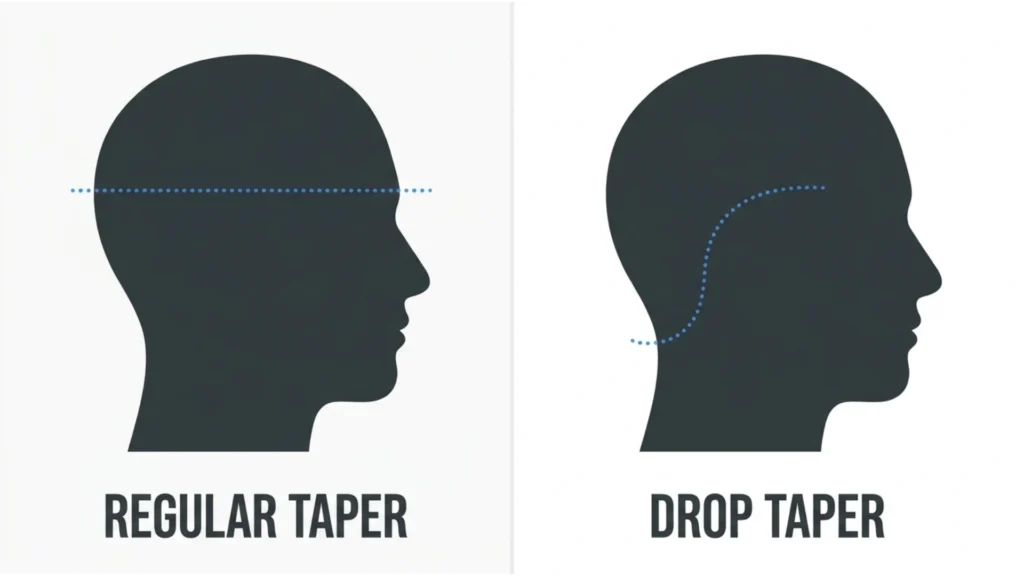
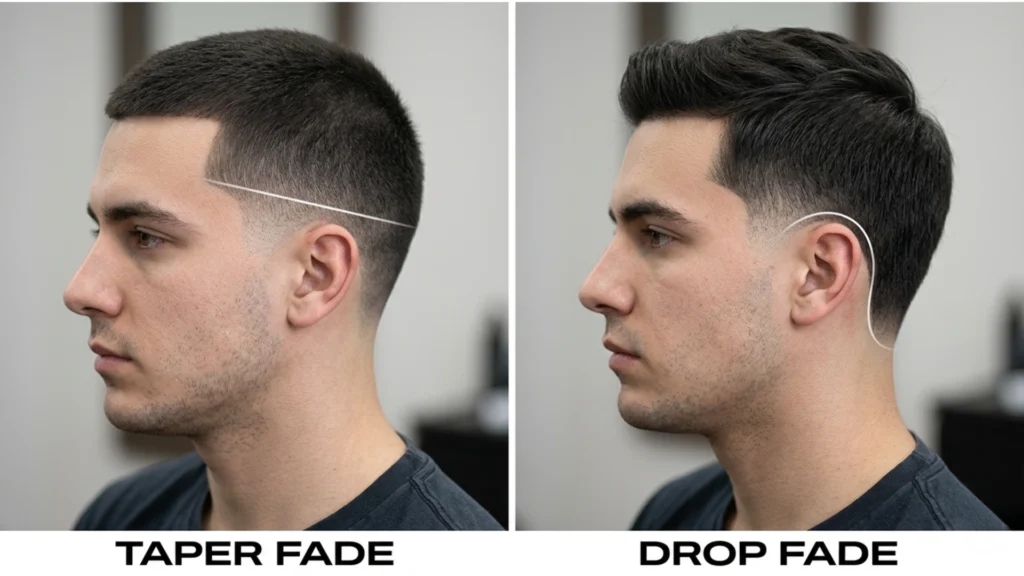
The biggest difference between a drop taper fade and a regular taper fade is the shape of the fade line. A regular taper keeps a straight, horizontal line that runs evenly around the head. A drop taper fade curves that line downward behind the ear, creating a distinct U-shaped arc that follows your skull’s natural contour.
Here’s a quick side-by-side to make it crystal clear:
| Feature | Regular Taper Fade | Drop Taper Fade |
|---|---|---|
| Fade Line Shape | Straight and horizontal | Curved, drops behind ear |
| Visual Effect | Subtle and balanced | Bold and sculpted |
| Head Shape Impact | Follows existing shape | Sculpts and enhances shape |
| Maintenance | Every 2–3 weeks | Every 10–14 days (high) to 3–4 weeks (low) |
| Best For | All face shapes, professional looks | Round, oval, square faces; modern styles |
Key Tip #1: The direction of the fade line is the most important thing to understand before visiting your barber. Straight line = taper. Curved, downward arc = drop taper. Remember this, and you’ll never walk out with the wrong cut.
The History of the Drop Taper Fade
The fade haircut has deep cultural roots. The fade first arrived on the scene with the invention of electric trimmers in the 1930s but grew to prominence in the 1940s and 1950s as a result of rigid military standards for grooming. Back then, it was practical clean, easy to maintain, and uniform for soldiers.
But the fade didn’t stay on the military base for long. It wasn’t long before the fade crossed over into mainstream culture, particularly within the African American community, where it became a canvas for creative expression when the 1980s came around it became a staple of hip-hop culture.
In this period, various takes on the fade surfaced: temple fades, skin fades, and drop fades became more commonplace. Black barbers were the pioneers of these creative variations, developing the curved arc and drop line that we now call the drop fade as a way to add artistry and personality to each cut.
Social media further accelerated the fade’s popularity. Barber influencers and platforms like Instagram and TikTok showcased the latest trends, helping the fade reach a global audience from New York’s urban neighborhoods to barbershops across the country.
Today, the low drop fade is dominating the barbershop scene and for good reason. It’s bold enough to make a statement, versatile enough to suit almost any hair type, and flexible enough to work in both casual and professional settings.
Fact: Although the fade stems from the military, the Black community elevated it with the hi-top, which helped to revive the original fade years later and make it more appealing to someone who may have never considered wearing it as an everyday style.
How Does the Drop Arc Work?
The drop arc is the defining physical characteristic of this haircut. Here’s how it works, step by step:
- The fade starts above the ear at a height that depends on whether you choose a low, mid, or high variation
- The fade line curves downward behind the ear instead of running straight across
- The arc sweeps toward the neckline, following the natural curve of your skull
- The hair blends into the neckline at the nape, either into the skin (skin fade) or into a natural-looking short length
This curved arc does something a straight taper line can’t: it contours your head’s shape, creating a three-dimensional silhouette instead of a flat, even line. The result looks sculptural, intentional, and sharp from every angle front, side, and back.
Key Tip #2: If you have a flat back of the head, the drop arc can actually create the illusion of a natural curve. This is one reason so many men prefer the drop taper fade over a regular taper it works with your head shape, not just around it.
Low Drop Taper Fade: The Complete Guide
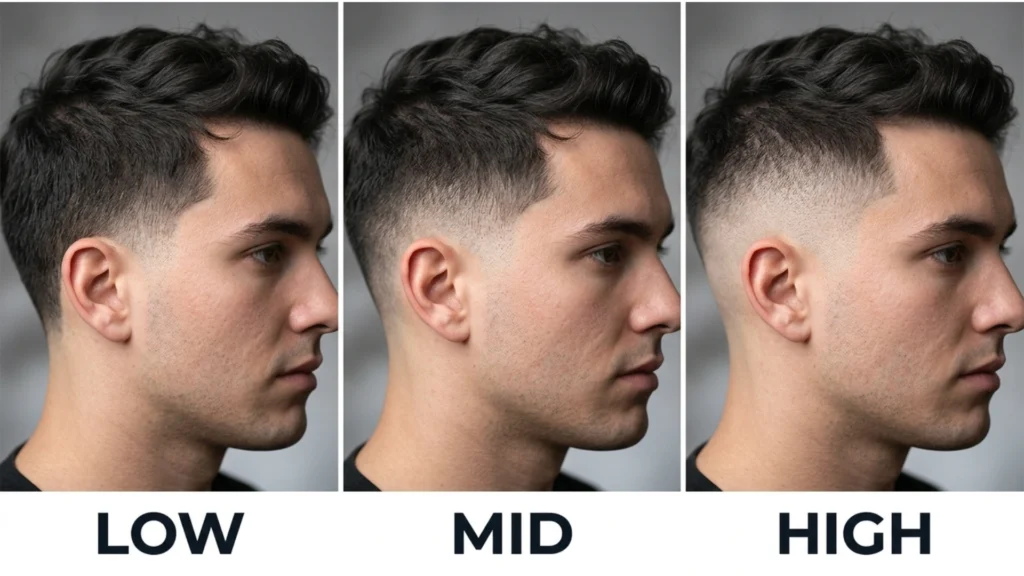
The low drop taper fade starts just above the ears and gently curves toward the neckline, creating a subtle yet stylish arc. It’s the most understated drop fade variation offering clean contrast without dramatic boldness, making it perfect for professional settings, first-time fade wearers, and men who want a fresh cut that stays looking good for longer.
What Is a Low Drop Taper Fade?
A low drop taper fade is exactly what the name says a drop taper fade that begins at the lowest point. The fade starts just above the top of your ear (roughly 1 to 2 inches), curves gently behind it, and drops toward the neckline in a smooth, gradual arc.
Because it starts low and blends gradually, there’s less scalp showing than with a mid or high variation. That makes it the best choice if you want the drop arc effect without the bold contrast of a higher fade.
Who is it best for?
- Men in professional or corporate environments
- First-time fade wearers who want to ease into the style
- Men who want a longer-lasting cut with fewer touch-ups
- Anyone who prefers clean and polished over bold and dramatic
Maintenance: The low drop taper fade lasts the longest of all three variations typically 3 to 4 weeks before you need a trim. Because the fade starts low and respects the natural hairline more than higher variations, regrowth blends in more softly and doesn’t look as sloppy when it starts to grow out.
Key Tip #3: If you’re new to fades, always start with a low drop taper. You can always go higher next time. Going too high too soon can leave you looking for a barber every week and spending way more money than you planned.
Low Drop Taper Fade for Curly Hair
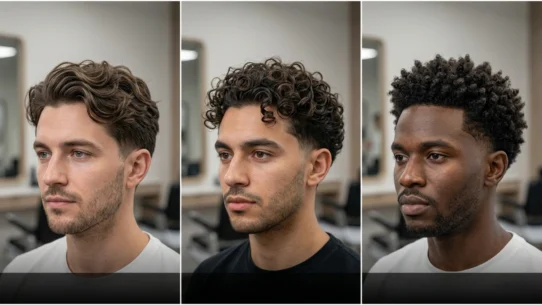
The low drop taper fade is one of the most popular styles for men with curly hair and it’s easy to see why. The fade creates clean, sharp edges around natural curls, highlights curl definition and volume, and prevents the sides from looking too bulky.
Because the fade starts low, there’s less scalp showing, which is something many men with curly or coily hair prefer. It keeps the look full and natural on top while still giving you that crisp, defined edge below.
Best for: Defined curls, 360 waves, coily afro texture, loose curls
How to style curly hair with a low drop taper fade:
- Start with freshly washed, damp hair
- Apply curl-enhancing cream from roots to ends
- Scrunch curls while blow-drying on low heat with a diffuser attachment
- Add a small amount of texture powder at the roots for lift
- Finish with 2 to 3 drops of hydrating argan oil for shine and frizz control
The result is a clean, structured cut on the sides with natural, bouncy curls on top. It’s one of the most versatile combinations in men’s grooming right now.
Low Drop Taper Fade for Straight Hair
Straight hair and a low drop taper fade are a great match. Straight hair makes the fade line look ultra-sharp and precise — the arc is clean, crisp, and highly visible. The contrast between the sleek top and the blended sides looks polished and professional.
How to style straight hair with a low drop taper fade:
- Blow-dry hair in your desired direction while damp
- Apply molding paste for a natural, matte finish or pomade for a sleek, shiny look
- Shape with fingers or a comb
- Add a small amount of styling cream to soften and define the ends
Best top styles for straight hair: Textured crop, side part, slick back, comb over
Low Drop Taper Fade with Beard
Pairing a low drop taper fade with a beard is one of the cleanest looks a man can pull off. The low fade blends naturally into the beard’s sideburn line, creating a smooth, cohesive flow from hair to facial hair without the harsh disconnect that a higher fade sometimes creates.
To make the combination work, keep your beard lines clean and shaped. Ask your barber to blend the fade into the top of your beard line for a seamless transition.
Best beard combinations: Full beard, tapered beard, goatee with clean lines, stubble with defined edges
Barber Tip: Tell your barber, “Blend the fade into my beard line I want it to flow naturally, not disconnect.” This one instruction can make the difference between a good cut and a great cut.
Best Face Shapes for Low Drop Taper Fade
The low drop taper fade works well on most face shapes. Here’s how it affects each one:
| Face Shape | Suitability | Why |
|---|---|---|
| Oval | Perfect | Universal fit all fade heights work |
| Round | Excellent | Vertical arc creates a slimming effect |
| Square | Great | Curved arc softens sharp jawlines |
| Heart | Good | Adds subtle width at temples |
| Long/Oblong | Use caution | Choose a fuller top to avoid elongating the face |
| Diamond | Good | Balances narrow forehead and chin |
Key Tip #4: If you have a round face and want the most slimming effect, a mid drop taper not a low will give you more vertical movement. But if you just want a clean, subtle style, the low drop taper still works great on round faces.
Best Top Styles to Pair with Low Drop Taper Fade
Because the low drop taper is subtle, it gives your top style room to shine. Here are the six best combinations:
- Textured Crop — Short, choppy layers with a natural fringe. Apply texture clay for matte definition. Clean, modern, effortless.
- Messy Fringe — Soft, tousled hair falling forward. Blow-dry lightly and tousle with fingers. Finish with styling cream.
- Pompadour — High volume brushed back from the forehead. Blow-dry upward with a brush and use strong-hold pomade.
- Comb Over — Clean side part with hair swept to one side. Sleek and professional use pomade for hold and shine.
- Slick Back — All hair brushed smoothly backward. Best for formal occasions. Use styling cream or pomade.
- Curly Top / Afro — Natural curls or afro texture left voluminous on top. Enhance with curl-enhancing cream and finish with texture powder for lift.
How Long Does a Low Drop Taper Fade Last?
A low drop taper fade typically lasts 3 to 4 weeks before needing a fresh cut. Here’s how it grows out week by week:
- Week 1: Peak freshness the arc is crisp and the fade is sharp
- Week 2: Still sharp you’re in the best window of the cut
- Week 3: The fade softens slightly still looks intentional and clean
- Week 4: Regrowth starts blending together time to book your next appointment
The low drop taper grows out more gracefully than any other variation. Because it starts close to the natural hairline, regrowth blends back into itself rather than creating a harsh line of demarcation. You can comfortably stretch it to four weeks and still look presentable.
Maintenance Cost Estimate:
- Visit every 3 to 4 weeks at $30 to $50 per visit = approximately $400 to $650 per year
Mid Drop Taper Fade: The Complete Guide
The mid drop taper fade starts around temple level and curves behind the ear toward the neckline, striking a balance between the subtlety of a low fade and the boldness of a high fade. It delivers more contrast and a more pronounced arc than the low variation making it the most popular drop taper choice in barbershops today.
What Is a Mid Drop Taper Fade?
A mid drop taper fade is a drop taper fade that begins at the temples approximately halfway up the sides of the head. The arc is steeper and more visible than a low fade, creating a sharper silhouette with stronger contrast between the top and sides.
Mid fades sit right in the middle of the most popular fades in 2024 and that trend has carried right into 2025. It’s the sweet spot between conservative and bold, making it a great choice for men who want a modern, polished look without going full drama.
Who is it best for?
- Men aged 18 to 35 who want a trendy, modern style
- Anyone who wants more contrast than a low fade delivers
- Men with round, oval, or diamond face shapes
- Those who don’t mind a touch-up every 2 to 3 weeks
Maintenance: The mid drop taper fade requires touch-ups every 2 to 3 weeks. Because the fade starts higher and the arc is steeper, regrowth is more noticeable than with a low fade.
Mid Drop Taper Fade vs Low Drop Taper Fade: What’s the Real Difference?
This is one of the most searched comparisons in the drop taper fade world and it’s a fair question because both cuts look similar from a distance. Here’s the breakdown:
| Feature | Low Drop Taper Fade | Mid Drop Taper Fade |
|---|---|---|
| Starting Height | Just above ears | Temple level (halfway up) |
| Arc Steepness | Gentle, subtle | Sharper, more pronounced |
| Contrast Level | Moderate | High |
| Scalp Visibility | Minimal | Moderate |
| Best For | Professional, conservative | Trendy, bold, modern |
| Maintenance Frequency | Every 3–4 weeks | Every 2–3 weeks |
| Grow-Out Behavior | Blends naturally | More noticeable regrowth |
| Face Shape Fit | All shapes | Oval, round, diamond |
| Best Hair Types | All types | Curly, wavy, textured especially |
The bottom line: Choose the low drop taper if you want subtle, professional, and easy maintenance. Choose the mid drop taper if you want a bolder, more modern look and don’t mind heading back to the barber a little more often.
Mid Drop Taper Fade for Curly Hair
The mid drop taper fade is especially popular for men with curly hair. The temple-level starting point gives curls more room to pop on top while the clean arc keeps the sides structured.
Because the fade starts higher, there’s more contrast between the natural curl volume on top and the blended sides. The result looks dynamic, modern, and energetic like your curls were made for this cut (because they kind of were).
How to style:
- Apply curl-enhancing cream to damp hair
- Scrunch while blow-drying with a diffuser on low heat
- Add texture powder at the roots for extra volume and lift
- Finger-shape for natural definition avoid combing or you’ll lose the curl pattern
Best styles for curly hair + mid drop taper: Sponge top, afro, defined coils, 360 waves, loose ringlets
Mid Drop Taper Fade with Beard
The mid drop taper fade with a beard creates a sharp, masculine look. Because the fade starts higher, it creates more of a visual separation between the hair and the beard emphasizing the beard as its own style element rather than blending seamlessly with it.
This combination works best when your beard lines are clean and crisp. The fade is precise, so your beard needs to match that energy.
Two ways to handle the beard line:
- Hard line: A defined, sharp line between the fade and beard bold, high-contrast, modern
- Soft blend: A gradual transition where the fade flows into the beard more natural and cohesive
Tell your barber which you prefer before they start.
Best beard styles for this combination: Full beard with clean lines, tapered beard, defined goatee, heavy stubble
Best Face Shapes for Mid Drop Taper Fade
| Face Shape | Suitability | Why |
|---|---|---|
| Oval | Perfect | All heights work mid adds modern edge |
| Round | Excellent | Higher arc creates more vertical movement = better slimming effect |
| Diamond | Great | Emphasizes cheekbones beautifully |
| Square | Good | Curved arc softens the jawline |
| Heart | Good | Adds width at the temples |
| Long/Oblong | Moderate | Use a fuller top to compensate |
How Often Should You Get a Mid Drop Taper Fade?
A mid drop taper fade needs a fresh cut every 2 to 3 weeks. Here’s the week-by-week breakdown:
- Week 1: Perfectly sharp, the arc is defined and clean
- Week 2: Still looking great; this is your window to show it off
- Week 3: The fade starts to soften and lose definition; time to book
- Week 4: The arc has lost its shape; you’ll notice it, and so will everyone else
Maintenance Cost Estimate:
- Visit every 2 to 3 weeks at $35 to $50 per visit = approximately $600 to $1,000 per year
Key Tip #5: Book your next barber appointment before you leave your current one. It’s the single best habit for keeping a mid drop taper fade looking its best. Waiting until it grows out and then trying to book means you’ll spend at least a week looking less than sharp.
High Drop Taper Fade: The Bold Statement
The high drop taper fade starts above the temples and curves dramatically behind the ear, creating maximum contrast and a bold, head-turning look. It’s the most dramatic of the three variations best for men who want to make a statement and don’t mind frequent barber visits.
What Is a High Drop Taper Fade?
The high drop taper fade begins above temple level the highest possible starting point for a fade. The arc is steep and dramatic, and the contrast between the longer top and the closely blended sides is striking. Depending on how close the fade goes, it can blend into a skin fade or bald fade near the neckline and ears.
Best for:
- Men who want bold, maximum contrast
- Younger guys who want a standout style
- Hair types with strong texture (curly, coily, thick)
- Anyone who is committed to regular barber visits
Maintenance: The high drop taper fade is the most demanding variation it needs a fresh cut every 10 to 14 days. The steep arc grows out quickly and becomes noticeable fast.
Fact: The maintenance requirement for fades depends on the variation. Skin fades require frequent upkeep, while low fades are more forgiving. The high drop taper falls closest to the skin fade end of that spectrum.
High Drop Taper Fade vs Mid Drop Taper Fade
| Feature | Mid Drop Taper Fade | High Drop Taper Fade |
|---|---|---|
| Starting Height | Temple level | Above temples |
| Contrast | High | Maximum |
| Scalp Visibility | Moderate | High |
| Maintenance | Every 2–3 weeks | Every 10–14 days |
| Look | Balanced, modern | Bold, dramatic |
| Best For | Everyday versatility | Statement occasions |
| Hair Type | All types | Curly, thick, textured especially |
Decision guide: Choose the mid if you want versatility and manageable upkeep. Choose the high if you want maximum impact and you’re comfortable seeing your barber every week or so.
Drop Fade vs Taper Fade: The Real Difference
A taper fade blends hair gradually with a straight, horizontal fade line that respects the natural hairline, creating a subtle, professional look. A drop fade curves downward behind the ears, sculpting the head shape with a bold arc that demands more maintenance but delivers dramatic, modern style.
This is the comparison that gets debated in barbershops across America every single day. And honestly, most people, including some barbers, use these two terms like they mean the same thing. They don’t.
The Fundamental Structural Difference
The most important difference between a drop fade and a taper fade is the direction of the fade line.
Taper Fade:
- Fade line runs straight and horizontal around the head
- It preserves and follows the natural hairline
- The blending is even and symmetrical from all angles
- The visual result is balanced, clean, and universally flattering
Drop Fade:
- Fade line curves downward behind the ear
- It redraws the hairline creating a new, sculpted arc
- The blending follows the skull’s contour
- The visual result is bold, structured, and three-dimensional
The simplest way to think about it: a taper fade polishes what you already have. A drop fade redraws the blueprint.
Fact: The drop fade features a curved fade line behind the ears for added shape. That curved line is what separates it from every other fade on the menu.
Drop Fade vs Taper Fade: The Full Side-by-Side Comparison
| Feature | Taper Fade | Drop Fade (Drop Taper Fade) |
|---|---|---|
| Fade Line Shape | Straight, horizontal | Curved, arced, drops behind ear |
| Visual Effect | Subtle, balanced | Bold, contoured, sculptural |
| Contrast Level | Low to moderate | Moderate to high |
| Maintenance Frequency | Every 2–3 weeks | Every 10–14 days (high) to 3–4 weeks (low) |
| Grow-Out Behavior | Blends naturally, ages gracefully | More noticeable, needs frequent touch-ups |
| Hairline Interaction | Respects natural hairline | Redraws and sculpts hairline |
| Best Hair Types | All types universal | Curly, textured, thick (but works on all) |
| Best Face Shapes | All shapes | Oval, round, square, heart |
| Vibe / Personality | Timeless, professional, clean | Trendy, bold, modern, statement |
| Beard Compatibility | Blends naturally into beard | Creates sharper disconnect |
| Scalp Visibility | Minimal to moderate | Moderate to high |
| Cost | $25–$40 per visit | $30–$50+ per visit |
Which Lasts Longer Between Cuts?
The taper fade wins this one and it’s not close. A taper fade lasts 2 to 4 weeks because the straight fade line grows out evenly and blends back into itself gradually. You can stretch it to three or four weeks and still look like you meant to have that much growth.
The drop fade is more demanding. Because the arc is a designed, curved line not a natural one regrowth disrupts the shape faster and more noticeably. The curve starts to flatten, the arc loses definition, and instead of looking sharp and intentional, it just looks like you skipped the barber.
Grow-out comparison:
- Low drop taper: 3–4 weeks: Most forgiving
- Mid drop taper: 2–3 weeks: Manageable
- High drop taper: 10–14 days: Most demanding
- Taper fade: 2–4 weeks: Grows out most gracefully
Annual Cost Comparison:
- Taper fade (every 3 weeks at $35) = approximately $600/year
- Low drop taper (every 3.5 weeks at $40) = approximately $580/year
- Mid drop taper (every 2.5 weeks at $40) = approximately $830/year
- High drop taper (every 12 days at $45) = approximately $1,350/year
Which Suits Your Face Shape Better?
Both cuts work on most face shapes but they do different things for each one:
Round Face:
- Drop taper fade wins the vertical arc creates a slimming contour effect
- The taper works, but lacks the same sculpting power
Oval Face:
- Both work perfectly oval is the universal face shape for all cuts
Square Face:
- Taper fade is slightly better softens angular jawlines without adding dramatic contrast
- Drop taper still works if you pair it with a softer, textured top
Long/Oblong Face:
- Taper fade is safer a drop taper can elongate the face further
- If choosing drop, use a fuller, wider top to add width
Diamond Face:
- Drop taper fade wins the curved arc emphasizes cheekbones and balances the narrow forehead and chin
Heart Face:
- Both work well drop taper adds subtle width at temples for better balance
Drop Fade vs Taper Fade with a Beard
This is where personal style really comes into play. Both cuts work with beards, but they create very different looks:
Taper Fade + Beard: The straight fade line flows naturally into the sideburn area of your beard, creating a cohesive, unified look. Hair and beard feel like one continuous style. Great if you want a harmonious, balanced appearance.
Drop Fade + Beard: The curved arc creates a visual separation between the fade and the beard, making the beard pop as its own distinct element. It’s a bolder, more defined look but it requires clean, sharp beard lines to match the fade’s precision.
Barber Tip: If you’re wearing a full beard, tell your barber whether you want a “hard line” (sharp separation between fade and beard) or a “soft blend” (gradual transition). Getting this right makes the whole look come together.
Drop Fade vs Taper Fade: Which One Is Right for You?
Use this decision guide to make the call:
Choose a Taper Fade if you:
- Want a low-maintenance cut (2–3 week touch-ups)
- Work in a professional or corporate environment
- Prefer timeless, universally flattering styles
- Have a limited grooming budget
- Want a cut that grows out gracefully and forgives a missed barber appointment
Choose a Drop Taper Fade if you:
- Want a bold, modern, head-turning style
- Don’t mind visiting the barber more frequently
- Have a round or oval face you want to contour and slim
- Love fresh, trending, Instagram-worthy cuts
- Have curly or textured hair you want to showcase with clean edges
Still sitting on the fence between the two? TaperMatch scans your facial geometry and scores both options against your actual bone structure, so the decision isn’t a guess, it’s a match.
Drop Taper Fade for Different Hair Types
The drop taper fade adapts to all hair types curly, wavy, straight, and textured by adjusting the fade height, arc steepness, and top styling. Curly hair gains structure and definition, straight hair achieves precision and polish, wavy hair adds natural movement, and textured hair highlights natural volume.
Drop Taper Fade for Curly Hair
Curly hair and the drop taper fade were made for each other. The fade creates clean, sharp edges around natural curls, highlighting volume and definition while keeping the sides structured and neat. The contrast between the bold, curly top and the blended sides is eye-catching without being overdone.
Why it works so well:
- The arc frames curls like a natural border
- Keeps the sides clean without removing curl volume from the top
- The drop arc adds a three-dimensional quality that curly hair enhances
Best variations for curly hair:
- Low drop = subtle, great for professional settings
- Mid drop = the most popular best balance of volume and sharpness
- High drop = maximum drama, makes tight curls pop
Styling products for curly hair + drop taper:
- Curl-enhancing cream for definition
- Texture powder at the roots for lift
- Hydrating argan oil for shine and frizz control
- Volumizing mousse before blow-drying for extra volume
Popular combinations: Drop taper with defined coils, drop taper with afro, drop taper with 360 waves, drop taper with sponge top
Drop Taper Fade for Straight Hair
Straight hair makes the drop taper fade look ultra-precise. The fade line is razor-clean, and the arc is highly visible and defined delivering a sharp, structured look that stands out.
Because straight hair doesn’t have natural texture to add interest on top, pairing the fade with a styled top is important. The best combinations are textured tops (textured crop, messy fringe), side parts, or slick backs.
Best products for straight hair:
- Pomade for a sleek, shiny finish
- Matte clay or texture clay for a natural, textured look
- Molding paste for flexible hold with a matte finish
Drop Taper Fade for Wavy Hair
Wavy hair adds a natural movement and flow that complements the drop taper fade beautifully. The clean, curved arc on the sides creates contrast with the soft, natural wave pattern on top giving you a look that’s relaxed and polished at the same time.
The mid drop taper works best for wavy hair the starting height balances the natural volume of waves without making the top look too heavy.
Best products: Sea salt spray for texture and grit, texture clay for matte hold
Best top styles: Wavy quiff, messy waves, wavy fringe
Drop Taper Fade for Thick Hair
Thick hair can look heavy and bulky without the right cut. The drop taper fade removes weight from the sides and back, creating clean structure while letting the top retain its natural volume.
Key tip for thick hair: Ask your barber to use thinning shears on the top to reduce bulk and help the style lay more naturally. Then use lightweight products heavy pomades or waxes will weigh thick hair down and ruin the look.
Drop Taper Fade for Fine/Thin Hair
Fine hair can actually look thicker with a drop taper fade. By removing hair from the sides, the contrast makes the top appear more voluminous and full even if your hair is naturally thin.
Key products for fine hair: Volumizing mousse applied to damp hair before blow-drying, texture powder at the roots for lift, and lightweight styling cream for hold without weight.
Avoid: Heavy pomades, thick waxes, or anything that flattens the hair against the scalp.
Drop Taper Fade by Face Shape: The Complete Guide
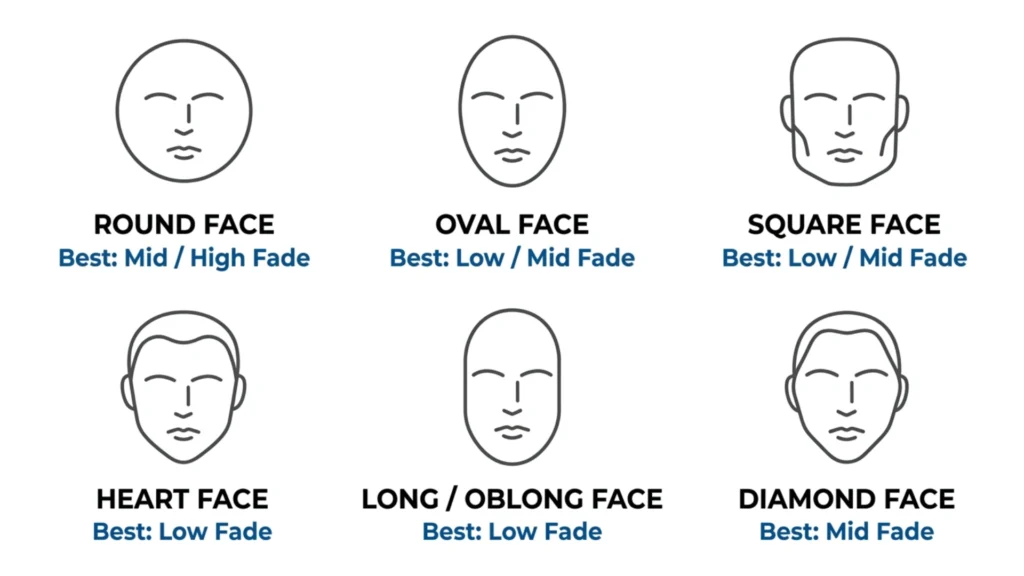
The drop taper fade flatters oval, round, square, heart, and diamond face shapes by adding vertical movement and natural contouring. Round faces benefit from the slimming arc, oval faces suit all variations, and square faces are softened by the curve’s natural flow.
Which Drop Taper Fade Height Is Best for Your Face Shape?
| Face Shape | Best Fade Height | Why |
|---|---|---|
| Oval | Low, Mid, or High | All heights work choose based on style preference |
| Round | Mid or High | Creates more vertical movement and a stronger slimming effect |
| Square | Low or Mid | Softens angular jawlines without overwhelming the face |
| Heart | Mid | Balances a wider forehead with clean sides |
| Diamond | Mid | Highlights cheekbones and balances narrow forehead and chin |
| Long/Oblong | Low | Avoids elongating the face further |
Detailed breakdown by face shape:
Oval Face: You’re the lucky one any drop taper variation works. Oval faces are universally balanced, so you can choose based purely on your style preference. Go low for subtle and professional. Go high if you want to turn heads.
Round Face: The mid or high drop taper fade is your best friend. The vertical arc created by the curved fade line draws the eye up and creates a slimming effect on the sides. Pair with a taller top style — like a pompadour or quiff — for maximum effect.
Square Face: The low or mid drop taper works well. The curved arc softens your sharp, angular jawline without removing the structure that gives square-faced men their naturally strong look. Avoid overly structured top styles go for something textured and natural.
Heart Face: A mid drop taper works great here. It adds subtle width at the temples while keeping the sides clean, which balances the naturally wider forehead that heart-shaped faces have.
Diamond Face: The mid drop taper is excellent for diamond faces because the curved arc highlights the cheekbones the most defining feature of this face shape. Pair with a side-swept or textured top for balance.
Long/Oblong Face: Stick with the low drop taper and choose a fuller, wider top style. The goal is to add width, not height. A high fade with a tall top on a long face will just make it look even longer.
Key Tip #6: If you’re unsure about your face shape, take a front-facing photo with your hair pulled back, hold a white piece of paper next to your face, and look at the overall outline. Or simply ask your barber a skilled barber will assess your bone structure and recommend the right fade height before touching a clipper.
Not sure which face shape category you fall into? Skip the front-facing photo and white paper. TaperMatch runs a structural biometric scan and maps your jaw angle, width, and symmetry to the right drop taper height automatically.
35+ Drop Taper Fade Styles
The drop taper fade pairs with 35+ different top styles, from pompadours and quiffs to Edgar cuts, afros, and French crops. Each combination uses the fade’s clean arc as a foundation while letting the top style express your personality.
Drop Taper Fade + Pompadour
One of the most iconic combinations in men’s grooming. The pompadour lifts the hair high at the front and sweeps it back, creating dramatic volume that’s perfectly complemented by the clean arc of a drop taper on the sides.
Best hair type: Straight, wavy Best drop height: Mid to high Style product: Strong-hold pomade for maximum lift and shine How to style: Blow-dry upward with a round brush, then shape with fingers. Apply pomade to damp hair and comb back.
Drop Taper Fade + Quiff
The quiff is a softer, more casual version of the pompadour it sits up but doesn’t go as high. Combined with a drop taper, it creates a look that’s modern and versatile for both office and weekend wear.
Best hair type: Straight, wavy Style product: Styling cream for flexible hold + pomade to finish How to style: Blow-dry forward and upward, then sweep back slightly. Shape with fingers.
Drop Taper Fade + Textured Crop
The textured crop is the most popular top style combined with any fade in 2025. Short, choppy layers on top with a forward-falling fringe it’s clean, modern, and effortless.
Best hair type: All hair types Best drop height: Low or mid Style product: Texture clay for matte definition and hold
Drop Taper Fade + Messy Fringe
A relaxed, tousled fringe that falls forward with soft texture. The drop taper on the sides adds a clean, structured contrast to the casual, effortless fringe on top.
Best hair type: Straight, wavy Style product: Texture clay + light sea salt spray
Drop Taper Fade + Comb Over
The comb over is the smart guy’s choice a clean side part with hair swept to one side. With a drop taper, it looks sharp, professional, and still stylish enough to wear on weekends.
Best hair type: Straight, slightly wavy Style product: Pomade for hold and shine
Drop Taper Fade + Slick Back
All hair pushed smoothly back from the forehead, with the drop taper keeping the sides tight and clean. This is the go-to style for formal events, job interviews, or any time you want to look seriously put-together.
Best hair type: Straight, wavy Style product: Strong-hold pomade or styling cream
Drop Taper Fade + Edgar Cut
The Edgar cut (a blunt, flat-top fringe with cropped sides) paired with a drop taper is one of the most popular styles among younger men right now. It’s bold, modern, and unapologetically sharp.
Best hair type: Straight, thick Style product: Texture powder for lift + pomade for a sleek finish
Drop Taper Fade + French Crop
The French crop has a straight, blunt fringe that falls forward, paired with closely cropped sides. The drop taper enhances the structure and adds a curved element to an otherwise angular style.
Best hair type: All types Style product: Molding paste for lightweight hold
Drop Taper Fade + Faux Hawk
The faux hawk creates a ridged, textured strip of hair running from front to back, while the sides are faded down. The drop taper adds extra dimension to the sides, making the faux hawk look even more defined.
Best hair type: Thick, wavy, curly Style product: Texture clay + sea salt spray for grip
Drop Taper Fade + Mohawk
A bolder take on the faux hawk. The mohawk leaves more length and height on the strip down the center, with the drop taper creating a clean, dramatic transition on the sides.
Style product: Sea salt spray before blow-drying + texture clay for strong hold
Drop Taper Fade + Afro
The drop taper fade with an afro is a stunning combination that celebrates natural hair texture. The clean arc frames the afro’s natural volume, giving it structure without reducing its size or expression.
Best hair type: Coily, kinky, natural Style product: Curl-enhancing cream + hydrating argan oil
Drop Taper Fade + Curly Top
Natural curls left voluminous on top with a clean drop taper on the sides. This is one of the most requested styles at barbershops across the country and for good reason. It’s fresh, full of personality, and works for almost every occasion.
Style product: Curl cream + texture powder
Drop Taper Fade + 360 Waves
The drop taper fade perfectly frames 360 waves, giving them a sharp border that makes the wave pattern look even more defined. Keep the top moisturized and brush regularly to maintain the wave pattern.
Style product: Pomade for wave hold + hydrating argan oil
Drop Taper Fade + Dreads / Dreadlocks
Dreadlocks on top with a clean drop taper on the sides is a bold, expressive style that’s growing in popularity. The fade keeps the silhouette clean while the locs bring personality and culture to the look.
Style tip: Keep the fade maintained more frequently (every 2 weeks) since the contrast with locs is very noticeable when the fade grows.
Drop Taper Fade + Man Bun
The man bun + drop taper is a surprisingly clean combination. The fade keeps the sides tight and modern while the bun adds length and flow on top. It’s casual, stylish, and effortlessly cool.
Style product: Styling cream for natural control + argan oil for shine
Drop Taper Fade + Undercut
The drop taper undercut keeps the sides tightly faded while the top stays longer and is swept back or to the side. It’s sharp, confident, and works well for men with thick or heavy hair.
Style product: Pomade for a sleek finish or molding paste for texture
Drop Taper Fade + Buzz Cut
The drop taper buzz cut is the ultimate low-maintenance style. Short, clean, and sharp the drop arc adds the only styling detail you’ll ever need. Wash, brush, done.
Style product: Light texture powder if you want subtle definition
Drop Taper Fade + Crew Cut
A structured, even crop on top with a clean drop taper on the sides. Classic, masculine, and always office-appropriate. The drop taper adds a modern touch to one of the most timeless cuts in men’s grooming.
Style product: Texture clay for matte hold
Drop Taper Fade + Mullet
The modern mullet + drop taper is one of the most talked-about combinations of 2025. The once-maligned mullet is experiencing an undeniable and surprisingly stylish renaissance, albeit with modern updates. Pair it with a drop taper for a look that’s retro, edgy, and completely current.
Style product: Texture powder for lift at the roots + styling cream for the longer back
Drop Taper Fade + Side Part
A defined side part gives the hair a clean, timeless structure. With a drop taper, the side part becomes elevated polished and professional but with a modern edge.
Style product: Pomade for shine and hold
Drop Taper Fade + Pompadour with Waves
For men with 360 waves, the pompadour wave combination with a drop taper is a show-stopper. The wave pattern flows across the top, the pompadour gives it height, and the drop taper frames everything below.
Drop Taper Fade + Slick Back (Formal)
Take the slick back from casual to formal by pairing it with a sharp mid or high drop taper. This is the version of the cut you wear to weddings, galas, or anywhere you need to look your absolute best.
Drop Taper Fade + Perm
The drop taper perm blends tight, springy curls on top with a clean fade that curves down behind the ear. The curls add fullness and movement, while the drop taper gives the whole look clean definition.
Style product: Volumizing mousse on damp hair before blow-drying
Drop Taper Fade + Fluffy Hair
High-volume, textured hair on top with a clean drop taper. The contrast between the full, fluffy top and the tightly faded sides is eye-catching and youthful. Apply texture powder at the roots and blow-dry with your fingers upward.
Drop Taper Fade + Wavy Quiff
A natural, loosely styled quiff with wave texture. Sea salt spray is your best friend here — it enhances the wave pattern, adds grit, and gives the quiff volume without making it look stiff.
Drop Taper Fade + Long Hair
For men growing out their hair, a drop taper keeps the sides neat and modern while the longer top grows freely. It prevents the “growing out phase” from looking messy or unkept.
Drop Taper Fade + Short Hair
Clean, minimalist, and always sharp. A drop taper with a short, even top is the classic choice for men who want a no-fuss cut that still looks intentional and styled.
Drop Taper Fade + Blonde Hair
Blonde hair makes the fade line even more visible and high-contrast. The drop taper works especially well with light-colored hair because the transition from longer to shorter is visually striking.
Drop Taper Fade + Textured Fringe
A layered fringe with texture and movement, paired with a clean drop taper on the sides. It’s playful, youthful, and easy to style. Apply texture clay and finger-shape for a natural, effortless result.
Skin Drop Taper Fade
The skin drop taper fade takes the arc all the way down to bare skin zero length at the lowest point. It creates the most dramatic contrast of any variation, with the sharp fade line disappearing completely into the skin. Best for men who want maximum impact and are committed to weekly touch-ups.
Bald Drop Taper Fade
Similar to the skin fade but starting higher, the bald drop taper fades to a completely clean, hair-free look at the sides. Bold, modern, and extremely high-contrast.
Burst Drop Fade
The burst drop fade is a creative variation where the fade curves behind the ear in a semi-circular burst pattern before dropping toward the neckline. It creates a rounded, almost halo-like arc that’s especially popular for mohawks, faux hawks, and high-volume curly styles.
Drop Taper Fade with Beard
One of the most requested combinations at American barbershops. The drop taper fade paired with a full, well-groomed beard creates a seamless flow from hair to facial hair. Keep the beard lines clean and sharp to match the precision of the fade.
Best beard styles: Full beard, tapered beard, defined goatee, heavy stubble
Drop Taper Fade for Black Men
The drop taper fade has deep cultural roots in the Black barbershop community, and it remains one of the most requested styles for Black men today. By the time the mid-80s rolled around, a reworked, edgier version of the fade was emerging thanks to Black barbers. It would soon become a standard in hip-hop culture during its golden era.
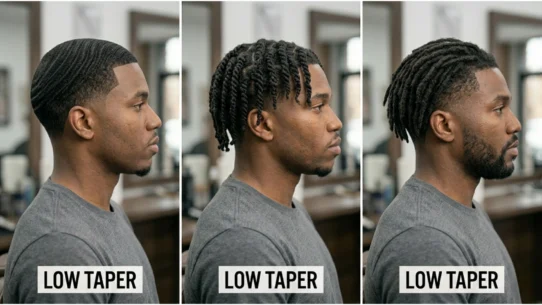
For Black men, the drop taper fade works across all natural hair textures coily, kinky, tightly curled, and everything in between. The clean arc enhances the natural shape of the head and frames afros, twists, locs, 360 waves, and sponge tops beautifully.
Key additions for Black men’s drop taper fades:
- Edge-up / line-up: A straight line carved along the forehead, temples, and sideburns for extra definition
- Part line: A shaved part line added to the top for design detail
- Hair art: Geometric designs or patterns carved into the fade for personalization
Products for natural hair: Curl-enhancing cream, hydrating argan oil, edge control gel for line-ups
How to Ask Your Barber for a Drop Taper Fade
To get a drop taper fade, tell your barber: “I want a [low/mid/high] drop taper fade with the fade curving behind my ears toward the neckline.” Bring reference photos from multiple angles, specify top length, and confirm clipper guard preferences to make sure you both share the same vision.
Use Clear, Specific Terminology
Vague instructions are the number one reason men walk out with the wrong cut. Your barber is skilled, but they can’t read your mind and terms like “just a fade” or “clean on the sides” can mean a dozen different things to different people.
Here’s a simple script you can use word for word:
“I want a mid drop taper fade. Start the fade at temple level, curve it behind my ears, and blend it down to the neckline. Keep the top about 3 inches I want to style it as a textured crop.”
Break it into four parts:
- The cut name: “I want a drop taper fade”
- The height: “Make it a low / mid / high drop”
- The arc description: “Curve the fade behind my ear and drop it toward the neckline”
- The top style: “Leave the top [X] inches and style it as a [pompadour / crop / comb over / etc.]”
Bring Reference Photos from Multiple Angles
Words can mean different things to different barbers. A photo is the universal language of the barbershop. It shows exactly what you want no guesswork, no miscommunication.
Bring photos from these three angles:
- Side profile — shows the drop arc and where the fade line lands
- Front view — shows the top style and overall proportions
- Back view — shows how the fade ends at the neckline
Where to find great reference photos:
- Instagram: Search #droptaperfade, #lowdropfade, #middropfade, #taperdropfade
- Pinterest: Save your favorites to a “Haircut Inspiration” board
- Google Images: Search “drop taper fade [your hair type]”
Save 3 to 5 photos before your appointment and show them all to your barber. Say, “This is the style I’m going for this arc, this height, this top.”
Know Your Clipper Guard Preferences
Clipper guards are numbered attachments that control how short the hair is cut. Lower numbers mean shorter hair. Knowing what guards your barber is using gives you more control over the result.
Common guard combinations for the drop taper fade:
| Fade Type | Bottom Guard | Middle | Upper Blend |
|---|---|---|---|
| Low drop taper | #1 | #2 | #3 |
| Mid-drop taper | #0.5–#1 | #1.5–#2 | #3 |
| High drop taper | #0 (skin) | #1 | #2 |
If you’re not sure, tell your barber: “I trust your judgment on the guards just keep it [subtle/balanced/bold].” ” A skilled barber will translate that into the right combination.
Mistakes to Avoid When Asking for a Drop Taper Fade
- Being too vague — Don’t say “just a fade.” Always specify it’s a drop taper with the curved arc behind the ear.
- Not bringing photos — Even a great barber can only work with the information you give them. Photos eliminate 90% of miscommunication.
- Forgetting to mention the top length — The barber might cut the top shorter than you expected if you don’t specify.
- Not mentioning the drop arc — This is the most critical detail. Without it, you might end up with a regular taper instead of a drop taper.
- Assuming your barber already knows what you want — Even if you’ve been going to the same barber for years, always be specific. Styles evolve, and what you picture may not be what they picture.
Every mistake on that list is solved by a single document. TaperMatch generates a Barber-Ready Brief from your face scan with your drop taper height, arc description, guard progression, and a verbatim phrase ready to read aloud. No guesswork, no miscommunication.
How to Style a Drop Taper Fade
To style a drop taper fade, start with clean, towel-dried hair, apply a pre-styler like sea salt spray, blow-dry in your desired direction while finger-shaping, then finish with your chosen product texture clay for matte hold, pomade for shine, or styling cream for flexible, natural hold.
Step 1: Prep Clean, Damp Hair
Start with freshly washed, towel-dried hair. Clean hair absorbs styling products more evenly and gives you a better foundation for any style. Hair should be damp not dripping wet, not bone dry.
- Wash with clarifying shampoo to remove product buildup
- Apply hydrating conditioner and rinse thoroughly
- Towel-dry until damp squeeze, don’t rub (especially for curly hair)
Step 2: Apply a Pre-Styler
A pre-styler is applied to damp hair before blow-drying. It sets the foundation for your style and makes everything that follows easier.
Best pre-stylers:
- Sea salt spray — adds texture, grit, and volume. Best for wavy or messy styles.
- Volumizing mousse — adds volume and helps define curls. Best for curly or wavy hair.
- Heat protectant spray — protects hair from blow-dryer damage. Always use if you blow-dry regularly.
Spray or apply evenly through damp hair, then comb or scrunch through for even distribution.
Step 3: Blow-Dry for Shape
Blow-drying sets the direction and shape of your style. This step is often skipped but it makes a huge difference in the final look.
- Use medium heat (high heat damages hair over time)
- Direct the airflow in the direction you want the hair to go upward for volume, forward for fringe, back for slick-back
- Use your fingers or a brush to guide and lift the hair as you dry
- Stop when hair is about 90% dry a little residual dampness is perfect for product application
For curly hair: Use a diffuser attachment on low heat and scrunch curls gently while drying. This preserves the natural curl pattern instead of disrupting it.
Step 4: Finish with the Right Product
| Desired Finish | Best Product | How to Apply |
|---|---|---|
| Matte, textured | Texture clay | Rub between palms, work through damp hair, finger-style |
| Shiny, sleek | Pomade | Apply to damp or dry hair, comb or brush smooth |
| Natural, flexible | Styling cream | Apply evenly, finger-shape, air dry or blow-dry lightly |
| High volume, gritty | Texture powder | Sprinkle at roots, massage in, tousle |
| Soft hold, frizz control | Molding paste | Rub between palms, shape with fingers |
Golden rule: Start with a dime-sized amount. You can always add more but too much product leaves hair greasy and weighs it down.
How to Maintain a Drop Taper Fade
Maintain a drop taper fade by scheduling barber visits every 2 to 4 weeks depending on fade height, washing hair 2 to 3 times weekly with hydrating shampoo, conditioning after every wash, and using lightweight styling products that don’t clog the scalp.
How Often Should You Get a Drop Taper Fade?
| Fade Type | Touch-Up Frequency | Annual Cost Estimate |
|---|---|---|
| Low drop taper fade | Every 3–4 weeks | $390–$650/year |
| Mid drop taper fade | Every 2–3 weeks | $600–$1,000/year |
| High drop taper fade | Every 10–14 days | $900–$1,350/year |
A fade, especially a skin fade, can start to lose its sharpness in about 2 weeks. This is especially true for high and mid variations the steeper the arc, the faster it loses definition.
Pro tip: Book your next appointment before you leave the barbershop. Waiting until your fade grows out before scheduling means at least a week of looking less than sharp and popular barbers book up fast.
Daily Hair Care Routine for Drop Taper Fades
Morning routine:
- Brush or comb hair to define your top style and remove any overnight tangle
- Apply a small amount of styling product texture clay, styling cream, or pomade depending on your finish
- Finger-shape for natural movement and definition
Evening routine:
- Brush hair before bed to prevent tangles and maintain shape
- If hair feels dry or coarse, apply 2 to 3 drops of hydrating argan oil to the ends
Weekly routine:
- Wash hair 2 to 3 times per week over-washing strips natural oils and dries out the scalp
- Condition every time you wash
- Use clarifying shampoo once a week to remove product buildup
How to Touch Up Your Fade at Home
There are two things you can touch up safely at home between barber visits: your edge-up and your neckline. The fade arc itself should always be left to the barber.
Safe DIY touch-ups:
- Edge-up / line-up: Use a trimmer to sharpen the line along your temples and sideburns
- Neckline cleanup: Trim any stray hairs at the nape
Tools you need:
- A quality electric trimmer with a #0 or #1 guard
- A small mirror and a large mirror positioned so you can see the back
How to do it:
- Use a #0 or #1 guard on your trimmer
- Carefully define your temple line and sideburns
- Clean up stray hairs at the neckline
- Go slow there’s no undo button
Warning: If you’re uncertain, wait for your barber. A bad DIY edge-up is harder to fix than a slightly overgrown fade.
Best Hair Products for a Drop Taper Fade
The best products for drop taper fades include texture clay for matte hold, pomade for shine, sea salt spray for volume, texture powder for lift, styling cream for flexibility, molding paste for medium hold, and hydrating argan oil for moisture and shine. Choose based on your desired finish and hair type.
Texture Clay For Matte, Defined Styles
Texture clay gives you a strong, matte hold that defines texture without the shine of pomade or wax. It’s ideal for textured crops, messy fringes, natural styles, and any look where you want the hair to look lived-in and deliberate.
How to use: Rub a small amount between your palms to warm it up, work through damp hair section by section, then finger-style.
Sea Salt Spray For Volume and Texture
Sea salt spray is the best pre-styler for adding natural grit, texture, and volume. It mimics the texture your hair gets from saltwater light, airy, and full of movement.
How to use: Spray evenly onto damp hair, scrunch or tousle, then blow-dry or air dry.
Texture Powder For Lift and Root Volume
Texture powder is a must-have for men with fine or flat hair. It adds instant volume at the roots and gives lightweight hold that doesn’t weigh the hair down.
How to use: Sprinkle a small amount directly at the roots, then massage in and tousle with your fingers.
Pomade For Shine and Sleek Control
Pomade is the classic grooming product high shine, smooth control, and strong hold. It’s the go-to for pompadours, slick backs, comb overs, and any style where you want the hair to look polished and defined.
How to use: Apply to damp or dry hair, then comb or brush through smoothly.
Styling Cream For Natural, Flexible Hold
Styling cream sits between pomade and clay it gives you flexible hold without heavy shine or stiff texture. It’s the most versatile product for everyday styling.
How to use: Apply to damp hair, finger-shape, and let air dry or blow-dry lightly.
Molding Paste For Medium Hold and Matte Finish
Molding paste builds texture and definition with a matte finish and medium hold. It’s great for styles where you want some structure without the firmness of clay.
Hydrating Argan Oil For Moisture, Shine, and Health
Argan oil is a nourishing treatment product, not a styling product. A few drops on damp or dry hair adds shine, reduces frizz, and keeps the scalp and hair healthy especially important for curly, textured, and coily hair types.
Clarifying Shampoo For Scalp Health
Use clarifying shampoo once a week to remove product buildup from all those styling products. A clean scalp means healthier hair growth and a better-looking fade.
Hydrating Conditioner For Strand Strength
Condition every time you shampoo. Conditioner restores moisture, strengthens the hair strand, and keeps the hair smooth and manageable, making styling easier every day.
Frequently Asked Questions
What is the difference between a drop fade and a taper fade?
A taper fade has a straight, horizontal fade line that blends evenly around the head and preserves the natural hairline, creating a subtle, professional look. A drop fade features a curved line that drops behind the ears, sculpting the head shape with a bold arc and creating stronger contrast and more visual impact.
What is a low drop taper fade?
A low drop taper fade starts just above the ears and curves gently toward the neckline. It’s the most subtle drop fade variation, offering clean contrast without dramatic boldness. It’s ideal for professional settings and easy to maintain requiring a touch-up every 3 to 4 weeks.
What is a mid drop taper fade?
A mid-drop taper fade starts at temple level and curves behind the ears with a sharper, more pronounced arc than the low variation. It creates stronger contrast and a bolder, more modern look. It requires touch-ups every 2 to 3 weeks to maintain sharpness.
What is the difference between a low and mid drop taper fade?
The main difference is the starting height and arc steepness. A low drop taper starts just above the ears with a gentle, subtle curve. A mid drop taper starts at temple level with a sharper, more dramatic arc. The mid creates more contrast, is bolder in appearance, and requires more frequent maintenance.
What face shape is best for a drop taper fade?
Drop taper fades best suit oval, round, square, heart, and diamond face shapes. The vertical arc slims round faces, highlights cheekbones on diamond faces, softens square jaws, and complements the balanced proportions of oval faces. For long or oblong faces, choose a low drop with a fuller top.
How long does a drop taper fade last?
A drop taper fade lasts 2 to 4 weeks depending on the fade height. Low fades last 3 to 4 weeks, mid fades last 2 to 3 weeks, and high fades need touch-ups every 10 to 14 days to maintain the sharp arc and defined fade line.
Is a drop taper fade high maintenance?
It depends on the variation. Low drop taper fades are relatively low maintenance a touch-up every 3 to 4 weeks. Mid fades require visits every 2 to 3 weeks (moderate maintenance). High fades need a fresh cut every 10 to 14 days that’s the highest maintenance level. Budget accordingly before choosing your fade height.
What should I tell my barber to get a drop taper fade?
Tell your barber: “I want a [low/mid/high] drop taper fade start the fade at [ear level/temple level/above temples], curve it behind my ear, and drop it toward the neckline. Keep the top [X] inches long.” Always bring reference photos from multiple angles to eliminate miscommunication.
Does a drop taper fade work on curly hair?
Yes the drop taper fade works beautifully on curly hair. The fade creates clean edges around natural curls, highlighting definition and volume while keeping the sides structured. Use curl-enhancing cream and texture powder for the best results on top.
Does a drop taper fade work on straight hair?
Yes. Straight hair makes the drop taper fade look ultra-sharp and precise. The arc is highly visible and clean, creating strong contrast between the sleek top and blended sides. Pair with pomade for a shiny finish or texture clay for a matte look.
Can I get a drop taper fade with a beard?
Yes. Drop taper fades pair well with beards. Low fades blend naturally into beard lines for a cohesive look. Mid and high fades create a sharper disconnect that emphasizes beard definition. Keep beard lines crisp and shaped to match the fade’s precision.
[…] drop taper fade gets its name from the way the fade line “drops” lower behind the ears rather than […]