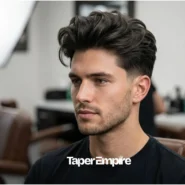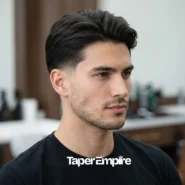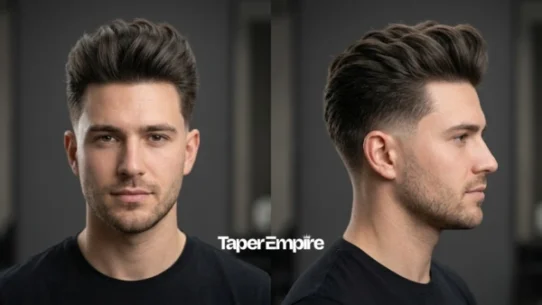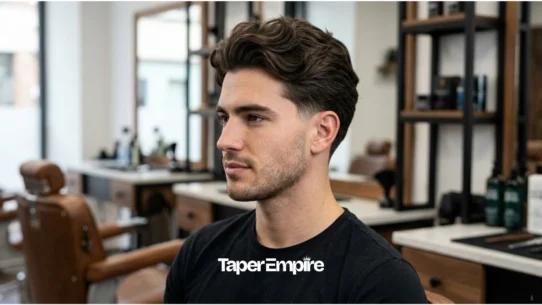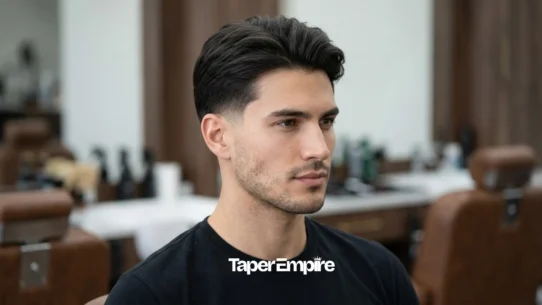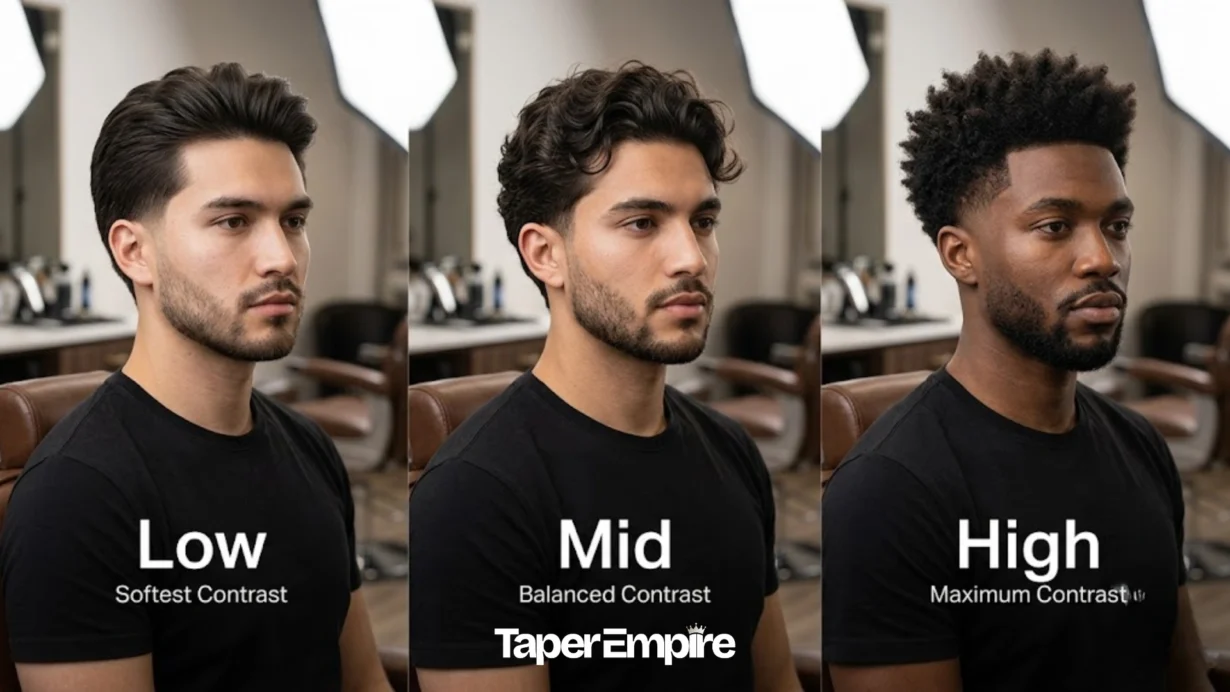

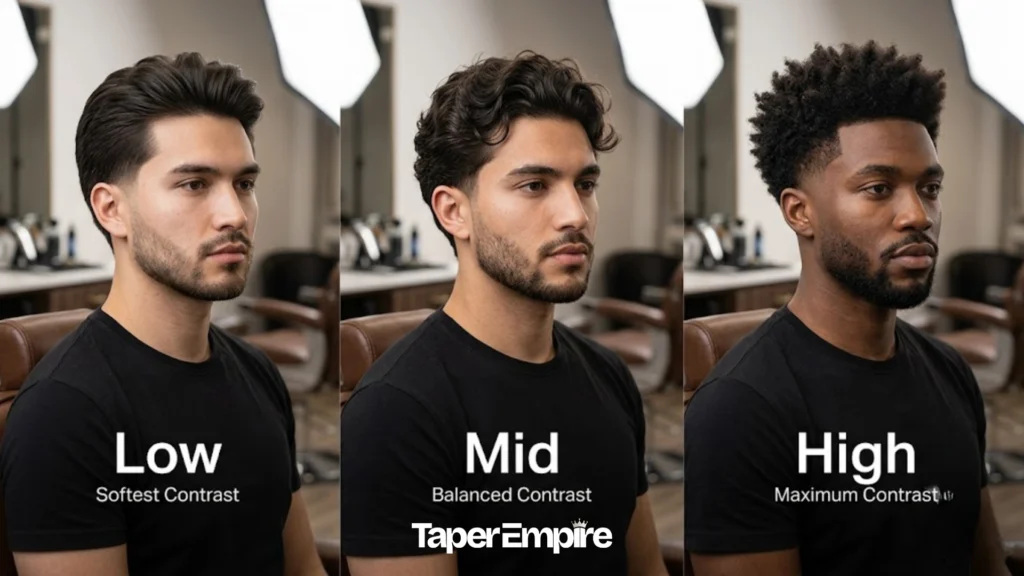
A blowout taper fade combines two techniques: a gradual taper that shortens hair from the crown down toward the hairline, and a blowout, which is a styling method that blow-dries the top section upward for lift. The fade blends the taper into the skin at the sides. This guide breaks down every major variation by taper height and hair type, explains which face shapes suit each version, and gives you exact wording to use at the barbershop so you leave with the cut you actually asked for.
What is a blowout taper fade?
A blowout taper fade combines a gradual taper on the sides with a blown-out, voluminous top. The taper shortens hair toward the hairline while the fade blends it into the skin. The blowout is a daily styling step, not a permanent part of the cut.
Key Points
- Combines taper, fade, and blowout
- Blowout is styled, not cut
- Works across most hair types
- Choose taper height by face shape
Table of Contents
What Is a Blowout Taper Fade?
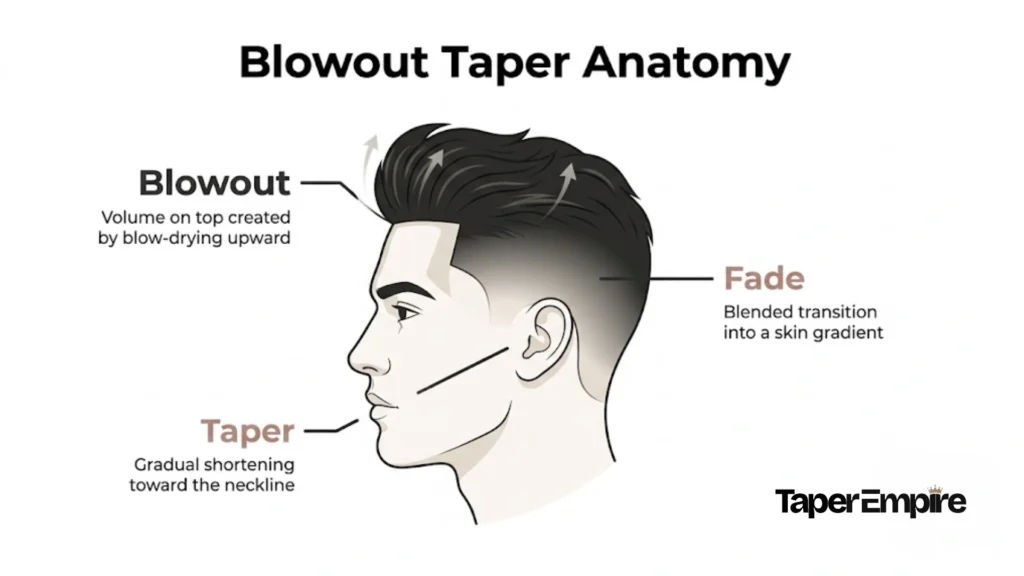
A blowout taper fade combines three separate ideas into one haircut. The taper gradually shortens the hair as it moves down toward the hairline and neckline. The fade blends that taper into the skin using progressive clipper guard changes, creating a smooth gradient rather than a hard line.
The blowout is different from the other two. It’s a styling technique, not a cutting technique. You blow-dry the top section upward and outward to build height and volume. Your barber won’t cut the blowout into your hair you create it at home, every time you style.
This distinction matters. If you book a “blowout taper fade” expecting the volume to show up automatically after the cut, you’ll be disappointed. The cut sets you up for the look. The blow dryer finishes it.
The taper itself is worth understanding on its own before you add the fade or the blowout on top of it, and a broader look at how tapering works as a haircut technique covers the basics if you’re new to the terminology. Tapering and fading aren’t interchangeable either; the core difference between the two techniques comes down to how much of the side panel is affected and how it grows out.
Once your barber blends the fade close to the skin, you’re working with what’s sometimes called a skin-level fade, which is the deepest, highest-contrast version of the fade component.
35 Blowout Taper Fade Variations
Every variation below combines a taper height with a blowout styling approach. They’re grouped by how high the fade sits on the head, since that’s the biggest visual difference between them.
Low Taper Blowout Variations
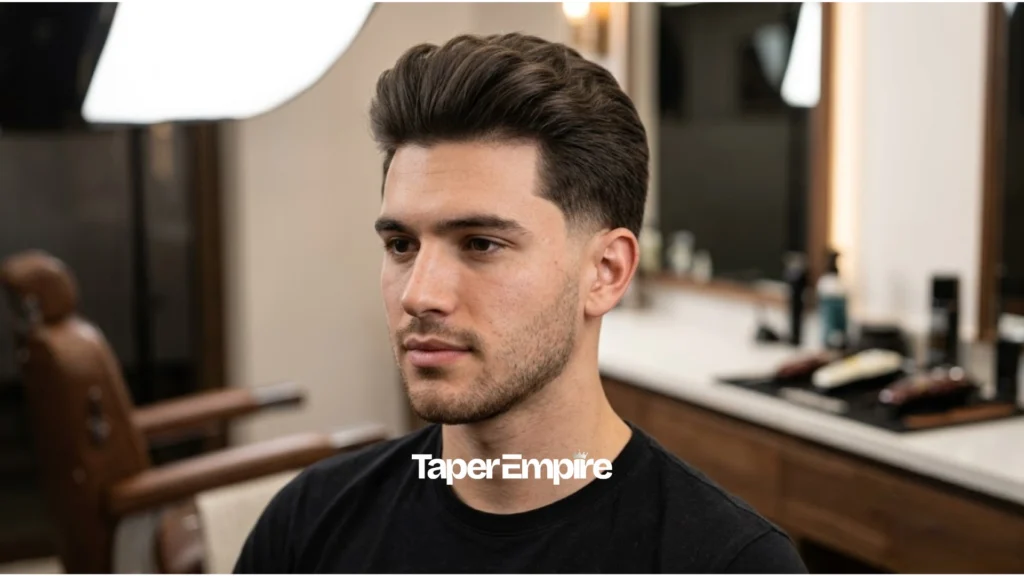
A low taper blowout keeps the fade close to the neckline and ears. The transition is subtle, which makes this the most professional-leaning option and the one that holds its shape the longest between trims.
- Classic low taper blowout — clean sides, natural volume on top, minimal contrast.
- Low taper blowout with side part — a defined part line adds structure to the blown-out crown.
- Low taper blowout with fringe — forward-falling top hair softens the face.
- Low taper blowout with beard fade — the low fade blends into a faded beard line for a connected look.
- Low taper blowout with hard part — a shaved line replaces the soft part for sharper definition.
- Low taper blowout with waves – Type 2 waves add texture beneath the blown-out volume.
- Low taper blowout with curl definition — curls are scrunched rather than blown fully straight.
- Low taper blowout, textured crop — shorter top length with heavy texture instead of full height.
- Low taper blowout, brushed-forward — top hair styled forward instead of up, for a softer silhouette.
This taper height overlaps closely with the standard low taper fade haircut, minus the blowout step on top.
Mid Taper Blowout Variations
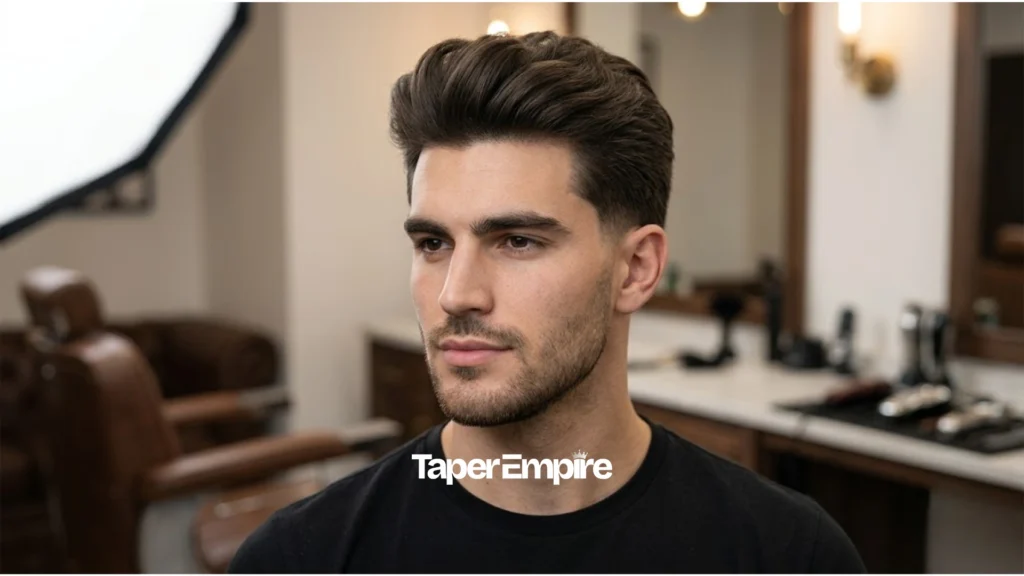
The mid taper blowout starts the fade around the temples. It’s the most requested height because it suits the widest range of head shapes and offers a visible but not extreme contrast.
- Classic mid taper blowout — balanced volume with moderate fade contrast.
- Mid taper blowout with quiff — top hair styled up and back for a lifted front.
- Mid taper blowout with pompadour influence — heavier volume at the front, tapering back.
- Mid taper blowout with curtain fringe — center-parted front sections framing the face.
- Mid taper blowout with skin fade sides — deeper contrast on the sides paired with mid-height taper.
- Mid taper blowout with beard connection — sides blend into facial hair.
- Mid taper blowout, cropped top — shorter length up top with a tighter blowout curl.
- Mid taper blowout with line-up — a sharp hairline edge adds definition at the front.
- Mid taper blowout, disconnected undercut — a visible line separates the top from the faded sides.
A non-blowout version of this same height sits in the general mid taper haircut category if you want to compare the two side by side.
High Taper Blowout Variations
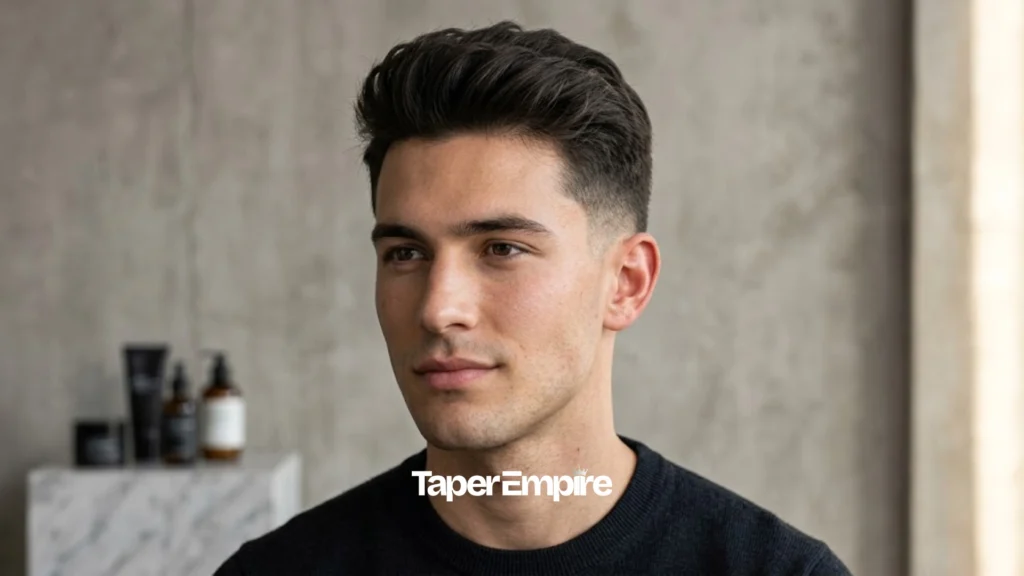
The high taper blowout brings the fade up near the upper sides of the head. This creates the sharpest contrast of the three heights and pairs well with thicker or curlier hair that can support more volume above the fade line.
- Classic high taper blowout — maximum contrast, tall volume on top.
- High taper blowout with spiky texture — top hair styled into defined spikes rather than a smooth sweep.
- High taper blowout, curly crown — natural curls left mostly untouched above a high fade.
- High taper blowout with design line — a shaved pattern added into the high fade zone.
- High taper blowout, brushed-back — volume directed straight back rather than up.
- High taper blowout with taper on beard — matching high contrast on facial hair.
- High taper blowout, disconnected top — a hard line separates a longer top from the high fade.
- High taper blowout, afro crown — natural afro texture styled up and out above a high fade.
- High taper blowout, wavy finish — waves brushed into place above the fade line.
Comparing this height directly against the mid and low options is easier with a side-by-side breakdown of all three taper heights if you’re still deciding.
Specialty Blowout Taper Variations
These variations add a distinct feature — a fringe shape, a perm, or a design — on top of any of the three taper heights above.
- Edgar blowout taper — a blunt, straight-across fringe at the front, faded sides, and volume built behind the fringe. This version needs more frequent front trims to keep the fringe line sharp.
- Slick back blowout taper — top hair blow-dried backward using fingers for lift, finished with pomade for hold and shine.
- Blowout perm taper fade — a loose or tight perm adds lift without daily blow-drying effort.
- Textured fringe blowout taper — a fringe with heavy texture falls forward instead of up.
- Design fade blowout taper — a custom line or pattern shaved into the fade zone for a personalized look. A closer look at back and side design options shows more placement ideas for this style.
- Center part blowout taper — a defined center part splits the volume into two sections.
- Ninja taper blowout — textured fringe styled with a directional, swept finish.
- Skin fade blowout taper — the fade is taken all the way to bare skin rather than left with a shadow.
- Shadow fade blowout taper — a very short length remains instead of bare skin, softening the contrast.
Which Blowout Taper Fade Suits Your Hair?
Hair type changes how much effort the blowout takes and how long the volume holds. The taper and fade work the same way regardless of texture, but the top section behaves differently depending on what you start with.
Straight Hair
Straight hair needs the most active styling to build a blowout. Flat texture doesn’t hold lift on its own, so you’ll rely on a round brush, blow dryer, and a volumizing product to create height that would come naturally with curl or wave. A taper fade built specifically for straight hair shows how the base cut looks without the added blowout step, which helps if you want to compare the two.
Curly Hair
Curly hair adds natural volume with far less daily effort. The curl pattern itself creates lift, so the blowout technique becomes more about direction and shape than building height from nothing. The taper still needs to control bulk at the sides so the curls don’t overwhelm the fade line. A curly hair taper fade guide breaks down the base cut for readers who want the style minus the blowout component.
Wavy Hair
Wavy hair sits between straight and curly in terms of effort. The natural movement in Type 2 hair enhances a blowout without requiring heavy products, making this one of the easier textures for daily maintenance. A wavy hair taper fade breakdown covers the low-taper version of this same texture pairing.
Afro-Textured or Coily Hair
Afro-textured and coily hair (often classified as Type 4) use a different blowout process. Instead of a standard blow-dry, barbers typically heat-stretch the natural curl pattern to create lift while keeping the texture intact. A shape-up or sponge tool is often used afterward to sharpen the perimeter and define the shape. Readers wanting a deeper look at style options and barber terminology built specifically for this hair type can review a gallery organized by hair texture with barber-approved wording.
Fine or Thin Hair
Fine or thin hair can absolutely support a blowout taper fade, but it needs adjustment. A slightly shorter top length holds shape better than a longer one, since thin strands lose lift faster under their own weight. Pairing the cut with a lightweight volumizing product — rather than a heavy paste keeps the top from collapsing by midday.
Choosing by Hair Density
Density is separate from texture, and it changes which taper height looks best.
| Hair Density | Recommended Taper Height | Why It Works |
|---|---|---|
| Low density (thin) | Low to mid taper | High contrast can expose thin spots; a subtler fade keeps the focus on shape, not scalp visibility |
| Medium density | Any taper height | No density-driven restriction; pick based on face shape or personal preference |
| High density (thick or curly) | Any taper height, high taper included | Thicker hair supports strong contrast without looking sparse |
Quick Tip
Comparing how different taper heights and blowout variations might look against your own hair type and face shape gets easier with a side-by-side view instead of guessing from photos alone.
What Face Shape Suits This Cut?
Face shape changes which taper height flatters your features most. A taller, higher fade adds vertical emphasis, while a lower fade keeps more visual weight close to the head.
| Face Shape | Recommended Taper Height | Why | Avoid |
|---|---|---|---|
| Oval | Any height | Balanced proportions suit all variations | — |
| Round | High taper | Adds vertical emphasis, elongating the face | Very low taper, which adds width |
| Square | Low to mid taper | Softens sharp jaw angles | High taper, which emphasizes angularity |
| Heart | Mid taper | Balances a wider forehead with a narrower jaw | Excess top volume, which widens the upper face further |
| Oblong | Low taper | Avoids adding further vertical length | High taper, which elongates further |
If you’re between two face shapes or unsure which category fits, a mid taper is the safest starting point. It’s the variation barbers describe as suiting the widest range of head and face shapes without needing adjustment.
How Long Does Your Hair Need to Be?
Most barbers recommend at least 3 inches of hair on top before a blowout taper fade will hold visible lift and volume 4 to 5 inches gives the best flow and shape. Individual growth rates vary based on genetics, age, and overall hair health.
Hair type shifts this number slightly. Curly hair often shows a blowout effect at a shorter length than straight hair, since the curl pattern itself adds visual height that straight strands can’t replicate without extra length or product.
If your hair is currently too short to hit that range, a low taper fade designed for shorter hair gives you a clean option to grow into the length you’ll need. If your hair is already well past the minimum, a long hair taper fade gallery shows what the more dramatic, higher-volume variations look like once you have extra length to work with.
How Do You Ask Your Barber?
The gap between what you say and what your barber hears is the most common reason a haircut doesn’t turn out the way you pictured it. Vague requests like “clean it up” leave too much room for interpretation.
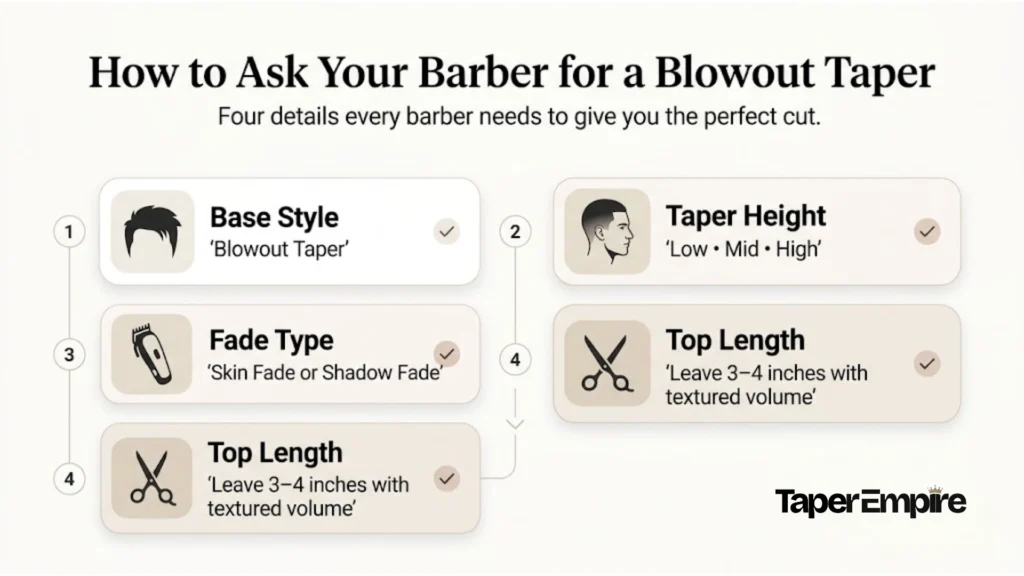
The 4-Part Barber Script
Use these four steps, in order, at the start of your appointment.
- State the base style. Say “I’d like a blowout taper fade.”
- Specify the taper height. Say “low taper,” “mid taper,” or “high taper” on the sides.
- Specify the fade type. Say “skin fade,” “shadow fade,” or “leave some length” depending on how much contrast you want.
- Specify the top. Confirm the top length you want and mention that you need enough hair left to blow-dry it for lift.
Scripts for Each Variation
Low or mid taper blowout: “I want a low [or mid] taper blowout. Keep the fade close to my [ears/temples], leave enough length on top to blow-dry up, and use a skin fade on the sides.” A barber-approved script built around this exact terminology, including back-view photo references, is broken down in more detail in a dedicated mid taper design guide.
High taper blowout or afro-textured hair: “I want a high taper blowout with a skin fade. Please heat-stretch the top for lift and keep the shape defined at the perimeter with a shape-up.” A texture-specific version of this script, organized by hair type, is available in a barber-script gallery built for high taper fades.
Slick back or perm blowout: “I want a blowout taper fade styled slick back [or with a perm]. Keep the sides low or mid taper, and leave the top long enough to brush straight back with pomade.”
Common Client Mistakes to Avoid
Small communication errors lead to results that don’t match what you pictured. Watch for these five before you sit down in the chair.
- Requesting the wrong taper height for your face shape. A high taper on an already narrow face can look unbalanced.
- Using “taper” and “fade” interchangeably. They’re related but distinct — mixing up the terms confuses the instruction.
- Not specifying a top length. Your barber can’t judge how much volume is possible without knowing your target length.
- Arriving without a reference photo. Verbal description alone leaves room for misinterpretation, even with a clear script.
- Requesting a high taper with low hair density. Thin, low-density hair can look sparse against a sharp, high-contrast fade.
How Do You Style It at Home?
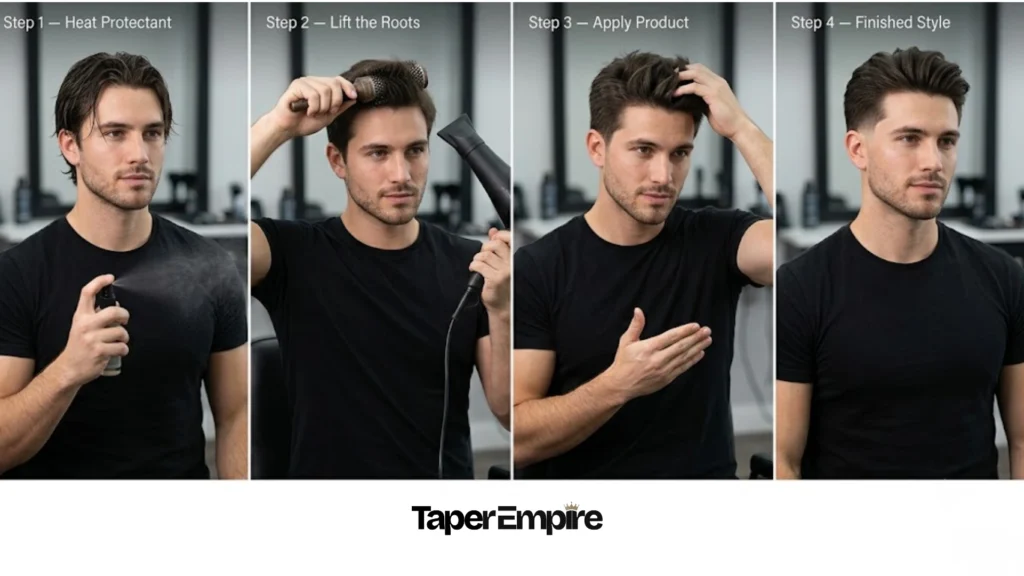
Recreating the blowout at home takes a dryer, a brush, and a few minutes of daily effort. Follow these steps after every wash.
- Apply heat protectant to damp hair before you start drying.
- Use a round brush to lift the roots while blow-drying upward and against the direction hair naturally falls, which builds more height than drying straight back.
- Add a volume or hold product once hair is about 80% dry mousse for lift, matte paste for texture, or pomade for a slicked finish.
- Finish with cool air to set the shape and lock in the volume before you leave the house.
Straight hair typically needs the full four steps every time. Curly and wavy hair can often skip the round brush and rely on finger-styling instead, since the natural texture does more of the lifting work already.
How Often Do You Need a Trim?
Trim frequency depends on taper height, since higher contrast reveals new growth faster than a subtle, low fade.
| Taper Height | Recommended Trim Frequency | Why |
|---|---|---|
| Low taper | Every 3 to 4 weeks | Sits close to the neckline, so regrowth is less noticeable |
| Mid taper | Every 2 to 3 weeks | Moderate contrast shows regrowth sooner than a low taper |
| High taper | Every 2 weeks | High contrast reveals new growth fastest |
A full breakdown of day-to-day care between trims including washing frequency and edge-up scheduling is covered in a general maintenance guide for taper fades if you want the complete routine beyond just the trim schedule.
What Does Grow-Out Look Like?
A blowout taper fade grows out in stages rather than losing its shape all at once. In the first week, the fade line softens slightly, but the overall shape still looks intentional. By week three, the contrast between the taper and the top starts to blur, especially on a high taper. By week four, most men book a trim; the fade has usually grown past the point where it reads as a defined style.
Quick Tip
If you’re planning your first appointment and want to walk in with the right wording already sorted, comparing a few variation scripts side by side before you go can save a round of back-and-forth in the chair.
How Is It Different From a Taper Fade?
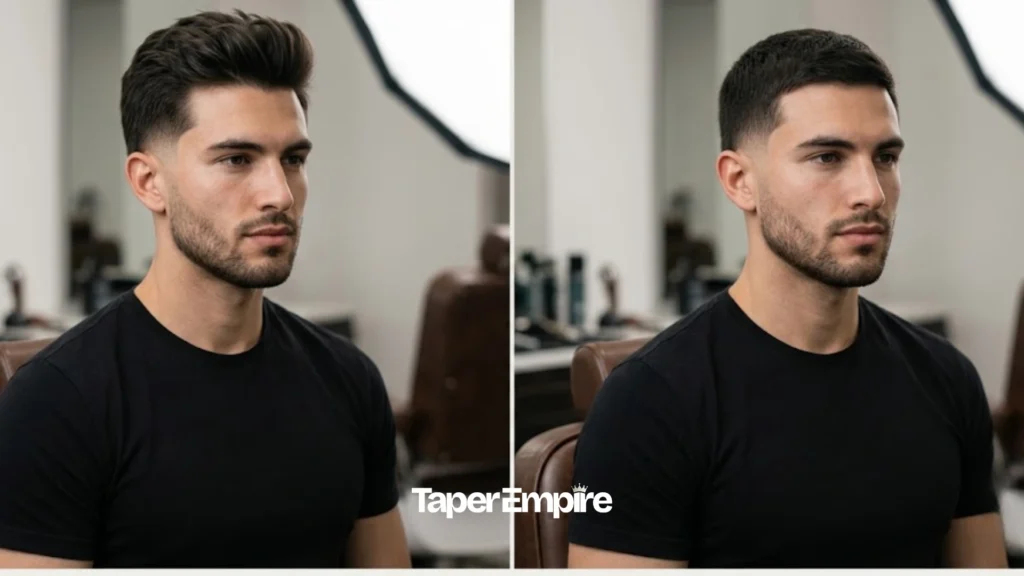
A standard taper fade and a blowout taper fade share the same side and back treatment. The difference is entirely on top.
| Feature | Blowout Taper Fade | Standard Taper Fade |
|---|---|---|
| Top styling | Blow-dried up for volume and lift | Left natural or styled flat |
| Top length needed | Longer, usually 3+ inches | Can be shorter |
| Daily styling time | More: requires blow-drying most days | Less: often no styling needed |
| Best for | Guys who want height and volume | Guys who want a lower-maintenance top |
If you’re deciding between the two before you book, a direct comparison of taper and fade as separate techniques explains the underlying cutting difference in more depth, and the standalone classic taper haircut, which skips the fade entirely, is worth a look if you want the lowest-contrast option available.
The honest trade-off: a blowout taper fade looks more dramatic, but it asks more of you every morning. A standard taper fade asks less of you but delivers a flatter, quieter result.
Is It Still Trending in 2026?
The blowout taper fade remains one of the most requested men’s haircuts in 2026, fueled by short-form video platforms like TikTok, where the style has gone viral across a range of hair types.
The style’s staying power comes from its flexibility. It works across straight, wavy, curly, and coily hair, and it scales from a subtle low taper to a dramatic high taper depending on how much contrast you want. That range is unusual for a single named haircut, and it’s part of why barbershops report continued demand for it across a wide range of clients.
Frequently Asked Questions
What is the difference between a blowout and a taper fade?
A blowout is a styling technique blow-drying the top section upward for volume. A taper fade is a cutting technique that gradually shortens hair from the crown toward the hairline, blending into the skin. Combined, they create the blowout taper fade.
Does a blowout taper fade work for curly hair?
Yes. Curly hair adds natural volume to the blowout with less daily styling effort than straight hair. The taper controls bulk at the sides while the natural curl pattern supports the lifted top section.
How do I ask my barber for a blowout taper fade?
State the base style name, specify a low, mid, or high taper, specify the fade type skin, shadow, or low and confirm the top length needed for enough hair to blow-dry upward.
How often does a blowout taper fade need a trim?
Trim frequency depends on taper height. Low tapers typically need trims every 3 to 4 weeks, mid tapers every 2 to 3 weeks, and high tapers every 2 weeks, since higher contrast reveals regrowth faster.
Can I get a blowout taper fade with fine or thin hair?
Yes, with adjustments. Fine hair supports this style using a lightweight volumizing product and a slightly shorter recommended top length, since thin strands hold lift less naturally than thick or curly hair.
What face shape suits a blowout taper fade best?
Oval face shapes suit any taper height. Round faces benefit from a high taper for vertical emphasis. Square faces suit low to mid tapers, which soften angular jawlines rather than emphasizing them.
Key Takeaways
A blowout taper fade works across nearly every hair type, but the right taper height depends on your face shape, hair density, and how much daily styling effort you’re willing to put in. Straight hair needs more product and technique to build volume; curly and coily hair often gets there with less effort.
Walking into the barbershop with a specific taper height, fade type, and top length already decided rather than a vague photo and a hope is what separates a haircut that matches your expectations from one that doesn’t. Use the four-part script above as your starting point, and adjust it for your hair type using the variation-specific wording covered in this guide.
Quick Tip
Once you’ve narrowed down a taper height and hair-type match from this guide, comparing a few final options side by side can help confirm your choice before you book.