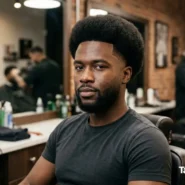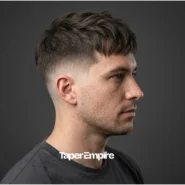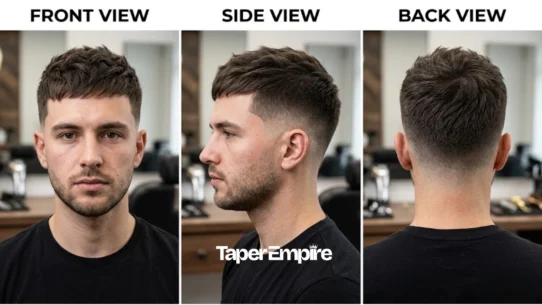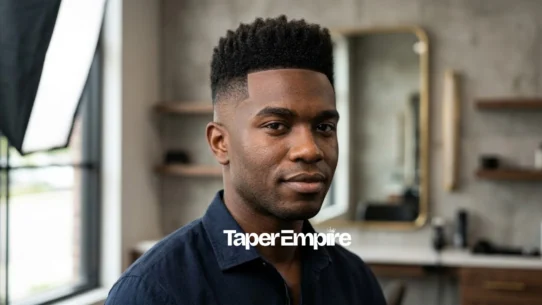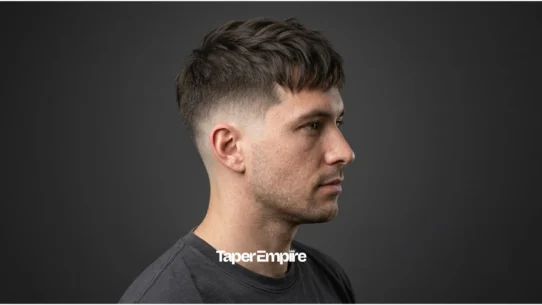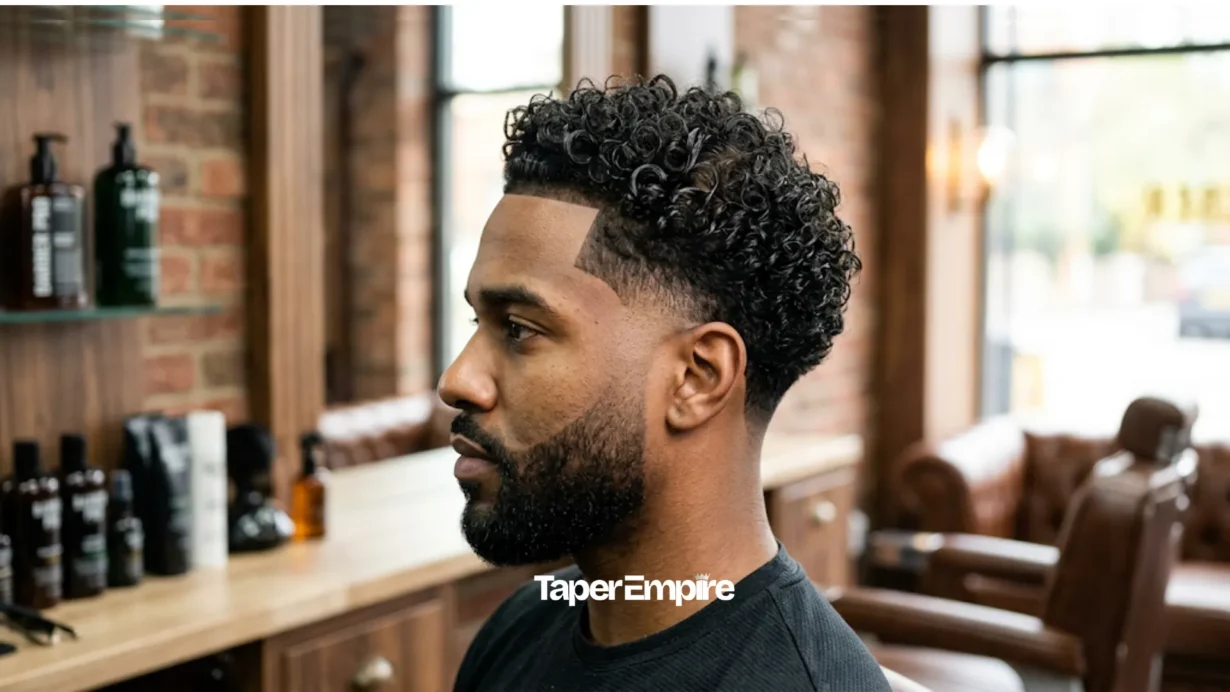

Curly hair looks incredible when it is cut the right way. But let it grow without structure, and you end up with the pyramid shape that makes your head look wider than it should. That is exactly what a mid-taper fade fixes. It removes bulk from the sides, keeps your natural curls full and defined on top, and creates a balanced silhouette that works whether you are heading to a job interview or a weekend hangout.
This guide covers every angle you need. You will find 15 handpicked styles organised by face shape and curl type, a word-for-word barber script so your next haircut goes exactly as planned, a daily styling routine, product recommendations, a grow-out timeline, a cost breakdown, and the most common mistakes that ruin this cut. Keep reading, your best haircut is waiting below.
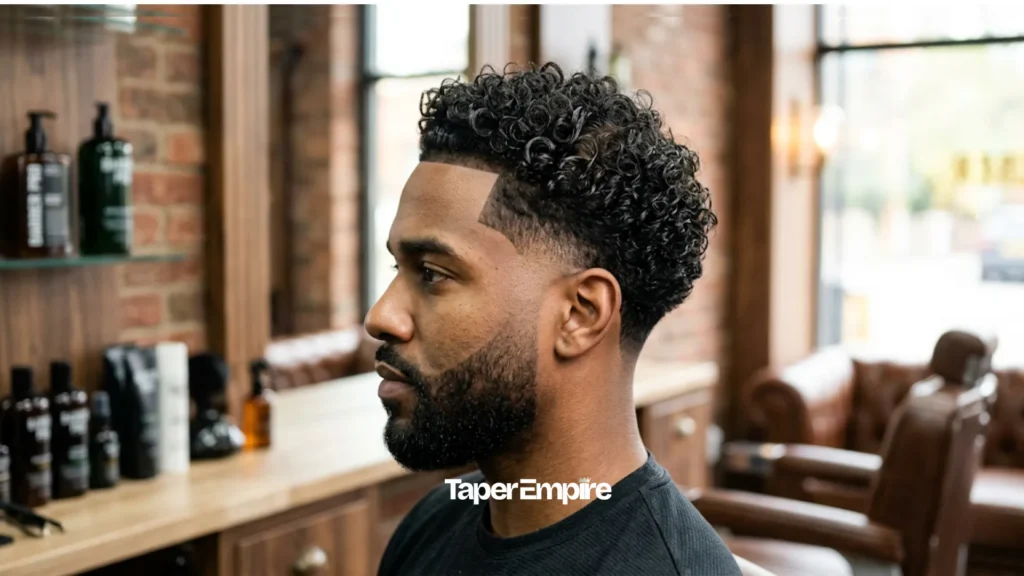
Table of Contents
What Is a Mid Taper Fade for Curly Hair and Which Curl Types Does It Suit?
A mid-taper fade for curly hair starts at the temple and blends down toward the neckline, keeping curls full on top while slimming the sides. It prevents the “pyramid” shape by removing side bulk without killing your curl pattern. It works on curl types 2C through 4C with the right top length and products.
KEY POINTS
- Temple-level fade that controls side bulk
- Works for curl types 2C to 4C
- Leave more top length for tighter curls
- Touch up every 2 to 3 weeks
What is a mid-taper fade for Curly Hair?
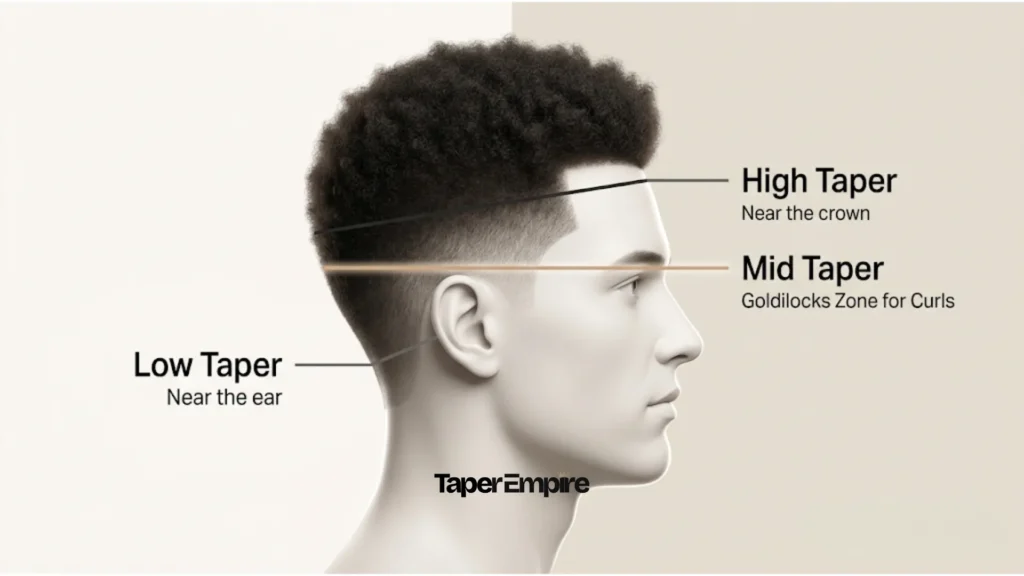
A mid-taper fade for curly hair is a men’s haircut where the fade begins at the temple, roughly halfway between the top of your ear and the crown of your head. The hair gradually blends shorter as it moves down toward the neckline, creating a smooth gradient from the longer curls on top to the closely trimmed sides and back.
What makes this cut special for curly hair is placement. The temple-level starting point preserves the volume and texture you want on top while eliminating the side bulk that makes curly hair spread outward into an unflattering shape. The result is a clean, structured frame around your face, with all the natural curl personality sitting exactly where it should be, on top.
Unlike a low taper fade that keeps the transition closer to the ears for a softer look, or a high taper fade that starts near the crown for maximum contrast, the mid taper sits in the middle. Barbers often call it the balanced choice because it gives you visible definition on the sides without looking overly aggressive or too conservative.
| Fade Type | Starting Point | Visual Effect | Curly Hair Suitability |
|---|---|---|---|
| Low Taper Fade | Near the ears and neckline | Subtle and conservative | Good for soft, understated looks |
| Mid Taper Fade | Temple level | Balanced contrast | Ideal for most curl types |
| High Taper Fade | Above the temples | Bold and dramatic | Can over-expose on thinner curls |
| Skin Fade | Any height, down to the skin | Maximum contrast | Works with care on tighter coils |
| Drop Fade | Curves downward from the temple | Unique arc shape | Great for a modern, artistic look |
Mid Taper Fade vs. Mid Fade: What Is the Real Difference?
These two terms sound almost identical, but they describe different cuts. A mid-taper fade blends gradually around the neckline and sideburns while retaining some length along the sides. A mid fade cuts more aggressively; it starts at the same midpoint but blends all the way down to the skin, exposing much more scalp and creating a sharper, bolder contrast.
For curly hair, this distinction matters. The mid-taper preserves more texture along the sides, so the transition into your top curls looks softer and more natural. The mid-fade creates a sharper line of contrast, which can look striking but requires more frequent barber visits to maintain as the hair grows back.
Taper vs. Fade: A Simple Explanation
A taper gradually reduces hair length toward the natural hairline. You still have some hair at the shortest point. A fade takes it further, blending the hair down to the skin for a more dramatic finish. A mid-taper fade combines both: it tapers gradually across most of the sides, then fades cleanly near the base and neckline. If you want clean sides without going completely bald at the bottom, the mid taper fade is the answer.
Why the Mid Taper Fade Works Perfectly for Curly Hair
Curly hair behaves differently from straight or wavy hair in almost every way. It grows outward before it grows downward. It shrinks when it dries. It adds bulk to the sides of your head faster than any other hair type. These are not flaws; they are just realities that need the right haircut to work with, not against.
The mid taper fade is built for exactly this. According to NaturallyCurly.com, curly hair in the 3B to 4C range can expand 20 to 40 per cent beyond its natural resting position when left unstyled on the sides. The mid taper eliminates that lateral expansion by tapering the sides down to a controlled gradient, directing all of the hair’s natural volume upward and keeping your overall head shape balanced and proportional.
Solves the Pyramid Shape Problem
If you have ever grown out your curly hair without getting the sides managed, you know what a pyramid shape looks like. Your hair puffs outward at the sides and narrows at the top, creating an inverted triangle silhouette that looks unbalanced from every angle. Some barbers refer to this as the mushroom effect. The mid taper fade eliminates it entirely by progressively removing side bulk, heaviest at the bottom and lightest near the temple, so that the width of your head stays controlled while your crown curls maintain their full volume and bounce.
Works for Every Curl Type From 2C Waves to 4C Coils
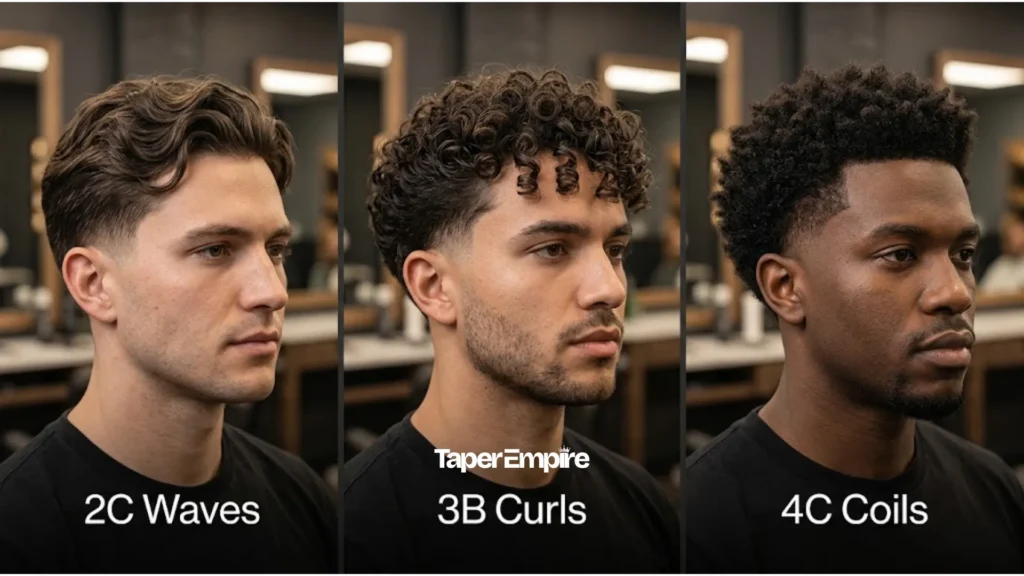
One of the biggest gaps in most haircut guides is treating curly hair as one single category. In reality, the difference between 2C loose waves and 4C tight coils is enormous in terms of shrinkage, density, volume behaviour, and how the fade line interacts with the texture.
| Curl Type | Characteristics | Shrinkage | Mid Taper Recommendation |
|---|---|---|---|
| 2C (Wavy) | Loose S-waves, low density | 10–15% | Subtle mid taper with a soft, natural blend |
| 3A (Loose Curls) | Wider spirals, moderate volume | 15–25% | Classic mid taper with natural transition |
| 3B (Medium Curls) | Springy defined coils | 25–30% | Mid-taper with curl cream for definition |
| 3C (Tight Curls) | Dense, tight corkscrews | 30–40% | Leave extra top length to account for shrinkage |
| 4A–4B (Tight Coils) | Very tight coil pattern, high density | 40–60% | Afro taper variation with dry cutting is essential |
| 4C (Tightest Coils) | Maximum density, maximum shrinkage | 50–70%+ | High contrast textured afro taper or skin fade |
This table is based on curl classification standards referenced by Ouidad and the Andre Walker Hair Typing System, which categorises curls from Type 1 (straight) through Type 4 (coily), with subcategories A through C within each type.
Professional and Casual Versatility
The mid taper provides enough structure for a corporate environment while keeping your natural curl personality intact. A low-taper fade can look overly conservative in casual settings, and a high-taper fade can read as too edgy in professional settings. The mid taper is the balanced middle ground that transitions from a Monday board meeting to a Saturday brunch without needing to change a thing. This versatility is a major reason it has become one of the most-requested fade haircuts for men across all age groups and professions.
15 Best Mid Taper Fade Curly Hair Styles for Men
Now, for what you came here to see. These 15 styles represent the best mid taper fade variations for curly hair in 2026, organised to help you match the right cut to your curl type, face shape, and personal style. Use these descriptions alongside a reference photo when you visit your barber.
1. Classic Mid Taper Fade with Natural Curls
This is the foundation of all curly taper styles: clean, balanced, and timeless. The tapered sides reduce bulk gradually while the crown stays full and defined, creating a structured silhouette without looking overdone. The seamless transition from faded sides to natural curls on top is what makes this cut universally flattering. If this is your first time trying a mid-taper, start here.
Best for face shape: Oval, square
Best for curl type: 2C to 3B
Occasion: Daily wear, professional, casual
Styling tip: Apply a lightweight curl cream to damp hair and diffuse on low heat for defined, frizz-free curls that last all day.
2. Blowout Mid-Taper Fade Curly Hair
This style is built for men who want maximum volume and a bold, head-turning presence. Your barber styles the curls upward and outward with a blow dryer and diffuser, creating a dramatic, fuller look on top, while the mid-taper fade keeps the sides crisp and controlled. The blowout effect works particularly well for 3C to 4B curl patterns where natural volume is already abundant.
Best for face shape: Oval, oblong
Best for curl type: 3C to 4B
Occasion: Parties, nightlife, creative environments, bold casual
Styling tip: Use a diffuser on medium heat to lift at the roots, then finish with a lightweight pomade to define the edges without weighing the curls down.
3. Curly Mohawk with Mid Taper Fade
A fusion of classic rebellion and modern refinement. The mid taper on the sides narrows toward a distinct curly strip on top, creating dramatic visual contrast between the clean gradient and the textured Mohawk. This is one of the most requested styles among men aged 18 to 28 who want their curls to make a statement.
Best for face shape: Oval, oblong, diamond
Best for curl type: 3B to 3C
Occasion: Concerts, weekends, creative workspaces, confident casual
Styling tip: Work curl cream through the Mohawk strip and scrunch upward; add a light-hold gel if you need the shape to stay firm all day.
4. Mid Taper Fade with Curly Fringe
The curly fringe falls forward across the forehead, adding an effortless, lived-in quality while the tapered sides maintain clean structure behind it. This variation works exceptionally well for men with loose to medium curls, where the fringe cascades naturally without looking heavy or forced. The forward movement of the curls softens the forehead, making this an excellent option for men with rounder or heart-shaped faces.
Best for face shape: Round, heart-shaped
Best for curl type: 2C to 3A
Occasion: Everyday wear, casual, creative settings
Styling tip: Use a light curl spray on damp hair and let it air-dry so the fringe falls naturally with soft movement.
5. Curly Quiff with Mid Taper Fade
The curly quiff adds controlled height and volume at the front, creating a polished, structured look that reads as intentional rather than chaotic. The mid taper fade supports the quiff by removing the side bulk that would otherwise compete with the upward volume. This cut is perfect for men who want a sharp yet natural look that transitions easily from the office to an evening out.
Best for face shape: Oval, square, round
Best for curl type: 3A to 3B
Occasions: Office, dates, smart casual, semi-formal events
Styling tip: Apply texture clay to the damp roots at the front, then blow-dry while lifting with your fingers to build height and direction.
6. Textured Afro Mid Taper Fade
Among Black men with natural curls and coils, this style carries cultural significance that goes beyond aesthetics. The textured afro mid taper maintains a natural, rounded shape on top that emphasizes the beauty of the coil pattern while the faded sides provide a clean, modern frame. According to Modern Salon, afro-textured hair holds the shape of a tapered fade exceptionally well because the density of tighter coils preserves the gradient longer than other hair types (ModernSalon.com). This is one of the most versatile options in the entire afro taper fade family.
Best for face shape: Round, oval, diamond
Best for curl type: 4A to 4C
Occasion: Professional, casual, cultural events, everyday wear
Styling tip: Shape the top daily with a soft-bristle brush and use a curl-defining cream to maintain moisture and coil definition between barber visits.
7. Long Curly Top with Mid Taper Fade
For men who want to showcase their curl length, this variation lets the top grow out to 4 inches or more, while the tapered sides and back provide structure that prevents it from looking unruly. The contrast between the longer, flowing curls and the clean fade creates a bold appearance that balances personal expression with grooming precision.
Best for face shape: Oval, square, heart
Best for curl type: 3A to 3C
Occasion: Creative work, social events, casual settings
Styling tip: Deep condition once a week and always use a leave-in conditioner before curl cream to keep longer curls soft and frizz-free.
8. Short Curly Top with Mid Taper Fade
This is the minimalist’s cut. Short curls on top paired with clean, tapered sides create a polished, low-maintenance look that suits virtually every professional setting. The taper adds sharpness without overwhelming the natural curl pattern, and the shorter length means your morning styling routine takes under five minutes. If you want a skin fade effect without going all the way to the scalp, this is the style to request.
Best for face shape: Oval, square, oblong
Best for curl type: 3B to 4A
Occasion: Professional, corporate, minimal-maintenance daily wear
Styling tip: Use a small amount of light-hold gel on damp curls to define them, then let them air-dry for a clean, natural finish.
9. Drop Fade with Curly Top
The drop fade curves downward around the ear, creating a distinctive arc shape that dips lower at the back of the head. When paired with natural curls on top, this curved fade line adds an architectural quality that standard straight fades cannot replicate. The smooth gradient frames the head beautifully from every angle and adds visual interest to the sides.
Best for face shape: Oval, round, heart
Best for curl type: 3A to 3C
Occasion: Social events, modern casual, creative offices
Styling tip: Ask your barber for a mid drop fade that clearly curves around the ear, and bring a reference photo to get the shape you want.
10. Disconnected Mid Taper with Curly Top
Instead of blending the fade gradually into the curly top, this variation creates a deliberate, visible separation between the two sections. The result is maximum visual contrast a clean, defined line where the fade ends and the textured curls begin. This style is heavily influenced by editorial fashion and runway grooming, making it a favourite among style-forward men who want their haircut to be a conversation starter.
Best for face shape: Oval, oblong
Best for curl type: 3B to 3C
Occasion: Fashion, nightlife, creative work, statement looks
Styling tip: Keep your barber appointments tight about every two weeks so that the hard line stays clean and does not blur into a half-grown fade.
11. Side Part Curly Mid Taper Fade
Adding a defined side part instantly transforms curly hair from casual to intentional. The part creates a clean visual division that organises the curls, and the mid taper fade frames it with structure on the sides. This is one of the most versatile professional styles available for men with medium curls, equally appropriate for a boardroom presentation and a dinner reservation.
Best for face shape: Oval, square, heart
Best for curl type: 3A to 3B
Occasion: Work, school, smart casual, formal events
Styling tip: Create the part on damp hair with a fine-toothed comb and a little lightweight pomade, then let it air-dry so the curls set around the part naturally.
12. Curly Mullet with Mid Taper Fade
The curly mullet has experienced a massive resurgence over the past two years, driven largely by social media and Gen Z style culture. The mid taper fade modernizes the classic mullet silhouette by keeping the sides tight and clean while the back section grows out with natural curl texture. It is equal parts retro throwback and modern statement piece.
Best for face shape: Oval, oblong
Best for curl type: 3A to 3C
Occasion: Festivals, creative work, weekends, casual social events
Styling tip: Use curl mousse on the longer back to define and control the curls without stiffness, and a slightly stronger product on the sides to keep the taper neat.
13. Textured Fringe Mid Taper Fade
Deliberately choppy, layered fringe with serious natural movement, paired with a sharp mid-taper, creates dynamic contrast that catches light and attention equally. The textured fringe brings forward-falling energy while the clean fade provides structural balance from the sides and back. This works best for loose to medium curls where the fringe has enough natural motion to look effortless.
Best for face shape: Round, heart, oval
Best for curl type: 2C to 3B
Occasion: Casual, dating, social, everyday wear
Styling tip: Apply sea salt spray to damp hair and let it air-dry so the fringe forms loose, textured waves with a natural, tousled feel.
14. Mid Taper Fade with Beard Integration
When the mid-taper fade connects seamlessly into a well-groomed beard, it creates a complete facial frame that elevates the entire look. The fade should blend into the beard line without any visible gap or harsh transition. Professional barbers call this a full face frame. A crisp hairline combined with a shaped beard is one of the most sophisticated men’s grooming combinations available.
Best for face shape: All face shapes (beard helps customise the outline)
Best for curl type: All curl types
Occasion: Professional, formal, business-casual, social events
Styling tip: Book beard and hair services together every two to three weeks so the fade and beard lines grow out at the same rate and stay connected.
15. Mid Taper Fade with Curly Hair Designs and Patterns
For men who want maximum individuality, incorporating sharp linework and artistic patterns into the fade transforms a standard mid taper into a personalised work of art. Geometric designs, signature symbols, or angular line patterns etched into the faded area complement bold curls on top, blending technical barbering skill with creative expression.
Best for face shape: Oval, round, diamond
Best for curl type: 3C to 4C
Occasion: Parties, creative work, performances, personal branding
Styling tip: Expect to visit your barber every 10 to 14 days because designs blur quickly as hair grows back and need regular refreshing to stay sharp.
Best Mid Taper Fade for Curly Hair by Face Shape
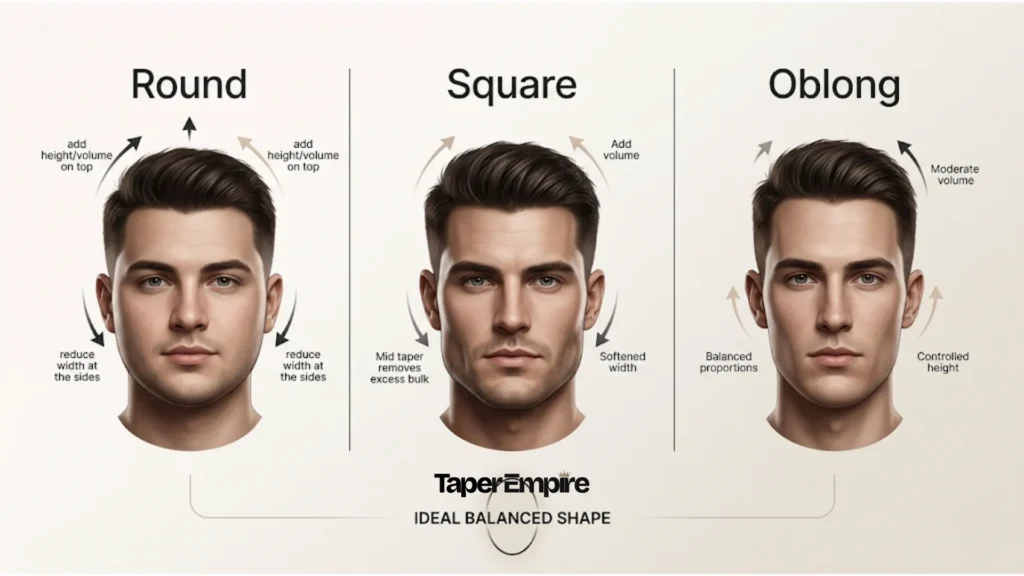
Choosing the right variation by face shape comes down to visual balance. The goal is to use fade height and curl volume placement to create the appearance of balanced, oval-shaped proportions, which is universally considered the most flattering facial proportion in men’s grooming.
Not sure which face shape or mid-taper style suits you best? Use our free Taper Empire analyser to get mid-taper recommendations tailored to your face and curls.
| Face Shape | Recommended Variation | Curl Volume Placement | What to Avoid |
|---|---|---|---|
| Round | Quiff, Mohawk, or classic with extra height | Crown — creates length | Too much side volume |
| Oval | Any variation | Versatile placement | Nothing specific |
| Square | Classic or side part with longer top | Crown — softens angles | Very short top |
| Heart | Fringe or quiff with crown volume | Crown and forehead area | Too much width at temples |
| Diamond | Classic with soft curved hairline | Around cheekbones | Sharp angular designs |
| Oblong | Blowout or voluminous sides | Sides adds width | Excessive crown height |
Round face: The priority is creating the illusion of length. Styles that add height on top while keeping the sides tight, like the curly quiff or the Mohawk, elongate the face visually and counterbalance its natural width. Avoid any variation that adds volume to the sides.
Oval face: You have the most flexibility. Almost every mid-taper variation flatters an oval face because the proportions are already balanced. Use this as an opportunity to choose based on personal style rather than corrective geometry.
Square face: A mid taper fade with slightly longer curls on top softens the angular jawline and forehead, while the clean sides emphasise the strong bone structure. The side part variation works exceptionally well here.
Heart-shaped face: Extra crown volume offsets the wider forehead and narrower chin. The curly quiff or fringe variations work best because they add strategic volume where it creates the most visual balance.
Diamond face: Benefit from curved, soft hairline designs that balance the narrow chin and forehead with the wider cheekbones. Avoid overly angular patterns that accentuate the sharpness.
Oblong face: The goal is to add width, not height. A blowout variation or any style with fuller sides helps balance the natural length of the face. Avoid excessive crown height that stretches the visual proportion further.
How to Talk to Your Barber About a Mid Taper Fade for Curly Hair
Poor communication is the single most common reason men walk out of a barbershop disappointed. For curly hair specifically, vague instructions can lead to unpredictable results because curls behave differently at every stage of the cutting process. The solution is going in prepared with specific language, a reference photo, and the right questions.
The Exact Script: What to Say Word for Word
Use these phrases at your next appointment. Each one targets a specific decision your barber needs to make, removing ambiguity from every step.
Step 1 — Define the fade height: Tell your barber, “I want a mid taper fade that starts at temple level — not higher.”
Step 2 — Specify the top length: Say: “Leave three to four inches on top. My curls shrink when they dry, so please account for that.”
Step 3 — Describe the blend: Request: “I want a smooth, seamless blend where the fade meets the curls on top — no visible line or disconnected gap.”
Step 4 — State your curl type: Inform them: “My curls are [tight/medium/loose] and they have [high/medium/low] shrinkage.” This simple statement provides your barber with critical technical information to plan the cut.
Step 5 — Specify neckline preference: Ask for: “A [rounded/tapered/square] neckline please keep it clean and precise.”
Step 6 — Beard integration (if applicable): Add: “Can you blend the fade into my beard line so the transition is seamless?”
According to a barber education article published by MENSPIRE, one of Europe’s leading barber training academies, combining a verbal description with a reference photo significantly reduces miscommunication because the two together eliminate the interpretation gap that either one alone leaves open (MENSPIRE).
Do not want to memorise the full script? Let the Taper Empire tool generate a barber‑ready mid‑taper brief for your face and hair in under a minute.
Should Curly Hair Be Cut Wet or Dry?
This is the most technically important question you can ask before your barber picks up the clippers. Curly hair stretches 20 to 40 per cent longer when wet because water weight reduces the curl’s natural spring tension. A barber who cuts your curly hair while it is wet will create fade lines that sit noticeably higher than intended once the hair dries and the curls shrink back to their natural resting length.
This is why experienced textured hair barbers either cut completely dry or use a hybrid approach. The hybrid method involves shaping the initial fade on dry hair so the barber can see the true curl behavior, dampening slightly for detail work, and then checking the final result on dry hair before finishing. The DevaCut technique, popularized by DevaCurl, takes this even further by cutting individual curls one at a time in their natural dry state to achieve maximum precision (DevaCurl.com).
When you sit down in the chair, ask: “Do you prefer cutting curly hair wet or dry?” If the answer is only wet, consider finding a barber with more experience with textured hair.
Questions to Ask Your Barber Before the Cut
Before any cutting begins, these five questions will tell you whether your barber is the right person for the job:
- Do you regularly cut curly or textured hair?
- Do you prefer to cut curly hair dry or wet, and why?
- Do you use scissors or clippers on the curly top section?
- Have you done a mid taper fade on my curl type before?
- Can I see photos of previous curly hair clients you have worked on?
A barber who confidently answers all five is likely experienced enough to handle your curls. One who hesitates or dismisses the questions may not be the right fit for a textured cut that demands specialized technique.
How to Style Mid Taper Fade Curly Hair Step by Step
Getting the perfect haircut is only half the equation. What you do at home between barber visits determines whether your mid taper curly hair looks sharp on Day 14 or loses its definition by Day 3. The good news is that a solid styling routine takes under 15 minutes once you know the steps.
Daily Styling Routine
Step 1 — Cleanse with a sulfate-free shampoo. Sulfate-free formulas clean your hair without stripping the natural oils that curly hair desperately needs to stay hydrated and defined. Wash every two to three days rather than daily to preserve moisture.
Step 2 — Condition generously. Apply a moisturising conditioner from the mid-lengths to the tips. Let it sit for two to three minutes before rinsing. This step is non-negotiable for maintaining curl elasticity and preventing breakage.
Step 3 — Apply leave-in conditioner to soaking wet hair. This is your moisture base layer. Everything else builds on top of it. Distribute evenly and make sure every curl cluster is coated.
Step 4 — Apply curl cream. Seal the moisture in and define the curl pattern. Work the cream through your hair in sections, ensuring even coverage from roots to tips.
Step 5 — Scrunch upward. Gently squeeze your curls upward toward the scalp to encourage natural curl formation and clumping. Do not rub or twist aggressively that creates frizz.
Step 6 — Choose your drying method. Air-dry for a more relaxed, natural finish. Or diffuse on low heat for faster drying with enhanced volume and definition. If you diffuse, hold the dryer beneath the curls and lift upward to maximise bounce.
Step 7 — Break the cast. Once your hair is fully dry, gently scrunch out any product crunchiness with clean, dry hands. This leaves your curls soft, touchable, and naturally defined.
Step 8 — Refresh between washes. On non-wash days, spray a light curl reviver on dry hair and scrunch gently to reactivate the curl pattern without starting from scratch.
Best Products for Mid Taper Fade Curly Hair
| Product Type | What It Does | When to Apply |
|---|---|---|
| Sulfate-free shampoo | Cleanses without stripping oils | Wash day (every 2–3 days) |
| Leave-in conditioner | Moisture base layer | Post-wash on soaking wet hair |
| Curl cream | Defines pattern, seals moisture | After leave-in on wet hair |
| Light-hold gel | Holds definition without crunch | After curl cream |
| Mousse or styling foam | Volume with soft, flexible hold | Alternative to gel |
| Diffuser attachment | Controlled drying with curl enhancement | Drying stage |
| Curl spray or reviver | Refreshes curls between washes | On dry hair, non-wash days |
| Deep conditioner | Intensive moisture treatment | Once weekly |
| Texture clay | Structured top styling with matte finish | On dry hair for finishing |
| Lightweight pomade | Defines edges and adds subtle shine | Final step for polishing |
The four products every man with a mid-taper curly cut needs at a minimum are a sulfate-free shampoo, a leave-in conditioner, a curl cream, and a diffuser. Everything else is an optional enhancement based on your preferred look.
Night Care Routine for Curly Mid Taper Fade
What happens while you sleep directly affects how your curls look in the morning. Standard cotton pillowcases create friction that pulls apart curl clumps, absorbs moisture, and generates frizz overnight. The fix is simple.
Sleep on a satin or silk pillowcase. The smooth surface reduces friction dramatically, preserving your curl definition and preventing the morning frizz that forces you to rewet and restyle. Alternatively, wear a satin bonnet over the top section of your curls if you move a lot during sleep.
For longer curls, the pineapple method, gathering your curls into a loose, high ponytail secured with a silk scrunchie, keeps them from being crushed flat overnight. A quick morning refresh with water spray and gentle scrunching reactivates your curl memory without a full restyle.
How to Maintain Your Mid-Taper Fade Curly Hair
One significant advantage of having curly hair with a mid-taper fade is that your natural texture extends the life of the cut. According to barber training resources published by Barber Theory, curly hair disguises the early stages of fade regrowth better than straight hair, keeping the cut looking sharp for 10 to 14 days and presentable through 21 to 28 days, compared to straight hair, which shows visible growth within 7 to 10 days (BarberTheory.com).
Grow-Out Timeline: What to Expect Week by Week
| Cost Factor | Standard Barber | Curly Hair Specialist |
|---|---|---|
| Per-cut cost | $30–$45 | $50–$75 |
| Time in chair | 25–35 minutes | 35–60 minutes |
| Visit frequency | Every 2–3 weeks | Every 2–3 weeks |
| Monthly product cost | $15–$30 | $30–$60 |
| Estimated monthly total | $60–$120 | $130–$210 |
Curly haircuts cost more for legitimate reasons. The barber needs specialised technique knowledge, including dry cutting and shrinkage compensation. The cut takes longer because each curl behaves individually. And the precision required for accurate fade placement on textured hair demands greater skill. Barbers proficient with curly texture command premium pricing, and the result, a fade that actually looks right when your hair dries, is worth the difference.
If cost is a concern, stretching your visits to every three weeks instead of two and doing basic neckline maintenance at home can reduce monthly spending by roughly 30 per cent without sacrificing the overall look.
Frequently Asked Questions
Is a mid-taper fade good for curly hair?
Yes. The mid-taper fade is one of the most recommended haircuts for curly hair because it starts at temple level, removing the side bulk that creates a pyramid shape while preserving full curl volume on top. It works for all curl types, from 2C loose waves to 4C tight coils, and suits every face shape with the right variation.
What is the difference between a mid taper fade and a mid fade for curly hair?
A mid-taper fade blends gradually around the neckline and sideburns while maintaining some hair length along the sides. A mid fade blends more aggressively, often down to the skin, for a bolder, higher-contrast look. For curly hair, the mid taper is generally more texture-preserving, while the mid fade creates stronger visual separation between the curls and the sides.
How often should I get a mid-taper fade with curly hair?
Most men with curly hair should visit their barber every two to three weeks. Curly texture extends fade longevity compared to straight hair, keeping the cut looking sharp for 10 to 14 days and presentable through 21 to 28 days. Men who prefer a softer, grown-in look can stretch to four weeks.
Should curly hair be cut wet or dry for a mid-taper fade?
Dry cutting is strongly recommended. Curly hair stretches 20 to 40 per cent when wet, causing fade lines to end up higher than intended once the hair dries and shrinks back. Experienced textured hair barbers cut dry or use a hybrid method, shaping the fade dry, dampening for detail work, and checking the result dry before finishing.
What products are best for styling curly hair with a mid-taper fade?
The four essential products are a sulfate-free shampoo to preserve natural oils, a leave-in conditioner as the moisture base, a curl cream for definition and hold, and a diffuser attachment for controlled drying. Optional additions include a light-hold gel, a curl-reviver spray for between-wash use, and a texture clay for structured styling on dry hair.
Does the mid-taper fade work for all face shapes?
Yes, with the right variation. Oval faces suit any style. Round faces benefit from added height on top with tight sides. Square faces look best with longer curls that soften angular features. Heart-shaped faces need extra crown volume. Diamond faces pair well with soft, curved designs. Oblong faces should avoid excessive height and instead add width with fuller sides.
How is a mid-taper fade different for Black men with afro-textured hair?
For Black men with 4A to 4C coil patterns, the mid taper fade carries cultural significance alongside its aesthetic value. The cut complements natural coil density, and tighter curl patterns actually hold the fade shape longer than looser textures. Dry cutting and DevaCut techniques are especially critical for tighter coils to ensure accurate fade placement. The textured afro mid-taper variation specifically preserves the rounded, natural shape on top while providing a clean, structured frame on the sides.