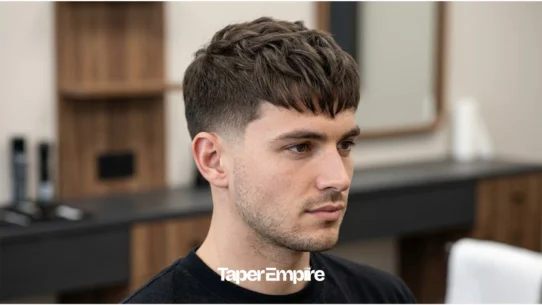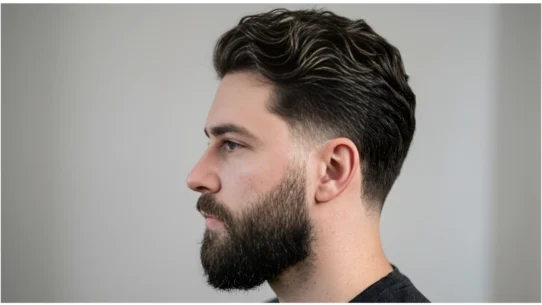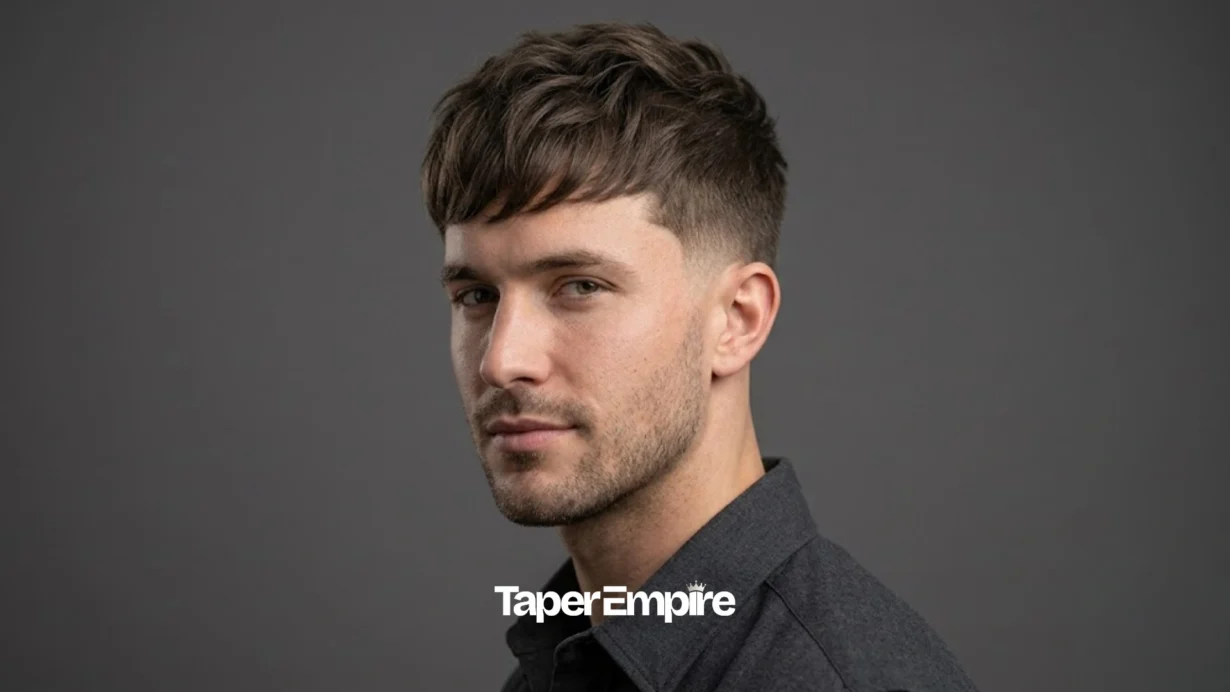

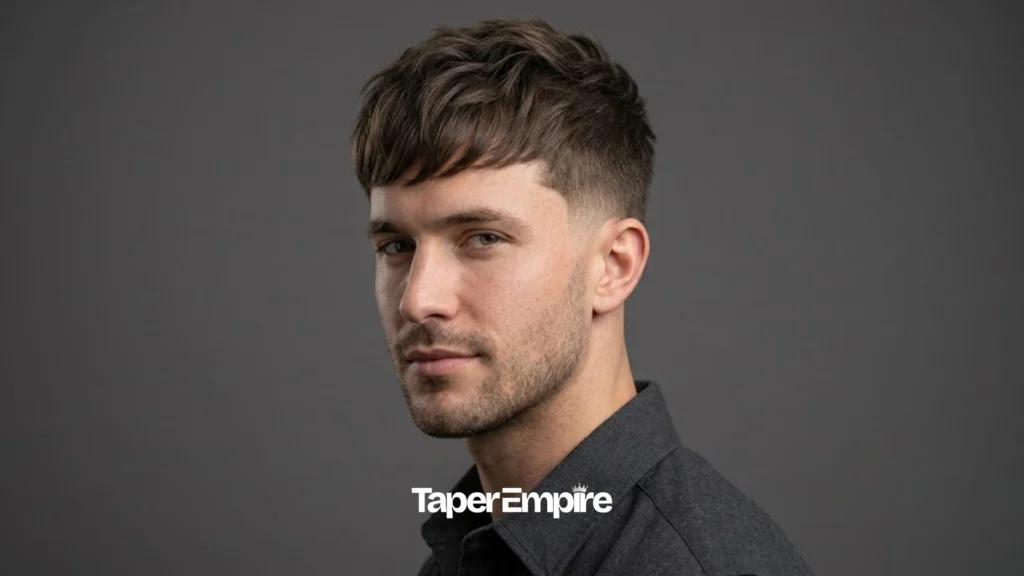
A blowout-tapered textured fringe is a men’s haircut that combines a clean taper on the sides and neckline, a voluminous, blow-dried crown, and a point-cut fringe that falls forward across the forehead. The taper sits low, mid, or high depending on the variant. Barbers create the texture using point cutting, not blunt scissoring, so the fringe falls broken rather than straight.
This guide breaks down every part of the cut: the three taper heights, exactly what to say in the chair, how it works on different hair types, and how to style it yourself once you leave the barbershop.
What is a blowout-tapered textured fringe?
A blowout-tapered textured fringe combines a clean taper on the sides, a blow-dried voluminous crown, and a point-cut fringe that falls forward across the forehead. The taper height can be low, mid, or high depending on how much contrast you want.
Key Points
- Three parts: taper, crown, fringe
- Taper heights: low, mid, high
- Fringe cut with point-cutting technique
- Trim every 2–4 weeks
Table of Contents
What Is a Blowout Taper Textured Fringe?
A blowout taper textured fringe is built from three parts working together. The sides and back use a clean taper that fades length gradually at the sideburns, ears, and neckline. The crown stays long enough for the barber to blow-dry it upward for volume. The front section gets point-cut so the strands fall at uneven lengths rather than in one straight line, creating a broken, piecey fringe instead of a blunt curtain.
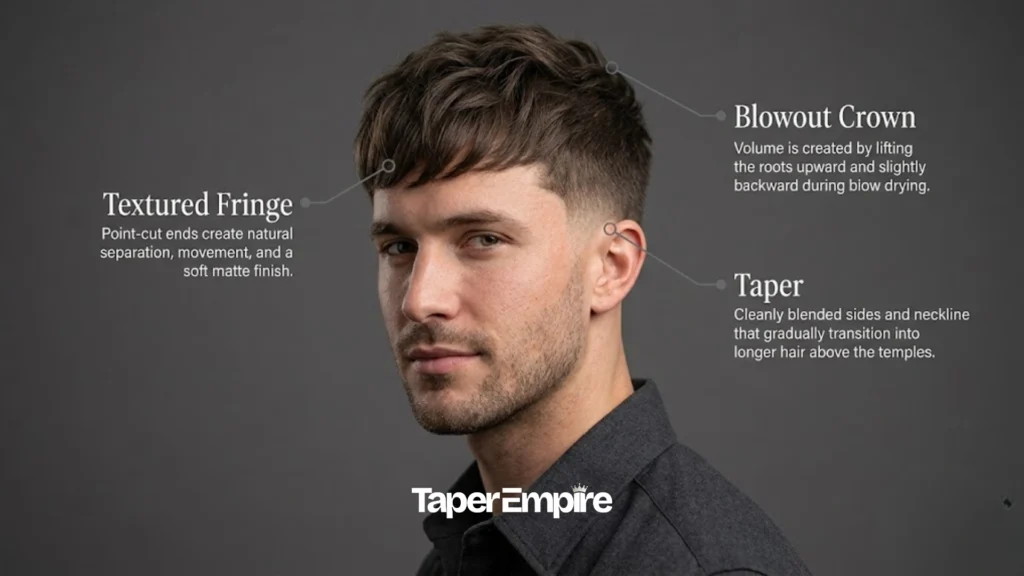
Getting the height and taper style right often depends on comparing it against related fade options, since the general distinction between a taper haircut and a fade-based style shapes how sharp the final contrast looks.
Taper vs. Fade: What’s the Difference?
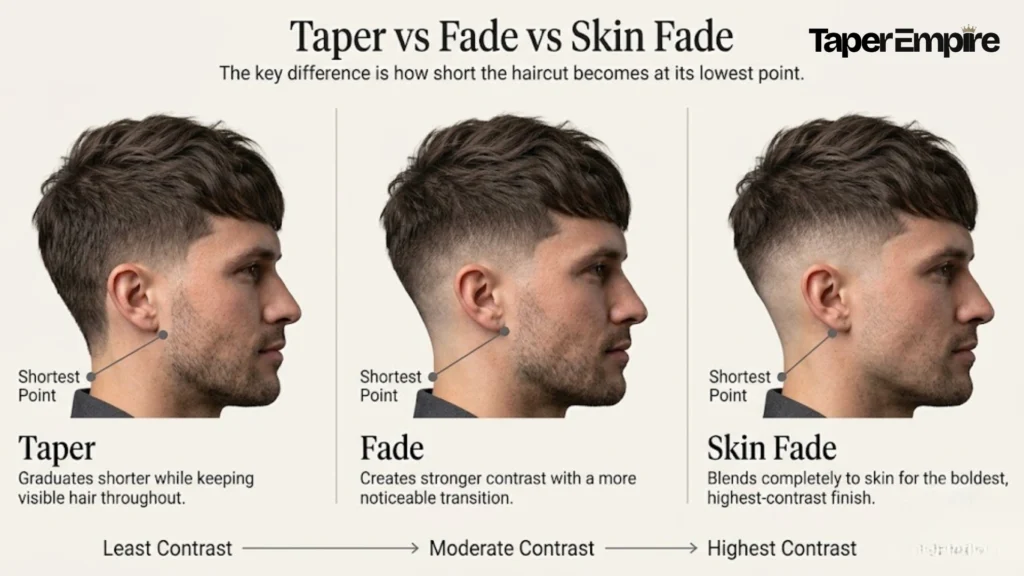
A taper leaves graduated length above the fade line, creating a soft, gradual transition. A fade removes hair down to the skin at some point on the head, creating a hard, zero-length contrast.
This distinction matters because the two terms are often mixed up. If you ask for a “blowout taper textured fringe” but your barber defaults to a skin fade on the sides, you’ll get a sharper, more dramatic look than you asked for. A taper keeps more length on the sides overall, which makes it the lower-maintenance, more versatile option for this specific haircut.
Some barbers use taper and fade interchangeably in casual conversation, which is why naming the exact technique matters more than assuming your barber already knows what you mean. Comparing all three related techniques side by side helps clarify where a skin fade fits relative to a taper and a taper fade.
| Feature | Taper | Fade |
|---|---|---|
| Shortest point | Graduated, never reaches skin | Reaches skin at some point |
| Transition style | Soft and gradual | Sharp and defined |
| Maintenance | Lower frequency | Higher frequency |
| Best for | This haircut’s low-maintenance goal | Sharper, high-contrast looks |
Textured Fringe vs. Textured Crop
A textured crop keeps the top short and flat with a blunt fringe cut close to the brow. A blowout-tapered textured fringe keeps the top long with a lifted, blow-dried crown and a piecey fringe.
Both styles use a forward fringe direction, so from the front they can look similar in photos. The real difference shows up in profile: the crop has almost no height, while the blowout taper builds noticeable volume above the forehead.
Which Taper Height Should You Choose?
Low taper keeps the fade line at the ears and neckline, preserving the most length overall. Mid-taper moves that line higher to the middle of the head for a sharper transition. High taper starts above the temple and creates the boldest contrast, but it carries the highest risk of a flat, mushroom-shaped result if the crown is cut too short.
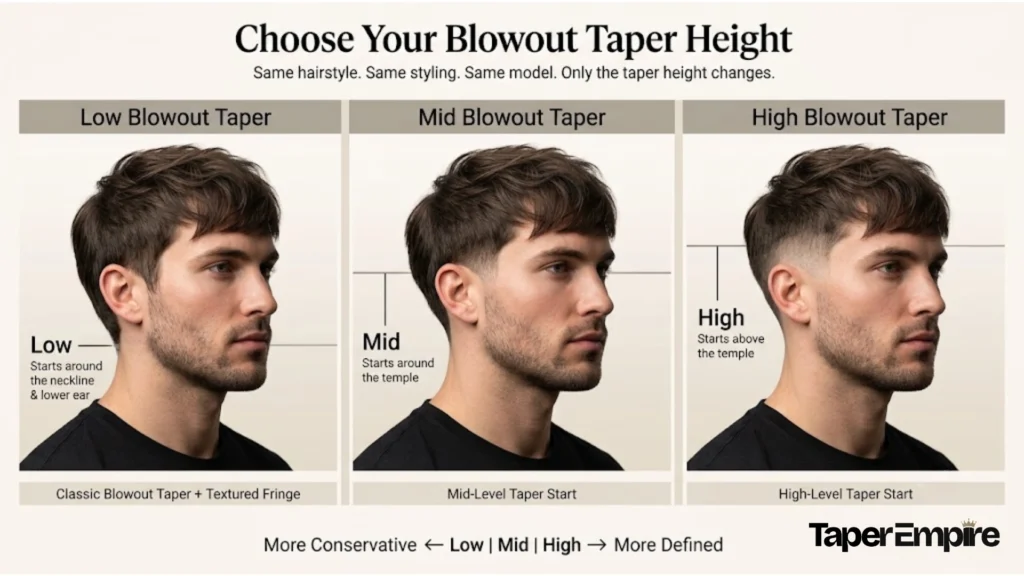
Reviewing all three heights side by side, independent of the fringe, can help you settle on the general contrast level you want before adding the styling details specific to this cut.
Low-Blowout Taper-Textured Fringe
The low taper confines the fade to the ears and neckline, leaving the most length on top among the three variants. It suits nearly every face shape and hair type, and it needs the least frequent barber visits because the taper line grows out more slowly than a higher one.
If you want to see this specific height explored in more depth on its own, a dedicated breakdown of the low blowout taper covers additional styling angles beyond the fringe pairing.
Mid-Blowout Taper Textured Fringe
The mid-taper starts fading around the middle of the head, just above the ears, creating more visible contrast than a low taper. It still leaves enough crown length for a full, textured fringe, making it a middle-ground option between subtle and bold.
High-Blowout Taper Textured Fringe
The high taper starts above the temple, producing the sharpest contrast of the three heights. This variant requires the barber to leave sufficient length on the crown cutting it too short here is the single most common cause of a flat, boxy silhouette instead of the intended lifted look.
Best Taper Height for Your Face Shape
Face shape changes which taper height looks most balanced. The added height a mid or high taper creates on top can shorten a long face or widen a narrow one, while a low taper keeps more length on the sides for faces that don’t need extra width up top.
| Face Shape | Recommended Taper Height | Why |
|---|---|---|
| Oval | Low, mid, or high | Balanced proportions work with any height |
| Round | Mid | Extra crown height elongates the face |
| Long or oblong | Low | Forward fringe shortens a longer face |
| Square | Low | Fringe softens an angular jawline |
| Diamond | Low or mid | Fringe adds forehead width for balance |
Barbers who cut this style regularly often check face shape before the client even sits down, since the same fringe length can read completely differently depending on forehead width and jaw angle. Uploading a photo to a haircut preview tool before your appointment lets you see how each taper height actually looks on your own face shape, rather than guessing from a chart.
Quick Tip
Seeing a taper height on your own face, rather than a model’s, makes the face-shape guidance above far easier to apply. Taper Empire’s AI haircut tool lets you preview low, mid, and high options on your own photo before you commit to one.
What Do You Tell Your Barber?
Tell your barber the exact taper height first, then describe the top. A complete request sounds like this: “I want a low blowout taper textured fringe. Point-cut the front so it’s piecey, keep the crown long enough to blow out, and blend the fringe into the sides so there’s no hard line.”
Including a reference photo eliminates confusion about names between shops, since barbers can interpret the same words differently. Naming the taper height clearly also helps when you’re comparing terminology used for related mid-taper designs, since barbers often use slightly different phrasing depending on the shop.
A complete barber request covers four things:
- Taper height — low, mid, or high
- Fringe technique — point-cut, not scissored straight across
- Crown length — long enough to blow-dry for lift
- Blend — no visible hard line between the fringe and the sides
Is Your Point Cutting Done Right?
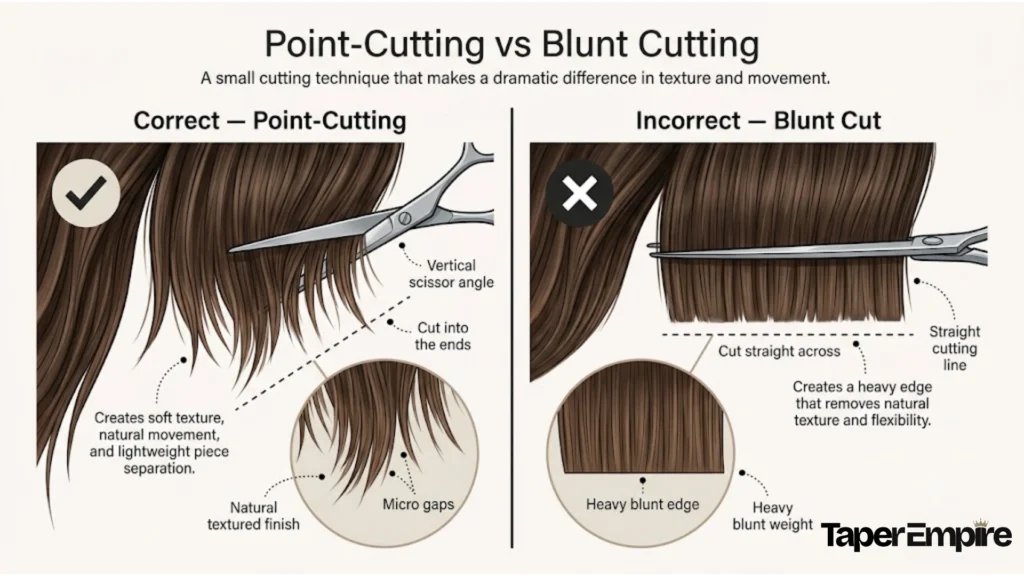
Point cutting is verifiable in the chair before the haircut is finished. Watch for the barber holding scissors at an angle into the ends of the fringe, not cutting straight across in one motion.
The cut strands should look uneven up close, not one flat line. If the barber finishes the fringe with a single straight cut and doesn’t go back in with an angled blade, ask for point cutting to be added before the blow-dry styling begins. Catching this in the chair is much easier than trying to fix a blunt fringe after you’ve already left the shop.
Quick Tip
If you’re not confident describing the exact look you want out loud, a visual reference solves that problem instantly. Taper Empire’s AI haircut tool generates a preview based on your own photo, so you can hand your barber an image instead of relying on words alone.
Generate Your Barber Reference Photo
Does It Work for Your Hair Type?
Yes, a blowout-tapered, textured fringe works on straight, wavy, curly, and fine hair, though each type needs a slightly different approach to the cut and styling. The technique that creates volume and texture changes depending on how your hair naturally behaves.
Straight Hair
Straight hair holds this cut well because it responds easily to direction during blow-drying. It needs deliberate texture added at the cutting stage, point cutting plus a lightweight styling product since straight strands don’t create natural texture on their own.
Comparing this to a straight-hair mid-taper fade can help if you’re weighing a fade-based sides treatment instead of the softer taper used here.
Wavy Hair
Wavy hair is one of the most compatible textures for this cut. The natural bend adds movement to the fringe without much extra styling effort, and it holds a blow-dried crown shape longer than straight hair does.
Curly Hair
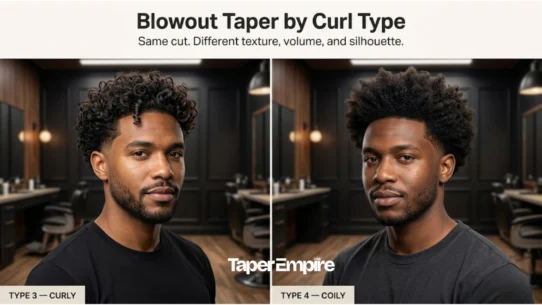
Curly hair works when the barber preserves the natural curl pattern and removes bulk specifically from the fringe area, rather than cutting it the same way as straight hair. Styling relies on curl cream and a diffuser attachment instead of a round brush, since a round brush can disrupt the curl pattern.
If you’d rather see how curly hair looks paired with a fade rather than a taper, reviewing curly styling options built around a taper fade highlights the contrast in maintenance and finish.
Fine Hair
Fine hair lacks natural volume density, which makes crown lift the hardest part of this cut to achieve. Applying a volumizing product at the roots before blow-drying, then finishing with texture powder instead of a heavier paste, keeps the crown from collapsing under product weight.
Asian and Hispanic Hair Textures
Asian hair typically has a straighter, denser, and stronger shaft, which means it needs more direct heat and product to redirect it forward into a fringe shape. Hispanic hair ranges from straight to wavy-curly, so compatibility depends on the individual’s specific pattern rather than a single rule.
A barber should assess density and curl pattern for these textures the same careful way they would for any other hair type before recommending a taper height. For readers with denser, coarser textures who want to compare styling options built specifically around that hair type, style galleries organized by hair texture for men with coarser or denser hair show additional variations worth considering.
How Do You Style It at Home?
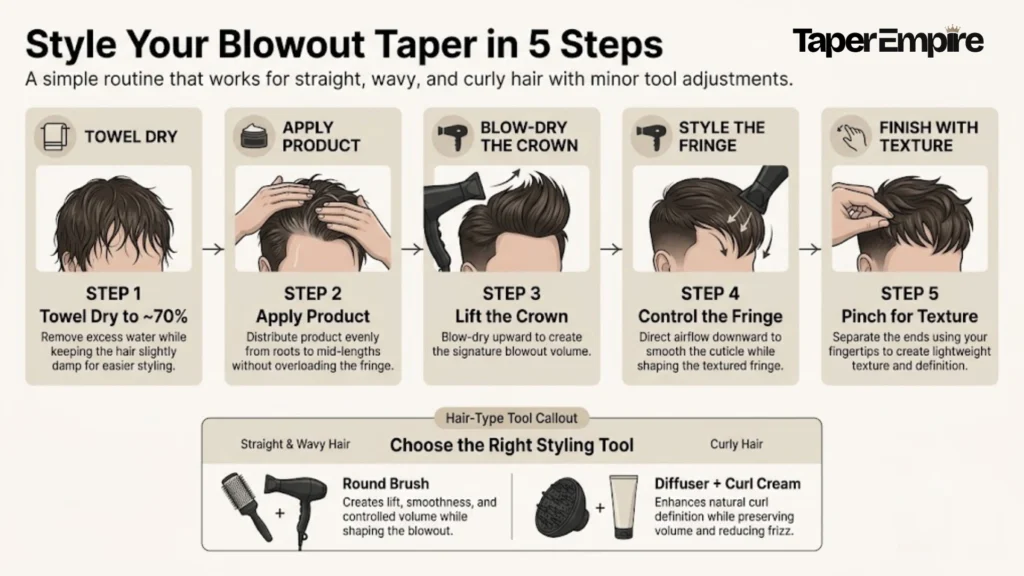
Most people spend five to ten minutes styling a blowout taper textured fringe once they’ve learned the routine. The exact steps differ depending on your hair type, but the basic sequence stays the same: towel-dry to partial dryness, work a texturizing product through the fringe, direct it forward and slightly to one side with a blow dryer, then finish by pinching and separating pieces with your fingers for that lived-in texture.
Morning Routine for Straight Hair
- Towel-dry to roughly 70% dry. Fully wet hair dilutes product and won’t hold shape once styled.
- Apply a volumizing or thickening spray at the roots.
- Blow-dry the crown upward using a round brush for lift.
- Blow-dry the fringe forward, directing the nozzle down the hair shaft.
- Finish with texture powder or matte clay worked through with your fingers.
Morning Routine for Curly Hair
- Apply curl cream to damp hair, focusing on the fringe area.
- Diffuse the crown on low heat, scrunching upward to build volume.
- Diffuse the fringe forward without touching it while wet, since disturbing wet curls creates frizz.
- Once fully dry, separate the curls at the fringe using only your fingertips.
Which Products Ruin This Haircut?
Heavy pomades and gels are the two most common products that ruin this cut’s shape. Both interfere with the volume and movement the entire style depends on.
| Wrong Product | Failure Mode | Correct Substitute |
|---|---|---|
| Heavy pomade or wax | Weighs the fringe into a flat curtain within hours | Matte clay or texture powder |
| Gel | Stiffens the fringe into a rigid block, killing movement | Sea salt spray for texture without stiffness |
| Product on fully wet hair | Dilutes the product; shape won’t hold once dry | Apply at 70% dry, not soaking wet |
| Hairspray as primary hold | Creates a crunchy, artificial texture | Use only as a light final seal |
How Often Should You Get It Trimmed?
The fringe needs more frequent attention than the taper. A fringe cut to fall between mid-forehead and eyebrow length typically stays in that range for about three weeks before it grows into the eyes consistent with the half-inch-per-month average growth rate confirmed by the American Academy of Dermatology.
The taper needs a cleanup every 2 to 3 weeks and a full cut every 3 to 4 weeks to keep the fade line sharp. For a closer look at keeping fade-based sides sharp between visits, a dedicated maintenance guide for taper fades covers upkeep from the fade-line side of things.
Does Fringe Length Affect Trim Frequency?
Yes. A fringe cut at the mid-forehead gives the longest window before it needs a trim roughly three weeks. A fringe cut closer to eyebrow length falls into the eyes much sooner, often within ten to fourteen days. The difference comes down to simple math: according to the American Academy of Dermatology, hair grows about half an inch per month, so a fringe starting closer to the eyes has less runway before it needs attention.
Choosing a longer starting length at the appointment reduces how often you need a fringe-only trim between full haircuts.
What Mistakes Ruin This Haircut?
Five mistakes account for most disappointing results with this cut.
- Cutting the taper too high without leaving enough crown length. The blowout needs hair to work with — too short means no lift and no movement.
- Skipping point cutting. A fringe scissored straight across and “texturized” afterward looks blunt, not broken.
- Using heavy pomade or gel. Both collapse the volume the entire cut depends on.
- Styling on fully wet hair. Product dilutes and the shape won’t hold once it dries.
- Ignoring weight distribution on the sides. Uneven weight creates an unbalanced silhouette even when the taper line itself is clean.
Honest tradeoff: This cut trades low daily styling effort for a higher-frequency barber schedule. The fringe needs trimming roughly every three weeks, faster than a standard haircut cycle. If frequent visits aren’t practical for you, choosing a longer starting fringe length reduces this tradeoff without eliminating it.
Is It Appropriate for Work?
Yes, but formality depends on taper height, fringe length, and product finish, not the haircut style as a whole. A low taper with a mid-forehead fringe finished in matte clay reads as conservative and office-appropriate. A high taper with a longer, messier fringe finished in sea salt spray reads as casual or better suited to creative industries.
| Variant Combination | Formality Level |
|---|---|
| Low taper + mid-forehead fringe + matte clay | Conservative, office-appropriate |
| Mid taper + mid-forehead fringe + matte clay | Business-casual |
| High taper + longer messy fringe + sea salt spray | Casual, creative-industry |
Choosing a low or mid taper with a shorter fringe length is the safest option if you work in a traditional corporate environment.
Frequently Asked Questions
Does a blowout-tapered textured fringe work on fine hair?
Yes, with adjustments. Fine hair lacks natural volume, so apply a volumizing product at the roots before blow-drying and finish with texture powder instead of paste. Powder adds texture without collapsing the crown’s lift the way heavier paste can.
What is the difference between a taper and a fade?
A taper leaves graduated length above the fade line for a soft transition. A fade removes hair down to the skin at some point on the head, creating hard contrast. This haircut uses a taper, not a fade.
How long does it take to style each morning?
Most people spend five to ten minutes once they’ve learned the routine: blow-drying the crown up, directing the fringe forward, and finishing with a lightweight matte product worked through with fingertips.
Why does my fringe go flat after a few hours?
Flat fringe usually means too much product, the wrong product type, or styling on hair that was too wet. Switch to a lighter matte clay or texture powder, apply it at about 70% dry, and use less than you think you need.
Can you get this cut with curly hair?
Yes. The barber preserves the curl pattern while removing bulk specifically from the fringe area. Style with curl cream and a diffuser rather than a round brush, which can disrupt the natural curl pattern.
What’s the difference between this cut and a textured crop?
A textured crop keeps the top short and flat with a blunt fringe. This haircut keeps the top long with a lifted crown and a piecey, point-cut fringe that builds more visible volume.
Final Takeaways
A blowout taper textured fringe comes down to three decisions: your taper height, your fringe length, and how well your barber executes point cutting. Low taper offers the most versatility and lowest upkeep. Mid and high tapers trade some of that ease for sharper contrast.
Once you’ve settled on a height, the fastest way to remove any guesswork before your appointment is seeing it on your own face rather than a model’s.
Quick Tip
Before you sit in the chair, previewing your chosen taper height and fringe length on your own photo takes the guesswork out of the decision. Taper Empire’s AI haircut tool shows you a personalized preview so you and your barber start from the same visual reference.