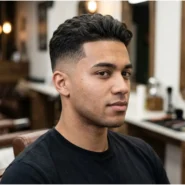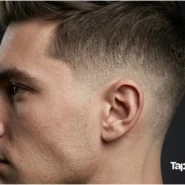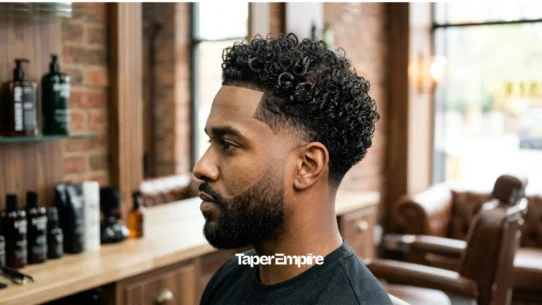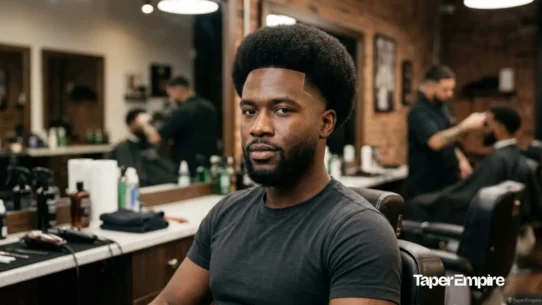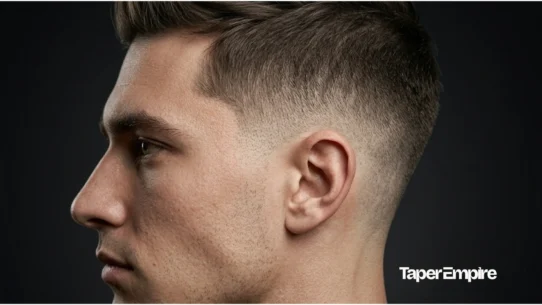

A low taper fade for wavy hair is one of the cleanest and most versatile men’s haircuts right now. Natural waves on top. Structured fade on the sides. The result? A cut that looks sharp for work, relaxed on weekends, and effortless every single day.
But here’s the problem most guys run into: they show up to the barbershop, say the wrong thing, get the wrong cut, and walk out frustrated.
This guide fixes that. You’ll find 25 of the best low-taper fade wavy hairstyles for 2026, a face-shape-matching guide, exact barber scripts, a 5-minute morning styling routine, and a maintenance plan that keeps your fade sharp for weeks. Everything you need, in one place.
Table of Contents
What Is a Low Taper Fade for Wavy Hair, and Which Wave Type Does It Suit Best?
A low taper fade for wavy hair gradually shortens the sides, starting just above the ears while keeping natural waves full and textured on top. It works on all three wave types 2A, 2B, and 2C but the top length and products change based on your wave density. It’s the most versatile and forgiving fade for wavy hair because it avoids the frizz zone that skin fades expose.
KEY POINTS:
- Starts just above the ears and tapers toward the neckline without going to bare skin
- Type 2A waves need 2 to 2.5 inches on top while 2C waves need 3 to 4 inches minimum
- Grows out more gracefully than mid or high fades and needs a trim every 2 to 3 weeks
- Avoid gel entirely and use sea salt spray, matte clay, or curl-enhancing cream instead
- Round faces benefit from height styles like a quiff while square faces suit slick backs best
What Is a Low Taper Fade for Wavy Hair?
A low taper fade for wavy hair is a men’s haircut in which the hair gradually shortens from just above the ears down to the neckline, creating a clean, seamless blend that lets the natural waves on top take full command of the look. The fade starts low, right above the ear, and tapers gently toward the nape, producing a soft gradient rather than an aggressive contrast.
Unlike a skin fade that drops all the way to the scalp, the low taper preserves a thin shadow of hair at the base. That shadow matters more than most men realise. Type 2 wavy hair often loses its shape easily without the correct products, and cutting the sides too close exposes the frizz zone where waves break down. The low taper avoids that zone entirely, keeping frizz contained while the wave pattern on top performs as intended.
The low-taper fade has become one of the most-searched styles for men. It is the most popular fade in 2026, starting just above the ears and blending gradually upward, clean and versatile, working with almost any cut and any setting.
Two components make this cut work. The first is the fade itself, a gradual gradient that shortens the sides without touching the wave structure on top. The second is the wavy texture, which provides natural volume, dimension, and movement that straight hair simply cannot replicate. Put them together, and the result is a haircut with both structure and personality.
Low Taper vs. Mid Taper vs. High Fade vs. Skin Fade: Which Is Best for Wavy Hair?
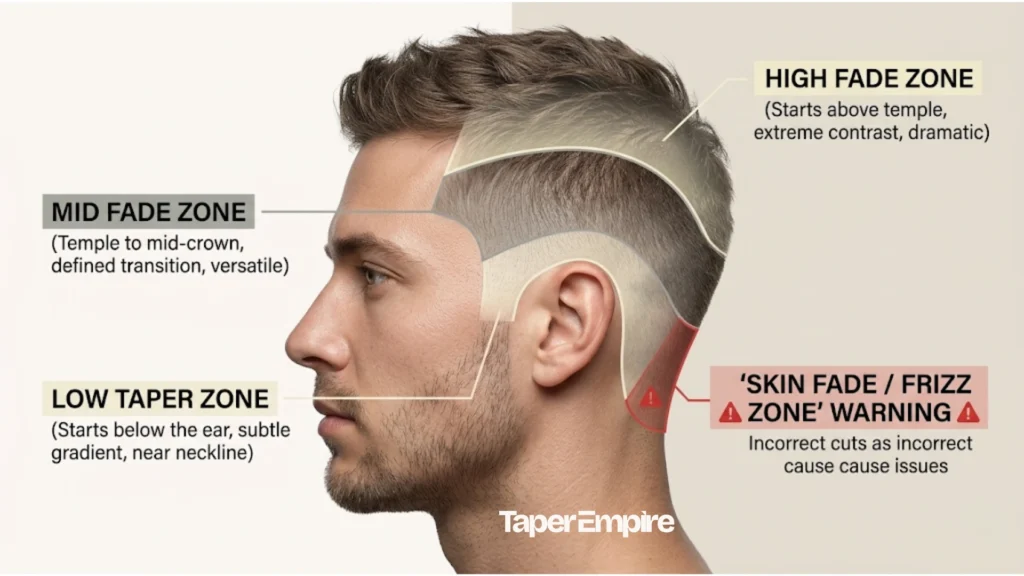
Not all fades are equal, especially for men with natural waves. Choosing the wrong fade height can flatten your wave pattern, expose frizz, or strip away the natural volume that makes wavy hair look great. Here is how the most common fade types compare:
| Fade Type | Starting Point | Contrast Level | Works for Wavy Hair? | Key Characteristic |
|---|---|---|---|---|
| Low Taper Fade | Just above the ear and neckline | Subtle, natural | ✅ Best option | Gradual blend; preserves wave formation |
| Shadow Fade | Just above the neckline | Very soft | ✅ Excellent option | Softest transition; ideal for fine 2A waves |
| Drop Fade | Curves behind the ear | Moderate | ✅ Good option | Follows head curve; adds dimension |
| Mid Taper Fade | Around the temples | Moderate | ⚠️ Use with care | More visual contrast; works on thicker 2C waves |
| High Fade | Near the top of the head | Bold and dramatic | ❌ Risky | Reduces wave mass on sides; aggressive |
| Skin Fade | Any point down to the skin | Maximum | ❌ Avoid | Exposes frizz zone; waves break down too close to the skin |
The skin fade is the one to avoid on wavy hair. When the clipper goes below the natural wave formation point, frizz takes over, and the smooth gradient disappears. A shadow fade or low taper keeping at least a #1 or #1.5 guard at the base preserves both the fade’s integrity and the wave pattern’s health.
The low fade is a subtle, clean look where the fade begins just above the ear, creating a soft transition from short to long. This style offers a minimal contrast between the hair on top and the sides, providing a polished, understated appearance.
Why a Low Taper Fade Works So Well for Wavy Hair (Types 2A, 2B, and 2C)
The low taper fade for wavy hair works so well because it creates structured contrast exactly where the wave pattern is hardest to manage, the sides, while leaving the top completely free to move, flow, and show off its natural texture.
Here is exactly why this cut is the right choice for wavy hair:
- Tames frizz and bulk on the sides where waves are most unruly
- Creates a clean silhouette that makes top waves appear fuller and more dimensional
- Gradual gradient enhances wave contrast without the aggression of a high fade
- Works across all wave densities: fine, medium, and thick wavy hair
- Grows out gracefully without an awkward in-between phase
- Polished enough for a professional setting, relaxed enough for weekends
Understanding your wave type helps you dial in the right variation, product, and top length. Type 2 hair, also known as wavy hair, can be defined by its “S” shape curls and looser texture. It can be broken down further into three subtypes: 2A, 2B, and 2C.
| Wave Type | Description | How It Behaves | Best Low Taper Approach |
|---|---|---|---|
| Type 2A | Loose S-shape, fine texture | Straightens easily; low volume; least frizz | Keep top at 2–3 inches; use sea salt spray only |
| Type 2B | Defined S-shape, medium texture | Waves start mid-length; prone to frizz at the crown | Keep top at 2.5–3.5 inches; curl cream + sea salt spray |
| Type 2C | Strong S-shape, thick and coarse | Waves from root; highest frizz potential | Keep top at 3–4 inches: matte clay + curl-enhancing cream |
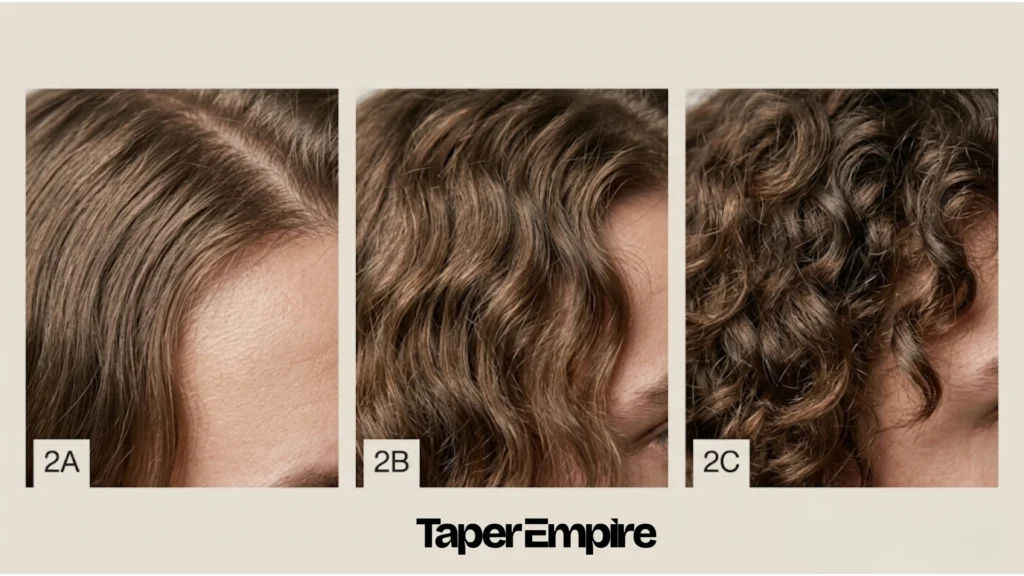
Type 2A is characterized by delicate “S”-shaped waves, not really defined or voluminous. Type 2B has more defined waves that get tighter toward the tips. Type 2C usually has fully voluminous and perfectly defined “S” waves.
Key Takeaway: The thicker and more defined your wave pattern, the more length you need on top to let those waves fully form. Never cut type 2C waves shorter than 1.5 inches; the pattern disappears, and so does the entire point of the haircut.
25 Best Low Taper Fade Styles for Wavy Hair (2026)
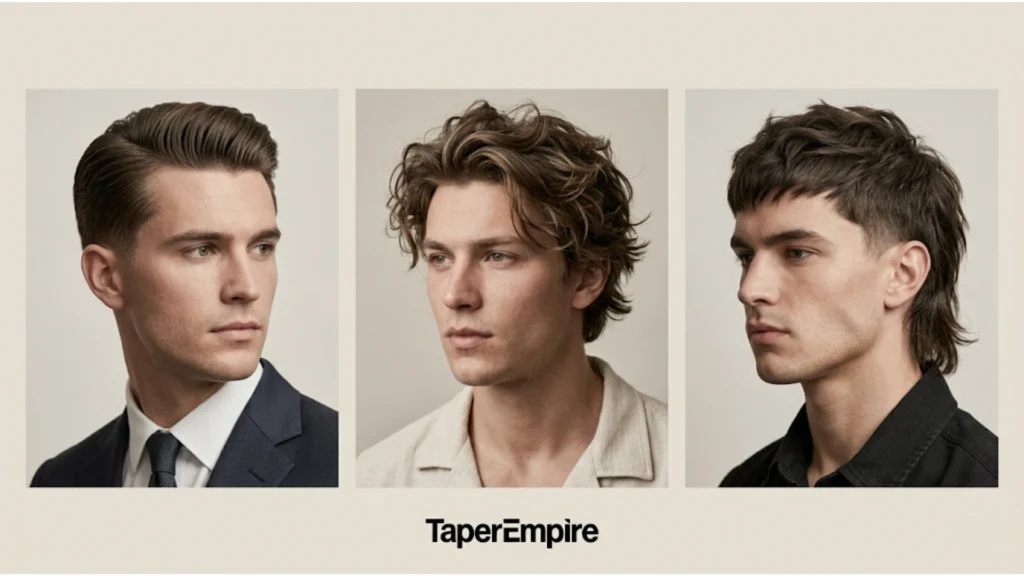
As a barber who works with wavy-textured clients daily, the most important lesson I can share before you look at any style below is this: choosing a variation based on your wave type and face shape will always produce a better result than choosing based on looks alone. Every style below includes a wave-type tag, a face-shape recommendation, and an exact barber tip so you walk in prepared.
1. Classic Wavy Low Taper Fade
The classic wavy low taper fade is the foundation of everything on this list: clean sides, natural waves at 2 to 3 inches on top, and a seamless taper that starts just above the ears. Nothing extreme. Nothing overthought. It is the haircut that works equally well on a Tuesday morning in the office and on a Saturday night out.
This is the style to request if you are getting your first taper fade. The simplicity of the classic variation makes it the most forgiving across all wave types and face shapes. It works for type 2A waves that need gentle encouragement and for type 2C waves that have volume to spare.
Best For: Oval and square face shapes. Wave Type: 2A, 2B. Barber Tip: “I want a low taper starting just above my ears with a clean neckline. Leave about two and a half inches on top to show my natural wave pattern.” Style With: Sea salt spray scrunched into damp hair; light styling cream through the top
2. Messy Tousled Wavy Low Taper
The messy, tousled, wavy low taper is the one you see everywhere on TikTok right now effortless, lived-in, and somehow both casual and intentional at the same time. The waves are finger-combed without any attempt to style them into a precise shape. The low taper provides just enough structure on the sides to stop the whole look from reading as unkempt.
This variation suits men who want maximum style with minimum effort. Apply sea salt spray to damp hair, scrunch it through, and let it air-dry; you are done.
Best For: Oval, round. Wave Type: 2A, 2B. Barber Tip: “Keep the top long enough for my waves to fall naturally; don’t take off too much bulk. Just clean the sides with a low taper above my ears. Style With: Sea salt spray, moulding paste for light definition
3. Short Wavy Low Taper Fade
The short, wavy, low-taper fade keeps the top between 1 and 1.5 inches short enough to manage in under 2 minutes, yet long enough for the wave pattern to show clearly. This is the go-to for men who want the cleanest possible look with the least possible maintenance.
The neckline on this variation matters more than any other. Since the top is shorter, the taper line and neckline do more visual work. Keep both crisp.
Best For: Square, diamond. Wave Type: 2A, 2B, 2C. Barber Tip: “Keep it short on top, about an inch and a half, but leave just enough for my wave pattern to show. Low taper above the ears, clean neckline.” Style With: Texture powder at the roots, light matte clay through the top
4. Wavy Blowout Taper
The blowout low taper fade is a key part of the 2025 and 2026 hair trends; men are loving giving cuts a voluminous edge while keeping the neckline and sides tight and clean. The wavy blowout taper takes this a step further; thick, natural waves are diffused for full volume and a soft, rounded top silhouette that commands the room.
The blowout variation occurs when wavy hair with good density meets a diffuser attachment and curl-enhancing mousse. The result is maximum volume and definition, anchored by the clean low taper on the sides. This is a bold choice. It suits men with type 2B and 2C hair where the wave density supports the lift.
Best For: Round, heart adds height that elongates the face. Wave Type: 2B, 2C; thick, dense hair works best. Barber Tip: “I want a low taper with the top left long at least 3 to 4 inches so my waves can be blown out for volume.” Don’t touch the top length too much. Style With: Curl-enhancing mousse on damp hair, diffuser attachment on low heat, texture spray for extra lift
5. Wavy Slick Back Taper
The wavy slick-back taper is the most polished variation on this list. Waves are brushed backwards with a fine-tooth comb and held in place with matte pomade or light styling cream; the natural wave texture still shows through, but in a more refined, swept-back form. The low taper on the sides provides the clean edges that this look needs to land properly.
This is the variation for men who work in professional environments and want a haircut that translates across every setting. Pair it with a trimmed beard or clean shave, and the effect is sharp without being aggressive.
Best For: Square, rectangular. The clean fade highlights the jawline. Wave Type: 2A and 2B medium-density waves brush back most cleanly. Barber Tip: “Give me a low taper with clean lines around the ears and neck. Keep the top at least 3 inches so I can slick my waves back. Sharp neckline.” Style With: Matte pomade worked through warm palms first; fine-tooth comb for the slick back direction
6. Low Taper Mullet for Wavy Hair
The low taper mullet for wavy hair is one of the biggest men’s style movements of 2025 and 2026, and it deserves to be. This is not the mullet from the 1980s; this is a modern, refined version with light layering in the back that lets waves stack naturally, a low tapered side profile, and a longer top that flows into the back section without any harsh lines.
The 2026 version keeps the sides faded or tightly tapered, adds choppy texture on top, and lets the back grow slightly longer with intentional shape. The low taper on the sides keeps the look modern and prevents the width from overwhelming the face.
Best For: Oval and heart. Wave Type: 2B and 2C, medium to thick density, provides the best layering and stacking. Barber Tip: “I want a modern low taper mullet. Keep the top and back longer with light layering so my waves stack naturally. Taper the sides low above my ears. I don’t want a skin fade.” Style With: Sea salt spray, light curl cream, low heat blow-dry with fingers
7. Low Taper Fade for Long Wavy Hair
The low taper fade for long wavy hair is the variation that gives waves the most room to live. The top stays at 4 inches or more, and waves create significant movement, dimension, and personality from root to tip. The low taper prevents the sides from looking bulky or overpowering the length.
This is extremely popular with Gen Z right now. It looks effortless but reads as deeply intentional. The key is to keep the top long enough for the full wave structure to form at every length from the root down.
Best For: Diamond and long face shapes; the length adds width balance. Wave Type: 2B, 2C. Longer waves need density to hold their shape. Barber Tip: “I want to keep my length on top, don’t take more than half an inch off. Just clean up the sides with a low taper above the ears and freshen the neckline.” Style With: Leave-in conditioner on damp hair, curl-enhancing cream through mid-lengths to ends, and a diffuser on cool setting
8. Textured Fringe with Low Taper
The textured, low-tapered fringe is a youthful, fashion-forward variation in which waves fall forward over the forehead in a soft, natural fringe rather than being styled back or up. The low taper on the sides frames the face cleanly, while the falling fringe creates texture and a relaxed confidence.
This variation works especially well on type 2A and 2B hair, where the fringe falls with a natural softness. For 2C hair, the fringe may need a light product to prevent it from puffing outward.
Best For: Round, heart, and falling-fringe faces; softens strong facial features. Wave Type: 2A, 2B Barber Tip: “Leave my fringe long enough to fall forward naturally. I want my waves to show through the front. Taper the sides low above the ears and clean the neckline sharply.” Style With: Light mousse on damp hair; sea salt spray scrunched through the fringe for texture
9. Side Part Wavy Low Taper
The side-part, wavy, low taper is the most professional and versatile variation on this list. A natural deep side part or a razor-defined hard part for maximum sharpness divides the top section, and the low taper keeps the sides clean without overpowering the structured look. Waves add softness and dimension that a straight side part simply cannot achieve.
This cut works in every professional environment and holds up through every social occasion. It is a workhorse of a haircut.
Best For: Square, rectangular, oval. Wave Type: 2A, 2B. Barber Tip: “Give me a low taper with a natural side part on the left. Keep the top at 2.5 to 3 inches and clean the neckline tapered, not squared off.” Style With: Matte pomade through the top; fine-tooth comb to define the side part
10. Middle Part Wavy Low Taper
The middle part, wavy low taper, divides the wave pattern evenly down the center, creating a symmetrical, balanced look that is one of the most recognizable Gen Z style signatures of the current era. It looks clean and current, and it works with the natural wave direction rather than fighting it.
The low taper prevents the middle part from becoming too heavy or unstructured. Without the clean sides, the middle part reads as unkempt. With the taper, it reads as intentional.
Best For: Oval, diamond. Wave Type: 2B, 2C need sufficient wave density to fall evenly on both sides. Barber Tip: “Keep the top long and even on both sides for a middle part about 3 inches. Low taper above the ears, clean neckline.” Style With: Light molding paste; sea salt spray scrunched through both sides for equal definition
11. Wavy Quiff with Low Taper
The wavy quiff with low taper directs waves upward and slightly backward at the front, creating height and forward structure that naturally elongates the face. The low taper provides the clean base that the quiff needs to read as polished rather than pouffy. This variation adds serious presence without requiring much product.
A diffuser and a round brush are the tools that make the wavy quiff work best. Blow-dry upward from the root, shape with your fingers, and lock in with a light styling cream.
Best For: Round and square shapes; the height elongates and balances wider face widths. Wave Type: 2A, 2B. Barber Tip: “I want a quiff on top, leave 3 to 4 inches at the front so I can blow-dry it upward. Low taper on the sides above the ears.” Style With: Medium-hold styling cream; diffuser and round brush for volume
12. Wavy Pompadour with Low Taper
The wavy pompadour with low taper is taller and more dramatic than the quiff waves are swept upward and backward from the front hairline, creating a vintage-modern hybrid silhouette that turns heads. The low taper grounds the look and ensures the pompadour reads as modern rather than theatrical.
This works best on thick 2C waves where the density supports the lift. Fine 2A waves will struggle to hold pompadour height without significant product.
Best For: Round and rectangular shapes; height creates more balanced facial proportions. Wave Type: 2B, 2C density is essential for pompadour volume. Barber Tip: “I want a wavy pompadour; keep the front at 4 inches minimum so I can sweep it upward. Low taper sides, sharp neckline.” Style With: Light mousse on damp hair, blow dryer with round brush; texture powder at roots for lift
13. Wavy Bro Flow with Low Taper
The wavy bro flow with low taper is the most relaxed and free-moving variation on this list. Longer waves sweep naturally in multiple directions, no enforced shape, no aggressive styling, just natural flow. A guy might grow out a bro flow that casual swept-back surfer hair, but have a low taper fade around the ears to maintain a clean outline. This is a very 2026 thing: mixing lengths and styles.
The low taper stops the bro flow from looking unintentional. That subtle taper line above the ear is the difference between stylish and sloppy.
Best For: Diamond, heart. Wave Type: 2B and 2C longer-flowing waves perform best. Barber Tip: “I want to keep my length and flow just taper the sides low above my ears and clean the neckline. No bulk reduction on top. Keep it all.” Style With: Leave-in conditioner and argan oil on damp hair for shine and frizz control; light molding paste for direction
14. Disconnected Undercut with Wavy Top
The disconnected undercut with wavy top is the boldest variation on this list. There is no fade blend; the shaved sides and full wavy top exist in maximum contrast, separated by a hard, defined line. The disconnection creates a striking silhouette that can be styled slick for formal occasions or left tousled for a casual edge.
This is not for every professional environment. But for men who want maximum visual impact from their haircut, this delivers.
Best For: Oval, square, and strong face structures handle the dramatic contrast. Wave Type: 2C thick waves are needed to match the boldness of the undercut. Barber Tip: “I want a disconnected undercut, shave the sides very close with no fade blend. Leave the top full and wavy. Keep the line between them sharp and defined.” Style With: Strong matte clay for top structure; curl-enhancing mousse for wave definition
15. Hard Part Wavy Low Taper
The hard part wavy low taper uses a razor-defined line to create a precise, geometric side separation in the top section. The hard part adds architectural precision to the natural wave pattern. The two textures complement each other perfectly, with structured lines meeting organic movement.
This variation is for men who appreciate deliberate, technical barbering. It requires a skilled barber who is comfortable with a razor and a trained eye for clean lines.
Best For: Square and oval. Strong features complement the sharp geometry. Wave Type: 2A, 2B Barber Tip: “I want a hard part razor line on the left side with a low taper. Define the part sharp and leave about 2.5 to 3 inches on top for my waves to show. Style With: Matte pomade; light styling cream to keep waves soft above the hard part
16. Textured Crop with Low Taper
The textured crop with low taper features choppy, forward-falling layers on top at a short-to-medium length. Very low maintenance. The low taper keeps the sides clean while the textured crop gives the top an intentionally undone, modern appearance. This is the style for men who want to look like they tried without actually trying.
Best For: Square and diamond. Wave Type: 2A, 2B. Barber Tip: “Textured crop on top with choppy layers and low taper on the sides. Keep the front falling forward naturally. Leave about an inch and a half on top.” Style With: Texture powder at roots; matte clay worked through with fingers
17. Wavy Comb-Over with Low Taper
The wavy comb-over with low taper uses the natural wave pattern direction to create an elegant, one-sided sweep that looks polished and intentional. Unlike a hard comb-over that requires fighting straight hair into place, a wavy comb-over works with the hair’s natural movement; the waves do half the work for you.
Best For: Rectangles and ovals. Wave Type: 2A, 2B. Barber Tip: “Low taper with a natural comb-over; leave enough length on top for my waves to stay after combing over. About 2.5 inches. Clean neckline, tapered.” Style With: Light pomade; fine-tooth comb for the comb-over direction
18. Wavy Faux Hawk with Low Taper
The wavy faux hawk with low taper directs volume upward and toward the center of the head, creating a Mohawk-shaped ridge of waves without fully shaving the sides. The low taper provides the clean profile, while the central wave ridge creates a bold, attention-grabbing silhouette that is far more wearable than a real Mohawk.
Best For: Oval, square, strong face shapes match the boldness of the faux hawk. Wave Type: 2B, 2C dense waves needed for the ridge to hold shape. Barber Tip: “I want a low taper on the sides with more length toward the center of the top. I’ll style my waves upward into a faux hawk shape. Keep 3 inches in the center.” Style With: Strong matte clay; diffuser to lift waves toward the center
19. Highlighted Wavy Low Taper
The highlighted wavy low taper adds a colour dimension to the wave pattern highlights, or balayage through the top waves creates visual depth that makes the natural S-shape of the waves pop in ways that a single-tone cut simply cannot achieve. The low taper keeps the look modern and grounded, while the highlighted waves serve as the visual centrepiece.
Best For: All face shapes; colour dimension flatters every face structure. Wave Type: 2A, 2B color shows most vividly on lighter, less coarse waves. Barber Tip: “Low taper on the sides; I already have highlights in my waves, so don’t cut too much off the top.” Keep the color visible. About 2.5 to 3 inches.” Style With: Colour-safe sulfate-free shampoo, argan oil for shine, and curl-enhancing cream to protect colour and define waves
20. Wavy Drop Fade
The wavy drop fade follows the natural curve of the head rather than a straight horizontal line, curving lower behind the ear before ascending at the neckline. This creates extra visual dimension and sharpens the outline in a way that a standard low taper cannot. The drop fade features a fade that curves around the ear, creating a unique and bold look. This fade gives a more customised look, ideal for men who want to stand out while maintaining a clean appearance.
Best For: Square, oval. Wave Type: 2B, 2C. Barber Tip: “I want a drop fade, follow the natural curve of my head down behind the ear. Keep the top full with my waves at least 3 inches.” Style With: Matte clay; sea salt spray for wave definition
21. Wavy Side Sweep with Low Taper
The wavy side sweep brushes natural waves to one side without a hard part or comb-over precision. It is more relaxed than a side part but more directional than a messy, tousled style. The waves fall naturally to one side in a sweeping motion that reads as effortlessly confident.
Best For: Oval, heart | Wave Type: 2A, 2B | Barber Tip: “Low taper with enough top length to sweep my waves to the right naturally about 2.5 to 3 inches.” | Style With: Molding paste; blow-dry to the side for direction
22. Layered Wavy Low Taper
The layered wavy low taper uses scissor-over-comb layering through the top section to create movement and shape through the wave structure. Layers allow thick 2C waves to sit without puffing and give 2B waves extra definition and bounce. This is a barber technique choice as much as a style choice.
Best For: Square, diamond | Wave Type: 2B, 2C | Barber Tip: “I want light layering through the top to give my waves shape and reduce bulk low taper sides above the ears.” | Style With: Curl-enhancing cream; diffuser for wave definition
23. Wavy Line-Up with Low Taper
The wavy line-up with low taper combines the standard low taper with a sharp, geometric edge-up at the hairline. A straight razor line from the front hairline creates a clean, defined frame that makes the entire haircut look freshly cut and intentional. This is the variation for men who want maximum crispness.
Best For: Oval, square | Wave Type: 2A, 2B, 2C all wave types benefit from the sharp frame | Barber Tip: “Low taper with a sharp line-up at the hairline, clean the edges straight across the forehead. Tapered neckline, not squared.” | Style With: Sea salt spray; light styling cream
24. Wavy Pompadour Crop with Low Taper
The wavy pompadour crop blends the structure of a pompadour with the shorter length of a crop. Waves are lifted slightly at the front without the full height of a traditional pompadour. The low taper keeps the sides clean and the cropped length makes this one of the lowest-maintenance pompadour variations available.
Best For: Round, rectangular | Wave Type: 2A, 2B | Barber Tip: “Short on top about 2 inches with a slight forward lift at the front. Low taper sides above the ears.” | Style With: Texture powder; light mousse for front lift
25. Natural Wavy Flow with Low Taper
The natural wavy flow with low taper lets the wave pattern do absolutely everything. No styling direction, no product-enforced shape. The waves fall and flow; they naturally want to. The only intervention is the low taper, which keeps the sides structured enough to prevent the look from losing its form entirely.
This is the zero-effort, maximum-authenticity option. It works best on 2B and 2C hair where the wave pattern is strong enough to self-organise.
Best For: All face shapes | Wave Type: 2B, 2C | Barber Tip: “Low taper above the ears keeps the top completely natural and full. Don’t direct the waves in any particular style. Just let the texture show.” | Style With: Leave-in conditioner on damp hair only; air dry completely
Which Low Taper Fade Style Suits Your Face Shape?
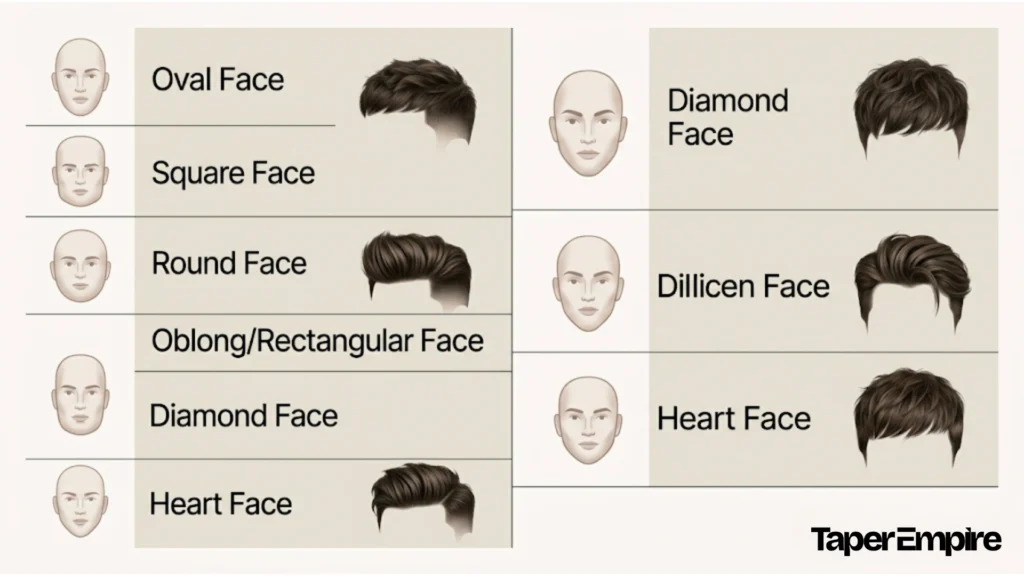
Choosing the right style variation for your face shape is the single most important decision you will make before sitting in the barber’s chair. The wrong variation can make a round face look rounder or a long face look longer. The right one does the opposite; it creates visual balance that makes your natural features work for you, not against you.
| Face Shape | Key Feature | Best Styles | Why It Works |
|---|---|---|---|
| Oval | Balanced, equal proportions | Any classic, messy, side part, or middle part | No correction needed; any silhouette looks proportional |
| Square | Strong jawline, wide forehead | Slick Back, Side Part, Hard Part, Textured Crop | Clean faded sides highlight the jawline and add authority |
| Round | Similar width and length | Quiff, Pompadour, Faux Hawk, Textured Fringe | Height on top elongates the face and reduces perceived roundness |
| Diamond | Narrow forehead and chin, wide cheekbones | Bro Flow, Long Wavy, Blowout, Side Sweep | Volume adds width to the forehead and chin for balance |
| Heart | Wide forehead, narrow chin | Modern Mullet, Bro Flow, Fringe | Length at the back and a falling fringe balance the wider forehead |
| Rectangular / Long | Long face, narrow width | Textured Crop, Comb-Over, Layered | Horizontal volume at mid-height reduces the perceived length |
| Triangular | Narrow forehead, wider jaw | Quiff, Pompadour Crop, Volume on Top | Top volume widens the forehead to balance the jaw |
Quick rule: If you want your face to look longer, add height. If you want it to look shorter, add width at the sides or keep the top flat. The low taper provides the clean base the style variation provides the proportional correction.
Matching your face shape to a style from a table works, but most men misidentify their own face shape. Taper Empire reads your facial geometry directly and scores taper styles to your actual proportions, not your best guess. Free, takes under a minute.
How to Ask Your Barber for a Low Taper Fade on Wavy Hair
Poor communication at the barbershop is the number one reason men walk out unhappy with their haircut. The solution is not complicated; it just requires specific language rather than vague requests.
“Give me a taper” tells your barber almost nothing. “Give me a low taper starting just above my ears with a shadow at the base, leaving 3 inches on top so my waves show” tells them everything.
Here is the exact process to use at your next appointment:
Step 1 — Know the Terminology Before You Sit Down. Say “low taper fade,” not just “taper” or “fade.” Specify that you want it starting just above the ears, not at the temples. Mention your wave type: “I have type 2B wavy hair, and I want to keep the wave pattern on top.”
Step 2 — Bring a Reference Photo (Non-Negotiable) A reference photo eliminates ambiguity entirely. Use images from this article, Pinterest, or Instagram. Show at least a front view and a side view photo. Tell your barber: “I want something close to this, adjusted for my wave texture.”
Step 3 — Give Exact Top Length Instructions
- Blowout style: “Leave at least 3 to 4 inches on top.”
- Short crop: “An inch and a half on top is good.”
- Long wavy flow: “Just clean up the sides — keep all the length on top.”
Step 4 — Specify the Neckline and Fade Base: Say, “Tapered neckline, not squared.” And: “I don’t want a skin fade, keep a soft shadow at the base, maybe a number one guard at the very bottom.”
Step 5 — Use This Complete Barber Script
“I want a low taper fade starting just above my ears and tapering cleanly down to the neckline. I have [type 2B] wavy hair, so leave about [3 inches] on top to keep my natural waves visible. No skin fade, keep a soft shadow at the base. Clean the neckline tapered, not squared. I have a reference photo to show you.”
PRO TIP: Book your appointment in the morning when possible. Barbers are at peak precision in their first two hours of work. Fade blending requires a steady hand. Morning appointments consistently produce sharper results than late-afternoon ones.
PRO TIP: Even if your barber has cut your hair six times, re-explain what you want at every visit. Hair grows differently across seasons, your preferences evolve, and a quick refresher prevents miscommunication from creeping in.
That’s a lot of detail to remember at the chair. Taper Empire generates your barber brief automatically, guard numbers, blend height, neckline finish, and exact phrasing calibrated to your face and wave pattern in about 60 seconds.
How to Style a Low Taper Fade on Wavy Hair (5-Minute Morning Routine)
The cut is half the equation. How you style a low taper fade on wavy hair every morning determines whether it looks intentional or accidental, and with the right routine, it takes less than five minutes.
Total Time: 4–6 Minutes
Step 1 — Wash or Refresh (60 seconds) On wash days (2–3 times per week): Use a sulfate-free shampoo followed by a moisturising conditioner. On non-wash days: Dampen hair with a spray bottle or wet hands. Then towel-dry with a microfiber towel, pat only, never rub. Friction from a cotton towel creates frizz before your styling even begins.
Step 2 — Apply Base Product on Damp Hair (45 seconds)
- Type 2A waves: 2 pumps of sea salt spray scrunched through the hair from mid-lengths to ends
- Type 2B waves: Pea-sized curl enhancing cream worked through mid-lengths to ends
- Type 2C waves: Fingernail-sized amount of matte clay distributed evenly through the top
Apply all products to damp, not dry, hair. Wavy hair absorbs product best when wet; applying it to completely dry hair leads to clumping and uneven distribution.
Step 3 — Dry Your Hair (90 seconds to 3 minutes)
- Blowout style: Use a diffuser attachment on low heat and scrunch sections upward while drying
- Slick back or side part: Blow dry with a round brush, directing hair backward or to the side
- Natural wave style: Air dry completely, or use diffuser on cool setting for speed without heat damage
Step 4 — Finishing Product (30 seconds)
- Matte clay or molding paste: Rub between palms until warm, apply through the top layers for flexible definition
- Texture powder: Sprinkle directly at the roots for volume lift before or after blow-drying
- Pomade: For slick back or side part work through warm palms and comb through for a refined finish
Step 5 — Edge Definition (Optional — 30 seconds) Use an edge brush or fine-tooth comb to lay any stray hairs flat along the taper line. A tiny amount of pomade along the fade line adds extra crispness for 2 to 3 days between barber visits.
PRO TIP: Never use gel on wavy hair. Gel creates a hard, crunchy cast on the wave pattern, kills movement, and looks outdated in 2026. Use creams, pastes, and sprays that provide a flexible hold without stiffness. Your waves should move when you move.
Best Products for a Low Taper Fade on Wavy Hair
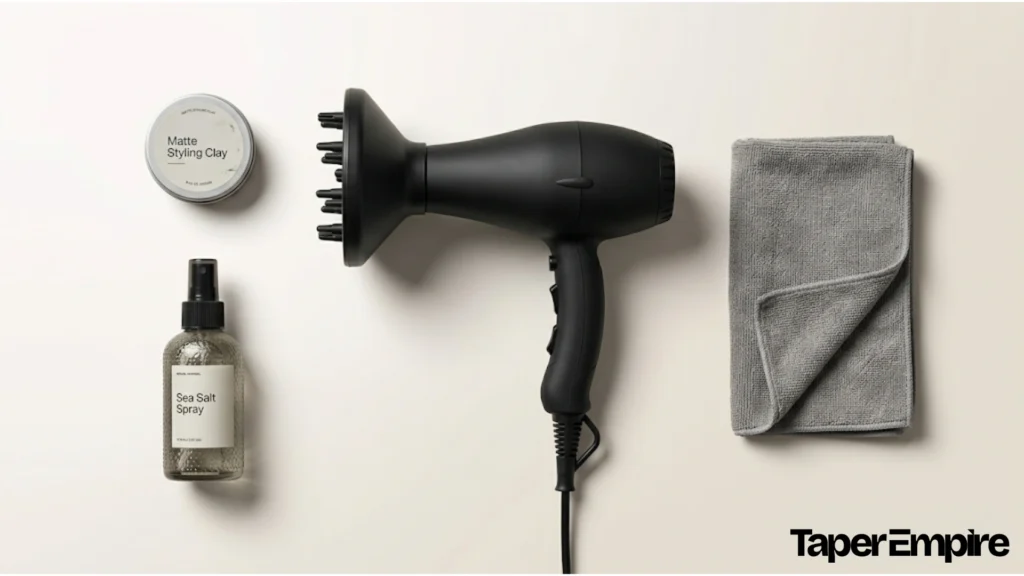
The right product makes the difference between waves that look alive and waves that look flat. The wrong product, too heavy, too stiff, or wrong for your wave type can undo a great haircut before you walk out the door.
| Product | Best For | Hold Level | Finish | Wave Type |
|---|---|---|---|---|
| Sea Salt Spray | Texture and wave definition | Light | Matte, beachy | 2A, 2B |
| Matte Clay | Structure and definition | Medium–Strong | Matte | 2B, 2C |
| Curl Enhancing Cream | Frizz control and definition | Light–Medium | Natural | 2B, 2C |
| Molding Paste | Flexible casual looks | Medium | Natural | 2A, 2B |
| Texture Powder | Root volume and pre-styling | Light | Matte | All types |
| Matte Pomade | Slick back and side part | Medium–Strong | Matte | 2A, 2B |
| Leave-In Conditioner | Moisture and movement | None | Natural | 2B, 2C |
| Light Mousse | Volume and wave definition | Light | Natural | 2A, 2B |
Product Layering Rule: Always apply a base product (cream or spray) to damp hair first. Then apply a finishing product (clay or paste) once the hair is mostly dry. Never layer two heavy products simultaneously, as they combine into buildup that weighs down the waves and produces a greasy finish.
Avoid gel. Avoid wax. For a relaxed finish, let it air-dry and use a sea-salt spray to build texture and movement. Simple, flexible products that work with your wave pattern rather than overriding it will always produce the best result.
Low Taper Fade Wavy Hair Maintenance Guide
How Often Should You Get a Low Taper Fade Trimmed?
A low taper fade needs a barber visit every 2 to 3 weeks to stay consistently sharp. The fade gradient starts softening around the 14 to 18-day mark as new growth blurs the transition between the tapered sides and the longer top.
According to the American Academy of Dermatology, human scalp hair grows at an average rate of approximately 0.5 inches (1.25 cm) per month. That growth rate means the low taper line loses its definition within 2 to 3 weeks of the original cut. Skin fades require barber visits every 2 to 3 weeks to keep them crisp and low-tapered, while more forgiving fades benefit from the same schedule if you want them at their sharpest.
Men with tighter schedules can stretch to 3-4 weeks. The low taper is one of the most forgiving fades for grow-out; it blurs softly rather than growing out in an obviously uneven way.
Weekly Wavy Hair Care Routine
| Day | Action |
|---|---|
| Day 1 (Post-barber) | Apply light styling cream or curl cream to damp hair; let waves form naturally |
| Day 2–3 | Refresh with sea salt spray; finger-comb waves back into shape |
| Day 3–4 | Wash day: sulfate-free shampoo and moisturizing conditioner; style as usual |
| Day 5–6 | Co-wash or wet refresh; reapply curl cream if needed |
| Day 7 | Rest day let hair breathe without product |
PRO TIP: Switch to a silk or satin pillowcase if you haven’t already. Cotton pillowcases create friction against wavy hair overnight, flattening the wave pattern and generating frizz by morning. A silk pillowcase reduces that friction and preserves your wave definition while you sleep. It is the single cheapest and most effective upgrade for wavy hair maintenance.
How to Adapt Your Wavy Low Taper Fade for Different Climates
No competitor covers this and it matters. Your product routine needs to change with the weather, not stay fixed year-round.
| Climate | What Happens to Your Waves | What to Do |
|---|---|---|
| High Humidity | Waves absorb moisture from the air, swell, and frizz intensifies | Switch to matte clay or sea salt spray; avoid heavy creams and gels in humid months |
| Dry / Cold Weather | Waves lose moisture and become brittle, dull, and frizzy in a different way | Add argan oil or leave-in conditioner to your daily routine; Increase wash frequency slightly |
| Hot / Sunny | UV exposure dries out the wave structure and fades color | Use a UV-protective light hair spray or apply argan oil before sun exposure |
| Rainy / Damp | Waves reactivate in the rain sometimes unpredictably | Embrace it; apply sea salt spray immediately post-rain to redirect the moisture into a controlled texture |
Type 2B hair is slightly resistant to styling and prone to frizz, especially in humid weather. Common concerns with Type 2C hair include frizz, especially in humid climates, and waves that look “messy” without proper styling. Both types need a lighter, more clay-based product approach in summer and a heavier, moisture-focused routine in winter.
Common Mistakes to Avoid with a Low Taper Fade on Wavy Hair
Even a perfectly executed low-taper fade can be ruined by the wrong decisions in the barbershop and at home. Here are the eight most common mistakes and exactly how to fix each one.
Mistake 1: Requesting a Skin Fade on Wavy Hair Wavy hair frizzes when cut shorter than the natural wave formation point. A skin fade on wavy hair exposes that frizz zone completely. Always request a shadow fade or a #1 guard at the base minimum.
Mistake 2: Saying “Just Give Me a Fade” Without Specifying Vague language produces vague results. Always say “low taper starting just above my ears.” The word “low” is non-negotiable.
Mistake 3: Cutting the Top Too Short. Wavy hair tends to lose its shape easily without the correct products and without sufficient length, the wave pattern has nothing to work with. Keep the top at a minimum of 1.5 inches. Below that, waves cannot form.
Mistake 4: Using Gel as Your Primary Styling Product Gel creates a hard cast that freezes the wave pattern in place and kills the natural movement that makes wavy hair look great. Replace gel with matte clay, molding paste, or sea salt spray.
Mistake 5: Rubbing Hair Dry with a Cotton Towel Friction is the fastest way to generate frizz. Pat dry only, never rub, and use a microfiber towel over cotton to reduce friction further.
Mistake 6: Skipping the Reference Photo A reference photo is not optional. It eliminates the single biggest source of miscommunication between clients and barbers. Bring one every time, even for the haircut you have had ten times before.
Mistake 7: Waiting Too Long Between Barber Visits Leaving 5 or 6 weeks between trims allows the fade gradient to blur completely. The clean low taper you paid for disappears within 3 weeks. Aim for every 2 to 3 weeks.
Mistake 8: Applying Product to Completely Dry Hair Wavy hair absorbs product best when damp. Applying product to dry waves creates uneven distribution, clumping at the surface, and reduced wave definition throughout the day.
PRO TIP: If you only make one change to your wavy hair routine, make it this switch to a diffuser attachment for blow-drying. Direct airflow breaks the S-shape of the wave pattern while it is forming. A diffuser maintains the shape by distributing airflow gently across the wave without disrupting it. The difference in wave quality is immediately visible.
Half of these mistakes happen before you even sit in the chair, wrong fade type, wrong length, no reference, no plan. Taper Empire eliminates the guesswork by building a barber-ready recommendation matched to your face, your wave type, and your maintenance reality.
Frequently Asked Questions
What is the difference between a low taper and a low fade for wavy hair?
A low taper refers to a gradual reduction in hair length toward the neckline it does not necessarily reach the skin. A low fade typically fades closer to the skin level and produces a slightly more aggressive gradient. Both start above the ears, but the low taper is more conservative at the base. For wavy hair, the low taper is generally the safer and more flattering choice because it preserves the shadow zone where waves begin to form.
How long should the top be for a low taper fade on wavy hair?
The top should be at least 1.5 inches long for the wave pattern to show clearly. Type 2A hair is characterised by delicate “S”-shaped waves, not really defined nor voluminous, so 2 to 2.5 inches works well for lighter waves. Type 2B waves perform best at 2.5 to 3.5 inches. Type 2C waves need 3 to 4 inches or more for the full wave structure to express itself. For blowout and bro flow styles, 4 or more inches are ideal.
What products are best for a wavy hair low taper fade?
Sea salt spray, matte clay, and curl-enhancing cream are the three core products for a wavy-hair low-taper fade. Sea salt spray adds texture and definition to lighter 2A and 2B waves. Matte clay provides structure and hold for thicker 2B and 2C waves without stiffness. Curl-enhancing cream controls frizz and defines the S-shape for all wave types. Avoid gel, it creates a crunchy, unnatural finish that kills the wave movement the haircut is designed to showcase.
How often should I get my low taper fade cut?
Every 2 to 3 weeks for a consistently sharp, clean gradient. According to the American Academy of Dermatology, hair grows approximately 0.5 inches per month on average, which means the fade line softens noticeably within 2 to 3 weeks. Men who prefer a more relaxed, slightly grown-out look can stretch to 3 to 4 weeks before the cut loses its recognizable shape.
Can I get a low taper fade if I have thick wavy hair?
Absolutely thick, wavy hair actually produces some of the best results with a low taper fade. Type 2B hair characteristically has natural waves that tend to adhere to the shape of your head. Type 2C hair will frizz easily and is fairly coarse, but the low taper manages that density on the sides while letting the full thickness of the waves perform on top. Blowout and bro-style variations are particularly well-suited for thick, wavy hair.
What should I tell my barber to get a low taper fade on wavy hair?
Tell your barber: “I want a low taper fade starting just above my ears, tapering clean to the neckline. Leave [X] inches on top to preserve my wave pattern I have [type 2B] wavy hair. No skin fade, keep a soft shadow at the base. Tapered neckline, not squared.” Always bring a reference photo. The combination of specific terminology and a visual reference eliminates almost all barbershop miscommunication.
Does a low-taper mullet work with wavy hair?
Yes, the low-taper mullet for wavy hair is one of the biggest trending styles in 2025 and 2026. The mullet with low taper fade is back. The taper fade softens the sides while the mullet keeps that bold, edgy vibe. Light layering in the back section allows the waves to stack naturally without puffing, and the low taper on the sides keeps the look modern and intentional rather than retro.
How do I stop my wavy hair from frizzing after a low taper fade?
Apply curl-enhancing cream or matte clay to damp hair immediately after patting dry with a microfiber towel. Diffuse on low heat rather than using direct airflow from a standard blow dryer. Sleep on a silk or satin pillowcase every night. Use a sulfate-free shampoo no more than 2 to 3 times per week to preserve the natural oils that regulate wave moisture. In high-humidity months, switch from cream-based products to clay or sea salt spray for better frizz control.
What face shapes suit a low taper fade with wavy hair?
A low taper fade for wavy hair works on every face shape. The style variation is what does the work of proportion. Oval faces suit any style. Round faces benefit from the quiff or pompadour for added height. Square faces look sharpest with a slicked-back or side-parted look. Diamond faces are best balanced with blowout or bro flow volume. Heart and triangular faces benefit from fringe variations and length at the back. When in doubt, oval and square faces have the most flexibility across all 25 variations.