

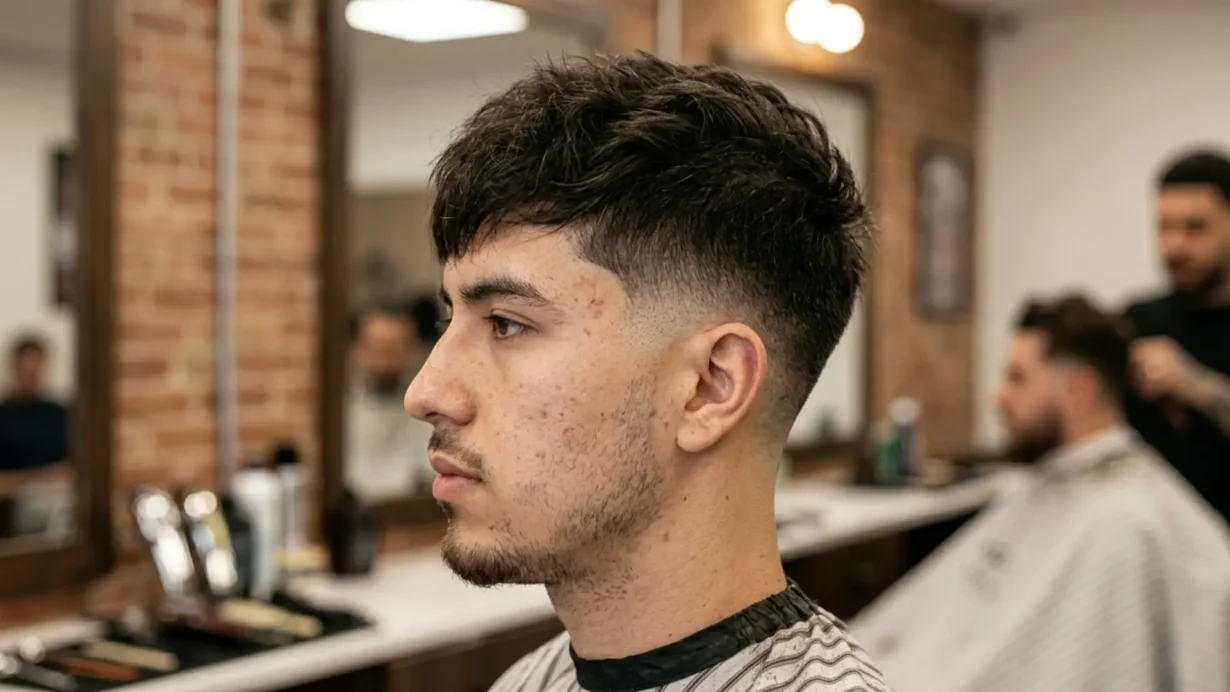

The difference between a taper fade, drop fade, and burst fade is structural: a taper fade follows your natural hairline with a gradual, horizontal blend. A drop fade creates a curved arc behind the ear that follows your skull’s occipital bone. A burst fade curves around the ear in a semicircle like a sunburst, keeping length at the back while fading the sides.
The right cut depends on your face shape, hair type, and your tolerance for maintenance. A round face needs a drop fade to slim the profile. A square face needs a taper to soften the jawline. Thick hair benefits from high fades. Thin hair needs low tapers. The wrong choice can make a round face rounder or cost you weekly barber visits you can’t afford.
This guide gives you everything you need to walk into any barbershop with total confidence. By the end, you’ll know which cut matches your face shape, hair type, and lifestyle, and exactly how to ask your barber for it.
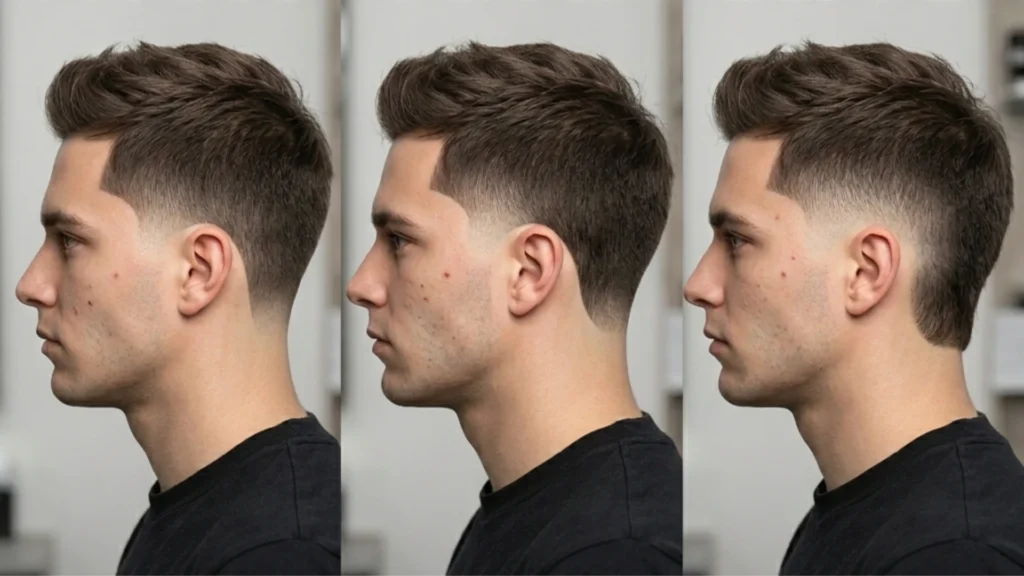
What’s the Difference Between a Taper Fade, Drop Fade, and Burst Fade?
A taper fade blends hair gradually along a straight, horizontal line that follows your natural hairline. A drop fade curves downward behind the ear, following your skull’s shape for higher contrast. A burst fade radiates in a semicircle around the ear while keeping length at the back. Each differs in shape, contrast level, and maintenance needs.
KEY POINTS:
– Taper fades last 3–4 weeks and suits professional settings best
– Drop fades need touch-ups every 7–14 days for a sharp arc
– Burst fades pair best with mohawks, mullets, and afros
– Choose based on your face shape, hair type, and lifestyle
Table of Contents
Your face shape determines which of these three fades actually works for you.
A drop fade and a burst fade don’t suit every face structure the same way. The Taper Style Tool matches your face shape and hair type to the right fade before you commit to one.
What Is the Real Difference Between a Taper Fade and a Drop Fade?
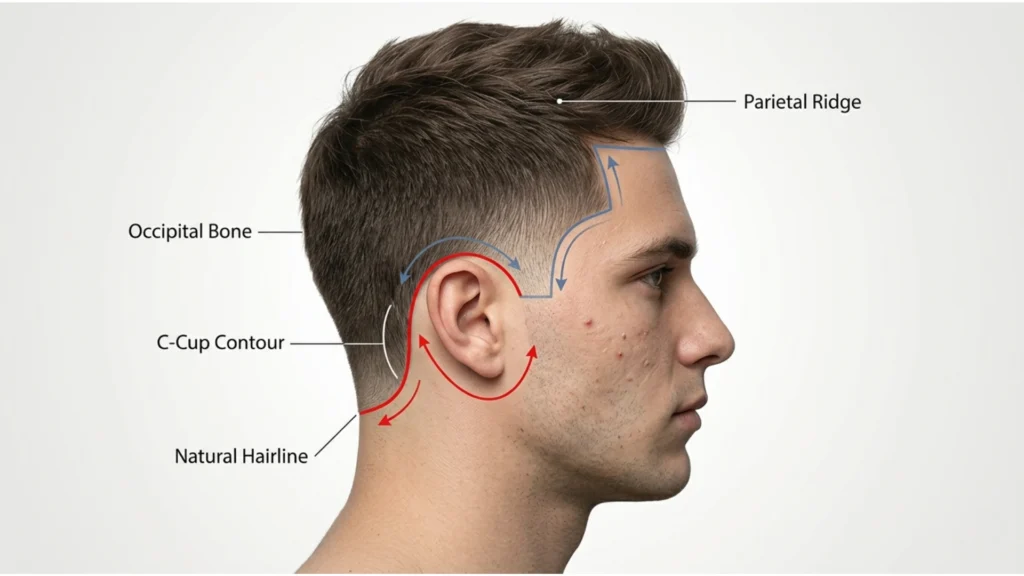
A taper fade follows the natural C-cup contour of your head with a horizontal fade line at the sideburns and neckline. A drop fade forces the fade to drop behind the ear in a curved arc that follows the occipital bone, creating intentional geometry instead of respecting your natural hairline.
The difference isn’t just visual, it’s structural.
A taper preserves your natural hairline. The work happens at the sideburns and neckline, feathering down to the skin without touching the bulk above. According to professional barber training standards from Milady’s Standard Professional Barbering textbook, a taper uses clipper guards ranging from #3 or #4 down to #1, creating a gradual blend that respects the natural contour of the head.
A drop fade does the opposite. It creates a new hairline by forcing the fade to drop behind the ear, tracking the curvature of your skull’s occipital bone, which is the natural bump at the back of your head where your skull meets your neck.
From the front, both cuts can look similar. The real difference shows from the side and back.
A taper has a straight, horizontal line from temple to nape. A drop fade has a visible downward curve behind the ear. This isn’t a small detail; it completely changes how your head looks in profile.
The Anatomy Fact Most Articles Miss
Here’s something most guys don’t know: if the back of your skull is flat (a common trait), a taper will expose that flatness. A drop fade can mask it by building weight into the drop, creating the illusion of a natural curve.
Expert Tip #1: Feel the back of your head right now. If there’s a minimal bump where your skull meets your neck, a drop fade will do more for your profile than a taper.
Which One Offers More Contrast?
Drop fades deliver high contrast. The curved arc creates a sharp, sculptural effect that people notice from across the room. Tapers deliver low contrast; the blend is gradual and subtle.
Drop fades work best when you want your cut to be noticed. Tapers work when you want a refined, classic look that doesn’t scream for attention. According to barber education, contrast level is one of the primary factors clients should consider when choosing between fade styles, as it directly impacts both visual impact and maintenance requirements.
What Is a Taper Fade? (Structure, Shape & When It Works Best)
A taper fade is a gradual blend from longer hair on top to shorter hair at the sideburns and neckline, following the natural contour of your head without creating new lines. It preserves the natural hairline, requires minimal maintenance (3–4 weeks), and suits professional, formal settings.
A taper starts with longer hair on top and gradually shortens toward the neckline and sideburns using clipper guards. Most barbers start with a #3 or #4 guard and work down to #1 or skin, depending on how clean you want the finish.
Unlike a fade, a taper doesn’t create artificial lines. It follows the natural arc of your ear-to-neckline curve. Barbers call this the C-cup contour line. It’s the shape your head already has, and a taper simply cleans it up.
Visual Characteristics
Tapers are defined by restraint. The blend is so gradual that there’s no obvious “start point” for the fade. From the side, a taper creates a straight, horizontal silhouette from temple to nape.
This is why tapers look timeless. They don’t rely on dramatic geometry or bold lines they work with what you already have.
Sub-Variants
A low taper starts the blend just above the ear. A mid-taper starts at the temple. A high taper starts above the temple, closer to the crown.
Expert Tip #2: If you want maximum coverage and minimal skin showing, ask for a low taper. If you want more contrast and a structured look, go mid or high.
Best Use Cases
Tapers are the safe bet for corporate environments, job interviews, weddings, and any formal setting where you need to project polish and professionalism. According to career advice from Indeed, conservative haircuts, such as tapers, are recommended for making a good first impression in professional settings because they signal attention to detail and respect for workplace norms.
A taper is also the best choice if you have a busy schedule and can’t visit the barber every 10–14 days. It grows out gracefully for 3–4 weeks, which means fewer appointments and lower maintenance costs over time.
What Is a Drop Fade? (Structure, Shape & When It Works Best)
A drop fade is a fade that curves downward behind the ear in an arc, following the natural contour of the occipital bone at the back of the skull. It creates high contrast, a sculptural silhouette, and requires maintenance every 7–14 days to keep the curved arc sharp.
A drop fade doesn’t follow a straight horizontal line. Instead, it “drops” downward behind the ear, creating a visible curved arc when viewed from the side or back.
The drop follows the natural bump of the occipital bone, which is the rounded bone at the back of your skull where it meets the neck. This is the same bone that determines the shape of your head when you lie down on a pillow. It’s real anatomy, not a style choice.
Visual Characteristics
Drop fades are designed to be noticed. The curved arc creates a sculptural, geometric effect that’s impossible to miss from the side profile. The contrast is sharp: hair goes from full length on top to skin (or near-skin) behind the ear in a tight gradient.
This is the cut you choose when you want people to know you take your grooming seriously.
Sub-Variants
A low drop fade starts the curve just above the ear. A mid drop fade starts at temple level. A high drop fade starts near the crown, creating maximum contrast.
Expert Tip #3: If you have a round face, a drop fade removes bulk behind the ear and slims your side profile. If you have a long face, be cautious, as overly extensive side removal can make it look even longer.
Best Use Cases
Drop fades work best in creative, casual, or fashion-forward environments where bold personal style is an asset, not a liability. Think advertising agencies, tech startups, music studios, or any workplace where individuality is celebrated.
This cut pairs exceptionally well with textured tops, pompadours, curly hair, and sponge top styles that benefit from the height and drama the drop fade provides.
The Maintenance Reality
Here’s the hard truth: drop fades require barber visits every 7–14 days. The curved arc loses definition quickly as hair grows back, and by week 3, the intentional geometry starts to blur.
According to grooming experts at Men’s Health, high-maintenance fades, as drop fades, are best suited for men who can commit to biweekly appointments and have the budget to sustain frequent professional cuts.
Key Point: If you can’t commit to bi-weekly barber visits, a drop fade will frustrate you. It’s a high-maintenance cut that demands consistency.
What Is a Burst Fade? (And How Does It Compare to a Taper?)
A burst fade is a semi-circular fade that curves around the ear like a sunburst, keeping length at the back of the head while fading the sides. It’s ideal for mohawks, mullets, afros, and textured crops and requires touch-ups every 2–3 weeks.
Unlike a drop fade (which drops behind the ear) or a taper (which follows the natural contour), a burst fade curves around the ear in a half-moon or semi-circle shape.
The burst fade gets its name from the “burst” or “sunburst” visual effect, which the fade radiates outward from the ear in concentric circles. Barbers create this by using circular blending motions instead of straight vertical or horizontal lines.
The Key Structural Difference
Here’s what makes burst fades unique: they retain length at the back of the head. While drop fades fade all the way around to the nape, burst fades keep the back longer, creating a V-shaped or natural neckline.
This makes burst fades the go-to choice for mohawks, mullets, and styles that need volume or length at the back.
Burst Fade vs Taper – Visual Comparison
A taper follows a straight, horizontal line. A burst fade follows a circular curve around the ear. The contrast in a burst fade is higher than in a taper, but it can be customized from subtle to dramatic.
Expert Tip #4: If you have curly, coily, or textured hair (Type 3–4), a burst fade enhances your natural curl pattern better than a straight taper because the circular shape complements the rounded silhouette of an afro or twist-out.
Burst Fade vs Taper Fade – Which to Choose?
Burst fades work exceptionally well on round, oval, and diamond face shapes because the circular arc adds angles and definition. If you have straight or fine hair, a taper is usually a safer bet, but fades can look unbalanced on hair that doesn’t have natural volume or texture.
Best Hairstyle Pairings
Burst fades are the default choice for mohawks and mullets because they fade the sides while keeping the back length. They also pair beautifully with afros, high-tops, and any style that needs volume retention.
According to hairstyle trends documented by Barber EVO, the burst fade has seen a 40% increase in popularity among men with textured and curly hair types over the past three years, particularly when paired with modern mohawk and mullet variations.
Maintenance Reality
Burst fades require touch-ups every 2–3 weeks. The semi-circular pattern loses definition faster than a taper but slightly slower than a drop fade. By weeks 4–5, the intentional curve becomes less obvious and starts to look like a standard grown-out fade.
What Is a Drop Taper Fade? (The Hybrid Cut Nobody Tells You About)
A drop taper fade (also called a tapered drop fade) is a hybrid cut that combines the curved arc of a drop fade with the gradual blending technique of a taper. It offers a middle ground: more style than a taper, less maintenance than a drop fade (every 2–3 weeks).
The drop taper fade is what you get when you ask your barber to combine the drop fade’s curved arc with the taper’s softer, more gradual blending technique.
It’s the compromise cut, you get the personality of a drop fade without the aggressive maintenance schedule or the dramatic contrast.
How It’s Different from a Pure Drop Fade
The drop taper fade has a visible drop behind the ear, but the gradient is softer, and the contrast is lower than in a traditional drop fade. Instead of sharp, high-contrast skin fades, the blend is more forgiving and natural-looking.
Maintenance sits between tapers and drop fades: expect to visit your barber every 2–3 weeks instead of 7–10 days (drop fade) or 3–4 weeks (taper).
Who Should Get It?
This cut is ideal for guys who want the drop fade’s style but work in environments where extreme contrast might be too bold, think corporate offices, client-facing roles, or industries with conservative dress codes.
Expert Tip #5: If you want a drop fade but can’t commit to weekly barber visits, ask for a “tapered drop fade” or “low drop taper.” Your barber will understand exactly what you mean.
Best Hairstyle Pairings
The drop taper fade pairs well with side parts, pompadours, and medium-length textured styles anything that benefits from the drop’s curve but doesn’t need the full drama of a skin fade. It’s versatile enough to work in both professional and casual settings.
Taper Fade vs Drop Fade vs Burst Fade – Face Shape Breakdown (Which Cut Is Right for YOU?)
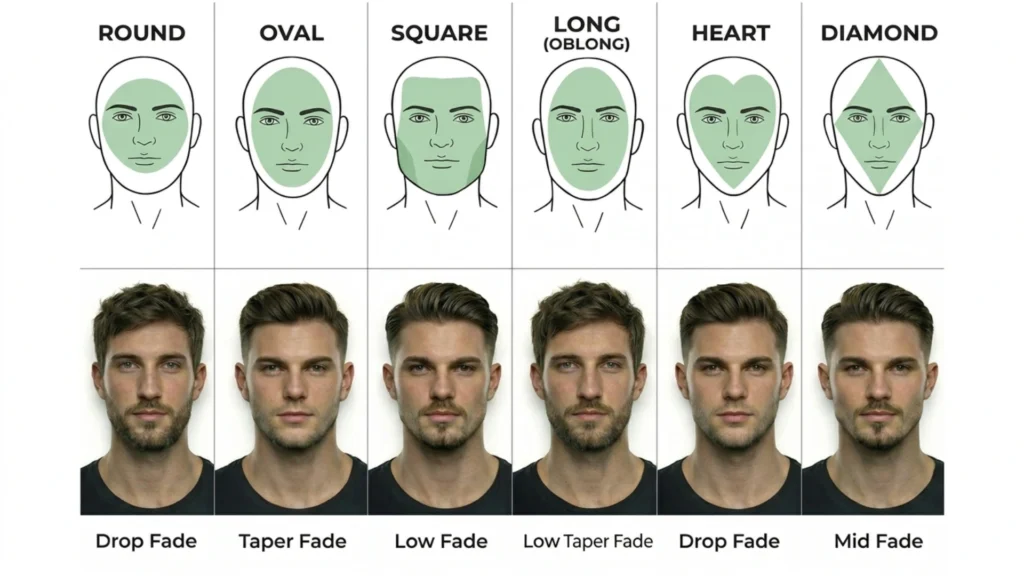
Round faces suit drop fades, and burst fades (which remove bulk and add angles). Oval faces suit all cuts. Square faces suit tapers (softening the jawline). Long/oblong faces suit tapers (maintains width). Heart-face suits burst and fade to low fades (add lower-face width). Diamond faces suit burst fades (balances cheekbones).
Face shape is the #1 factor in choosing the right cut. The wrong fade can make a round face rounder or a long face longer. Here’s how to match your cut to your face.
Round Face
Drop Fade: Best choice. Removes bulk behind the ear and slims your side profile. The curve pulls the eye down and back, not out. According to GQ’s grooming guides (gq.com/style/grooming), drop fades are consistently recommended for round faces because the vertical curve counteracts horizontal width.
Burst Fade: Good choice. The circular arc adds angles and definition, counteracting roundness.
Taper Fade: Use with caution. Keeping too much hair around the ears can add width and make your face look rounder. If you choose a taper, go mid or high, not low.
Expert Tip #6: Ask for a mid- or high-drop fade with a textured crop or pompadour on top. The vertical height on top, combined with the slimmed sides, creates the most balanced look.
Oval Face
All Cuts Work: Oval faces are the most versatile. You can wear a taper, drop fade, or burst fade and look great. The natural symmetry of an oval face means you have maximum freedom.
Recommendation: Tapers enhance the classic symmetry. Drop fades add a modern edge. Burst fades work if you want a statement cut.
Key Point: Your decision should be based on lifestyle, maintenance tolerance, and personal style, not face shape limitations.
Square Face
Taper Fade: Best choice. Softens the sharp angles of a square jawline. The gradual blend creates a refined, balanced look.
Drop Fade: Use with caution. High-contrast drop fades can over-emphasize your jawline and make your face look boxy. If you want a drop fade, go low or mid, not high.
Burst Fade: Risky. The circular shape can clash with the angular structure of a square face.
Expert Tip #7: Pair a low or mid-taper with a side part or a textured crop. Keep the top slightly longer to add vertical height and balance your jawline width.
Long / Oblong Face
Taper Fade: Best choice. Keeps hair around the ears, which adds width and balances your face’s length. A low taper is ideal.
Drop Fade: Avoid high drop fades. Stripping too much from the sides makes your face look even longer. If you must get a drop fade, go low and keep the volume on top minimal.
Burst Fade: Use carefully. The circular shape can work well when paired with a fuller top, but avoid high-burst fades.
Fact: The goal with a long face is to add width, not height. Avoid pompadours and faux hawks, stick with side parts, Caesar cuts, or textured crops.
Heart Face
Burst Fade: Best choice. Adds width to the lower face, balancing a narrow jawline and wide forehead.
Low Fade / Low Taper: Good choice. Keeps volume around the ears, which adds width where you need it.
High Fade / High Drop Fade: Avoid. Removes too much side volume, making your forehead look even wider.
Key Point: Pair your fade with a side part or textured crop that doesn’t add height on top.
Diamond Face
Burst Fade: Best choice. The circular arc balances prominent cheekbones and adds structure to a narrow forehead and chin.
Taper Fade: Good choice. Adds structure without over-emphasizing cheekbones.
Drop Fade: Works, but keep it low. High drop fades can make your face look top-heavy.
Fact: Diamond faces benefit from styles that add width at the forehead and jawline, quiffs, textured crops, and side parts work well.
Not confident about your face shape or which cut it calls for? TaperMatch scans your facial geometry, jaw angle, width, and symmetry and maps it to the right fade automatically. No guesswork, no self-diagnosis.
Which Cut Suits Your Hair Type?
Straight hair suits all cuts; tapers show clean lines, and drop fades show the arc clearly. Curly and coily hair (Type 3–4) pairs best with drop fades and burst fades; texture amplifies contrast. Thick hair benefits from high fades (removes bulk); thin hair needs low tapers (preserves coverage).
Straight Hair
Straight hair shows every line and transition with maximum clarity; tapers look crisp; drop fades show the curved arc perfectly; and burst fades display the sunburst effect cleanly.
If you have straight hair, you have the most freedom; all three cuts will work. Your decision should be based on face shape and lifestyle, not hair type.
Wavy Hair
Wavy hair (Type 2) is forgiving; it blends naturally and softens hard lines. Tapers look effortlessly classic, and drop fades add movement.
Expert Tip #8: If you have wavy hair, ask your barber to work with your natural wave pattern. Don’t fight it with too much product. A matte clay or texture spray enhances the natural movement.
Curly Hair (Type 3)
Curly hair (Type 3) pairs beautifully with drop fades and burst fades because its texture amplifies contrast, making the fade more eye-catching.
A taper works with curly hair, but the blend is subtler; you won’t get the same dramatic effect as a drop or burst fade.
Key Point: Keep the top longer to showcase your curls. Pair a drop fade with a curly top, textured crop, or faux hawk.
Coily Hair (Type 4)
Coily hair (Type 4) is the perfect match for burst fades, the semi-circular shape complements the rounded silhouette of an afro, sponge top, or twist-out.
Drop fades also work exceptionally well with coily hair, especially when paired with waves (360 waves) or a tapered afro. According to the American Academy of Dermatology, textured hair types benefit from fades that work with natural curl patterns rather than against them, making burst and drop fades ideal choices.
Expert Tip #9: If you have coily hair, communicate with your barber about your natural curl pattern. Burst fades should enhance, not fight, your hair’s natural shape.
Thick Hair
Thick hair benefits from high fades and drop fades because they remove bulk from the sides, preventing your head from looking too wide or heavy.
Key Point: A low taper on thick hair can make your head look bulky. Go mid or high.
Thin / Fine Hair
Thin or fine hair needs coverage. A low taper is the best choice because it keeps more hair on the sides and creates the illusion of fullness.
Avoid high skin fades if you have thin hair; they expose the scalp and make thinning more obvious.
Expert Tip #10: Pair a low taper with a textured top styled with matte clay. The texture adds perceived volume.
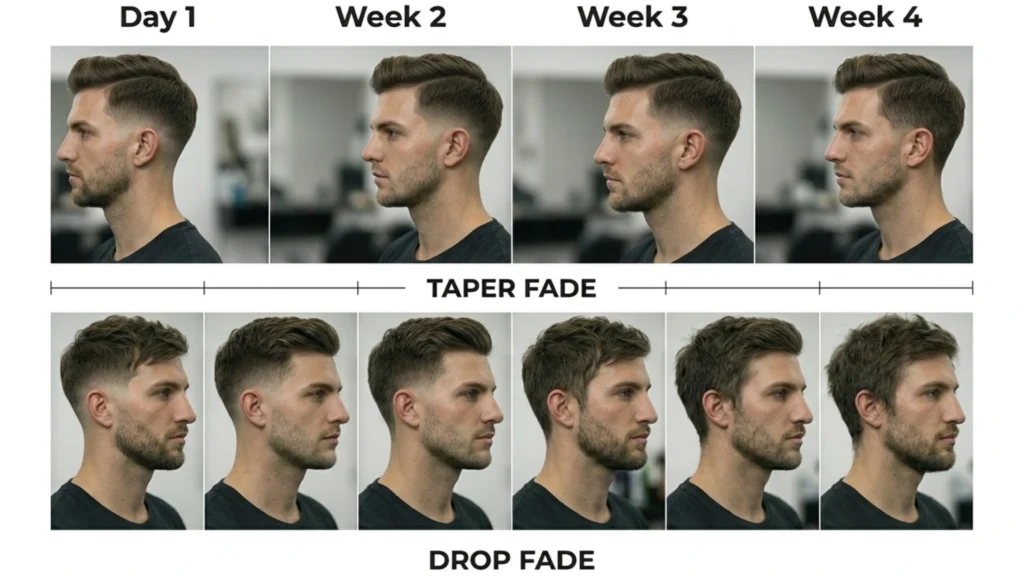
Taper Fade vs Drop Fade – Maintenance and Grow-Out Compared (Day-by-Day Breakdown)
Taper fades last 3–4 weeks and grows out gracefully because they follow the natural hairline. Drop fades require touch-ups every 7–14 days, and the curved arc blurs quickly. Burst fades need maintenance every 2–3 weeks. Grow-out behavior is the biggest real-world difference between these cuts.
The biggest difference in the taper fade vs drop fade debate shows up two weeks after your haircut. A taper grows out on your terms. A drop fade doesn’t.
If you can’t visit a barber every 10–14 days, a drop fade will frustrate you. Maintenance isn’t optional, it’s structural.
Maintenance Timeline Comparison
| Cut Type | Fresh Cut (Day 0–7) | Week 2 (Day 8–14) | Week 3 (Day 15–21) | Week 4+ (Day 22+) | Barber Visit Needed |
|---|---|---|---|---|---|
| Taper Fade | Perfect, clean | Still clean | Minor fuzziness | Still acceptable | Every 3–4 weeks |
| Drop Fade | Perfect, sharp arc | Arc starts to blur | Definition lost | Looks grown-out, messy | Every 7–14 days |
| Burst Fade | Perfect, sunburst visible | Pattern fading | Circular shape blurred | Awkward growth | Every 2–3 weeks |
| Drop Taper Fade | Clean, soft arc | Clean | Slight blur | Still acceptable | Every 2–3 weeks |
Why Tapers Grow Out Gracefully
Because a taper respects the natural hairline, regrowth blends back in rather than fighting for attention. You can stretch it to 3–4 weeks and still look deliberate.
Tapers don’t rely on dramatic contrast, so when the hair grows, the blend just softens it doesn’t collapse.
Why Drop Fades Lose Definition Fast
A drop fade’s curved arc is artificial; it’s drawn by the barber, not by your natural hairline. When hair grows back, the arc blurs, the contrast fades, and the intentional geometry disappears.
By week 3, a drop fade that looked sculptural and sharp now looks like a half-grown fade that’s neither taper nor drop, the worst of both worlds.
Burst Fade Grow-Out – The Awkward Phase
Burst fades lose their definition within 3 weeks as growth blurs the curved pattern. By weeks 4–5, the intentional semi-circle becomes a vague fade that looks accidental.
Expert Tip #11: If you get a burst fade, schedule your next appointment before you leave the barbershop. Don’t wait until it’s grown out; you’ll regret it.
Maintenance tolerance is one of the variables. TaperMatch scores before returning a recommendation so your result already accounts for how often you can realistically visit the barber, not just how the cut looks on day one.
The Drop Taper Fade – The Middle Ground
The drop taper fade offers a compromise: it grows out better than a pure drop fade but worse than a pure taper. Expect to visit your barber every 2–3 weeks.
At-Home Maintenance Tips
If you want to stretch your cut an extra week, invest in a quality trimmer and clean up your neckline and sideburns between barber visits. Don’t touch the fade itself; leave that to the professional.
Expert Tip #12: Use a handheld mirror and a wall mirror to see the back of your head. Trim only the stray hairs below your natural neckline. Don’t try to recreate the fade gradient yourself.
Drop Fade vs. Low Taper: Which Is Better for a Professional Setting?
A low taper is better for professional settings; it’s conservative, polished, and grows out gracefully for 3–4 weeks. A drop fade can work in creative or casual corporate environments but requires weekly touch-ups and delivers a bolder, less traditional look.
If you work in a corporate office, law firm, finance, consulting, or any client-facing role, a low – or mid-taper is the safer bet. It’s polished, timeless, and universally accepted.
Drop fades can work in creative industries (advertising, tech, media) or casual corporate environments where personal style is encouraged, but they’re still riskier than tapers.
The Maintenance Factor at Work
Professionals with busy schedules often can’t commit to visiting the barber every 7–14 days. A taper’s 3–4-week maintenance window fits better with demanding work schedules.
Expert Tip #13: If you want a fade but work in a formal environment, ask for a “low drop taper” or “low skin taper.” You get a subtle edge without crossing into bold territory.
First Impressions Matter
In job interviews and client meetings, a taper signals polish, professionalism, and attention to detail. A drop fade signals style and personality, which can be an asset or a liability depending on the industry.
According to career experts at The Balance Careers, grooming choices, including haircuts, contribute to first impressions in professional settings, with conservative styles generally perceived as more trustworthy in formal environments.
Key Point: When in doubt, go conservative. You can always get a drop fade after you land the job or close the deal.
The “Boardroom to Barbecue” Effect
Tapers are the only cut in this comparison that works equally well in a boardroom and at a weekend barbecue. Drop fades lean casual; they’re harder to dress up for formal events.
What Hairstyles Pair Best With Each Cut?
Taper fades pair well with side parts, comb-overs, crew cuts, and Ivy Leagues (classic, professional styles). Drop fades pair with pompadours, textured crops, faux hawks, and curly tops (bold, modern styles). Burst fades pair with mohawks, mullets, afros, and high-tops (statement styles).
Best Hairstyles for Taper Fade
Top Pairings:
Side Part: Classic, professional, and timeless. Works in any setting, from the office to weddings.
Comb-Over: Refined, elegant. Ideal for formal events and office settings.
Crew Cut: Military precision. Low-maintenance and universally flattering.
Ivy League: Preppy and polished. Perfect for corporate environments and college campuses.
Caesar Cut: Short fringe, horizontal line. Works with all face shapes.
Slick Back: Paired with a mid-taper, this creates a sharp, executive look.
Key Point: Taper fades are designed for classic, timeless hairstyles that translate across formal and casual settings.
Best Hairstyles for Drop Fade
Top Pairings:
Pompadour: The drop fade enhances the height and sweep. This is the bold style for guys who want drama and don’t mind the attention.
Textured Crop: Modern, versatile. The drop fade adds contrast and structure to the choppy top.
Faux Hawk: Edgy, statement-making. The drop fade amplifies the spiky top and draws the eye upward.
Curly Top: The drop fade slims the sides and lets curls dominate on top without looking unbalanced.
Sponge Top: A favorite in the natural hair community. The drop fade frames the sponge texture perfectly.
Waves (360 Waves): Drop fades are the default pairing for wave patterns, creating clean contrast with the brushed texture.
Fact: Drop fades work best with styles that have height, texture, or volume on top. The contrast between the faded sides and bold top creates maximum visual impact.
Best Hairstyles for Burst Fade
Top Pairings:
Mohawk: The burst fade is designed for Mohawks. It fades the sides while keeping length in the center strip and crest.
Mullet: A trending combination. The burst fade removes side bulk while preserving the long back that defines a mullet.
Afro: The semicircular shape complements the rounded silhouette of a natural afro beautifully.
High-Top: Retro style is making a comeback. Burst fade keeps the structure clean and defined.
Twist-Out: Popular in natural hair communities. The burst fade frames the texture without disrupting curl patterns.
Textured Crop: Works with wavy or curly hair. The burst fade adds edge and modern appeal.
Fact: Burst fades are statement cuts; they’re designed for bold, fashion-forward styles that demand attention and express individuality.
How to Tell Your Barber Exactly What You Want
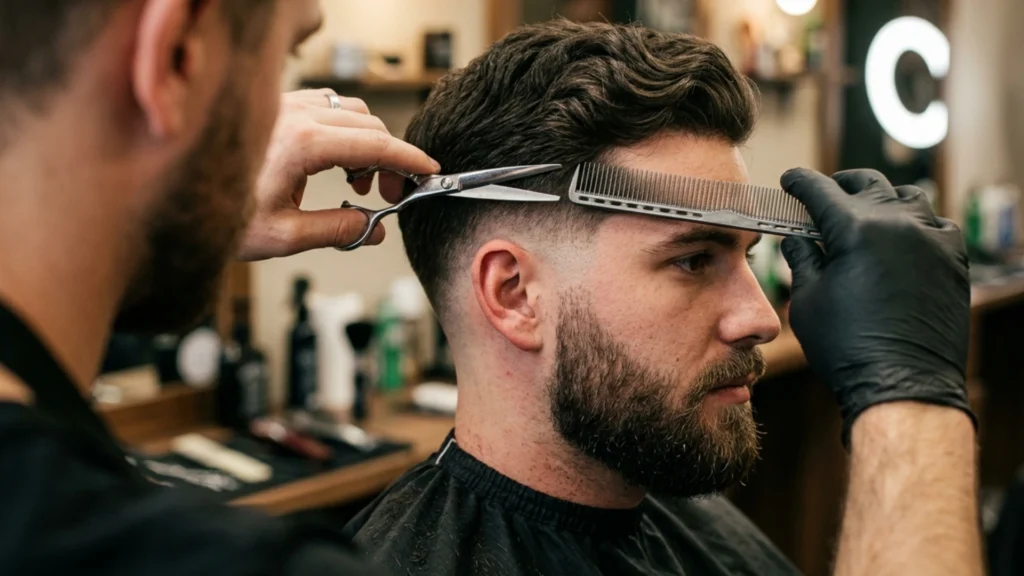
Bring a reference photo to eliminate miscommunication. Use specific terms: “low taper starting just above the ear,” “mid drop fade with a curved arc behind the ear,” or “burst fade around the ears with length at the back.”Specify guard numbers if you know them.
Barbers use the terms “taper,” “fade,” and “taper fade” interchangeably, which confuses clients. The best way to avoid miscommunication is to bring a reference photo.
A photo is worth a thousand words. Show your barber exactly what you want in the inside, back, and top views, if possible. According to Modern Barber’s professional barber communication training, visual references reduce miscommunication by over 70% compared to verbal descriptions alone.
How to Ask for a Taper Fade
Exact Script 1: “I want a low taper that starts just above the ear and blends gradually to the neckline. Keep the natural hairline; I don’t want skin showing.”
Exact Script 2: “Give me a mid taper fade with a #2 guard on the sides, blending up to the top. I want a classic, professional look.”
Expert Tip #14: If you’re unsure about height, ask your barber: “Where do you think the blend should start for my face shape?” A good barber will guide you based on your individual features.
How to Ask for a Drop Fade
Exact Script 3: “I want a mid-drop fade; the fade should curve down behind my ear, following the natural shape of my head. Take it to the skin at the bottom.”
Exact Script 4: “Give me a low drop fade with a curved arc. I don’t want it too high, just a subtle drop behind the ear.”
Key Point: Use the word “drop” and describe the curve. Don’t just say “fade”; Barbers will default to a straight fade if you’re not specific.
How to Ask for a Burst Fade
Exact Script 5: “I want a burst fade, a semi-circle around the ears that fades the sides but keeps length at the back. I’m pairing it with a mohawk.”
Exact Script 6: “Give me a burst fade with a natural neckline. I want the fade to curve around my ears like a sunburst.”
How to Ask for a Drop Taper Fade
Exact Script 7: “I want a drop taper. I want the fade to drop behind my ear, but I want the blend to be softer and more gradual than a full drop fade.”
Exact Script 8: “Give me a low drop taper. I want some curve behind the ear, but not too much contrast.”
Expert Tip #15: If your barber looks confused, show a reference photo of a drop fade and say, “Like this, but less dramatic, more tapered.”
General Communication Tips
Always specify fade height (low/mid/high), whether you want skin showing, and how much length you want on top.
If you’re unsure, ask your barber to start conservative you can always go shorter, but you can’t add hair back.
Taper Fade vs Drop Fade vs Burst Fade – Quick Decision Table
Here’s a complete at-a-glance comparison covering every decision factor:
| Factor | Taper Fade | Drop Fade | Burst Fade | Drop Taper Fade |
|---|---|---|---|---|
| Shape | Straight, horizontal line | Curved arc behind the ear | Semi-circle around the ear | Soft arc behind the ear |
| Contrast | Low, subtle | High, sharp | Medium to high | Medium |
| Best Face Shape | Oval, square, long | Round, oval | Round, oval, diamond, heart | Oval, round |
| Best Hair Type | All types | Straight, curly, thick | Curly, coily, textured | All types |
| Maintenance | Every 3–4 weeks | Every 7–14 days | Every 2–3 weeks | Every 2–3 weeks |
| Grow-Out | Forgiving, graceful | Unforgiving, blurs fast | Unforgiving, pattern fades | Moderately forgiving |
| Professional Setting | Ideal | Risky | Too bold | Acceptable |
| Casual Setting | Works | Ideal | Ideal | Works |
| Best Paired With | Side part, crew cut, comb over | Pompadour, textured crop, curly top | Mohawk, mullet, afro | Pompadour, side part, waves |
| Skin Exposure | Minimal | High (goes to skin) | Medium (depends on style) | Medium |
| Neckline Style | Natural or tapered | Follows arc to nape | V-shape or natural (retains length) | Tapered or natural |
| Lifestyle Fit | Busy professionals, low-maintenance | Style-focused, high-maintenance | Fashion-forward, creative | Balanced lifestyle |
| Age Range | All ages | 15–40 | 15–35 | 20–45 |
Use this table to narrow your decision. If you’re still torn, bring this guide and a reference photo to your barber and ask for their recommendation based on your face shape, hair type, and lifestyle.
TaperMatch skips the scripting entirely; it generates your barber brief directly from your face scan, with exact guard numbers, blend points, and a verbatim phrase ready to read aloud at the chair.
Frequently Asked Questions (FAQ)
Which fade is best for a round face?
A drop fade is best for a round face because it removes bulk behind the ear and slims your side profile. The curved arc pulls the eye down and back, not out. Burst fades also work well. Avoid low tapers; they can add width and make your face look rounder.
How long does a taper fade last?
A taper fade lasts 3–4 weeks before needing a touch-up. Because it follows the natural hairline, regrowth blends back in rather than looking messy. You can stretch it to 4–5 weeks if you maintain the neckline and sideburns at home between visits to the barber.
How long does a drop fade last?
A drop fade requires touch-ups every 7–14 days to keep the curved arc sharp. By week 3, the arc blurs and the contrast fades, making the cut look grown-out and unintentional. Drop fades are high-maintenance cuts that demand frequent barber visits.
Which cut is better for professional settings?
A taper fade is better for professional settings; it’s conservative, polished, and universally accepted in corporate, legal, finance, and client-facing roles. Drop fades can work in creative industries or casual corporate environments, but they require weekly maintenance and deliver a bolder look.
Can I get a drop fade with curly hair?
Yes, drop fades work exceptionally well with curly hair (Type 3) because the texture amplifies the contrast and makes the fade more eye-catching. Pair a drop fade with a curly top, textured crop, or faux hawk for maximum visual impact.
What is the difference between a burst fade and a drop fade?
A drop fade drops behind the ear in a downward arc and fades all the way around to the nape. A burst fade curves around the ear in a semi-circle and retains length at the back. Burst fades are ideal for mohawks and mullets; drop fades pair with pompadours and textured crops.
How do I tell my barber what I want?
Bring a reference photo to eliminate miscommunication. Use specific terms: “low taper starting just above the ear,” “mid drop fade with a curved arc behind the ear,” or “burst fade around the ears with length at the back.” Specify whether you want skin showing and how much length you want on top.
Is a taper fade the same as a taper?
Not exactly. A “taper fade” is a term that emerged when people started mixing up tapers and fades. A pure taper has no skin showing and blends gradually. A taper fade can go to the skin. The terms are often used interchangeably, which is why bringing a reference photo is critical.
What’s the difference between a skin fade and a regular fade?
A skin fade (also called a bald fade) blends down to skin (zero guard) at the bottom. A regular fade stops at a #1 or #0.5 guard, leaving minimal hair and avoiding skin exposure. Skin fades deliver maximum contrast but require more frequent touch-ups.
Which fade grows out better?
A taper fade grows out better; it’s forgiving because it respects the natural hairline. Regrowth blends back into itself, and you can stretch it to 3–4 weeks. Drop fades and burst fades grow out poorly. The intentional curves blur quickly, and the cuts look messy by week 3.
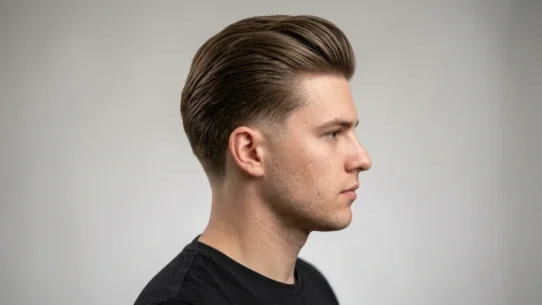
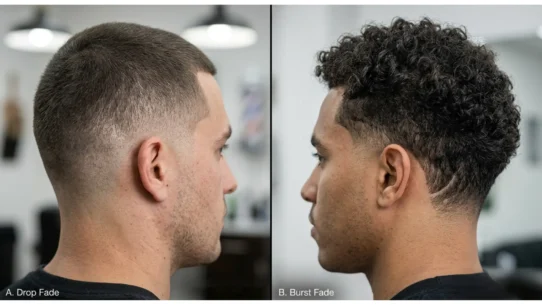
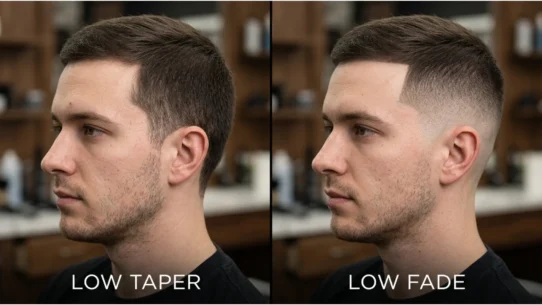
[…] burst fade creates a semi-circular shape around your ear. Instead of the fade going straight across, it […]
[…] in a straight line, creating a rounded shape at the base of the sideburn. This differs from a standard drop fade or burst fade, which typically drops lower and blends further into the neckline. The mid burst version keeps most […]
[…] burst taper fade is one of the most distinctive variations. Instead of fading in a straight horizontal or vertical […]
[…] burst taper fade features a unique semi-circular fade arc that radiates behind the ear like a sunburst. Unlike […]